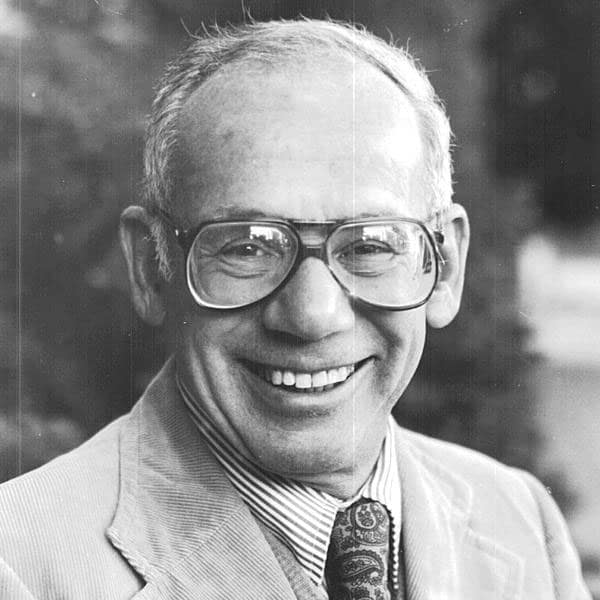
An overflow crowd of nearly 500 mourners attended funeral services last week for Rabbi William M. Kramer, a Los Angeles institution, who died at the age of 84.
They came to pay tribute and share recollections of the man they had known in one or more of his multifaceted careers as rabbi or historian, author or professor, lawyer, family counselor, actor or art collector.
As Rabbi Mark Sobel, who succeeded Kramer as spiritual leader of Temple Beth Emet in Burbank, noted, “Probably some 80 percent of the Jews in the San Fernando Valley had a relative or friend who was married, buried or bar mitzvahed by Rabbi Bill.”
Sobel officiated at the Hillside Memorial Park service with Rabbis Toba August and Michael Resnick of Adat Shalom.
Weddings were Kramer’s specialty and during his 63 years in the rabbinate, he lost count after the 10,000th one, recalled Jonathan, Kramer’s son from his first marriage to the late Joan Oppenheimer Kramer.
“On Sundays, my abba would do seven or eight weddings, and a couple of funerals and bar mitzvahs,” Jonathan Kramer said. “My brother, Jeremy, or I would wait outside in the getaway car, the engine running, and race to the next event.”
Kramer was one of the first rabbis to officiate at interfaith weddings, provided the couple solemnly promised to raised their children as Jews.
Betty Wagner Kramer, the rabbi’s second wife, and eight grandchildren joined in the tributes.
“He was truly a renaissance man, the many facets of his life blended into the unique character that was my husband for the last quarter of his lifetime,” she said.
Barry Fisher, whose Ellis Island Klezmer band often joined Kramer at weddings, told The Journal that his old law partner was “a strong life force, a man of great curiosity and humanity, a teacher from beginning to end.”
Rabbi Mark Diamond, executive vice president of the Board of Rabbis of Southern California, recalled a colleague who, when he reached the half-century mark, observed, “I have a 50-year-old body and a 5,000-year-old soul.”
Dr. Uri Herscher, founder of the Skirball Cultural Center, said “Bill and I rejoiced in one another’s lives for over four decades. I fully ascribed to his philosophy, which was, ‘Life needs continued purpose to maintain the option called living.'”
Even a bare bone recitation of Kramer’s activities and accomplishments could fill many pages.
Born in Cleveland, he earned seven college and university degrees and assumed his first pulpit in St. Louis before he was 23 years old. After coming to Los Angeles, he served at Temple Israel of Hollywood for a decade, where he conducted his most publicized wedding, joining entertainer Sammy Davis Jr. with actress May Britt.
Then he settled down for 30 years as spiritual leader of Temple Beth Emet, also spoke at a weekly minyan at Adat Shalom, and toward the end of his career led a “cyberspace” congregation he dubbed B’nai Bill.
Kramer established the Jewish studies program at CSUN, and taught at Hebrew Union College-Jewish Institute of Religion, Los Angeles City College, University of Judaism, USC and UCLA.
For some three decades, he wrote a weekly column for Heritage and contributed to a range of Jewish, legal, art and poetry journals. He was a leading chronicler and researcher of early Jewish life in the Western United States, serving as co-editor of the Western States Jewish Historical Quarterly with Dr. Norton B. Stern. At the time of his death, Kramer had completed a manuscript on Albert Einstein’s sojourn in Southern California during the early 1930s.
His visage and white beard lent him the aspect of a biblical patriarch, and he was cast as a rabbi in various movies, television shows and in ads for bagels and yogurt. On one show, actor Edward G. Robinson complimented Kramer for doing a passable impersonation of a rabbi.
Donations in his memory may be sent to Adat Shalom or the Skirball Cultural Center.
For details, visit