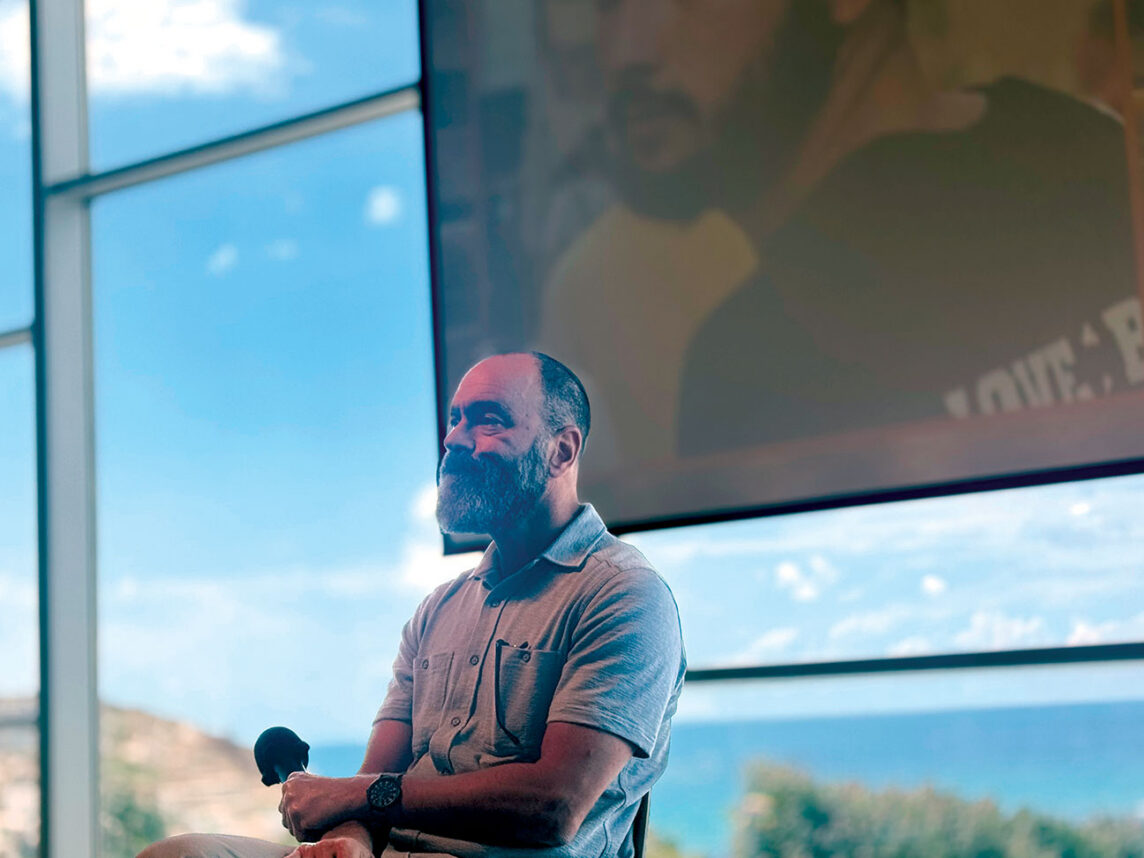

During the Second Lebanon War in 2006, Israeli Defense Forces tank commander Ron Weinreich was paralyzed from the waist down after a building collapsed on his tank during a Hezbollah strike. He was 20.
“My injury put my hotshot tank commander days to an end. I turned into a broken sack of bones. I had to learn how to live my life once again,” he told the Journal.
Weinreich, who was born on the East Coast and moved to Israel with his family when he was 15, now lives in Los Angeles after moving here in 2013.
After his injury 12 years ago, Weinrich refused to accept doctors who told him he would probably never walk again and went looking for practitioners and therapists who could possibly help him.
In 2009 he visited a Danish therapist in Israel — Dan Tager. After speaking with Weinreich for 10 minutes, Tager urged him to get up out of his wheelchair.
“He put my arms on his shoulders, pressed his knees against my knees and his hands on my hips,” Weinreich recalled. “And he goes, ‘1, 2, 3, stand.’ And then he pulls me up. There I am, standing for the first time in 2 1/2 years.”
Weinreich is still in a wheelchair, but Tager’s work with him has given him hope and helped improve his quality of life — a rehabilitation strategy he thinks needs to be made more available to others.
“If the medical community doesn’t believe something can be done, [it] cuts off the chance of recovery,” he said. “It is possible to significantly improve the quality of life of people with disabilities, but it’s never really put into action.”
For years Weinreich has had a vision of creating a state-of-the-art rehabilitation center that looks like a gym, not a hospital. “It would be a place that when you walk in, you are told, ‘Welcome. So great to see you. Let’s throw everything we’ve got and the kitchen sink at you to see what we can do to reverse your condition.’”
“My injury put my hotshot-tank-commander days to an end. I turned into a broken sack of bones. I had to learn how to live my life once again.”– Ron Weinreich
He added the caveat that “Of course, there would be no guarantees,” but such a center would “employ the modalities and therapies that will come with the kind of mindset where anything is possible. … Places for yoga, Pilates, etc. — they don’t exist for people with disabilities.”
Today, Weinreich is turning his vision into reality. He plans to establish a facility in Israel for people with mobility disorders.
Despite the fact that he now lives in the U.S., Weinreich said he chose Israel for the center because “It’s my home base. I know that many of my peers and my very good friends who are disabled IDF veterans, who were injured either with me or in previous wars, [feel] hopeless and don’t have an outlet for where they can get this kind of treatment.”
To that end, Weinreich is working with a team that includes Los Angeles kinesiologist Taylor Kevin Isaacs and Dr. Avi Ohry of the Reuth Medical Center and Tel Aviv University’s Sackler Faculty of Medicine. He hopes to open the center by the end of 2019.
“The center will be called Nua,” Weinreich said. “Nua in Hebrew means move or advance.”
And while he is starting in Israel, Weinreich hopes other countries will eventually embrace his concept.
“Israel is a pillar in the world medical community,” he said. “I truly believe if we can implement this, other countries will see [it], and it will be the most prominent stamp of approval.”