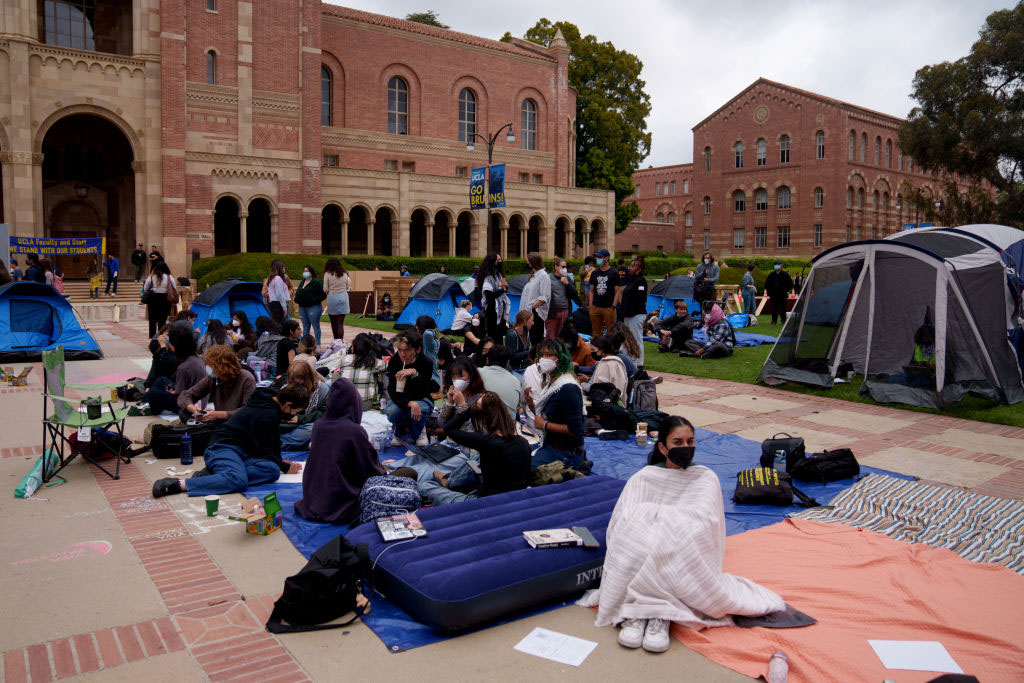
A symptom of our dysfunctional times is that political opponents — whether Republicans versus Democrats in Congress or Zionists versus Israel bashers on campuses — not only disagree on fundamental issues, but they also do not even share the same language and terminology.
So posits Gideon Aronoff, CEO of Ameinu (Our People), whose organization has published a kind of lexicon for “progressives” in an attempt to counter the verbal attacks by the “far left” on the latter’s own grounds.
Titled “The Third Narrative,” the 25-page pamphlet takes on such blood-pressure-raising discussion points as “Is Israel an ‘apartheid state’?” “Is pro-Israel and progressive an oxymoron?” and “Does the pro-Israel lobby have a stranglehold on the U.S. government?”
“In the Near East conflict, there is an Israeli narrative, and there is a Palestinian narrative,” Aronoff said during a recent visit to Los Angeles. “There won’t be any settlement until both opponents understand that there is some good and some bad on each side’s position.”
The booklet, written in clear and concise language by Dan Fleshler, an Ameinu board member, summarizes its viewpoint in an introductory statement: “We think the American left — Jewish and non-Jewish — could use a third narrative, one that neither reflexively attacks, nor reflexively justifies, Israel’s policies and actions.”
Ameinu seeks to draw a clear line between criticism of Israel and delegitimization of the state, and perhaps a more difficult line between the far left and progressives.
Aronoff defines the former as “activists who are committed to a particular strict political orthodoxy, with the Palestinian narrative as one of its core beliefs. Progressive activists are inclined toward liberal or left positions, but are open to a broader array of facts and interpretations, so are likely to be open to a Third Narrative approach on the Middle East.”
The Third Narrative campaign is one sign of a new level of energy and activity at Ameinu, which describes itself as “the leading grass-roots progressive Zionist organization in North America.”
It was established in 2004 as the successor organization to the venerable Labor Zionist Alliance, which for decades reflected and supported the policies of Israel’s founders, such as David Ben-Gurion and Golda Meir.
Another and complementary indicator is the hiring of Aronoff, who represents the third generation of Habonim (Labor Zionist youth movement) alumni in his family. For the preceding 12 years, he was the president and CEO of HIAS, the Hebrew Immigrant Aid Society, active in a dozen countries, including Israel.
In parallel, Ameinu has beefed up its national board of directors by adding six well-known Jewish community activists and has started a drive to expand its membership and add new chapters to its existing ones in New York, Chicago, Los Angeles, San Francisco, Detroit, St. Louis, Philadelphia and Washington, D.C.
In line with its pro-labor tradition, Ameinu plans to reinvigorate its role “as a passionate advocate for economic and social justice in America and the world,” according to Kenneth Bob, Ameinu’s president.
Currently, Ameinu lists some 2,000 to 3,000 supporters in the United States and Canada, and it has established beachheads in Australia and South Africa. It runs — with a small staff — on an annual budget of close to
$1 million, Aronoff said.
He is casting a wide net to boost membership among “mainstream Jews who speak in the language of the left, progressive American Christians, especially among Presbyterians and Methodists,” and liberal Arab Americans.
As one step, he plans to reach out to the kind of progressives who read such magazines as Mother Jones, The American Prospect and the English edition of the Israeli daily Haaretz.
Most recently, Ameinu’s statements have strongly condemned a tough Israeli law to crack down on “asylum seekers,” or illegal immigrants from Africa, and government plans, later halted, to relocate thousands of Bedouin from their villages.
Locally, Ameinu leadership includes such veterans of liberal causes as Martin Taft and Alisa Belinkoff Katz, both of Los Angeles, and Sharon Bershtel of Long Beach. As members of Ameinu’s national board of directors, all three have been involved in launching the Third Narrative campaign.
At present, this effort is only in its beginning stage on the local scene, said Taft, a mechanical engineer and management consultant, and Katz, who has served as Los Angeles County Supervisor Zev Yaroslavsky’s chief deputy for 25 years.
One recent achievement of the local group was to finalize the purchase of the Habonim camp in Big Bear, while on Jan. 22 the group will confer its Tzedek award on Raphael J. Sonenshein, executive director of the Pat Brown Institute for Public Affairs at California State University, Los Angeles, and a columnist for the Journal.
To download the contents of “The Third Narrative” or request a printed copy, visit this story at jewishjournal.com.













 More news and opinions than at a Shabbat dinner, right in your inbox.