
“We must be patient and realistic in our expectation regarding the Middle East,” Sen. George Mitchell told an audience at UCLA on March 1.
Mitchell delivered this year’s Bernard Brodie Distinguished Lecture on the Conditions of Peace, and he struck a tone that was, perhaps appropriately, but not overwhelmingly, pessimistic about the dim prospects for a peaceful resolution to the Israeli-Palestinian conflict.
The architect of the Good Friday Agreement in 1998 that paved the way for an end to the violence in Northern Ireland, Mitchell spent two and a half years as President Obama’s Special Envoy for Middle East Peace. Beginning in 2009, Mitchell tried but ultimately failed to help the Israelis and Palestinians break the impasse that has all but halted peace negotiations.
While he acknowledged last week that there are many reasons to be skeptical about the possibility of peace between the Palestinians and Israelis — first and foremost the uncertainty that has been brewing in the Arab world since the revolutions that deposed the dictatorial regimes in Tunisia and Egypt in 2011 — Mitchell said he still believes a peaceful resolution to the conflict remains possible.
To illustrate what Israeli-Palestinian peace might look like, Mitchell cited a January 2009 speech by then President George W. Bush. Just before leaving office, Bush described the Palestinians’ goal as “a viable, contiguous, sovereign, and independent state,” based on the 1949 armistice lines, with agreed swaps. The Israeli goal, Bush said, was to have a Jewish state “with secure, recognized, and defensible borders.”
These two goals could be achieved peacefully through difficult compromise, Mitchell told the 500 people in the audience, but only if both Israeli and Palestinian leaders can find a way to present it as a win-win solution.
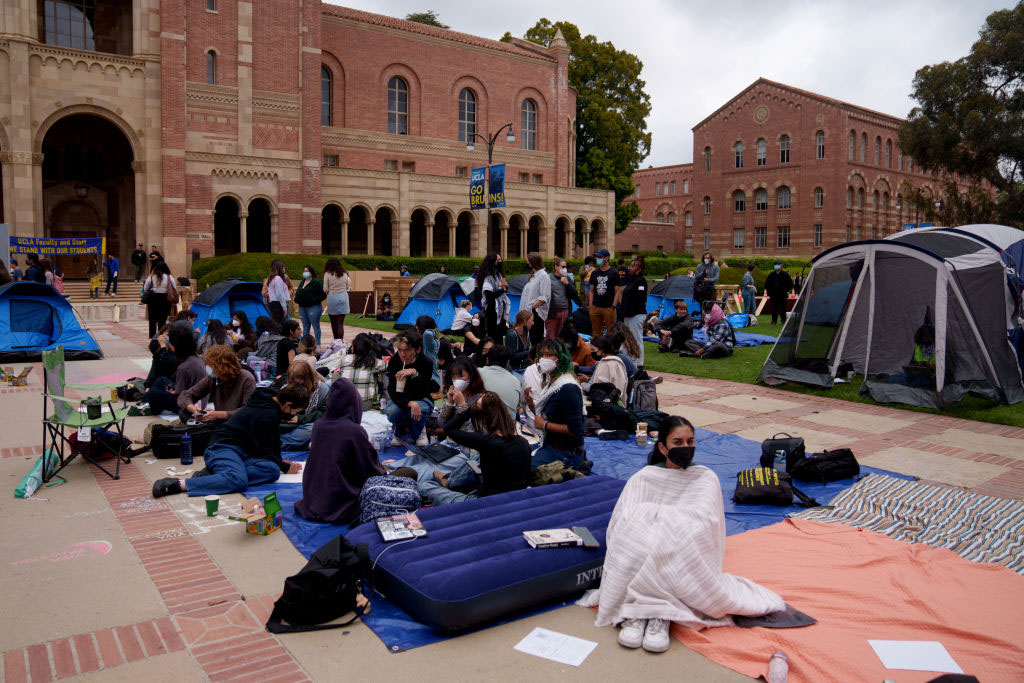
Although Mitchell never ignored the difficulties of reaching such an agreement, his faith in the solvability of the Israeli-Palestinian conflict stood in stark contrast to the protests and counter-protests going on on campus during UCLA’s Palestine Awareness Week, sponsored by a pro-Palestinian student group.
Starting in February, campuses across the country have been marking the eighth annual Israel Apartheid Week.
As in previous years, campus pro-Israel organizations mounted public awareness campaigns to counter that narrative. One such campaign is Israel Peace Week, created by Hasbara Fellowships, a project of the Orthodox nonprofit organization Aish Hatorah. Now in its third year, the program is aimed at showing that “Israel wants peace and has demonstrated its willingness to make painful sacrifices for peace.”
Other pro-Israel campus organizations staged their own, differently themed, events to mark the week. The UCLA chapter of J Street U, the college division of the “pro-Israel, pro-Peace” lobbying group, sponsored a speech titled “Supporting Israel, Opposing Occupation,” where Uri Zaki, the United States director of the Israeli human rights group B’Tselem, spoke to the student group at UCLA on Feb. 29, one of almost a dozen appearances on campuses across America this spring.
In his presentations, Zaki said he talks about the human rights abuses perpetrated against Palestinians living in the Israeli-occupied territories, but also makes clear that at the same time, the existence of Israel as a democratic Jewish state is a remarkable achievement.
“An organization with a strong record on human rights advocacy can say, ‘Yes, but,’ ” Zaki said.
For his part, Mitchell, after concluding his remarks, took questions from National Public Radio’s Renee Montagne, as well as from the audience. Asked about what the United States should do about Iran’s nuclear ambitions, Mitchell expressed support for the Obama administration’s policy of imposing sanctions without taking the military option off the table.
He added that a nuclear Iran would not only threaten Israel, but could also put at risk the success the nonproliferation treaty that has, for more than forty years, limited the spread of nuclear weapons to just nine countries.
A nuclear Iran, Mitchell said, “could lead to a rapid disintegration of that agreement.”

















 More news and opinions than at a Shabbat dinner, right in your inbox.