fbpx

March 8, 2012

Farmar Hits Game Winner

Last night Deron Williams gave up the ball and found Jordan Farmar for a huge game winner over the Clippers.Check it out below:

Farmar Hits Game Winner Read More »

My Single Peeps: Rachelle S.

Rachelle is originally from New York.  “I went to San Francisco in my 20s, so I feel as if I grew up [there].”  Her husband at the time wanted to get out of New York, “and I’m actually glad he wanted to move.  I love San Francisco.”  She divorced in the 1970s and, while working as an actress on the set of a film, she met a makeup artist and moved down to Los Angeles to be with him.  She dated other men she met on film sets, but none led to marriage.  “There was one I should have stayed with — I made a mistake.  Didn’t make a lot of mistakes but …”  She trails off. 

After years of acting and modeling, she couldn’t take the rejection anymore, so she found something else to do.  She spent years working as a publicist for nonprofits.  “I finally decided, in my 50s, I needed a regular job, and I went to work for Jewish Family Service.”  She retired four years ago, “and it’s even harder now to meet men.  Because when you volunteer (she spent four years volunteering at Cedars-Sinai Hospital), there aren’t a lot of men.  There are mostly women.”

“I don’t care how somebody looks.  I like a strong, successful person.  I don’t want to raise anybody.  I don’t want somebody who has to worry about me.  I’d like an equal.  And I know that scares a lot of men.  But I don’t want a hanger-on.  I find veterinarians and doctors terribly interesting.  I want [a man] close to my age range, because I’m so old.” She’s 70. “I want to spend some time with someone, but I find the men my age want 30-year-olds, and I don’t want [those men].  My friend who married a CEO of a company has had the most gorgeous life I’ve known.  I’d like a little bit of that.  I’m not into maids and fur coats and designer handbags, but I like nice restaurants and good places.”

I ask her what kind of things she likes.  “I like going to concerts; I like going to lovely dinners together; I like walking on the beach.  I don’t like hiking.  But I like taking drives; I like plays, movies, and I love Netflix.  I like watching movies at home lots of times.  I like having people over for dinner on Friday night.  I do like cooking — it’s a creative outlet.  I love cats.  I have a cat.  But I love dogs, too.  It’s funny, I like cats telling me what to do, but I don’t like men telling me what to do.”

Rachelle’s pretty and very natural looking.  She’s over 30 years older than me, but I don’t feel a huge generation gap.  If she were closer to my age, and we were having the same conversation, it wouldn’t come off as odd.  Maybe she picks up on what I’m thinking, because when we talk about the difficulties of dating, she says, “We’re like you — only older.”

She tried online dating, but one guy berated her for calling too late, another asked where she lived and said a duplex wasn’t nice enough, and the third one didn’t respond after having her send him a picture.  “So I gave up.  Three strikes, and you’re out.”

“Retirement was hard for me.  Not having a business card who says who you are — it defines you.  Because I was so defined by all the things I did.  You lose your identity.  You’ve done so much — what do you want to do next?  And that’s enjoy life.  I want to enjoy it with someone special.  That’s so cliché.  But it’s true.”

If you’re interested in anyone you see on My Single Peeps, send an e-mail and a picture, including the person’s name in the subject line, to mysinglepeeps@jewishjournal.com, and we’ll forward it to your favorite peep.


Seth Menachem is an actor and writer living in Los Angeles with his wife and daughter. You can see more of his work on his Web site, sethmenachem.com, and meet even more single peeps at mysinglepeeps.com.

My Single Peeps: Rachelle S. Read More »

Israel flying high with NASCAR

There is not a long and storied history of Jews in motorsports. The cast of characters is limited and filled mostly with names like Jody and Tomas Scheckter, François Cevert and Peter Revson, all of which likely means little to the average American, and less to the average American Jew. Even Kenny “The King of Speed” Bernstein, a Motorsports Hall-of-Famer, isn’t well known outside racing circles. Perhaps the most iconic Jewish racer was Paul Newman, a man far better known for his acting and activism. And if you narrow the story’s scope to Israel, it becomes so short it could be a haiku: Chanoch Nissany /did not race in the Grand Prix /how good could he be?

So it might have come as some surprise if you happened to catch the trials for this year’s Daytona 500 and caught an odd sight on the track. There, among the cars emblazoned with the logos of corporations like Target, Burger King, GEICO, FedEx and Miller, was the No. 49 car, a bald eagle on its hood, clutching the flags of Israel and America in its talons, with the words “United We Stand” above its grille.

If your first instinct is to suspect that this development is AIPAC’s latest foray into public relations, or that a pro-Israel billionaire like Sheldon Adelson decided to drop a couple million on a car to bring his message to the masses, you’d be wrong. In fact, the No. 49 car was conceived in a partnership between Robinson-Blakeney Racing and America Israel Racing, and their background might surprise you.

Speaking on the phone from North Carolina, America Israel Racing (AIR) co-founder Rich Shirey wasn’t hesitant to say that there’s “not one Jewish person on our team.” Shirey was raised Baptist in a home where, he says, they were always taught to stand behind Israel. Shirey, who has no background in racing, says the idea for America-Israel Racing came out of a desire “to show the world, and Israel, that a majority of Americans do support Israel.”

After being inspired to do something in support of Israel, Shirey got in touch with his friend, AIR co-founder Mark MacCaull, a former NASCAR engineer, to try and make his idea a reality. In Shirey’s mind, there was no better way to raise awareness about Israel than through NASCAR racing, the sport he loves. “Fortunately enough, Jay Robinson of Robinson-Blakeney Racing was coming up out of the Nationwide Series,” NASCAR’s second division, “to the Cup Series, and we went and met with him and it just was a perfect fit,” Shirey said.

“Everybody we have on our team, from the air team to the driver, to the crew chief, to the team that actually owns the racing team … everybody is 100 percent on board with this,” Shirey said. Even driver J.J. Yeley, when told what would be on the hood of his car, was hugely supportive. “When J.J. found out what we were trying to do … he was ecstatic.”

With Robinson-Blakeney and Yeley on their team, Shirey and MacCaull knew there were still many hurdles ahead. “Everything we do, NASCAR has to approve of,” said Shirey. And while the sport’s governing body has been very supportive, there’s still the matter of funding a race car, which is no small feat.

“We’re not rock stars or movie stars or anything like that, we’re just ordinary people,” said Shirey. “We have enough money to run Daytona, and Phoenix, and there’s a good possibility we’ll be in Las Vegas, but we definitely need to get funding.”

While AIR has been collecting donations on its Web site, americaisraelracing.com, the real struggle is “to try and get some corporate sponsors on the car.” But despite having yet to find a big-name sponsor, Shirey remains hopeful. “In America right now, things are tight for everybody.”

More than anything, Shirey wants to get the message out that America and Israel need each other and that, at least in the world of NASCAR, Israel is a true friend to America. “We’re two countries that are a lot alike in everything we do. They’re our closest ally in an area of the world that’s not real friendly to the West. And we need Israel as much as Israel needs us.”

Israel flying high with NASCAR Read More »

A new front in campus Israel wars?

To critics, the one-state conference held at Harvard University was a thinly veiled assault on the legitimacy of the Jewish state.

To organizers, the condemnations and calls on Harvard to cancel the conference amounted to thinly veiled attempts to silence any criticism of Israel.

In the end, “Israel/Palestine and the One-State Solution” — arranged by a group of graduate students at Harvard’s Kennedy School of Government and held at the university — held few surprises.

Activists and academics came together over the weekend to talk about how the Israeli-Palestinian conflict is a colonizer-settler relationship. A handful of pro-Israel activists stood outside the Kennedy School bearing signs that read “Shame on Harvard, Haven for Jewish Hatred.” Organizers declared the conference a success, while critics denounced it as a sham.

“The reality is, no matter what the conversation, if it’s critical of Israel, the response is the same,” Israel-born Elisha Baskin, a conference organizer, said of criticism of the event. Baskin is a research fellow at the Kennedy School and a graduate student at Brandeis University.

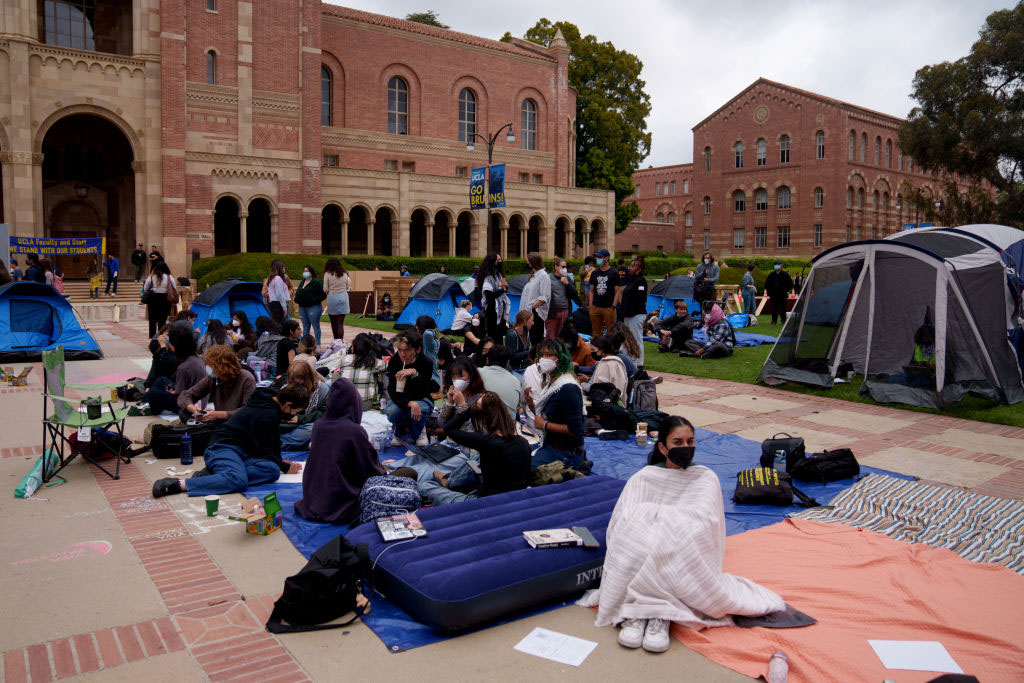
The fact that the conference took place at all   may have signified a possible new front developing in the campus wars over Israel.

Until now, most of the campus agitation over Israel has centered on the campaign for Boycott, Divestment and Sanctions against Israel, known as BDS. But the Harvard conference, and the intensity with which opponents fought to derail it, suggests a great anxiety among pro-Israel groups about the one-state solution turning into a new anti-Israel rallying cry on U.S. campuses.

“To the extent that the idea of a one-state solution is gaining currency, it is important to fight this line of thinking,” said Rob Leikind, director of the American Jewish Committee’s Boston office.

In the weeks leading up the event, pro-Israel groups sought to discredit the conference as an exercise in delegitimizing Israel, and Sen. Scott Brown (R-Mass.) called on Harvard to cancel the forum.

For its part, Harvard issued several statements clarifying that it was organized by students and received only a small amount of financial support from the university, as do other student conferences.

Kennedy School dean David Ellwood said, “We would never take a position on specific policy solutions to achieving peace in this region, and certainly would not endorse any policy that some argue could lead to the elimination of the Jewish State of Israel.”

Not all Harvard faculty members opposed the conference.

“As a Harvard faculty member, I am extremely proud that this conference in happening here,” Harvard law professor Duncan Kennedy said in his opening remarks as its first speaker.

Kennedy was among some two dozen speakers — academics and political activists — who addressed the audience of 300 or so at the March 3-4 conference. Organizers said the goal was to open up serious dialogue about alternatives to the two-state solution, but the lineup included a who’s who of academics, activists and officials who have made careers out of attacking the notion of a Jewish state.

Speaking at the conference, Ali Abunimah, co-founder of Electronic Intifada and author of the 2006 book “One Country: A Bold Proposal to End the Israeli-Palestinian Impasse,” denounced the two-state solution as an attempt to preserve Israeli Jewish power.

Boston University law professor Susan Akram talked about how “Israel’s claim of a state, on the basis of exclusive and discriminatory rights to Jews, has never been juridicially recognized. In other words, the concept of the Jewish people as a national entity with extraterritorial claims has never been recognized under international law.”

Other speakers included Rabbi Brant Rosen, a congregational rabbi from Evanston, Ill., who is co-chair of the rabbinical council of Jewish Voice for Peace, which favors BDS; Dalit Baum, co-founder of Who Profits from the Occupation; and Ilan Pappe, a history professor at the University of Exeter who argues that Israel engaged in concerted ethnic cleansing during the establishment of the state in 1948.

One of the few defenders of the two-state solution was Stephen Walt, a Kennedy School professor who co-authored the 2007 book “The Israel Lobby and U.S. Foreign Policy,” which was denounced by many Israel supporters as borderline anti-Semitic. Walt said at the conference that he has not given up on the idea of two states for two peoples.

Students at Harvard were of mixed minds about the conference. Some circulated a petition to have Harvard withhold funding from the conference. But Joshua Lipson, co-president of Harvard Students for Israel, said he fully supports students’ rights to expression and disagreed with those who called for Harvard to withdraw financial support from the conference.

A few Israeli students who attended the conference said that while they disagree with the one-state solution, it’s a legitimate topic for academic discussion.

That, said Ahmed Moor, one of the main student organizers of the conference, was the whole point of the exercise.

A new front in campus Israel wars? Read More »

White House: Obama didn’t discuss bunker busters with Netanyahu

A White House spokesman denied reports that President Obama promised Israeli Prime Minister Benjamin Netanyahu bunker-buster bombs and refueling planes that could help in a military strike against Iran.

“In meetings the president had there was no such agreement proposed or reached,” the White House press secretary, Jay Carney, said at a press briefing Thursday.

When asked whether the issue was discussed in Israeli meetings with other U.S. officials, such as Defense Secretary Leon Panetta, Carney answered he had no knowledge and said, “I would refer you to other officials.”

The Israeli daily Maariv had reported Thursday that Obama promised Israel bunker-buster bombs and other weaponry which could help it strike Iran on the condition Israel not attack this year.

An Israeli official told Reuters that a request for such assistance was made around the time of the prime minister’s visit. The Israeli official, however, labeled as “unrealistic” reports that there was an agreement to give such equipment to Israel in exchange for Israel agreeing to not attack Iran this year.

A U.S. official told Reuters that military capabilities were discussed during the Netanyahu-Panetta meeting but that no agreement was reached during those discussions.

White House: Obama didn’t discuss bunker busters with Netanyahu Read More »

Contrite and destitute: The new Jack Abramoff

“Former lobbyist and Washington insider — fell into the abyss, working to repent and repair.”

That economical bio — just 91 characters, including spaces — appears at the top of Jack Abramoff’s Twitter feed, and it only hints at just how hard it is to size up this new man.

Abramoff is an easy fellow to demonize. Once considered one of Washington’s most powerful lobbyists, Abramoff claims to have had some measure of influence with 100 different members of Congress and the Senate. He invited lawmakers and their staff to eat and drink for free at the two restaurants he owned, helped raise buckets of money for their reelection campaigns, even took them on international golfing vacations. He also cultivated relationships with high-ranking officials in the executive branch.

In return, those officials helped advance policies and laws favorable to Abramoff’s clients — whom, it was later found, were being fraudulently charged by the lobbyist. Furthermore, as shown in e-mails uncovered by the Department of Justice’s investigation, Abramoff used a variety of derogatory terms to refer to the Indian tribes that were his paying clients, paying him in the tens of millions of dollars.

Bad guy, that Jack Abramoff.

But Abramoff says he has changed since pleading guilty to criminal charges of conspiracy to bribe public officials, fraud and tax evasion in January 2006. He did his time — spending three and a half years in federal prison and, unlikely as it may seem, Abramoff has now become a very public advocate for reform. Last year, he published a memoir titled “Capitol Punishment,” in which he outlines a reformist agenda. And that is the message Abramoff has been spreading in speeches across the country and in televised interviews; he is scheduled to appear in Los Angeles at American Jewish University on April 1.

I met the former lobbyist at a Coffee Bean in Beverly Hills. He was wearing a blue and green anorak to keep out the late-February chill and, to my eye, he looked nothing like the Washington insider he used to be.

“When I come ask a congressman to help me, who’s my buddy, who I play golf with, who I do this with, who I do that with, what do you think he’s going to do? He’s going to try and do it if he can,” Abramoff said. “And even if he doesn’t do that one thing, he will do something for me — and he shouldn’t do that. That is an un-level playing field. That is bribery.”

Abramoff believes corrupt lawmakers — and the lobbyists who seek to influence them by improper means — don’t see anything wrong with what they’re doing. He should know — he didn’t think he was doing anything wrong, either.

“You’ll hear from Congressmen, ‘A $2,000 contribution isn’t going to buy my vote.’ ‘A meal isn’t going to buy my vote,’ ” Abramoff said, the table between us bare but for his laptop computer. “But we learn, in fact, from the Talmud that they’re wrong.”

Abramoff, 53, has been an observant, Orthodox Jew since he was 12, so it’s not surprising that he points to a talmudic source as part of his new campaign against bribery of public officials. But while he was showering legislators with gifts, Abramoff believed he wasn’t on the wrong side of Jewish law, as the Torah restriction on bribery focuses only on judges.

“Legislators,” Abramoff said, “I never thought or considered them to be judges.”

He later found Jewish commentators who do equate bribing lawmakers with bribing judges, but Abramoff said that, generally speaking, it’s difficult to pinpoint why what lobbyists do is wrong. Even those who don’t live and work inside the Beltway, he said, shrug their shoulders at the thought of a lobbyist buying a meal for a lawmaker.

“But having a restaurant where congressmen can come and eat sushi to their hearts’ content, drink wine and then leave without a bill? Over and over again?” Abramoff asked, rhetorically. “Put him on a Gulfstream, fly him to Scotland to play St. Andrews and Carnoustie and all these places, you know? Raise a bunch of money for him? I think we’re getting into the trouble zone here.”

Abramoff lived in that zone for years. In addition to offering freebies at Signatures, his restaurant in D.C., each year he gave away $1.5 million worth of tickets to local sporting events. In 2002, Abramoff took Bob Ney, then a Republican congressman from Ohio, to Scotland for a golfing vacation that cost more than $130,000 — and that wasn’t the only international golfing junket Abramoff funded. (Ney later pled guilty to charges of conspiracy to commit fraud and falsifying documents and served 17 months in prison.)

“There isn’t one big crime there,” Abramoff said. “There never was.”

Still, there are reasons to feel some sympathy for Abramoff. His mother died while he was in prison, and, unlike many prisoners, he wasn’t allowed to attend her funeral. He sat shivah alone in his cell.

In his absence, his wife and five children lived a life of penury. “She didn’t even put the air conditioning on,” Abramoff said. “She couldn’t afford it.” Even now, Abramoff is attempting to pay off a $44 million court-ordered restitution, which, he says, ensures he remain all but penniless for the rest of his life. 

And yet, Abramoff says he considers himself very blessed, noting that his wife did not leave him, unlike 80 percent of men who spend two years or more in jail.

According to Abramoff, what he did was — and remains — routine for most lobbyists in Washington, in spite of a bevy of new laws passed in an effort to limit the improper influence of lobbyists. Indeed, were he not the one whose reputation and business were destroyed by scandal, Abramoff said he’d likely still be doing the same things he always did, and he might even be among those trying to silence his call for reform.

“They don’t want me talking about this stuff, and I understand why,” Abramoff said. “They’re making money off of it, like I did.”

Abramoff wrote “Capitol Punishment” in 28 days — “minus the Sabbath days, of course,” he was quick to add — and the book includes a good deal of Abramoff’s personal history and a smattering of self-justification. But much of the attention it has received has focused on its concluding chapter, titled “Path to Reform,” in which he lists a few proposals to eliminate bribery of government officials, as much as possible.

To shut the “revolving door” between Capitol Hill and the K Street offices of D.C.’s biggest lobbying firms, Abramoff writes, Congress must institute a lifelong ban on legislators and their aides becoming lobbyists.

“Once I offered them a job, they worked for me,” Abramoff said, referring to the legislative staffers he lobbied. Congressional chiefs of staff, Abramoff said, make anywhere between $90,000 and $185,000 depending on their boss’ seniority. Abramoff says 40 lobbyists in his shop made at least $300,000 a year. Many of them had been staffers on the Hill; as lobbyists, they didn’t have to worry about their bosses getting re-elected.

“You’ve got to ban it,” Abramoff said. “They can’t be allowed to cross the line.”

Abramoff also proposes barring lobbyists from giving gifts of any amount to any lawmaker, and prohibiting lobbyists and special interests from giving any political donations. That’s not to say that Abramoff, a lifelong Republican who describes himself as a small government conservative, is advocating publicly funded elections.

“I think that would breed more corruption,” Abramoff said. “People who don’t know the lobbying world don’t understand that as soon as you have ‘publicly funded fill-in-the-blank,’ we go after the money. There’d be people running for office all over the country to make a living. There’d be no way to control it.”

Abramoff also advocates instituting strict term limits for representatives and senators.

“As a lobbyist, I was against them,” Abramoff explained. “Of course I was against them. Why? Because once you buy a congressman and their office, you don’t want to have to rebuy that office in six years. It’s inefficient. You want somebody in there until they die.”

Even if these reforms could be enacted, though, Abramoff doesn’t harbor illusions about whether lobbyists will find ways around them.

“You’re not going to ever solve these problems entirely,” Abramoff told me. “There is no cure-all. It’s just going to be an ongoing fight.”

These positions may not be winning Abramoff any friends on K Street, but the reforms he’s proposing have won him some fans on the political left, including documentary filmmaker Michael Moore. He and Abramoff met when both were scheduled as guests on the same TV show.

“He was on first,” Abramoff said, “and as he came off, I was going on, and he grabbed me and gave me a big hug and said, ‘God bless you. Your book is amazing.’ ”

“I thought, ‘Wow,’ ” Abramoff said. “Incredible.”

Abramoff will appear at American Jewish University in conversation with Dr. Robert Wexler on Sun., April 1 at 4 p.m.

Contrite and destitute: The new Jack Abramoff Read More »

Canter’s Deli’s queen of pastrami on wry

Stop in to the iconic round-the-clock Canter’s Deli most nights during the 7 p.m.-to-4 a.m. shift, and you’re likely to encounter another icon — a short, solid woman in her 70s with auburn hair who wears a white waitress uniform with metal snaps, a black sweater and sports a youthful twinkle in her eye. This is Bella Haig, who started waiting tables at the deli 47 years ago and who now serves as manager and unofficial queen of Canter’s.

Raised in Boyle Heights, around the corner from the original Canter’s, she was an early patron. “We were poor; I was the oldest of five kids. My mother didn’t have much money, but she liked to take us out to eat. She’d take us to Canter’s, and we’d sit at the counter. They’d wait on us last,” Haig remembers, “because Mom was not a good tipper.” Haig began working early. “I worked all through high school, Fridays, Saturdays and Mondays at a clothing store, Lerner’s,” she said. She married early as well, at 18.

The year that Haig started working at Canter’s, 1965, Lyndon
Baines Johnson gave his “Great Society” State of the Union Address, and the Beatles song “Yesterday” reached No. 1 on the charts, where it stayed for four weeks. Haig always chose to work the night shift.

“My kids were 2 and 7. My husband worked all day, and I wanted to supplement our income. I figured if I worked nights and he worked days, we wouldn’t have to have a babysitter. Now, I’m used to these hours. I prefer the night; it’s not boring.” Especially in the restaurant’s adjoining bar, she says.

“Our bar closes at 2 a.m., but customers find all sorts of sneaky ways to keep drinking,” she says. “They hide drinks between their legs, or pour them into their water glass.” Which is fairly tame compared to some of the shenanigans Haig has witnessed from the young rockers who stop in after the clubs close. A favorite trick? “I look at the stall and see two feet on the floor, and two feet not on floor. I usually just bang on the door and say, ‘It’s over. Get a motel. I’m gonna give you two minutes, then I’m gonna open the door.’ ”

These days, working 47 consecutive years in any job is remarkable enough — add to that the fact that Haig has never missed a single day of work. What has kept her going for so long?

“When they hired me as manager, they told me, ‘Pretend it’s your own place and run it the way you want to,’ and that’s what I’ve been doing.” Which means she takes things very personally. Such as when people try to skip out without paying the check. On numerous occasions she has put her life on the line, chasing customers more than four blocks down the street from the restaurant. She’s demanded expensive rings, watches and gold chains as collateral, and if someone is reluctant to part with their personal items, Haig doesn’t hesitate to enlist the police’s help. As for the actual running, Bella explains, “I could shop all day and work all night; my legs are good.”

Her vision is good, too. Nothing escapes her. Her two main responsibilities are keeping the diners happy and making sure the
waiters and waitresses do their jobs, and she confides that her staff regards her “with a mixture of friendship and fear.”

“They know I’m not gonna put up with any nonsense. And that I have the power to terminate them. That’s fire them,” she clarifies, “not kill them. But they also realize I’m gonna be fair and nice with them. If they’re slacking off, I don’t yell; I discipline. I take them to the back room and say, ‘What’s going on? Your customers need something, and what are you doing? I don’t see you working.’ I’ve had to let some go. Some take advantage or just don’t do their job.”

Haig relishes the celebrity customers, though they’re treated just like anyone else. “I waited on Paul Newman and Joanne Woodward, Rock Hudson, Van Halen, Anna Nicole Smith,” she says, listing just a few.

Rodney Dangerfield, she says, “was a pain in the neck. He used to try to sneak in beer. He’d put a menu in front of him — like nobody could see the beer. He’d come in every weekend and would want to try tastes of everything before making up his mind. I didn’t want to say no, because he was already not getting very much respect.”

Canter’s Deli’s queen of pastrami on wry Read More »

At UCLA, peacemaker Sen. George Mitchell gives insight Into Middle East

“We must be patient and realistic in our expectation regarding the Middle East,” Sen. George Mitchell told an audience at UCLA on March 1.

Mitchell delivered this year’s Bernard Brodie Distinguished Lecture on the Conditions of Peace, and he struck a tone that was, perhaps appropriately, but not overwhelmingly, pessimistic about the dim prospects for a peaceful resolution to the Israeli-Palestinian conflict.

The architect of the Good Friday Agreement in 1998 that paved the way for an end to the violence in Northern Ireland, Mitchell spent two and a half years as President Obama’s Special Envoy for Middle East Peace. Beginning in 2009, Mitchell tried but ultimately failed to help the Israelis and Palestinians break the impasse that has all but halted peace negotiations.

While he acknowledged last week that there are many reasons to be skeptical about the possibility of peace between the Palestinians and Israelis — first and foremost the uncertainty that has been brewing in the Arab world since the revolutions that deposed the dictatorial regimes in Tunisia and Egypt in 2011 — Mitchell said he still believes a peaceful resolution to the conflict remains possible.

To illustrate what Israeli-Palestinian peace might look like, Mitchell cited a January 2009 speech by then President George W. Bush. Just before leaving office, Bush described the Palestinians’ goal as “a viable, contiguous, sovereign, and independent state,” based on the 1949 armistice lines, with agreed swaps. The Israeli goal, Bush said, was to have a Jewish state “with secure, recognized, and defensible borders.”

These two goals could be achieved peacefully through difficult compromise, Mitchell told the 500 people in the audience, but only if both Israeli and Palestinian leaders can find a way to present it as a win-win solution.

Although Mitchell never ignored the difficulties of reaching such an agreement, his faith in the solvability of the Israeli-Palestinian conflict stood in stark contrast to the protests and counter-protests going on on campus during UCLA’s Palestine Awareness Week, sponsored by a pro-Palestinian student group.

Starting in February, campuses across the country have been marking the eighth annual Israel Apartheid Week.

As in previous years, campus pro-Israel organizations mounted public awareness campaigns to counter that narrative. One such campaign is Israel Peace Week, created by Hasbara Fellowships, a project of the Orthodox nonprofit organization Aish Hatorah. Now in its third year, the program is aimed at showing that “Israel wants peace and has demonstrated its willingness to make painful sacrifices for peace.”

Other pro-Israel campus organizations staged their own, differently themed, events to mark the week. The UCLA chapter of J Street U, the college division of the “pro-Israel, pro-Peace” lobbying group, sponsored a speech titled “Supporting Israel, Opposing Occupation,” where Uri Zaki, the United States director of the Israeli human rights group B’Tselem, spoke to the student group at UCLA on Feb. 29, one of almost a dozen appearances on campuses across America this spring.

In his presentations, Zaki said he talks about the human rights abuses perpetrated against Palestinians living in the Israeli-occupied territories, but also makes clear that at the same time, the existence of Israel as a democratic Jewish state is a remarkable achievement.

“An organization with a strong record on human rights advocacy can say, ‘Yes, but,’ ” Zaki said.

For his part, Mitchell, after concluding his remarks, took questions from National Public Radio’s Renee Montagne, as well as from the audience. Asked about what the United States should do about Iran’s nuclear ambitions, Mitchell expressed support for the Obama administration’s policy of imposing sanctions without taking the military option off the table.

He added that a nuclear Iran would not only threaten Israel, but could also put at risk the success the nonproliferation treaty that has, for more than forty years, limited the spread of nuclear weapons to just nine countries.

A nuclear Iran, Mitchell said, “could lead to a rapid disintegration of that agreement.”

At UCLA, peacemaker Sen. George Mitchell gives insight Into Middle East Read More »

In love and defense

I have a complicated relationship with Israel. My younger brother made aliyah last year and is currently serving as a paratrooper in an elite unit of the Israel Defense Forces (IDF), leaving me feeling simultaneously proud, nervous and occasionally nauseous all at once. We were raised in a Zionistic home with a strong legacy of Israel support — our grandparents collected money in little blue tzedakah boxes before Israel even became a state. My own schooling taught me the importance of being informed about complex Middle East issues; as an educator, I confront the media bias and hatred of Israel and instead promote positive messages about the country and her people. Through professional work, I also lead an annual student delegation from Los Angeles to Israel, where I continually experience the Jewish homeland through my students’ eyes. 

A 2007 study by sociologists Steven M. Cohen and Ari Kelman explained that American Jews’ connection to Israel drops off with each generation, leaving many youth alienated and apathetic about Israel’s future. Since that study, Hamas has come to power in Gaza, a barrage of rockets have fallen on southern Israeli cities, the world has shouted in outrage over the flotilla incident, the controversial and emotional prisoner exchange for Gilad Shalit’s release occurred, and the United Nations bid for Palestinian statehood is ever looming. Yet, the majority of American Jews have not felt compelled to get involved and advocate for Israel’s security.

I surmise the reasons for this disconnect are in one’s upbringing, lack of Jewish education (not just from day schools but without the Jewish learning provided by religious schools, supplemental programs, camps and youth groups), and absence of positive, personal experiences in Israel that bind one to the land and the people. The silence in response to threats against Israel is not just limited to the youth, however. Many parents are not imbuing their children with support for the Jewish homeland because they, too, do not believe in its importance. Too comfortable and too assimilated in American society, just as Jews were in different societies throughout history before becoming a scapegoat, these parents do not see Israel’s existence as a beautiful culmination to centuries-old longing and an integral piece of our past and future.

Since Israel’s victory in the 1967 Six-Day War,  public perception of has changed from Israel’s being the sympathetic underdog that rose from the ashes of the Holocaust to a powerful and accomplished nation. Particularly in the last decade, there seems to be a misplaced sense of liberalism that breeds exclusive concern for the Palestinians, coupled with virulent anti-Zionism (often cloaked anti-Semitism), affecting Jewish support.

Despite the 7,563 miles separating Los Angeles from Tel Aviv, my connection with Israel is strong and my commitment is unbreakable. Today I can say that I have come full circle — once a student at L.A. Hebrew High School, I’m now its program director. Israel and engagement in the Jewish community has always been a common thread in my life. Even during my college days, I was vice president of Hillel and a student leader with AIPAC. My administrative work today includes teaching a politics and values elective called Jewish Civics Initiative (sponsored by the Panim Institute), which happened to be my favorite class when I was 16 years old.  For the past four years, I also served as the Partnership Coordinator for the Jewish Federation’s Tel Aviv-Los Angeles Partnership School Twinning Program, which seeks to deepen the connection between American and Israeli teenagers to create a shared sense of Jewish identity and destiny. It has been amazing for me to head the programs that I had been involved in as a student and that had such an impact on my personal growth. Through my position, I focus on leadership training, to give the students the tools they need to be successful ambassadors for the causes that matter to them.

My students are the exception to the majority in that they understand the importance of using their voice to defend and strengthen Israel. When we returned from the Jewish Federation’s annual delegation trip to Israel in December, I was overwhelmed by the breadth of student testimonies that attest to the necessity of providing students with actual experiences that connect them to Israel. They talked about the importance of visiting and learning about the land for themselves:

“All my life I heard about Israel. How I need to be pro-Israel and love the country. My relationship to Israel was outlined by others, but now I can develop my own opinions on Israel based on firsthand experience. I own it.”

“What I loved about this experience was that I really got to connect to my Jewish roots and appreciate how we are all different but all the same.”

“Being pro-Israel means understanding its history, its present situation and most of all, protecting its future.”

“I never realized how such an amazing place can have so many problems and conflicts that seem to never end. I hope many things for Israel, but above all I hope one day this country will be at peace. I hope a day will come when all the fear will not exist and Israel can live freely and be secure.”

Many participants spoke in length about the shared values that both America and Israel stand for and how moved they were in actually looking at all accomplishments that these countries of immigrants have achieved. The group of Israeli and American teens discussed how it does not matter where you are from, Jews all over the world are bound together through their shared memories, and Israel is the center. The opportunity to actually travel to Israel cemented their feeling of Jewish unity and commitment to ensuring a strong Jewish future.

As demonstrated by these students’ thoughtful reflections, despite claims to the contrary, students do care. When an issue speaks to them, they are passionate. But when it comes to Israel, they need to first feel a sense of love and pride for the country and then be given the tools to defend her. We do not need to teach that Israel is always right or to support every policy, but our silence is inexcusable.

Many organizations are already producing effective programming and resources to explain why support for Israel is essential and well deserved. It is time for us as educators, congregations, community leaders and parents to utilize them in designing meaningful programs that educate the greater community about Israel. To create the next generation of leaders, we cannot simply provide talking points, a list of Israel’s technological innovations, or screen Israeli movies while eating falafel, nor can we expect support of Israel just because the Torah states it was our land for thousands of years. All of those activities may have an impact, but none can be done in a vacuum and expected to be successful in the long run.

There needs to be a multitiered approach to help students (both affiliated and unaffiliated) build their own relationship with Eretz Yisrael. We should teach the history of the Jewish homeland and facilitate honest dialogue about its ongoing challenges, while also celebrating its diverse culture and encouraging travel to the country. When this experiential learning occurs, as evidenced from the declarations from the students that participated in the Tel Aviv-Los Angeles Partnership program, the youth will be empowered to answer the tough questions, correct misinformation with facts, and articulately respond to the anti-Israel rhetoric in college and throughout their life.

“I will fight because no one else will do it for me, no other nation will do what is necessary for Israel to survive,” my brother once wrote in an e-mail explaining to family and friends his reasoning for enlisting in the IDF.

He is right. Our actions are what define us, and this is our opportunity to act as Israel’s guardians and ensure that the Jewish homeland we dreamed about for so long continues to survive, thrive and hold meaning for future generations. One need not make aliyah and join the army, but we must find our own way to be a voice for Israel, whether it is in the media or over the dinner table.

“Israel is the greatest story ever told,” said one student from the Partnership program during our reflection activity in Tel Aviv. It is our responsibility to be the authors of our own narrative and keep telling it to future generations. Am Yisrael Chai.

Erica Solomon is program director for Los Angeles Hebrew High School (lahhs.org).

In love and defense Read More »

Cal State system to resume Israel study program

California State University, with 420,000 students on 23 campuses, has resumed its Study in Israel program at the University of Haifa, after a 10-year hiatus.

During the initial application period, which has now ended, only three students applied for the program that will begin this fall.

However, because many students may have missed the initial announcement, CSU has extended the application deadline up to April 10, provided all required forms are in order, university spokesman Erik Fallis said.

Interested students are urged to contact their campus international programs advisers as soon as possible.

CSU suspended its Israel Study programs in 2002, at the height of the second intifada, citing security concerns. For the same reason, the administration decided not to resume at this time the previous programs at Tel Aviv University and the Hebrew University in Jerusalem.

Even so, the CSU chancellor’s decision to restart the Haifa study program triggered some protests on a few CSU campuses. Some 81 faculty members and 46 students and alumni signed a petition opposing any relations with Israeli universities.

The University of Haifa campus is located atop the Carmel Mountain range, southeast of the city of Haifa, and is populated by some 18,000 students, studying in 55 departments and 60 research centers.

The university’s International School hosts more than 800 foreign students during its fall, spring and summer semesters, of whom some 60 percent are from the United States.

In addition, the university has recently launched several international MA programs, taught in English, including peace and conflict management, business administration and patent law, Holocaust and genocide studies, creative art therapies, and maritime civilizations.

Cal State system to resume Israel study program Read More »