
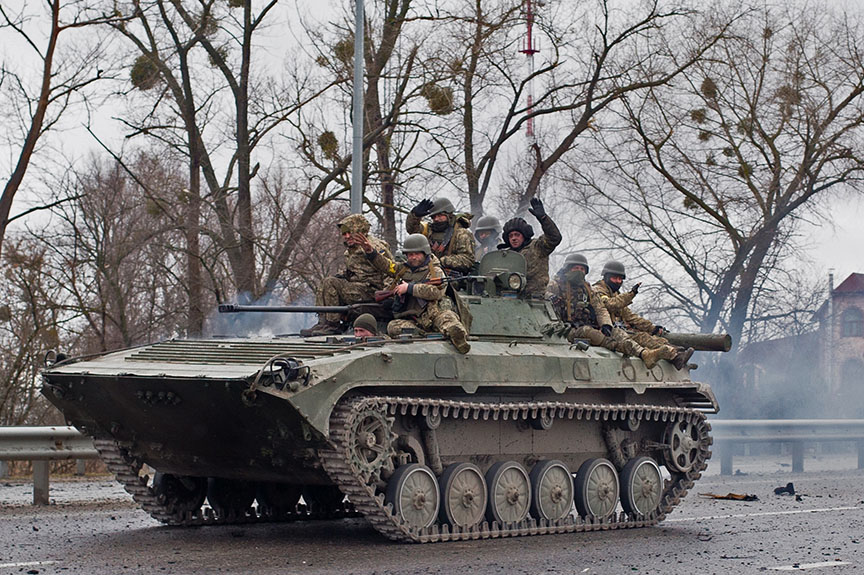
How we got to Russia’s invasion of Ukraine is a long and complicated story. For one thing, Russian President Vladimir Putin never got over the loss of global influence that followed the dissolution of the Soviet Union in the early 1990s. I’ve read countless analyses of this period, and they’re replete with mistakes, blunders and missed opportunities from all sides. A few key moves here and there might have prevented the tragic war scenes we’re seeing daily from Ukraine.
The problem is that, right now, none of that really matters. Once a war starts, it’s all about the fighting.
It’s like schoolyard rumbles. At first, there’s plenty of talking, posturing and threatening. A peacemaker might even try to intervene. But when the punches start flying, it’s the fight that matters and nothing else.
This is where we’re at in Ukraine. We can analyze the past all we want, but at this moment, we’re in all-out war. These questions, among many others, are critical:
Will Ukrainian troops receive more Javelin missiles in time to make a dent on the Russian onslaught?
How far will Putin go with his military escalation, which includes an unprecedented attack on a nuclear plant?
How long will the capital city of Kyiv stay out of Russian hands, and will Ukrainian President Volodymyr Zelensky survive?
How many civilian refugees will be able to escape?
This is Putin’s war, the war of a bully who’s done something I never thought I’d see: He has united pretty much the whole world, but especially the West. Western nations, institutions and organizations have been falling all over themselves to sanction and isolate Russia– oil and gas be damned. They’re all in fighting mode, too.
This is Putin’s war, the war of a bully who’s done something I never thought I’d see: He has united pretty much the whole world, but especially the West.
In this fighting mode, both sides try to inflict as much pain as possible on the other, in the hope that they’ll have more leverage when the shooting stops.
A schoolyard bully, regardless of how strong or threatening he is, loses leverage when he gets beat up. He is humbled and humiliated. Putin knows that. For a man obsessed with prestige, the last sentiment he wants to feel is humility. His first week of war has not gone well, which is why he is doubling down. He must avoid a beating at all cost.
His problem is that Ukraine owns the moral high ground, utterly and completely. No one has bought Putin’s propaganda that this is a defensive war. The Western world would not be so united if this wasn’t a naked, unprovoked land grab.
We’re back, then, to the bombs, the tanks and the missiles. Who will prevail on the ground? If Russia prevails but triggers an ongoing Ukrainian insurgency, will that be considered a victory?
“[Putin] simply cannot do what he hoped to do: install a puppet and basically go home,” Thomas Friedman wrote in The New York Times. “If he installs a puppet, he’s going to have troops there forever. So I think Putin basically has four choices: lose early, lose late, lose big or lose small.”
The Russian bully is in a bind: even if he wins, he loses.
As much as there is value to preventing fights, there is also value in teaching the bullies of the world a lesson. With the horrific human toll that this war has already caused, that lesson is the least we can hope for.
































