Just as things were returning to normal, and rabbis across America were eagerly anticipating a full reopening for the High Holy Days, the Delta variant showed up.
Oh no, not again.
Need I remind you that nearly every synagogue and Jewish center in America pretty much shut down during last year’s High Holidays because of COVID-19? That the great American Jewish ritual of scoring High Holiday tickets succumbed to a deadly, global virus? That rabbis had to scramble for alternatives, from Zoom services to backyard minyans?
Those days of physical isolation were supposed to be behind us. As Roni Caryn Rabin writes in today’s New York Times, “The country seemed to be exiting the pandemic; barely a month ago, a sense of celebration was palpable.” But now? “Rising case rates are upending plans for school and workplace reopenings, and threatening another wave of infections that may overwhelm hospitals in many communities.”
We thought the vaccine would be our salvation, but according to reports, the Centers for Disease Control and Prevention is expected to recommend this week that even people vaccinated for the coronavirus resume wearing masks indoors in certain parts of the country.
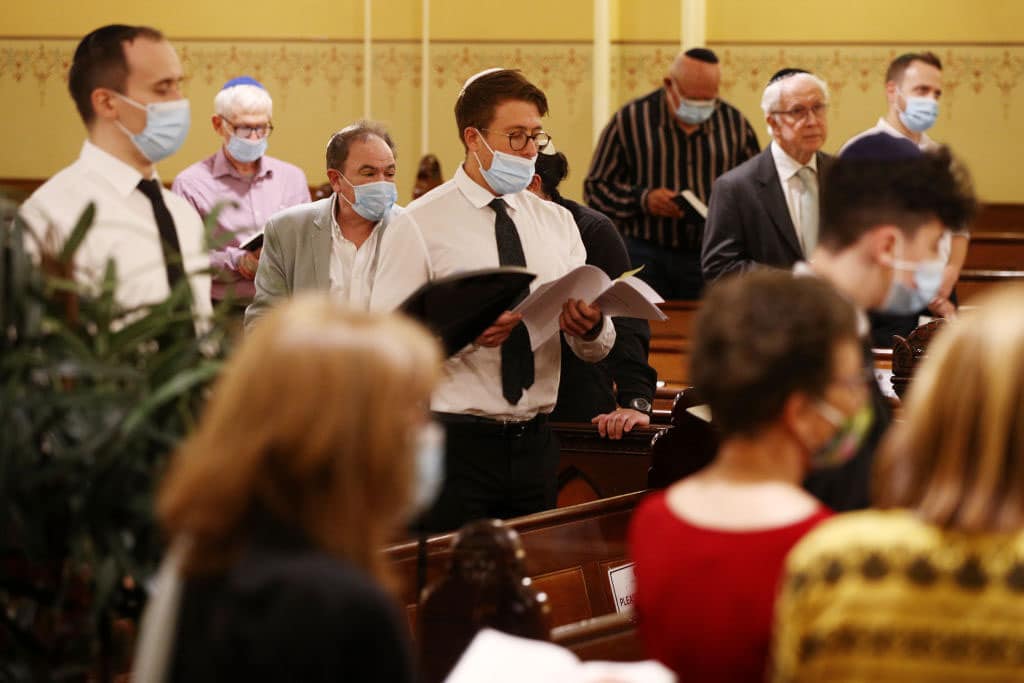
Of the many obstacles to in-person prayer services caused by COVID, one of the toughest is surely the mask mandate.
When more pleasant alternatives are easily available—either via online or in someone’s backyard—how many Jews will brave the unintended indignity of covering one’s face during our holiest days of the year?
How many people will tolerate wearing masks during the long Rosh Hashana and Yom Kippur services? It’s one thing to wear a mask while you go grocery shopping or briefly enter a public space, but when more pleasant alternatives are easily available—either via online or in someone’s backyard—how many Jews will brave the unintended indignity of covering one’s face during our holiest days of the year?
As I write this, the anxiety of uncertainty is building: If the mask mandates continue, how many Jews will grace the pews? How many will renew their memberships? Will new habits formed during the pandemic take over? After two years of unprecedented COVID disruptions, these are worrying questions.
It’s easy to expound on new-age ideas like “creative reimagining” and “creative disruption,” but right now, the hard reality is that many congregations depend on the High Holiday season for significant fundraising. They already took a big hit last year—can they withstand another one?
Online alternatives may be incredibly efficient and comfortable, but when so much is available for free, there’s less incentive to pay or donate. The in-person experience, which has dominated Jewish life since time immemorial, has concrete value. A live appeal from a rabbi, needless to say, is a lot more powerful than an online one.
And yet, this is the new reality in which we find ourselves, for better or worse. Enclosed indoor spaces of all kinds have gone out of fashion. And that includes synagogues. As long as mask mandates are around, and alternatives are available, many people will see these indoor spaces as an inconvenient risk not worth taking.
there’s simply no substitute for gathering in a real space, for hugging your friends, for making eye contact, for feeling the electricity of communal prayer, for hearing a live inspirational sermon.
I hope this doesn’t last. Prolonged physical isolation can be debilitating, especially for communities that are used to mingling and interacting and connecting in person. Regardless of how creative and impactful we’ve been with online programming, there’s simply no substitute for gathering in a real space, for hugging your friends, for making eye contact, for feeling the electricity of communal prayer, for hearing a live inspirational sermon.
I hope community members, and especially major donors, will step up and keep our most vulnerable synagogues afloat until safer days are back.
I hope community members, and especially major donors, will step up and keep our most vulnerable synagogues afloat until safer days are back. Yes, Jews are supposed to be resilient, but sometimes the price of that resiliency can be quite high, in more ways than one.