
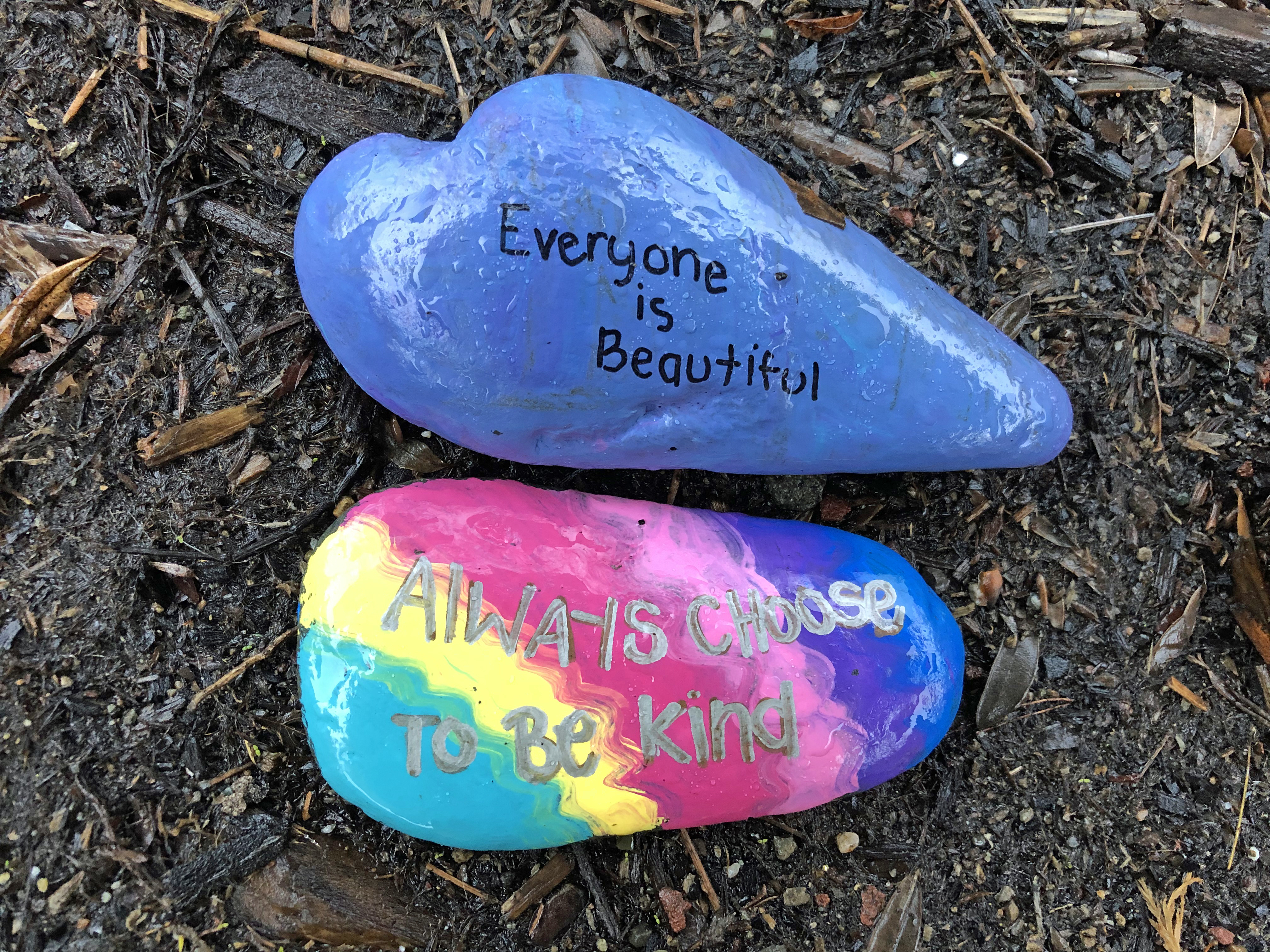
A couple of weeks ago, I arrived at my synagogue to find a number of painted rocks in the landscaped areas around the patio at the entrance. “Everyone is Beautiful” said one, while another read, “Always choose to be kind.” Similar positive messages were written on each rock.
Rabbi Lara Regev, head of the religious school, told me they’re called “Kindness Rocks,” and were painted by children in the religious school. At the website for The Kindness Rock Project, it says: “Take one when you need one. Share one with a friend who needs some inspiration. Or leave one for another. 1 message at just the right moment can change your whole day, outlook, life.”
The introduction of rocks of any kind clearly would not have helped the situation in which Native American Tribal Elder Nathan Phillips stood before students from Covington Catholic High School near the Lincoln Memorial last Saturday. The messages those rocks are meant to convey, however, were sadly in short supply.
I am not going to name or focus on the one high schooler who stood in front of Mr. Phillips, although his name has been published by others. Too much of the focus is on this one young man. There were many others from his high school there with him, each of whom deserves as much focus as he does.
At the age of 13, Jewish boys become bar mitzvah. Too many people believe this means this means they become a “man” at this age. I don’t believe that to be true, but I do believe in the translation of “bar mitzvah,” meaning “son of the commandments.” By this age, they are old enough to know right from wrong, and are responsible for following the commandments. They are responsible for their own actions. By this age, although guidance from their elders is still helpful and sometimes needed, whether or not they receive this guidance, they cannot lay the blame for their actions at the feet of anyone else.
I mention this because I believe all of these Covington Catholic High School students are older than 13, some of them by three to five years, and I am therefore looking at them through the perspective of one who believes they are old enough to know right from wrong and are old enough to be held accountable for their own actions.
At the same time, I don’t believe children should be tried in the courts (of justice or of opinion) as adults. It’s my understanding that the prefrontal cortex, which is the rational part of the brain, is not fully formed until around age 25. Thus, young adults may know, in an emotional or “gut” way, whether what they are doing is right or wrong, but they may have difficulty coming to a rational decision about what to do when faced with an unexpected situation, especially one in which they are well outside their normal operating zone.
We all have a way we operate in the world when we’re comfortable, and we all have a fallback way of operating when we feel unsafe or uncomfortable. It’s clear to me that these high school students when they were in just such an unfamiliar and uncomfortable situation, fell back into a mode of behavior that was highly disrespectful of Mr. Phillips.
Forget about the photo of the one young man standing in front of Mr. Phillips. Instead, look at the video of numerous young men jumping, waving their arms, and making noise. As Dr. Susan Schorn so succinctly put it on Twitter, “This is classic primate threat behavior. It is the opposite of de-escalatory.”
Our synagogue is teaching our children that when they are faced with the unfamiliar and are uncomfortable, they should remember, “B’tzlem Elohim,” everyone was created in the image of God, and thus, “Everyone is beautiful.” They are being taught to treat everyone with kindness. It is our hope that, whenever they are in a situation where they feel themselves moving from their “comfortable” mode of behavior to their “fallback” mode, they will keep these concepts in the front of their mind. If they do so, they will not find themselves jumping up and down, waving their arms, and making noise in front of a man singing with a drum.
I don’t know what they’re teaching these kids at Covington, but the school administration and the parents knew they were bringing these kids to counter-protest people who were marching in defense of women’s rights. Surely they knew they might be walking into a confrontation or two at some point during the day. It doesn’t appear these young men were properly prepared for that, or given effective guidelines about how to behave in such a situation.
That being said, as young adults who are old enough to know right from wrong, these students are old enough, and have now had enough time to reflect, for us to hold them accountable for an adequate response. I can’t write that response for them, but it might contain the following talking points:
- We take responsibility for our own actions.
- We are sorry we were disrespectful to Mr. Phillips.
- We recognize that all human beings deserve to be treated with dignity and respect, at all times.
- We understand that our actions made the situation worse, and we will take the initiative to seek out training on how to effectively de-escalate the situation when we find ourselves in a confrontation in the future.
- We will examine our own biases to try to determine how they may have played a part in how we reacted in this situation.
- We will strive in the future to always treat others with kindness.