(JTA) — Not long after the gruesome reality of the Holocaust had burst onto the world’s consciousness, the philosopher and social theorist Theodor Adorno famously observed in 1949 that writing poetry after Auschwitz was barbaric — “nach Auschwitz ein Gedicht zu schreiben, ist barbarisch.”
Less well known but equally insightful was Adorno’s subsequent conclusion, expressed in a 1966 radio address in Germany, that Auschwitz itself constituted nothing less than a “relapse into barbarism.”
Adorno understood that the Shoah’s calculated, systematic savagery was an absolute deviation from the fundamental norms of civilization and civilized behavior. To be valid, anything written or said about the Holocaust, whether in poetry or prose, must first and foremost encapsulate and reflect its barbaric essence. Aesthetic sensitivities and considerations must yield to the undeniable absolute evil that sparked and perpetrated the genocide of European Jewry, requiring us to absorb and try to come to terms with the unprecedented, the unfathomable and, above all, the inexplicable.
Perhaps the most cogent context for this inexorable immersion into the unknown was given by my late teacher and mentor Elie Wiesel, who explained in his essay “A Plea for the Dead” that “Auschwitz signifies not only the failure of two thousand years of Christian civilization, but also the defeat of the intellect that wants to find a Meaning – with a capital M – in history. What Auschwitz embodied had none.”
And yet, despite all these flashing yellow lights, I, the son of two survivors of Auschwitz and Bergen-Belsen who was born three years after the end of World War II in the displaced persons camp of Bergen-Belsen, long ago turned to expressing myself in poetry. Over the decades I have tried to give voice to the dead in my poems, to comfort ghosts, and to provide a memorial to the millions who have none. A collection of these writings, “Poems Born in Bergen-Belsen,” is being published this month by Kelsay Books to coincide with Yom Hashoah, the Jewish day of remembrance for Holocaust victims on April 8, and the anniversary of the liberation of Bergen-Belsen on April 15, 1945.
For me, conceptualizing my poems is often simultaneously a refuge and an escape. An escape from the realm of conventional human experience into a parallel internal reality. And a refuge where amorphous phantasmagoric thoughts and images emerge sufficiently from their nebulous twilight to allow me to express them, however inadequately, in words.
We need poems, songs and parables. We need a Kafkaesque, morbid language of dreams and nightmares to be able to penetrate the nocturnal universe of Auschwitz and Birkenau, of Treblinka, Majdanek and Bergen-Belsen, of Belzec, Chelmno, Sobibor and Terezin, of the Warsaw Ghetto, Transnistria and Babyn Yar.
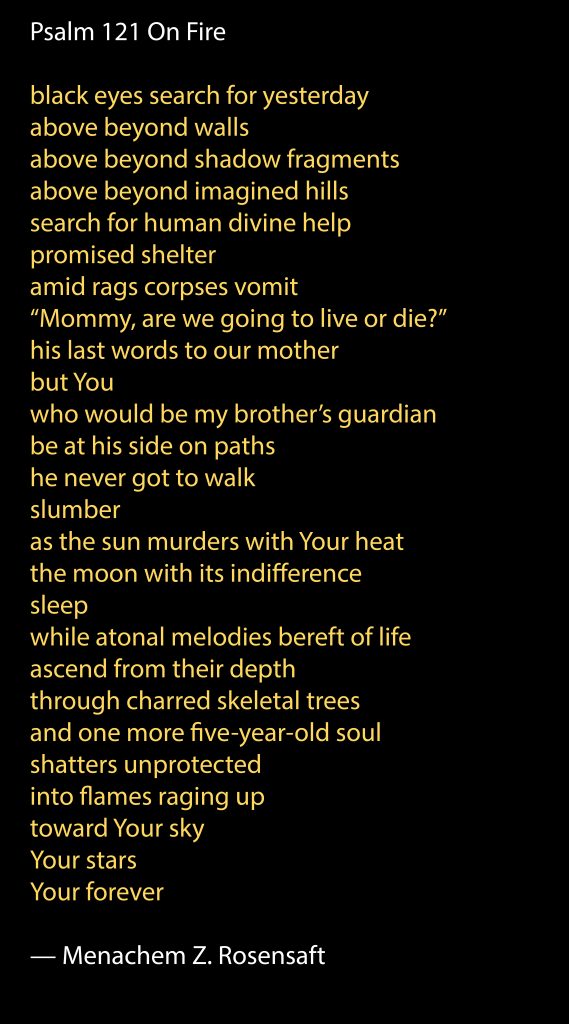
“Psalm 121 on Fire” by Menachem Rosensaft
A sparse inscription on a Birkenau barrack wall forces us to identify with its author without knowing anything else about him: “Andreas Rapaport – lived sixteen years.” Aware that he was about to die, a Jewish teenager tried to leave a sign, a memory of his existence on earth. Without pathos, without self-pity, Andreas Rapaport was the author of his own eulogy, his own Kaddish: Andreas Rapaport – lived sixteen years. Andreas Rapaport – abandoned, alone, afraid. Andreas Rapaport – hungry, in pain. Andreas Rapaport – gas-filled lungs. Andreas Rapaport – incinerated, black smoke, ashes.
In “Under Your White stars,” Avraham Sutzkever, the Yiddish poet of the Vilna Ghetto, wrote, “stretch out to me Your white hand. My words are tears that want to rest in Your hand.” It is the beginning of a monologue addressed to God that never turns into a dialogue because there is no response. Against a “murderous calm” that permeated the precarious existence of the ghetto’s inhabitants, the narrator writes: “I run higher, over rooftops, and I search: Where are You? Where?”
The poems written by Sutzkever and other poets in the ghettos and even in the Nazi death and concentration camps were their way of refusing to become dehumanized, of defying their oppressors and remaining sane in a world gone mad.
Upon arrival at Auschwitz-Birkenau on the night of Aug. 3-4, 1943, a little boy named Benjamin was separated from his mother and sent directly into a gas chamber with his father and grandparents.
Benjamin was my half-brother. Even though my mother rarely spoke about him, I know that she thought of him every day of her life. Since her death in 1997, Benjamin has continued to exist within me. I see his face in my mind, try to imagine his voice, his fear as the gas chamber doors slammed shut, his final tears. If I were to forget him, he would disappear.
And I write about him so that my grandchildren, and their children and grandchildren in turn, will remember Benjamin as well. My poems are my legacy to them.
Menachem Z. Rosensaft is associate executive vice president and general counsel of the World Jewish Congress and teaches about the law of genocide at the law schools of Columbia and Cornell Universities. He is the author of “Poems Born in Bergen-Belsen”.


Writing Poetry Helps Me Process the Unspeakable Evils of the Holocaust
Menachem Z. Rosensaft
(JTA) — Not long after the gruesome reality of the Holocaust had burst onto the world’s consciousness, the philosopher and social theorist Theodor Adorno famously observed in 1949 that writing poetry after Auschwitz was barbaric — “nach Auschwitz ein Gedicht zu schreiben, ist barbarisch.”
Less well known but equally insightful was Adorno’s subsequent conclusion, expressed in a 1966 radio address in Germany, that Auschwitz itself constituted nothing less than a “relapse into barbarism.”
Adorno understood that the Shoah’s calculated, systematic savagery was an absolute deviation from the fundamental norms of civilization and civilized behavior. To be valid, anything written or said about the Holocaust, whether in poetry or prose, must first and foremost encapsulate and reflect its barbaric essence. Aesthetic sensitivities and considerations must yield to the undeniable absolute evil that sparked and perpetrated the genocide of European Jewry, requiring us to absorb and try to come to terms with the unprecedented, the unfathomable and, above all, the inexplicable.
Perhaps the most cogent context for this inexorable immersion into the unknown was given by my late teacher and mentor Elie Wiesel, who explained in his essay “A Plea for the Dead” that “Auschwitz signifies not only the failure of two thousand years of Christian civilization, but also the defeat of the intellect that wants to find a Meaning – with a capital M – in history. What Auschwitz embodied had none.”
And yet, despite all these flashing yellow lights, I, the son of two survivors of Auschwitz and Bergen-Belsen who was born three years after the end of World War II in the displaced persons camp of Bergen-Belsen, long ago turned to expressing myself in poetry. Over the decades I have tried to give voice to the dead in my poems, to comfort ghosts, and to provide a memorial to the millions who have none. A collection of these writings, “Poems Born in Bergen-Belsen,” is being published this month by Kelsay Books to coincide with Yom Hashoah, the Jewish day of remembrance for Holocaust victims on April 8, and the anniversary of the liberation of Bergen-Belsen on April 15, 1945.
For me, conceptualizing my poems is often simultaneously a refuge and an escape. An escape from the realm of conventional human experience into a parallel internal reality. And a refuge where amorphous phantasmagoric thoughts and images emerge sufficiently from their nebulous twilight to allow me to express them, however inadequately, in words.
We need poems, songs and parables. We need a Kafkaesque, morbid language of dreams and nightmares to be able to penetrate the nocturnal universe of Auschwitz and Birkenau, of Treblinka, Majdanek and Bergen-Belsen, of Belzec, Chelmno, Sobibor and Terezin, of the Warsaw Ghetto, Transnistria and Babyn Yar.
“Psalm 121 on Fire” by Menachem Rosensaft
A sparse inscription on a Birkenau barrack wall forces us to identify with its author without knowing anything else about him: “Andreas Rapaport – lived sixteen years.” Aware that he was about to die, a Jewish teenager tried to leave a sign, a memory of his existence on earth. Without pathos, without self-pity, Andreas Rapaport was the author of his own eulogy, his own Kaddish: Andreas Rapaport – lived sixteen years. Andreas Rapaport – abandoned, alone, afraid. Andreas Rapaport – hungry, in pain. Andreas Rapaport – gas-filled lungs. Andreas Rapaport – incinerated, black smoke, ashes.
In “Under Your White stars,” Avraham Sutzkever, the Yiddish poet of the Vilna Ghetto, wrote, “stretch out to me Your white hand. My words are tears that want to rest in Your hand.” It is the beginning of a monologue addressed to God that never turns into a dialogue because there is no response. Against a “murderous calm” that permeated the precarious existence of the ghetto’s inhabitants, the narrator writes: “I run higher, over rooftops, and I search: Where are You? Where?”
The poems written by Sutzkever and other poets in the ghettos and even in the Nazi death and concentration camps were their way of refusing to become dehumanized, of defying their oppressors and remaining sane in a world gone mad.
Upon arrival at Auschwitz-Birkenau on the night of Aug. 3-4, 1943, a little boy named Benjamin was separated from his mother and sent directly into a gas chamber with his father and grandparents.
Benjamin was my half-brother. Even though my mother rarely spoke about him, I know that she thought of him every day of her life. Since her death in 1997, Benjamin has continued to exist within me. I see his face in my mind, try to imagine his voice, his fear as the gas chamber doors slammed shut, his final tears. If I were to forget him, he would disappear.
And I write about him so that my grandchildren, and their children and grandchildren in turn, will remember Benjamin as well. My poems are my legacy to them.
Menachem Z. Rosensaft is associate executive vice president and general counsel of the World Jewish Congress and teaches about the law of genocide at the law schools of Columbia and Cornell Universities. He is the author of “Poems Born in Bergen-Belsen”.
Did you enjoy this article?
You'll love our roundtable.
Editor's Picks
Israel and the Internet Wars – A Professional Social Media Review
The Invisible Student: A Tale of Homelessness at UCLA and USC
What Ever Happened to the LA Times?
Who Are the Jews On Joe Biden’s Cabinet?
You’re Not a Bad Jewish Mom If Your Kid Wants Santa Claus to Come to Your House
No Labels: The Group Fighting for the Political Center
Latest Articles
Why I Came to Vote in Israel
Bibi’s Battle
Bibi and Gadi
Riots in France, Balagan in Israel
California Governor Election Preview: Xavier Becerra vs. Steve Hilton
Up (and Down) In Michigan
Highest Turnout Ever Recorded in Israel as Ballots Are Cast to Decide Netanyahu’s Fate
The first parliamentary election since Oct. 7, 2023, pits Benjamin Netanyahu’s coalition against Gadi Eisenkot’s ideologically diverse opposition, with neither bloc expected to secure a governing majority.
Can a Day of Political War Be a Day of Sacred Prayer?
Sleep-deprived and anxious, I called my friend Yossi Klein Halevi in Jerusalem in the hope that it might bring some relief to my nervous system.
The Jewish Grandparents Network Learning Fest to Take Place in January
The event will cover topics like family relationship challenges, passing down Jewish joy, long-distance grandparenting, and the role of grandfathers, while offering tools for active grandparents.
Democracy Is Built Before Election Day
This is where democracy is truly tested. Not at the ballot box on Election Day, but long before, in classrooms where educators decide whether to avoid controversy or help students learn how to engage disagreement with curiosity, respect, and a recognition of one another’s humanity.
Au Revoir, France
Like in many other Western countries, the center in France has capsized. All that’s left is the death-wish nihilism of the extremes—and an unhealthy dose of Islamist menace.
To Begin Again
No matter how long we have lived, no matter how far we have traveled, the most important part of our becoming may still lie ahead.
Abraham’s God in the Age of Atheism
Faith is disappearing in the western world, but we carry on.
AJU Reopens Ziegler School Admissions, Seeks to Reimagine Rabbinic Education
The Ziegler reopening reflects AJU’s broader goal of helping create a sustainable pipeline of future rabbis.
Show Us How It’s Done – A poem for Parsha Lech Lecha
This is not the party I want to be at.
Weinberg: The Secret German Life of a Jewish Last Name
It’s no coincidence that American Jews generally don’t know that at some point the German language slithered its way into their last names.
The Anti-Zionist Agenda at the Heart of UC Ethnic Studies
The classroom becomes an instrument for advancing political causes rather than a place where those causes are freely examined and debated.
The Beauty of the Slow and Steady
What could our lives look like if we embraced the infinitesimal as infinite?
Ziegler School Welcomes Prominent Rabbi, O.C. Federation Names CEO, Pico-Robertson Cleanup
Notable people and events in the Jewish LA community.
A Moment in Time: Beyond the Chuppah
A Bisl Torah ~ The Company You Keep
Does the company we keep enable our name to be a blessing? Are we doing enough to make our name as great as God intends?
Because We Can
Print Issue: The View From Israel | October 23, 2026
Three years after Oct. 7, a country trying to heal is still waiting for a full accounting of what went wrong.
Rabbis of LA | Rabbi Taff’s Daughter Follows Her Father’s Footsteps
Second of two parts
‘The Nuremberg Women’: The Untold Stories of Eight Women Who Witnessed History
“These women were pivotal to both the process and the outcome of the trial. Yet they were marginalized on many occasions, literally reduced to footnotes.“
A Very Jewish Stew: Toscano Hamin
This Hamin Toscano recipe reminded us of a Tuscan wedding soup.
More news and opinions than at a Shabbat dinner, right in your inbox.