

David Nimmer remembers how the idea began.
During a 2004 Torah class in B’nai David-Judea Congregation’s sukkah, a rabbinic intern explained that when God told the Israelites to “do my work,” it was a commandment to feed the hungry, clothe the naked and visit the sick.
Nimmer took the message to heart. “We should do this,” he recalled saying. “We should invite some poor and hungry people into the sukkah.”
The congregation made an effort, extending lunch invitations to a number of homeless people in its Pico-Robertson neighborhood.
Only one person showed up.
“It was not the most auspicious beginning,” said Nimmer, a former B’nai David-Judea president. “But it was a beginning.”
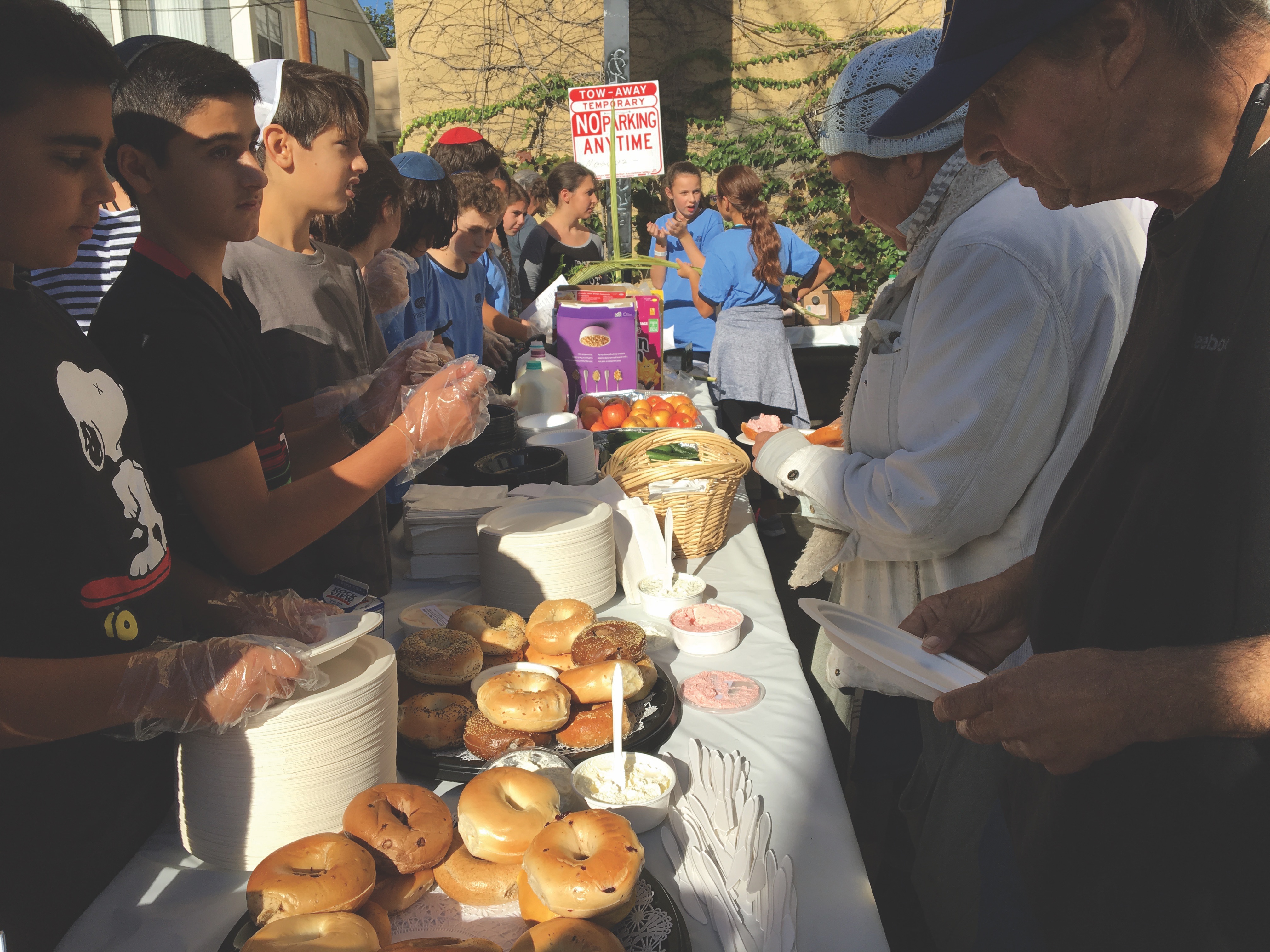
On Oct. 10, some 70 people gathered for what has become an annual sukkah breakfast, part of a B’nai David-Judea program that serves monthly meals to about 60 homeless people. The program is celebrating its bar mitzvah year.
Inside the sukkah, B’nai David-Judea members and students from nearby Pressman Academy sat alongside homeless people, chatting with them and bringing bagels, cereal, coffee and juice to those too frail or too tired to stand in line themselves.
The monthly meals are usually served by students from Yeshivat Yavneh or Yeshiva University of Los Angeles, but Pressman students serve on Sukkot.
As the morning continued, attendees learned about traditional Sukkot customs, heard some Torah from B’nai David-Judea’s Rabbi Yosef Kanefsky, and sang, danced and shook the lulav.
Noah Weissberg, 13, was busy pouring cereal and milk into bowls for people waiting in line. “It’s really nice to see the people and talk with them,” he said. “It’s just a good thing to do. They seem really happy and we make them feel good.”
As the program grew over the years, it began to draw many from the Russian-Jewish immigrant community. To accommodate those Russians who speak no English, the synagogue now serves two monthly meals, including one specifically for the Russian community.
This year’s Sukkot meal, though, was a combined event with plenty of Russian being spoken. One attendee, Eugene, apologized for his broken English but said he loved the monthly meals, “because I did not grow [up] with Judaism in the Soviet Union.”
He waved off a reporter’s attention, saying, “I am nobody.” But on this day, every homeless person was treated as special, and Eugene said he enjoyed all the “Jewish things.”
Those things included Pressman students showing attendees how to shake a lulav if they wanted to try. Three girls assisted an elderly Spanish-speaking woman in saying the blessings over the lulav, explaining everything in Spanish.
Take a look around at everyone here and see how miraculous it is.” – Rabbi Yosef Kanefsky
It was a festive, raucous morning, with people stomping their feet, clapping, singing, and even forming a conga line with Kanefsky at the lead.
Among those enjoying the festivities was Jesse, who said he had worked for 22 years cleaning the stands at Dodger Stadium, “But I’m retired now.” Jesse said he had attended the monthly lunch previously, but not the Sukkot meal. “This is all so new,” he said, “but I love it.”
He made an effort to shake the lulav and recite the blessings. “It’s so wonderful how the kids come and talk to you,” he said. “It’s really a beautiful thing.”
Jesse said that when he has attended the monthly meals he has also picked up one of the Ralphs grocery store gift cards Kanefsky has distributed to homeless people for years.
The number of gift-card recipients has grown so much that the synagogue eventually created a registration system to control costs, Kanefsky said, “but we also have smaller denomination cards for unregistered people who show up so that no one ever walks away empty-handed.”
With the meal program in its 13th year, Kanefsky said the challenge is constantly assessing “How are we meeting the needs of this [homeless] population and how are their needs changing?”
Standing in the sukkah, Kanefsky noted during his drash the impermanent and precious nature of life. “If we can enjoy the things while they are here, then our lives will be rich with fulfillment and joy and memories that will last us a lifetime,” he said. “Take a look around at everyone here and see how miraculous it is.”
B’nai David-Judea will commemorate the program’s anniversary with a Nov. 5 community brunch. Evangelical author and speaker Philip Yancey will discuss how to care for society’s less fortunate. The event will also feature Torah learning on feeding the hungry.

































