






fbpx

LAJFF celebrates 50 years of Kuni Lemel

Not one but two Kuni Lemels are coming to town, hoping that a new generation of filmgoers will welcome the ultimate shtetl shlemiel as warmly as its parents and grandparents did a half-century ago.
[additional-authors]
May 18, 2016

Not one but two Kuni Lemels are coming to town, hoping that a new generation of filmgoers will welcome the ultimate shtetl shlemiel as warmly as its parents and grandparents did a half-century ago.

Also on hand at the Los Angeles Jewish Film Festival for the 50th anniversary revival screenings of “Shnei Kuni Lemel” — “Two Kuni Lemels,” aka “The Flying Matchmaker” — will be actor Mike Burstyn, who made Kuni Lemel a household name in Israel.

The character of Kuni Lemel also launched Burstyn’s career, so the two are linked forever to each other, much as Marlon Brando and “The Godfather” are joined in the public mind.

The plot of the film, directed by Israel Becker, is so convoluted that it’s hard to unravel without giving too much away.

Max (Burstyn) is the handsome French tutor of Caroline (Rina Ganor), daughter of the wealthy Reb Pinchas (Shmuel Rodensky) in the shtetl of Kabtzansk, a name that loosely translates as Pauperville.

Between grammatical conjugations, Max and Caroline embrace passionately, but are interrupted when her father gives Max the boot not only for his amorous advances, but because he is the son of the shtetl atheist.

However, Reb Pinchas still needs to find a bridegroom for Caroline and tasks the resident shadchen, or matchmaker, Reb Kalman (Raphael Klatchkin), to find a suitable candidate.

Max, though, hasn’t given up on marrying Caroline, and with the help of four confederates, cooks up a dastardly scheme.

In another shtetl lives Max’s cousin, Kuni Lemel, a pious young Chasid who, as a key selling point, counts a prominent rabbi among his ancestors. Kuni Lemel is also played by Burstyn, so he looks exactly like Max, with a few minor variations — he stutters, limps and is blind in one eye.

Nowadays, no filmmaker in his right mind would make fun of such a handicapped character, but when “Kuni Lemel” premiered in 1966, such disabilities were often the stuff of comedy.

In any case, after various plots and counter-plots, the pious Kuni Lemel arrives in Kabtzansk after a two day-ride on a horse-drawn cart (with Burstyn’s father, famed Yiddish actor Pesach Burstein, as the driver).

However, to win Caroline’s hand in marriage with her father’s consent, Max now pretends to be Kuni Lemel, after pasting on some convincing sidelocks.

To add to the confusion, the triangle becomes a quartet when the real Kuni Lemel hitches up with Libelah (Germaine Unikovsky), the shadchen’s daughter.

Finally, the two Kuni Lemels/Burstyns confront each other, quite a feat with the split-screen technology then available. Ultimately, the real Kuni Lemel starts to doubt his own existence in the lament “I’m Not Me” in the film’s lilting musical score, which climaxes with a double wedding that has the whole shtetl singing, dancing and leaping.

The film was Israel’s entry for the Academy Awards in 1966 and spawned two sequels, “Kuni Lemel in Tel Aviv” (1976) and “Kuni Lemel in Cairo” (1983).

The character of Kuni Lemel was created in 1880 by Abraham Goldfaden, generally credited as the progenitor of Yiddish theater. Burstyn made the film — and the film made him — when he was 19.

Burstyn was born in New York City, but followed his show biz parents to spend many years in Argentina and Israel respectively. He made his stage debut at age 3, stealing the show, by his own admission, from both his Yiddish-speaking parents. His first Hebrew-speaking role was as Kuni Lemel, and he subsequently dubbed the role in English.

While the name Kuni Lemel has become a synonym for shlemiel, Burstyn said during an interview at his home that he tried to infuse his portrayal with some of the sweet naiveté of Forrest Gump.

The success of the film also marked the revival in Israel of Yiddish as a “respectable” language, after having been cast aside during the “Hebrew-only” campaigns of Israel’s first decade.

“I remember that in the 1950s, the Israeli government expressly forbade performances of Yiddish plays,” Burstyn recalled.

As the present revival of the film shows, Kuni Lemel is alive and dancing at 50 and remains a vivid memory to those who saw it during its original release.

“Whenever I meet an Israeli of a certain age, he’ll greet me like a long-lost brother and tell me, ‘I grew up on you,’ ” Burstyn said.

At 70, the youthful-looking Burstyn can look back on a busy and many-sided career in theater, film and television. In two of his most impressive stage roles, he portrayed Roy Cohn of McCarthy-era notoriety and mob financier Meyer Lansky.

Currently, Burstyn plays an elderly rabbi in an eight-part Israeli TV series about a Jewish vampire.

At 8 p.m. May 21 at Laemmle’s Music Hall in Beverly Hills, Burstyn will be honored with a Lifetime Achievement Award, presented by veteran game show host Monty Hall, following the screening of “Shnei Kuni Lemel.” He will also participate in a Q-and-A session the same evening, as well as after a second showing of the film on at 7:15 p.m. May 22 at the Town Center in Encino.

To find tickets and scheduling information for the L.A. Jewish Film Festival, directed by Hilary Helstein and sponsored by the Journal, visit

Did you enjoy this article?
You'll love our roundtable.

Editor's Picks

Latest Articles

‘NAZA’ Proves Nada

“Naza” is not successful on any level as a documentary, but if judged on awards, and getting people who were already angry angrier, it very well may be.
The Virtues of Fresh Salads

After weeks of holiday feasting and heavy meals, the new Jewish year is a perfect time to reset, to nourish our bodies with food that is wholesome and still tastes delicious.

On Oct. 7, Reflections on Remembrance

Even as we mourn everything we’ve lost, let us also remember the moments of hope and healing — moments that restore our faith in humanity’s promise.

The Other Shoe

I stood there in awe, my eyes blurring with tears, listening to the hush and experiencing the unnamed. I couldn’t tell which was stranger: feeling the rainforest in me, or me in the rainforest. And then my phone rang.
A New Graphic Novel Re-Presents the Bible

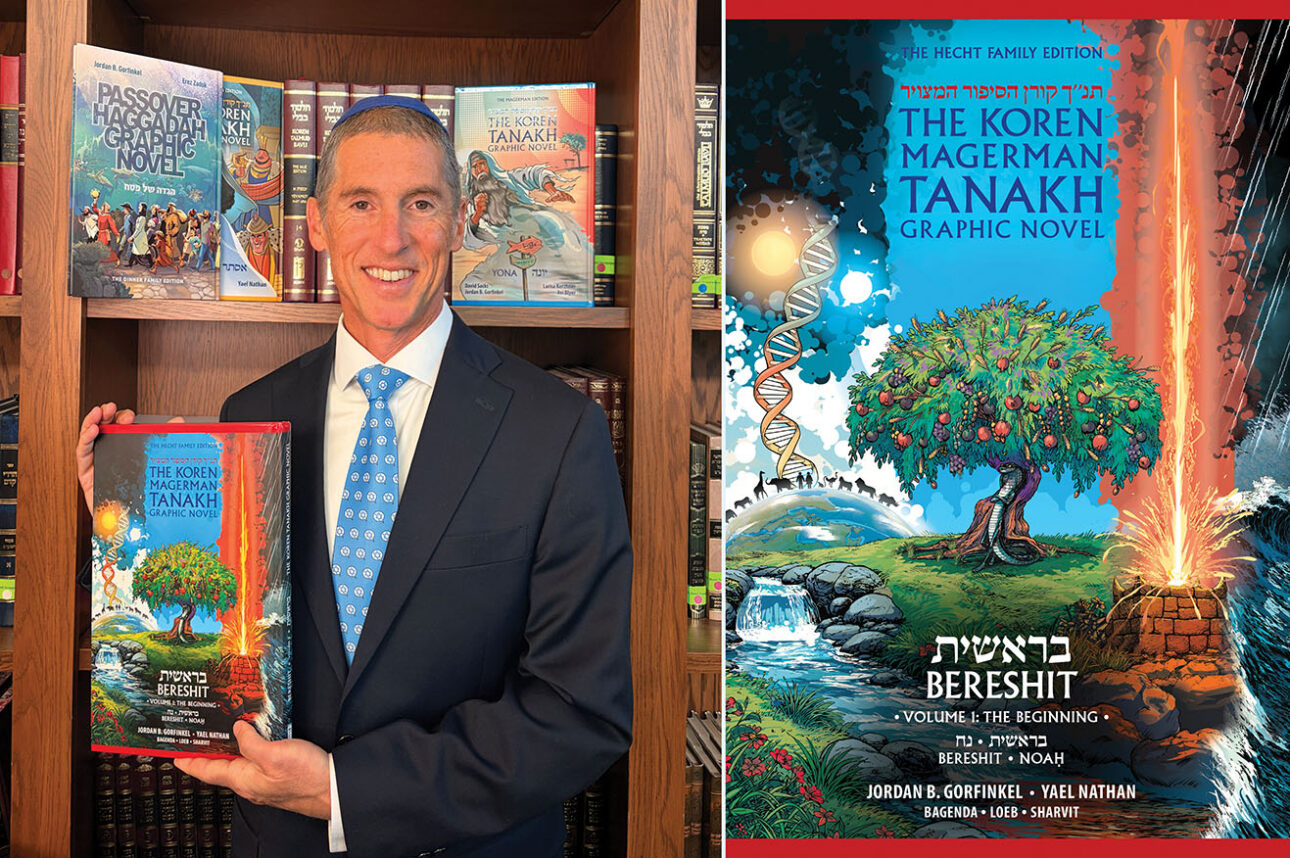
Following on the heels of his earlier presentations of the Passover Haggadah and the books of Esther and Jonah, Gorfinkel, known to his friends as “Gorf,” along with Israeli illustrator Yael Nathan and a team of specialized artists, have produced “The Koren Magerman Tanakh Graphic Novel: Bereshit Vol. 1,” which renders the first two Torah portions in Genesis, Bereshit and Noah, in dynamically engaging visual narrative form.

Flydubai Flight FZ1073 and the Indomitability of the Jews

FZ1073 has a message for the world. For the terrorists striving to take innumerable Israeli lives and make the survivors’ lives unbearable, the message is that your love of death will never diminish our love of life nor make us any less determined to defend it.

Achievement, Relationship, Purpose

A career becomes more rewarding when it supports rather than consumes the rest of life. Wealth becomes more meaningful when it creates security and enables generosity.

More news and opinions than at a Shabbat dinner, right in your inbox.