Anita Diamant laughed as she described how readers often approach her to exclaim, “I love your book!”
“Actually I’ve written 13 books, but I always know which one they’re talking about,” Diamant said during a telephone conversation from her Boston-area home. “It’s my best-seller — my best bestseller — and I’ve gotten used to that.”
Diamant, 63, is referring, of course, to her 1997 novel, “The Red Tent,” a sexy riff on the Genesis story of Dinah, told as a first-person narrative, which was one of the first modern tomes to proffer a feminist spin on biblical events. Through the untraditional route of book groups and word-of-mouth recommendations, her debut novel exploded into an unexpected global phenomenon, translated into 28 languages and selling 3.3 million copies worldwide to date.
On Dec. 7 and 8, Diamant’s fictionalized Dinah will reach an even wider audience with the premiere of a Lifetime miniseries based on the novel, also titled “The Red Tent,” starring Rebecca Ferguson as the daughter of the biblical Jacob; alongside Academy Award nominee Minnie Driver as Leah, Dinah’s mother; Morena Baccarin (“Homeland”) as Rachel, Jacob’s beloved second wife; and Oscar nominee Debra Winger as Jacob’s mother, Rebecca. To coincide with the series, Picador recently released a TV tie-in edition of Diamant’s book.
Like the novel, the miniseries reimagines as a torrid romance the biblical tale in which Dinah is raped by a Canaanite prince. After Dinah’s brothers take revenge for her supposed assault by murdering her lover and all his male tribe, the shattered young woman flees to Egypt, where she eventually becomes an esteemed midwife. Along the way, there are stories of the patriarchs and especially the matriarchs — as well as Jacob’s wives Zilpah and Bilhah — who gather in a red tent during menstruation and childbirth to dance, sing and share secrets.
Diamant, a daughter of Holocaust survivors who began studying Judaism in earnest as her husband-to-be was converting to Judaism in the 1980s, began writing “The Red Tent” during a midlife career change about a decade later. She previously had worked as a journalist and as a pioneering author of Jewish lifecycle books, with how-tos such as “The New Jewish Wedding” and “Living a Jewish Life” under her belt. But by the time she was in her 40s, she wanted to challenge herself by writing a novel, and without an original story in mind she turned to the Torah. “Lots of people have stolen from the Bible; it’s the great treasure trove of stories, the mythic birthright of Western civilization,” she said.
“And, of course, my novel was going to be about women, which is my primary interest as a writer. So, I initially thought I would focus on Rachel and Leah, because I thought their relationship had to be more complicated than just who’s going to sleep with Jacob.”
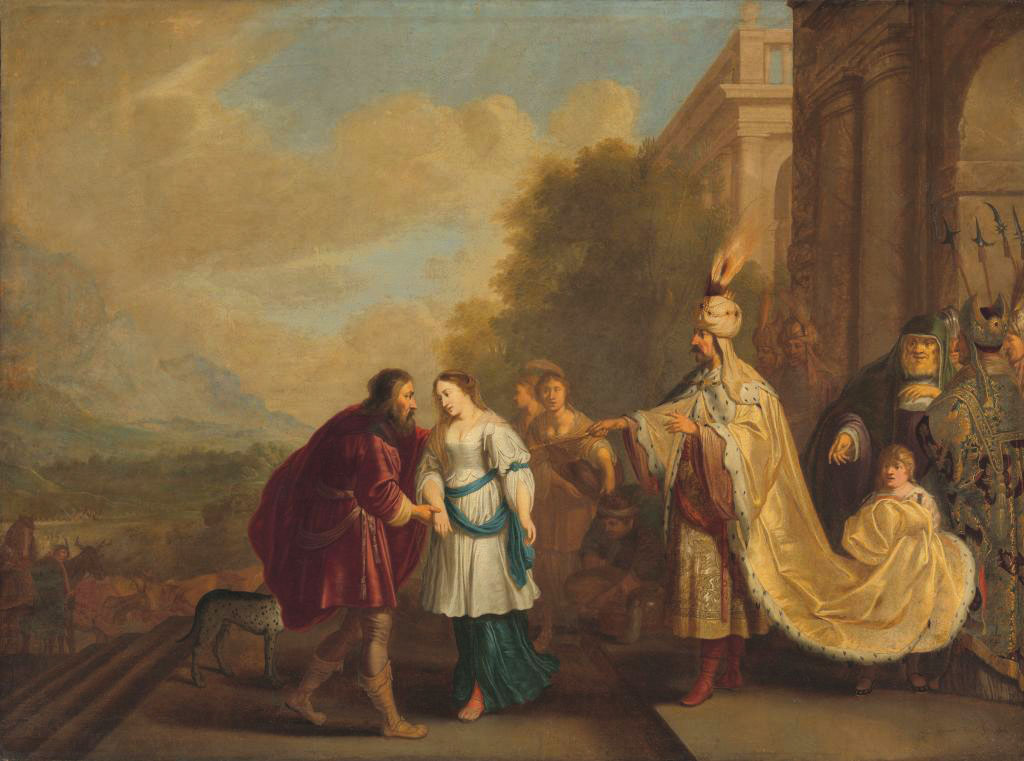
But as Diamant kept reading the biblical text, she came across the short, dramatic account of Dinah, which begins in Genesis 34: “Now Dinah, the daughter whom Leah had borne to Jacob, went out to visit the daughters of the land. Shechem son of Hamor the Hivite, chief of the country, saw her, and took her and lay with her by force. Being strongly drawn to Dinah, daughter of Jacob, and in love with the maiden, he spoke to the maiden tenderly. So Shechem said to his father Hamor, ‘Get me this girl as a wife.’ ”
Diamant was fascinated, she said, because, “It was pretty clear to me that it wasn’t a rape, since the prince doesn’t behave the way a rapist does. He goes to Dinah’s father and is willing to give any bride price, and to have his entire community circumcised, which is remarkable. And, in fact, we don’t know what really happened, because Dinah doesn’t say anything in the entire short passage. It is her brothers who characterize her [relationship] as a violation and set the murders in motion. So Dinah’s silence was a kind of open door for me. That’s where it became the possibility of a love story. We know that something profoundly terrible happened, and I wanted to write about why and how that happened and what the aftermath was.”
Diamant immersed herself in research to flesh out her story, focusing in particular on the daily lives of women in Mesopotamia, the land of Palestine and Egypt circa 2500 B.C.E., including traditions surrounding sex, food, fertility and childbirth. But, she said, “I really turned away from the religious sources early on so I could tell my own story. I was not creating midrash [although feminist scholars have disagreed]. I would never have had the nerve to do biblical commentary, but I did have the nerve to write a novel.”
The red tent of the book is Diamant’s own invention, largely modeled after the menstrual huts and tents that existed throughout the pre-modern world.
The novel matter-of-factly depicts the polygamy of the period: “I tried not to pass modern judgment on the characters,” she said. “This was a world before girls’ empowerment, but it was also a world in which women lived lives of dignity and strength and supported one another.”
It was also a world in which Dinah and the matriarchs worshipped goddesses: “I never considered the characters to be Jewish,” ‘Diamant said. “The book takes place before Moses, and before the law was delivered at Sinai. It’s a book based on the pre-ancestors, not only of the Jewish people but of Christians and, to some extent, Muslims as well.”
Diamant admitted that there “have been people who have objected to all of the liberties I took in telling the story.” Critics have blasted the novel for its depiction of Rebecca as an imperious shrew, for example, and of Dinah’s “rape” as consensual, ecstatic sex.
“But I don’t think the book justifies rape at all, because it doesn’t characterize the events as a rape,” Diamant said. “And I’m not the first person to challenge the notion that it was a violation. There have been other writers and commentators who have questioned that. And look, this is a novel,” she added. “It’s like jazz, an improvisation on the biblical story.”
Once Diamant finished writing “The Red Tent,” however, the word from publishers was that historical fiction was a hard sell. The author struggled to find an agent and finally managed to sell her manuscript to St. Martin’s Press for a modest advance (Picador published the subsequent paperback edition the following year).
Initially only 10,000 copies sold — even Jewish newspapers declined to review the book — after which the publisher announced that it would pulp remaining copies of the tome. “It was painful,” said Diamant, who nevertheless immediately sprang into action.
She urged her publisher to send books destined for the shredder to every female rabbi in the country accompanied by a cover letter praising the novel from the Women’s Rabbinic Network. Additional copies were sent to every Reconstructionist synagogue in the United States, as well as to Christian female clergy and bookstore reading groups, along with a printed reading guide.
Diamant herself pounded the pavement, speaking to every reading group and at every Jewish book fair possible. It was the buzz generated from these mostly female book groups over the next 2 1/2 years that turned the novel into a best-seller. “I felt like Cinderella,” said Diamant, whose new novel, “The Boston Girl,” will hit bookstores in early December.
Thereafter, discussions of possible film or television adaptations of “The Red Tent” came and went, “so I didn’t think it was ever going to happen,” said Diamant, who in 2004 helped found the country’s first independent pluralistic mikveh, Mayyim Hayyim, located in Newton, Mass.
“Then, about two years ago, Lifetime approached me, and they were both enthusiastic about the book and committed to the project — and they followed through.”
“It was a passion of mine to see this book adapted into a miniseries from the moment I read Anita’s beautiful book” in 1997, Nancy Bennett, vice president of original movies at Lifetime, wrote in an email. “It touched and moved me deeply.”
Bennett, who is Jewish, wrote, “I identified with the love and connectivity of the world of women (though in my family our tent took the form of my grandmother’s kitchen more often than not). … We keep people alive by sharing their stories. This is the resounding message of Anita’s book [and] Dinah’s story.”
Diamant was not involved in any way in the adaptation: “I had to learn to let go,” she said. “But Lifetime [ended up] doing a very respectful job of it. The main take-away is one of celebration of women’s power, strength and resilience, which is one of the major themes of the book. So is the importance of women’s relationships, which tend to be trivialized in our society,” she said.
Lifetime’s miniseries “The Red Tent” premieres Dec. 7 and 8 at 9 p.m. on Lifetime.