fbpx

Blinken: Biden Administration Will Consult With Israel on Iran Moves

Antony Blinken said that the United States would seek to return to the Iran nuclear deal but would also consult with Israel on Iran policy.
[additional-authors]
January 20, 2021
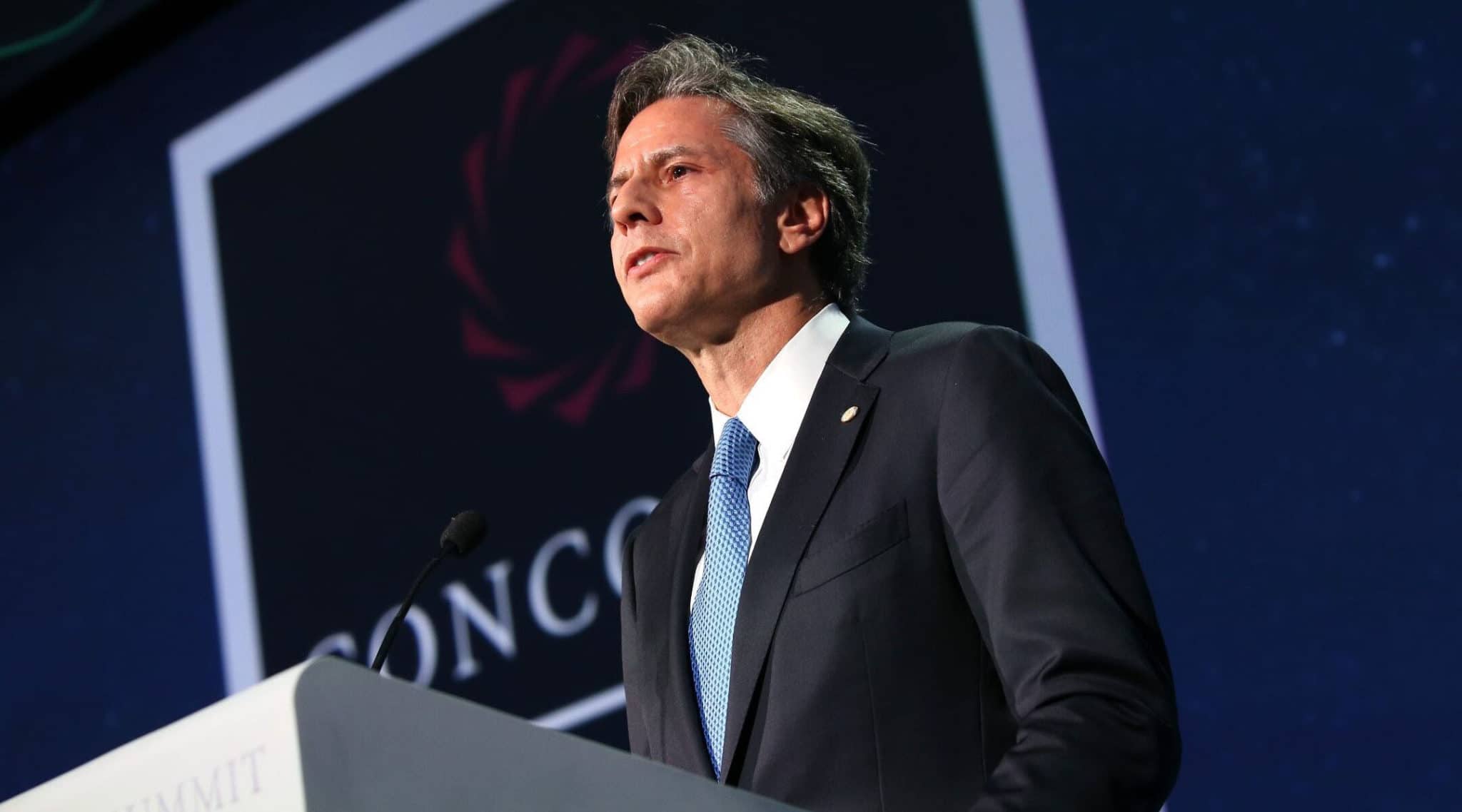
United States Deputy Secretary of State and the former Deputy National Security Advisor for President Barack Obama Anthony Blinken speaks at the 2016 Concordia Summit – Day 1 at Grand Hyatt New York in New York City. on Sept. 19, 2016. (Paul Morigi/Getty Images for Concordia Summit)

(JTA) — Antony Blinken, President-elect Joe Biden’s nominee to be secretary of state, said that the United States would seek to return to the Iran nuclear deal but would also consult with Israel on Iran policy.

“It’s also vitally important that we engage on the takeoff and not the landing with our allies and with our partners in the region to include Israel and to include the Gulf countries,” Blinken said Tuesday at a Senate confirmation hearing.

Blinken’s remarks represented an implicit acknowledgment that Iran policy under President Barack Obama, whom he served as a deputy national security adviser, was flawed in keeping negotiations with Iran that led to the 2015 deal secret from Israel and the Sunni Arab states.

Under sharp questioning from Sen. Robert Menendez, a New Jersey Democrat who is set to become the chairman of the Foreign Relations Committee and who was among a handful of Democrats to oppose the 2015 deal, Blinken said Biden would seek to return to the agreement.

China, Russia and the European Union have remained in the deal since it was formed. But President Donald Trump left the deal in 2018, saying it was too generous in its terms, offering sanctions relief for a partial rollback of Iran’s nuclear capabilities.

Blinken said Biden believed the deal needed amending, and that other concerns about Iran needed to be addressed, including its missile program and its adventurism in the region. But first, he said, it was vital to get back into the deal because Iran had used Trump’s pullout as a pretext to abrogate parts of the deal and now is closer than ever to a nuclear weapon.

The Iran deal, “for whatever its limitations, was succeeding on its own terms in blocking Iran’s pathways to producing fissile material for a nuclear weapon on short order,” he said. “It is now enriching at a higher level, it is deploying centrifuges in ways that were prohibited.”

He said getting back into a deal would be complicated by Iran’s violation of some of its terms. “We’re a long way from there,” he said.

In his introductory remarks, Blinken, who is Jewish, described the gratitude of his step-father, Samuel Pisar, at his rescue from Holocaust Europe.

He also reaffirmed a number of pro-Israel policies that Biden championed during his campaign, including keeping the U.S. embassy in Jerusalem, opposing boycotts of Israel and support for the normalization deals the Trump administration has brokered between Israel and four Arab states.


Did you enjoy this article?
You'll love our roundtable.

Editor's Picks

Latest Articles

The Beat Goes On

While so much of the world seems obsessed with and consumed by its hatred of Israel and Jews, Israelis continue to build, create, work, celebrate, argue, raise families, and plan for the future.

Viral AI Video Targets Jewish Comedian

“The biggest concern is that people now have a pathway to shut down Jewish voices through complete falsities that people will believe. … For the future of Jewish entertainment, it’s very scary.”

Yiddish Historians: Writing in Their Own Language for Their Own People

Mark Smith has compiled an important anthology of Jewish history using 49 works by Yiddish historians to recreate or at least open the door to a world of Jewish thought that was once almost mainstream, but which no longer exists, except in the minds of too few specialists.

The Everlasting Melody

Most Jews who have sung “Eitz Chaim” over the past half-century probably never knew Portnoy. They did not know when he wrote the melody or how young he was when he composed it. They simply knew the song.

Who’s Really the Victim?

Those who would revel in Israel’s demise are claiming victimhood on every front and denying attacks on us in the same breath.

Biblical Deterrence

After Oct. 7, the sentiment in Israel toward the Iranian leadership was unequivocal: You went medieval — so we will go biblical.

How Sukkot Makes Us Whole

This year, I bless us that we open our eyes to truly see the beauty and the holiness of the world, and of the person before us at each and every moment, and to see the godliness of their aspirations and their fears.

The New Ushpizot

Ushpizin invite us to “welcome in our ancestral constellation and dwell amongst them.” This year, it’s Ushpizot, for the women. It’s the year of the Feminist Visitation.

Macklemore, Or Less

In between his songs, he proclaimed, “Free Palestine,” which is fine, asserted that opposing Israeli military actions is not antisemitic, which is accurate, and accused Israel of apartheid and genocide, which is offensive, untrue and hateful.

The Rokeach’s Remarkable Sukkah

To Rabbi Eleazar ben Judah of Worms (1176-1238), the medieval German pietist known as the Rokeach, the sukkah symbolized Jewish military might.

The Sukkah and the Power of Endurance

They can destroy our Temples, demonize us in social media, shower us with hate, but they can’t destroy a spirit that never stops building. That enduring spirit is the power of the sukkah.

NY Mag’s Habibi City

A satirical response to Zaina Arafat’s erasure of Jews in her New York Magazine article “Habibi City,” written as Zaina Arafat.

The ‘Fauda’ Enigma

In many of the nations that believe Israel has no right to exist and routinely root for terrorists to slaughter Jews, a TV show that depicts Israeli covert operatives outsmarting and dispatching Arabs has an inexplicably loyal global audience.

More news and opinions than at a Shabbat dinner, right in your inbox.