fbpx

September 15, 2026

Pink Found Her Courage When the Music Industry Lost Its Spine

There are moments when celebrity is merely celebrity – fame, glamour, applause, record sales. And then there are moments when celebrity becomes a test of character.

This week, Pink passed that test magnificently.

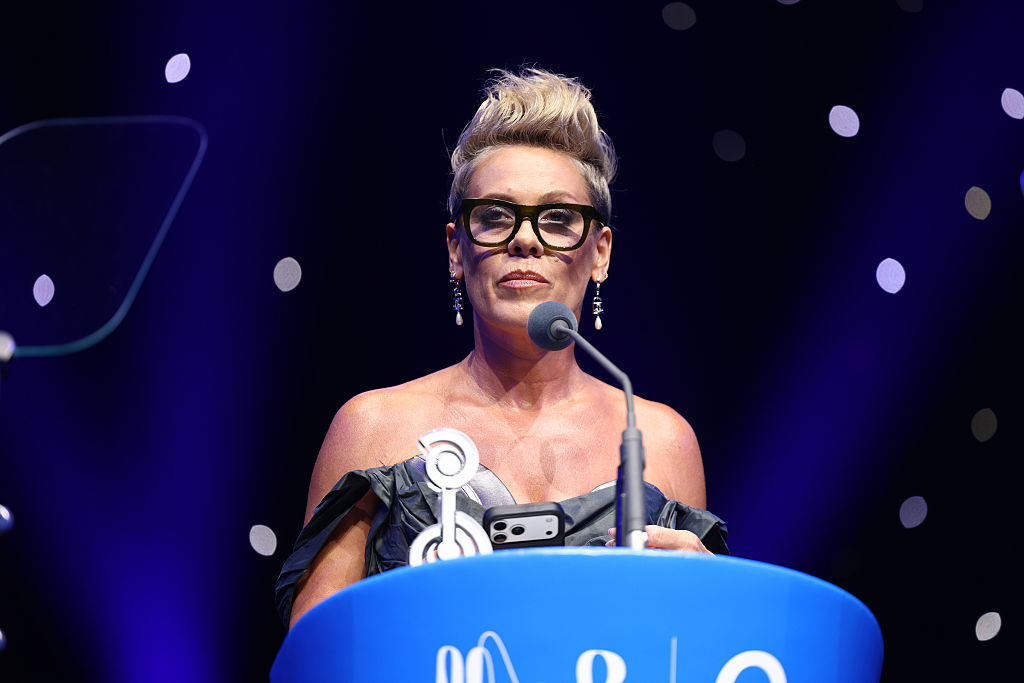
After rapper Macklemore turned an Ed Sheeran concert at New Jersey’s MetLife Stadium into a platform for his anti-Israel activism – performing Hind’s Hall, displaying wrenching images from Gaza, accusing Israel of genocide, and repeatedly proclaiming “Free Palestine” – Pink did something that has become astonishingly uncommon among the superstars of Western music.

She stood up.

More importantly, she stood up as a Jew.

Pink – born Alecia Beth Moore – had initially reposted criticism of Macklemore’s performance and was immediately engulfed by the predictable social-media fury. Her response was not to crawl away, hire a crisis consultant, or issue one of those pathetic celebrity apologies crafted to offend absolutely no one.

Instead, she wrote words that should reverberate throughout the Jewish world:

“I was born a Jew. I didn’t pick it, and I’ve never hidden it.”

And then came the sentence that moved me most:

“I’m standing up for my own people.”

She acknowledged that she expected doing so to be lonely – and discovered it was even lonelier than she imagined.

Pink did not discover her Jewishness when it became fashionable. She proclaimed it precisely when Jewish solidarity came with a price.

God bless her.

Pink was careful. She did not endorse every action of the Israeli government. She explicitly affirmed Palestinian humanity and aspirations, grieved for innocent children, and said she speaks for neither Israel nor any government. But she also stated an elementary truth that much of the entertainment establishment seems incapable of uttering without trembling: Hamas is a terrorist organization.

That balance makes her stand more compelling, not less.

You can care about Palestinian civilians and still recognize Jewish fear.

You can criticize an Israeli government and still refuse to demonize Israel.

You can mourn children in Gaza without pretending October 7 never happened.

And you can support Palestinian dignity without turning a stadium filled with families who came to hear Ed Sheeran into a one-sided political rally in which Jewish concertgoers suddenly find themselves effectively put on trial.

That is what Pink understood.

Macklemore insisted that his criticism of Israel was not criticism of Jews, telling his “Jewish brothers and sisters” that opposition to what he calls apartheid and genocide was not directed at them.

Pink’s answer was devastating in its simplicity: “You don’t get to decide that for us.”

Precisely.

For years, Jews have been lectured about what does and does not constitute antisemitism by people who would recoil in horror if any other minority were treated similarly. Jews are told that slogans calling for the disappearance of the world’s only Jewish state are harmless. We are told not to feel threatened. We are told that the obsessive singling out of Israel has nothing whatever to do with Jews.

And when Jews say, “Actually, this frightens us,” the response is often: Your fear is propaganda.

Pink rejected that arrogance.

Nor was Macklemore’s history irrelevant. Pink reminded her audience that in 2014 he appeared onstage disguised with a large prosthetic hooked nose, black beard and wig – imagery widely criticized as evoking an antisemitic caricature. Macklemore denied antisemitic intent and apologized at the time. Pink said she accepted that apology. But the memory understandably colors how Jewish audiences experience his current activism.

Jews do not need Macklemore’s permission to decide when rhetoric, imagery and obsessive anti-Israel agitation make them feel targeted.

And here is the scandal within the scandal: Why did Pink’s intervention feel so extraordinary?

Because the music industry has displayed a breathtaking lack of backbone.

There have certainly been actors, comedians and public figures who have defended Israel or Jewish communities since October 7. But among the highest-profile international recording stars, the ranks of those willing to withstand the mob have been depressingly thin.

One glorious exception has been my friend of nearly 30 years, the great Boy George.

This summer, the Culture Club legend released We Will Dance Again, a song explicitly honoring the victims of the Nova festival massacre and declaring solidarity with the Jewish people. He even incorporated Hebrew and confronted those who speak endlessly about Gaza while erasing October 7. The Jerusalem Post described it as an extraordinarily direct pro-Israel and pro-Jewish statement from a mainstream recording artist.

Boy George showed courage.

Now Pink has shown courage.

Where is everybody else?

Where are the stadium-filling singers who fill award ceremonies with speeches about justice, oppression and speaking truth to power?

Where are the performers who spent years telling us that “silence is violence”?

Apparently, for too many of them, silence becomes perfectly acceptable when Jews are the victims.

That hypocrisy is revolting.

It does not require supporting every Israeli policy to say that Israelis had a right to defend themselves after the mass murder, kidnapping and atrocities of October 7. It should not be professionally dangerous to demand the defeat of Hamas. It should not require bravery to say Jewish fans deserve to attend a concert without being made collectively responsible for a Middle Eastern war.

But in today’s cultural climate, apparently it does.

Which is why Pink deserves our gratitude.

She knew what would happen. She knew followers would attack her. She knew there would be boycott threats and accusations. She knew that acknowledging her Jewish identity would cause strangers to project every imaginable political belief onto her.

And she did it anyway.

That is courage.

Not the performative courage of celebrities applauded by every person in the room. Not the safe activism of repeating whatever slogan is already trending.

Courage is speaking when applause is uncertain.

Pink reminded the world that Jewish identity is not something to whisper about until the cultural weather improves.

Pink once introduced herself onstage during a Hanukkah performance with the beautifully uncomplicated declaration, “My name’s Alecia. I’m a Jew.”

This week she gave those words far greater meaning.

She effectively said: I am still a Jew when it costs me something. I am still a Jew when the comments become vicious. I am still a Jew when standing beside my people is lonely.

For that, Pink deserves more than applause.

She deserves the thanks of the Jewish people.

And the entertainment industry should look at her example – and be ashamed of its cowardice.


Rabbi Shmuley Boteach is the international bestselling author of thirty-eight books, translated into more than twenty languages. He has been hailed as “the most famous rabbi in America” (The Washington Post, Newsweek), “arguably the most famous Orthodox Jew on earth” (The New York Observer), and named one of the fifty most influential Jews in the world (The Jerusalem Post). Follow him on Instagram and X @RabbiShmuley.

Pink Found Her Courage When the Music Industry Lost Its Spine Read More »
The 9/11 Families’ Case Against Mamdani Never Needed His Faith

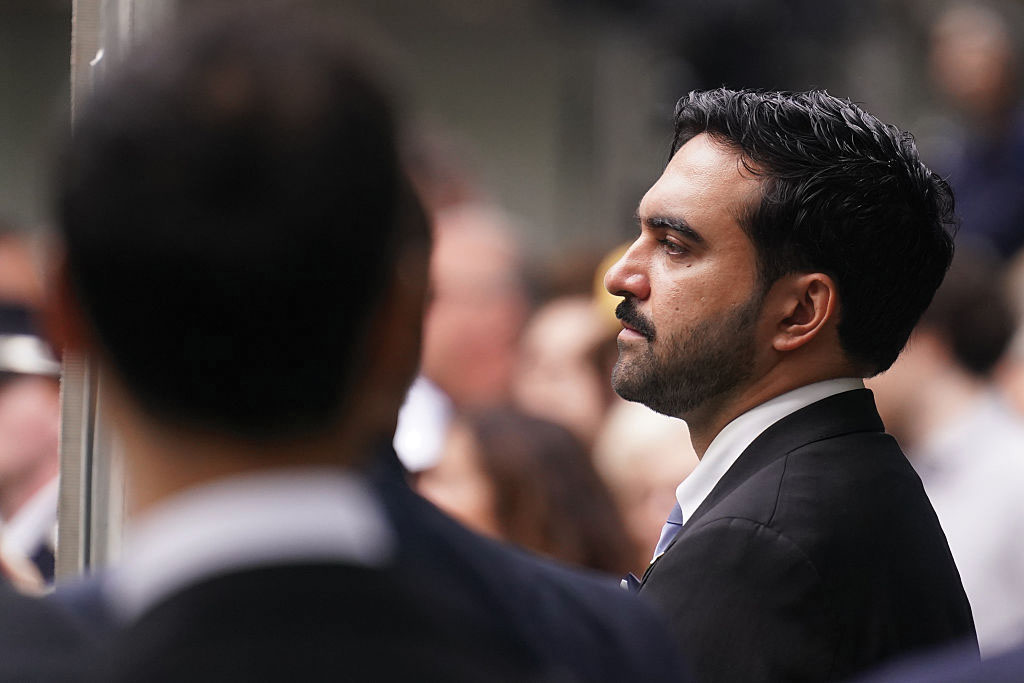
New York’s Mayor Zohran Mamdani stood at Ground Zero last Friday for the 25th anniversary of Sept. 11, over the objections of more than 100,000 people who had signed a petition asking him not to come. He did not merely attend over those objections. As the names of the dead were read aloud, video showed him visibly laughing and chatting with Rep. Alexandria Ocasio-Cortez, drawing a fresh wave of criticism layered on top of the original one. 

Predictably, CNN and others rushed to frame the backlash, both the petition and the reaction to his conduct at the ceremony, as an echo of “post-9/11 Islamophobia.” That broadbrush framing was never accurate. Because the objections to Mamdani’s presence, and now to his conduct once there, stood on their own, built entirely from his own record, and required no reference to his religion at all.

Start with the man he appointed as his chief legal counsel. Ramzi Kassem’s résumé includes representing a convicted al-Qaeda operative whose brother-in-law was among the hijackers who struck the Pentagon. Mamdani made this man his chief lawyer. Contrast that with how Mamdani treated John Leventhal, a retired Jewish appellate judge recommended for his judicial advisory committee, whom Mamdani rejected specifically because Leventhal had once represented Ghislaine Maxwell on appeal.

By Mamdani’s own stated logic, representing a notorious client disqualifies a lawyer from public trust. He applied that standard to a Jewish judge over Maxwell. He never applied it to Kassem over al-Qaeda. Then there is “Globalize the intifada,” which Mamdani has had a year of opportunities to disavow outright and has instead treated as a debate to be managed. It is not an abstraction. Australian officials linked the slogan’s normalization to the massacre of Jewish worshippers at a Bondi Beach Hanukkah celebration last December. Congress cited it in a resolution referencing the Boulder, Colorado firebombing that murdered 82-year-old Karen Diamond in June of 2025.

Then there is Hasan Piker, who in 2019 asserted that America deserved 9/11. To his credit, Mamdani called the remark “reprehensible” in a campaign debate. To his discredit, that is where the accountability stopped. Mamdani appeared on Piker’s show. His campaign touted Piker’s support. A one-line condemnation, offered once, under pressure, is not distance. It’s damage control.

Piker isn’t a one-off, either. Aber Kawas, a state senate candidate Mamdani endorsed and campaigned for, won her primary this year while sitting on a resurfaced clip in which she plainly suggests America deserved the attacks, framed as insufficient atonement next to the scale of “genocide and slavery.” Mamdani’s answer to Piker was that his comment was reprehensible. His answer to Kawas was silence and an endorsement for public office.

Then there’s his own household. In 2017, Mamdani, rapping as Young Cardamom, released “Salaam,” in which he lauded the Holy Land 5, five men convicted of funneling $12 million to Hamas through a sham charity: “My love to the Holy Land Five, you better look ’em up.” Hamas’ own leadership did not condemn the Sept. 11 attacks. Hamas called them a consequence of American “injustice,” a line Aber Kawas would echo decades later almost word for word. Hamas and al-Qaeda share the same current of Islamist supremacism that treats the mass murder of civilians as legitimate “resistance.” That’s not ancient history Mamdani can wave off as a youthful mistake. He was 25 when he lauded men who funneled money to Hamas.

Mamdani’s wife, Rama Duwaji, posted a tribute to Leila Khaled in 2017, captioned with Khaled’s own line that she’d be “happy to accept death” for the cause. Khaled was the first woman to hijack an airplane, in 1969, pioneering a tactic terrorists refined 32 years later into the deadliest attack ever carried out on American soil. In the immediate aftermath of Oct. 7, 2023, Duwaji liked a wave of Instagram posts celebrating the massacre, including one dismissing the rape of Israeli women as a hoax. She has since partially apologized, crediting her age at the time. She was 20 in 2017, not 15, and the explanation for a grown woman liking posts cheering a massacre in 2023 isn’t hard to find: sympathy for Islamist supremacist violence explains it.

Not one item on that list, and nothing about laughing with a colleague while the names of the dead were being read, requires Mamdani’s religion to make its case. A Muslim mayor who had spent the last decade unambiguously rejecting Islamist supremacist terrorism, its apologists and its propagandists, and who then showed the ceremony itself basic solemnity, would not have faced this petition or this backlash, whatever his faith. All it took to prompt the 9/11 families who objected to Mamdani’s presence, and to draw the second round of criticism once he arrived, was his own pattern, documented in his own lyrics, his own wife’s posts, his own appointments, his own campaign endorsements and now his own visible conduct at the memorial itself, of proximity to and indifference toward people, causes, and moments connected to the murder of Americans and Israelis by terrorists animated by that same ideology. Calling that pattern Islamophobia doesn’t just misdescribe it. It tries to insulate it from the scrutiny it has earned on the facts alone.

That pattern hasn’t stayed confined to old social media posts. Mamdani’s first month in office, January 2026, saw antisemitic hate crimes in the city jump 182% year over year, days after he used his first day as mayor to revoke New York’s adoption of the IHRA definition of antisemitism. By August, the cumulative year-to-date rise stood at 8%, enough to make Jews, roughly 10% of the city’s population, the target of well over half of all confirmed hate crimes in New York. Crime has dropped almost everywhere else in the city this past year. It did not for Jews.

And then there was the move the Islamophobia framing was built to protect: Mamdani’s own habit of centering himself and his family as 9/11’s victim. In a 2020 campaign video, he described being pulled out of class as a nine-year-old on the day of the attacks, saying his teacher warned him and another Muslim student that they might face bullying because of what had just happened. He has also invoked an aunt who, he says, stopped riding the subway after 9/11 out of fear for wearing her hijab. Nearly 3,000 people died that day. Mamdani was nine years old, safe in a classroom, and his own accounts of the day center on a warning he received and a relative’s purported discomfort, not a grave anyone in his family had to visit. This year, at the actual ceremony for those nearly 3,000 dead, he could not manage the solemnity his own retold childhood story asks the rest of us to extend to him.

None of this requires invoking Mamdani’s faith, and that is precisely the point. The 9/11 families who asked him to stay away were not judging his beliefs about G-d. They were responding to what he has said, whom he has hired and endorsed and whom he chooses to associate with. Their concerns were realized in how he conducted himself as their relatives’ names were read into the public record. The evidence is there in his own words, and on video. They were paying attention. Everyone else should be, too. 


Micha Danzig is an attorney, former IDF soldier, and former NYPD officer. He writes widely on Israel, Zionism, antisemitism, and Jewish history. He serves on the board of Herut North America.

The 9/11 Families’ Case Against Mamdani Never Needed His Faith Read More »

Tennis, Neilah at 3 a.m.

In the final week of the U.S. Open, the fifth set became the story. Carlos Alcaraz, the biggest star in the sport, and Ben Shelton, the up-and-coming American pushing him, took the court after 11p.m. on Tuesday night and didn’t finish until past 3 a.m. Wednesday morning: five sets, tiebreakers, both men still standing in front of the hard-core tennis congregants who’d made their pilgrimage to Flushing and weren’t going anywhere.

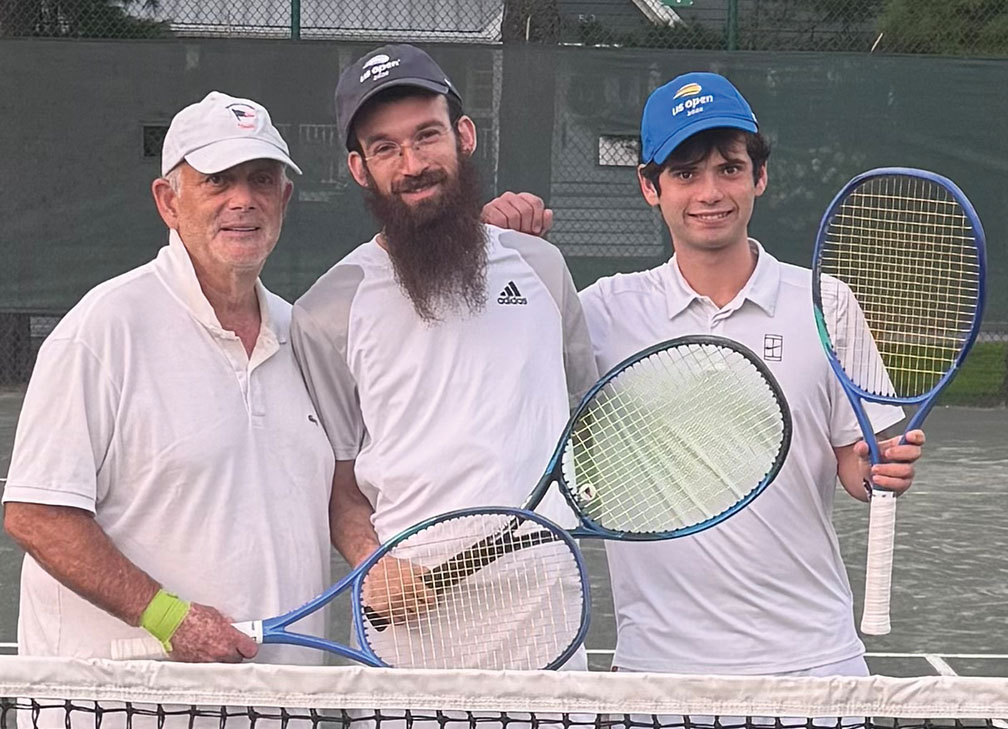
This past week, at our regular Torah and tennis session with Rabbi Chaim Pinczower, a bright and insightful Chabad rabbi, at Beach Point in Westchester, where we play in the same whites we’ll wear to shul before the month is out, our talk of the week’s parsha elevated into tennis, and we asked him if there was a connection to what had just happened at the Open. Here’s what he shared.

I’ve spent years describing that moment as the ninth inning of a World Series game. After watching this one stretch into the early hours of Wednesday morning, I’m revising the metaphor. It’s a fifth set that runs past three in the morning. No fresh legs, no plan B, just whatever is true about a person after four hours on court with nothing left to hide behind. Anyone who stayed to watch Alcaraz and Shelton that late wasn’t just watching strategy. They were watching two men down to their last, truest layer, which is exactly what Neilah is built to reveal in us.

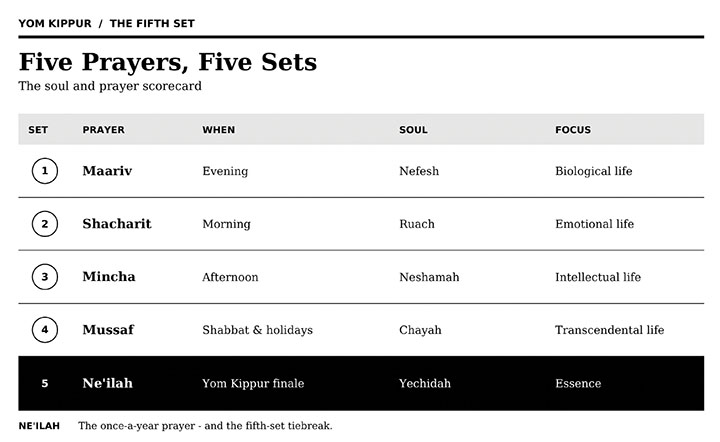
Neilah means “closing.” It’s the fifth and final prayer of Yom Kippur, the one no other day of the year has. Every day we say three prayers: Maariv at night, Shacharit in the morning, Mincha in the afternoon. On Shabbat and every holiday, we add a fourth, Mussaf. Only on Yom Kippur do we get a fifth, and it corresponds to the fifth and highest level of the soul, the one we can only touch this one day, at this one hour.

Every other day, we live in the first three levels. On Shabbat we reach the fourth. Only in that last hour before the gates shut do we touch the fifth, yechidah, oneness itself. By Neilah every defense is down. We’ve fasted all day and prayed all day, and there’s nothing left standing between us and the most exposed, most honest part of who we are.

That’s the hour Alcaraz and Shelton were still on court, deep into the early hours of Wednesday morning, when the match was finally decided.

Kabbalistic teachings say there’s no higher moment for a Jew than the instant he’s ready to give his whole life over. That’s the spark and the flame at their closest all year, and it’s also what I watched at three in the morning. Nobody wins a match like that on technique. It comes down to what’s left when everything else runs out.

Both players that night went beyond their best, each one reaching for more than he thought he had left. That’s the mentality worth carrying out of Neilah: not just getting through Yom Kippur but applying that same effort to the whole year ahead, reaching for our potential instead of settling for what’s comfortable, and using it to actually make a difference in 5787.


Conrad Pearlman is a Columbia University Class of 2030 student and tournament tennis player. Mark Pearlman, a business strategist and investor, created JInsider.com, Sinai Live Books and is a tennis aficionado.

Rabbi Chaim Pinczower grew up in Melbourne, Australia, gained early tennis exposure at the Australian Open, received his smicha in Israel and now serves as a Chabad rabbi in Larchmont and Mamaroneck, NY.

Tennis, Neilah at 3 a.m. Read More »