
fbpx

July 5, 2026

No Wars for Jews

A year ago, B-2 stealth bombers and “bunker busting” bombs attacked three nuclear sites in Iran. Whether the primary aim of the U.S. action was to help Israel, or to eliminate the potential threat posed by a nuclear-armed Iran to world order, is a moot point. However, there is no doubt about the meaning of a recent story about a Young Republicans chapter in Tennessee that was in turmoil because of a mail campaign promoting a platform that included “No wars for Jews.” In fact, a little over 80 years ago the U.S. refused to bomb a target on behalf of the Jews.

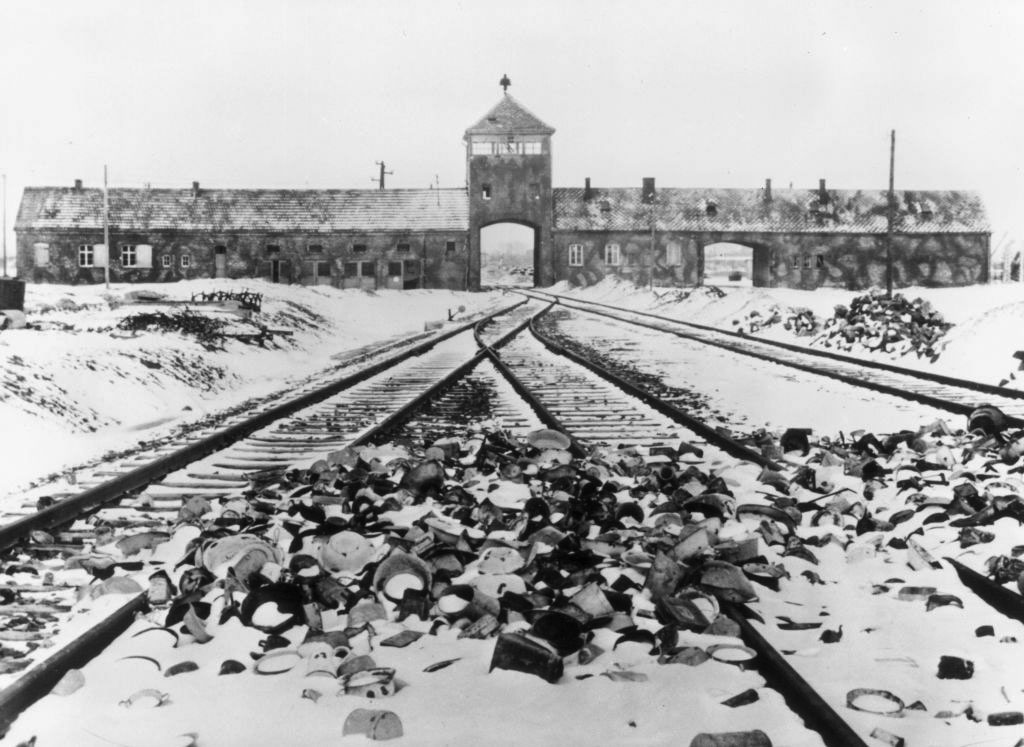
I am referring of course to whether the railway lines to Auschwitz should have been bombed during World War II, a controversial Holocaust topic. The year was 1944. It was already too late for a majority of those murdered during the Holocaust. Yet it was abundantly clear that the extermination machine at Auschwitz was still operating at full capacity, in spite of the fact that the tide of war had turned against the Nazis and their allies. From April to November, the gas chambers and crematoria were consuming as many as 12,000 human beings a day, most of them Hungarian Jews.

Realizing that a significant number of Jews still in Nazi hands could be saved if the murder machine could be interrupted, Jewish leaders appealed to the Americans (and the British) to bomb the railway lines into Auschwitz. The appeals led nowhere. Why?

Was it because details about Auschwitz and the extermination of the Jews were uncertain? Hardly.

As early as 1941, Winston Churchill referred to the killing of Jews in Eastern Europe as a crime for which there is no name. Varian-Fry wrote about it in 1942, as did the British newspaper the Daily Telegraph. The Pope knew details about what was later called the Holocaust as early as 1942. Eyewitness accounts by Jan Karski about the liquidation of the Warsaw Ghetto and about the Belzec extermination camp, and the Vrba-Wetzler Report about Auschwitz, indicate the facts were known.

Was it because the bombers available did not have the flying range? Not at all. In 1944 an industrial slave labor camp near Auschwitz, Buna (also known as Monowitz), that produced aviation fuel and synthetic rubber, was bombed more than once by the Americans.

The claim that bombing the rail lines to Auschwitz would be ineffective because the lines were easily repaired is simply another excuse, as Rafael Medoff points out. In fact, the Allies found that bombing the German rail lines was very helpful to the war effort.

Perhaps the most compelling reason for not bombing was that Auschwitz was not a military target and the primary focus of the Allies was to end the war as quickly as possible. Here again the excuse is not convincing, for Auschwitz contained a large ammunition factory that was producing the fuses (detonators) for one-half million artillery shells per month. The factory, Weischel Union Metallwerke, included 2000 to 2500 workers, mostly young Jewish women, and was located in Auschwitz II (Birkenau). Originally, it was a Krupp enterprise located in Essen. It moved to Auschwitz after it had been bombed in 1943. It was a valid bombing target in the past, so why not now?

As it turns out, the primary reason for not bombing Auschwitz lies in another direction. Thomas J. Dodd, U.S. counsel at the 1945-46 Nuremberg Trials, later a U.S. Senator, was concerned there were too many Jews in the prosecution. He wrote, “Jews should stay away from this trial—for their own sake. For—mark this well—the charge ‘a war for the Jews’ is still being made.” In Eight Days at Yalta, Diana Preston says the same, citing President Roosevelt’s advisors in noting that the rail lines at Auschwitz were not bombed because doing so would have confirmed the charge that the war was a war for the Jews.

Not only Jews asked the Allies to bomb Auschwitz. The Volunteer by Jack Fairweather is about Witold Pilecki, a Polish man who was a member of the Polish underground during World War II. Pilecki volunteered to have himself arrested and sent to Auschwitz. Pilecki’s reports, smuggled out to the underground for over two years, describe how Auschwitz transitioned from being a concentration camp to an extermination center, mainly for Jews. The information he provided was sent to the Polish Government in Exile in London, then on to the Americans and the British. The Allies rejected requests by the Poles to bomb Auschwitz for “fear of stirring up antisemitism at home.” (After the war Pilecki was accused of being a spy for the west by the Communist government of Poland. He was executed, but his notes survived.)

The decision not to bomb the rail lines to Auschwitz was due to a toxic combination of antisemitism and isolationism, both of which were pervasive in the U.S. in the 1940s. (Perhaps, to some extent today too, as the news from Tennessee suggests.) It was of paramount importance, particularly to the Americans, that their fight in World War II not be seen as a war on behalf of the Jews.


Jacob Sivak, a Fellow of the Royal Society of Canada, is a retired professor, University of Waterloo.
No Wars for Jews Read More »

One Wedding, a Heatwave, Fireworks and a Eulogy

What a July 4th weekend in NYC!

New York doesn’t readily come to mind as one of the British colonies that revolted against the Crown. With the Battle of Brooklyn, New York City fell to the British early in the campaign. For the duration of the Revolutionary War, New York City was British-occupied.

New York was a bit ambivalent about independence from the outset. In fact, it initially abstained from adopting the Declaration of Independence.

It was an indifference very much unlike intrepid and rowdy New Englanders, who, over time, evolved into crazy Boston Red Sox fans. Virginia also demonstrated a higher level of commitment in fighting for American freedom. Virginians supplied the Commander-in-Chief of the Continental Army, George Washington. The drafters of both the Declaration of Independence (Thomas Jefferson) and the Constitution (James Madison) were favorite sons of Virginia.

Despite its wishy-washy, half-baked beginnings—and the beating it took from Hessian mercenaries—New York improbably ended up as America’s first marquee state. It always had that flair for flashy premiers and parades. Broadway would become known as the Great White Way of illumination; Madison Avenue was where all those taste-making slogans got concocted.

New York always attracted stars and grabbed the headlines. George Washington was sworn into office as America’s first president at Federal Hall on Wall Street. New York City was, for a short time, the capital of the United States!

The new progressive, Islamist Mayor of New York City, Zohran Mamdani, is seen as a political aberration. But maybe he fits in perfectly, given his city’s history of cynical patriotism and shameless showboating. What better pulpit from which to govern as America’s leading anti-American mayor?

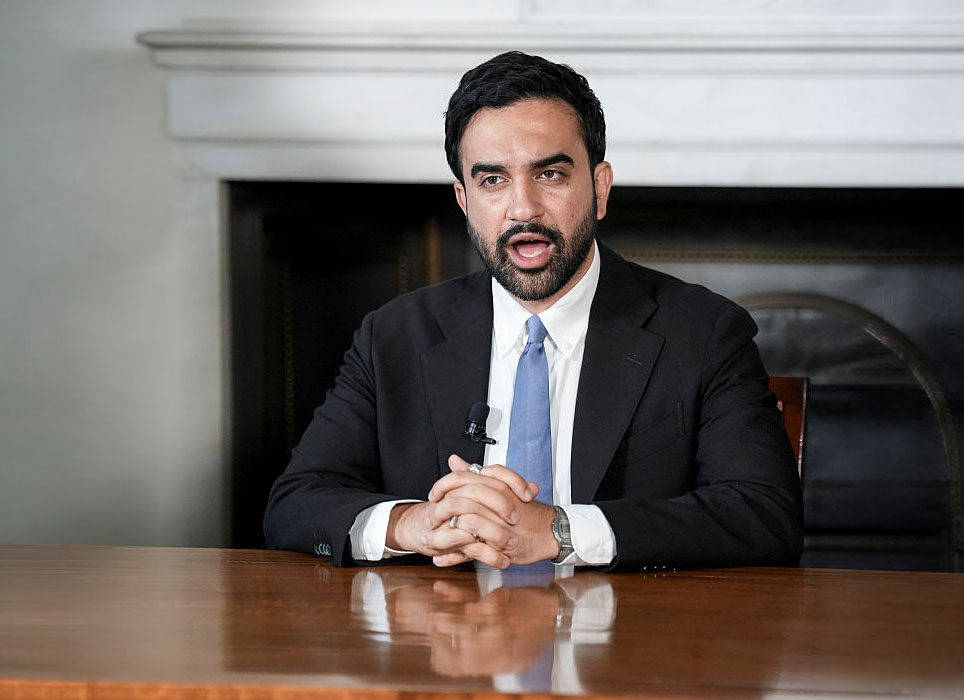
He certainly was a sight to see when he hauled out Washington’s desk as a prop to deliver a July 4th address to the entire nation. (Why waste words on a New York City constituency when he has the hot political hand and aspirations beyond City Hall?)

More about that, later.

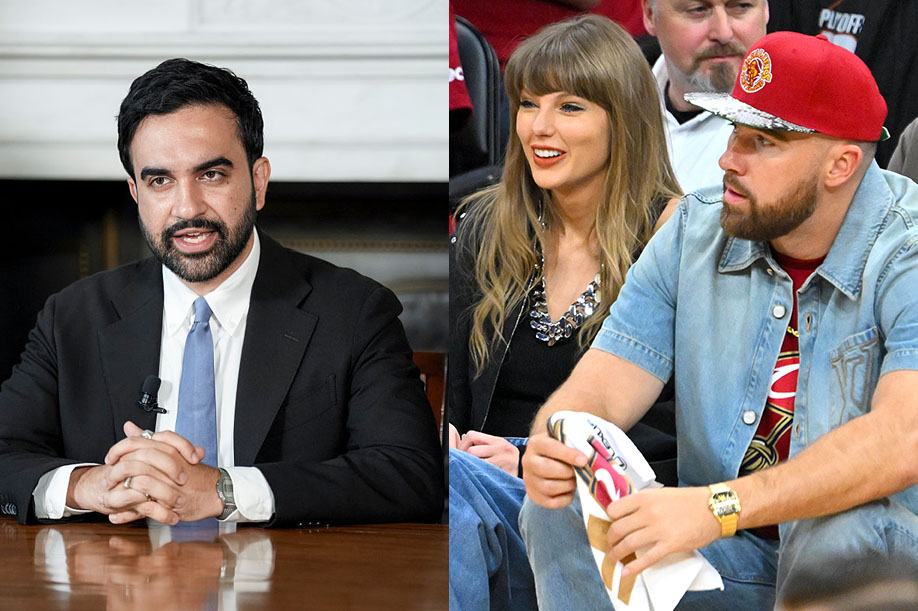
The bigger local draw, however, was the wedding nuptials of musical superstar Taylor Swift and Super Bowl winning tight end, Travis Kelce. Hosted at Madison Square Garden before 1,000 A-list onlookers—at a price tag estimated to run as much as $25 million—it overshadowed the Big Apple’s July 4th celebration, which featured fireworks off the East River and flyovers along the Hudson River of America’s military might.

In terms of spectacle, the exclusive indoor wedding trounced the outdoor aerial show.

Swift and Kelce are not native New Yorkers. Madison Square Garden is a decidedly atypical matrimonial venue. Swift was seen courtside screaming her vocalist’s lungs out when the New York Knicks recently won the NBA Championship. Maybe it made sense that she would tie the knot where Knicks players recently cut down the nets. She apparently invited the starting five as wedding guests.

The wedding, and “The Life of a Showgirl,” probably should be showcased in New York. Unfortunately, Swift was unable to “shake off” a national heatwave.

All throughout the July 4th weekend, the heat-index in New York City reached as high as 110 degrees. Mayor Mamdani advised New Yorkers to set their air-conditioning thermostats to 78 degrees to avert blackouts. (Do his supporters realize this was their first glance at socialist rationing?) ConEd reduced citywide voltage everywhere except at Madison Square Garden. In fact, massive, industrial-strength AC units were brought in to treat wedding guests to Arctic climates.

Surrounding streets were closed off. Traffic snarled and the concrete jungle heaved with heat. Commuters were forced underground into sweltering subways. Meanwhile, a gateway carved from public streets and barricaded from the great unwashed made it possible for the tuxedo-and-gown set to wade into Madison Square Garden without breaking a sweat.

Inside, Adam Sandler officiated the wedding without any rabbinic ordination. It didn’t matter to masses of antisemites on social media, who denounced Swift and Kelce for allowing a genocide-enabler to pronounce them man and wife. Didn’t the ignorant horde realize that the bride and groom had more than one Jewish friend? Paul Rudd, Jack Antonoff, Gracie Abrams, Aaron Dessner, Benny Blanco and the Haim sisters attended the nuptials. (Are any of them, actually, Zionists?)

Not to worry, the holy trinity of Jew-haters Dua Lipa, Emma Stone and Gigi Hadid were in the Garden, too—not to catch the bouquet, but if the occasion presented itself, to scream, “Free Palestine!”

An occasion to hate the Great White West did arise, however—courtesy of Mayor Mamdani’s predictably dour and dire anti-American words of disunity. The fact that he was doing so from behind the desk of America’s Founding Father was both tone-deaf and crudely blind. It was a deliberate spoiling of the national celebration.

This mayor was giving the finger to America. George Washington would have been appalled.

Mamdani turned the milestone of America’s 250th birthday into a national indictment. He utterly refused to express joy for the world’s oldest experiment in representative democracy. He had no interest in acknowledging the political imagination that gleaned from Enlightenment values the moral imperatives of personal autonomy and the consent to be governed. He begrudged the United States’ past 250 years as the single greatest incubator of human achievement and economic opportunity the world has ever known.

Why else do we have such an immigration problem? Swifties, and everyone else, know “All Too Well” what happens to those who avail themselves of American opportunities.

But that’s not the opinion of New York City’s mayor. He chose to devalue and discredit all of America’s enviable accomplishments. He delivered a eulogy, not a congratulatory message. He said powerful people in America believe freedom “belongs only to those with the right accent or the right shade of skin.” He called such people, and implicitly the nation, not exceptional or even great, but rather “small,” “weak,” and “unoriginal.”

New York City’s mayor chose to devalue and discredit all of America’s enviable accomplishments. He delivered a eulogy, not a congratulatory message.

He described immigration enforcement as “masked agents terrorizing our streets … spiriting them away in unmarked vans.” He said nothing about how those being deported had entered the United States illegally. He ignored that many committed crimes and were less than exemplary neighbors.

As for America being the land of opportunity, Mamdani dismissed the idea entirely. He impugned the United States for allowing fortunes to be amassed only by a “precious few . . . for whom negligence is a business model.” Does this explain why he is shaming billionaires— giving them every reason to take their job creation, and donations to cultural institutions, to more tax-friendly places like Florida?

The more the smug mayor speaks, the more he decimates his city’s tax base.

This is the man voters entrusted as caretaker for the financial capital of the world? The progressive movement that brought him to this moment in American history sees the United States only in racial and tribalist terms—hierarchies that must be dismantled for reasons of equity and inclusion, regardless of merit or effort.

This latest socialist craze is spearheaded by effete individuals who feel unjustly deprived of the happiness they are too lazy, bitter, and blame-shifting to pursue.

This latest socialist craze is spearheaded by effete individuals who feel unjustly deprived of the happiness they are too lazy, bitter, and blame-shifting to pursue.

Taylor Swift brought her expensive “Love Story” to New York City this July 4th. At the same time, Mayor Mamdani turned up the heat on his American hate.


Thane Rosenbaum is a novelist, essayist, law professor and Distinguished University Professor at Touro University, where he directs the Forum on Life, Culture & Society. He is a contributing writer for White Rose magazine. His most recent book is titled, “Beyond Proportionality: Israel’s Just War in Gaza.

One Wedding, a Heatwave, Fireworks and a Eulogy Read More »

In His Fourth of July Speech, Mamdani Asks Everything of America and Nothing of Americans

Our country failed you.

That was Zohran Mamdani’s central message in his America 250 speech on Friday.

The New York City mayor never mentions what individual Americans might do to improve their lot. Instead, it’s all about what America is failing to do to improve people’s lives.

When he harked back to early immigrants, it wasn’t as a model of hard work and personal responsibility that today’s immigrants might emulate.

No, it was to remind us that America failed those immigrants too, and only added to their hardship.

“We are told that America is exceptional because we are richer, stronger, more powerful than everyone else,” he said.

Really? Who told you that?

America is exceptional because, as the English writer G. K. Chesterton observed, “America is the only nation in the world that is founded on a creed.” That creed is set forth most clearly in the Declaration of Independence, which proclaimed that “all men are created equal” and are “endowed with unalienable rights, including life, liberty and the pursuit of happiness.”

It is those principles that led to America becoming exceptionally powerful and the world’s favorite destination for those searching for freedom and opportunity.

“The truth, my friends, is that America is exceptional because here, nothing is fixed into place,” Mamdani added.

Actually, the most important things in America– our founding principles and ideals—are very much fixed into place.

Mamdani used flowery language throughout his speech to soften his blow-by-blow of grievances against the country that made him famous.

The main villain in this hit job is a group he calls the “powerful.”

That group, Mamdani said, sees “America as an arena of supremacy, where only a select few are allowed freedom, where not all are created equal…America, they will tell you, belongs only to those with the right accent or the right shade of skin.”

Really? What about the millions of successful Americans who don’t have the “right” shade of skin? Or the millions of poor white Americans who do have the right shade of skin?

While railing against those who “have tried to win power and enrich themselves by turning us against one another,” Mamdani does his own version by turning the “powerless” against the “powerful.”

He rails against “our leaders [who] do not believe in a vision of this nation as an asylum for the persecuted, but rather as one that persecutes those seeking asylum.”

He rails against “the wealthiest country in the history of the world, one where children go to sleep hungry while the world’s first trillionaire hungers for more.”

He rails against “monopolies that dominate every industry and oligarchs who buy elections. We see masked agents terrorizing our streets, eating food cooked by our undocumented neighbors before spiriting them away in unmarked vans.”

He rails against “a nation whose immense wealth has been built by those with calloused, dirt-streaked hands, those who toil on factory floors and chisel into stone. And we see a nation that has allowed so much of that wealth to be held instead in the soft hands of a precious few.”

He rails against “a health insurance industry that exploits the sick.”

Putting aside whether one agrees or not with these grievances, Mamdani’s blow-by-blow was jarring at a time meant to inspire unity and patriotism. Maybe that’s why he was savvy enough to throw in some uplifting ideas, such as: “The work of fulfilling the values first enshrined in the Declaration of Independence — that work endures and it belongs to us all.”

Yes, but even then, according to Mamdani, what evidently most endures and belongs to us all are the endless grievances against America he gladly chronicles in his speech.

I couldn’t help wonder how Mamdani’s speech would have gone over had he emulated President John Kennedy, who famously urged Americans to “Ask not what your country can do for you; ask what you can do for your country.”

We shouldn’t hold our breath. For Mamdani and his socialist brethren, a message of personal agency is galaxies away from their go-to mantra that “our country is failing you.” No need to make any personal sacrifices, they tell Americans.

That patronizing message contradicts the can-do attitude that has made our country exceptional. In Mamdani’s world, it’s only your country that fails you. It’s never you, because, remember, you’re powerless.

In His Fourth of July Speech, Mamdani Asks Everything of America and Nothing of Americans Read More »