fbpx

July 3, 2026

Archbishop of Canterbury Embraces Supporters of Killers of Christians

Why would England’s most important Christian religious leader embrace supporters of a terrorist group that slaughtered seventeen American Christians?

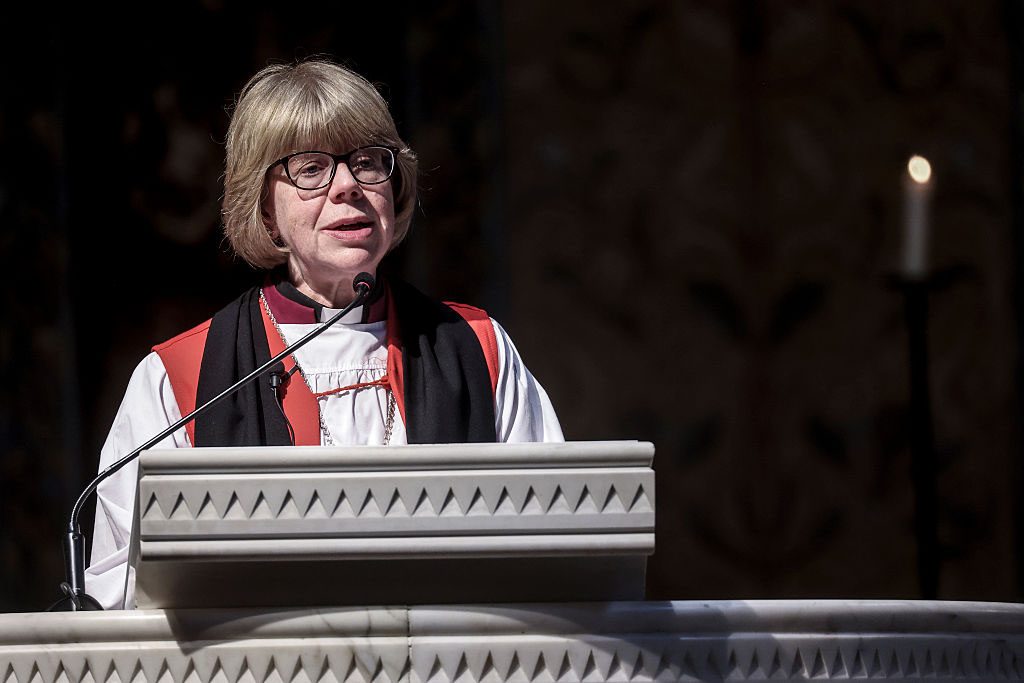
The new Archbishop of Canterbury, Dame Sarah Mullally, visited Israel and the Palestinian Authority territories last week. To judge by the photos and remarks she posted on her website, she spent a good deal of time in the company of two supporters of a terrorist group—and had only praise for them.

One was Layan Nasir, whom the archbishop described only as “a 26-year-old Anglican woman who has spent three periods in Israeli administrative detention and prison over the last five years.”

What Archbishop Mullally didn’t mention is that Ms. Nasir was detained because of her activities with the terrorist Popular Front for the Liberation of Palestine (PFLP).

During her years as a student at Bir Zeit University, Nasir was an active member of the “Progressive Democratic Student Pole.” That’s the PFLP’s campus branch. PFLP flags are proudly visible in Nasir’s social media posts. “Long live our Front!,” she exclaimed in one of them.

Archbishop Mullally also had herself photographed with a 25 year-old Arab woman whom she did not name, but whose “powerful testimony” she praised. David Collier, the British investigative journalist, has identified the woman as Zeina Barbar.

Ms. Barbar’s social media posts show her proudly marching with an official PFLP poster, in a protest demanding the release of PLFP terrorist Samer Arbid. He’s presently serving life in prison for murdering a teenage Israeli girl.

What makes this distasteful episode rich with irony is that the PFLP perpetrated the most notorious massacre of Christians in Israel’s history.

The terror group that the archbishop’s new friends, Layan and Zeina, support organized the May 1972 attack at Lod (later Ben-Gurion) Airport. The terrorists slaughtered 26 defenseless civilians and wounded 80 more. Seventeen of the dead were American citizens—Christians from Puerto Rico who had just completed a pilgrimage to religious sites in the Holy Land.

One of the wounded was a British citizen, Ms. Ros Sloboda, who was a student in Israel at the time. It might be worthwhile for the Archbishop of Canterbury to meet her. That shouldn’t be too hard to arrange; they do live in the same city, after all.

In an interview with the BBC, Ros described how she heard the gunfire and saw “people dropping to the floor, and there was blood everywhere.” She “turned to run, and as I turned, this huge hole appeared in the back of my thigh, and I realized I had been shot.”

“I ran and I hid under a seat,” Ros continued. “It’s impossible to convey the utter terror when you think you’re going to lose your life, and I saw [in my mind] a picture of my house in London, and my family, and I was just waiting for the next bullet to hit me, because I was convinced that it would kill me.”

Then, suddenly, “there was an eerie quiet.” Ros “stood up to see the stuff of nightmares, really—the man next to me was dead. His head was resting in his wife’s lap.”

In the hospital where she was treated for her wounds, Ros found herself alongside a “visibly pregnant” Puerto Rican woman who was frantically asking for her husband. He was one of those who was killed in the attack.

Back home in London, all these years later, the terrible memories have never left her. “I often go into my garden,” Ros told the interviewer, “and I say to myself, ‘This is a good-to-be-alive day’.”

Ros mentioned in the interview that when she reads about Israelis who were wounded in Arab terrorist attacks, she often writes them letters of comfort, even though they are total strangers. Which is the sort of thing you might expect a Christian religious leader to be doing.

One would have thought that the spiritual leader of 85 million Anglican Christians worldwide would at least remember that horrific attack, and would decline to be photographed with supporters of the group that carried it out. But apparently not.

Remembrance of these American Christian victims of Palestinian terror appears to be confined to Puerto Rico, where the local government some years ago designated May 30 as an annual “Lod Massacre Remembrance Day.”

Perhaps next May 30, the Archbishop of Canterbury will pay a visit to Puerto Rico and take part in mourning the victims of the terrorists whose supporters she has been embracing.

In the meantime, though, there’s something even more constructive that the archbishop could do.

One of the mass-murderers at Lod was Kozo Okamoto, a Japanese Red Army terrorist who collaborated with the PFLP. He was originally captured and sentenced to life in prison, but then released in a prisoner exchange and granted political asylum by the government of Lebanon, even though he’s still on Japan’s most-wanted list.

Archbishop Mullally could use her stature as one of the world’s most prominent religious leaders to demand that Lebanon surrender Okamoto for prosecution—whether in his native Japan, or in one of the countries of his victims, such as the United States or Great Britain.

Because that’s where the Archbishop of Canterbury and her Church of England should be—on the side of the victims of terror, not on the side of the terrorists’ supporters.


Dr. Medoff is founding director of The David S. Wyman Institute for Holocaust Studies and author of more than 20 books about Jewish history and the Holocaust. Follow him on Facebook to read his daily commentaries on the news.

Archbishop of Canterbury Embraces Supporters of Killers of Christians Read More »

Grateful Are We

Jews are guided to start each day with a statement of gratitude, and so it is fitting as the United States celebrates its 250th anniversary, we, American Jews, pause to express our profound gratitude.

Grateful are we for a nation that, unlike so many others through Jewish history, did not merely tolerate Jewish life, but made possible its flourishing.

From the earliest days of the American experiment, Jews were drawn to the promise of a nation founded not on bloodline, monarchy, or established religion, but on liberty, covenant, and the dignity of the individual. Having known the weight of persecution and exclusion, Jews recognized in America’s founding ideals something rare in human history: the possibility of belonging without surrendering our identity.

American Jews were not merely beneficiaries of this promise. We helped construct it. Jewish patriots supported the Revolutionary cause with blood, treasure, and the wisdom of our sacred texts. The Liberty Bell, commissioned in 1751, bears a defining expression of the American spirit with a quote from the Hebrew Bible (Leviticus 25:10), “Proclaim Liberty Throughout The Land… .” The conviction that we are all created equal, which was enshrined in our Declaration of Independence, was found in the Bible’s creation story, with its teaching that we are all made in the image of the Divine. Jewish merchants from the Caribbean, together with Jewish Patriots in the Colonies, aided the Continental Army by supplying arms. On July 4, 1788 Jews joined clergy and civic leaders on Independence Mall in Philadelphia to celebrate the ratification of the Constitution, a charter that offered freedoms unprecedented in the modern world.

And in 1790, President George Washington gave an enduring voice to the American promise in his letter to the Hebrew Congregation in Newport, declaring that “For happily the Government of the United States […] gives to bigotry no sanction, to persecution no assistance…”

Here, Jewish immigrants arrived with little and built lives of dignity. Here, Jewish communities established synagogues, schools, charities, businesses, and institutions of civic life. Here, Jews rose not because success was guaranteed, but because freedom made striving possible.

To us, being American means fidelity to a civic covenant.

We believe in individual liberty: free citizens must be able to live, speak, worship, assemble, and pursue their own paths, so long as they do not infringe on the rights of others.

We believe in equality of opportunity: every person should have the chance to rise through effort, talent, and perseverance.

We believe in the rule of law: justice must be impartial, rights protected, and power constrained.

We believe in freedom of conscience and expression: truth emerges not through coercion, but through open discourse, moral courage, and democratic persuasion.

We say this with clear eyes. America has not always lived up to its own ideals. Its history is marked by acts and periods of injustice, exclusion and failures that wounded many communities, including at times our own.

Yet America’s greatness has never rested on perfection. It rests on the enduring power of its ideals and the willingness of citizens to struggle to live up to them.

That is our charge now.

At a time of division, distrust, and fragmentation, we recommit ourselves to strengthening the bonds of citizenship, renewing a culture of democratic responsibility, and modeling a patriotic pluralism that makes room for deep difference within shared national purpose. We also commit ourselves to teach these values to our children and our children’s children.

We are proud to contribute to helping America more fully realize the promise of a more perfect union.

Grateful are we. Committed are we.\ Hopeful are we.

God bless America.

Inaugural Signatories:

Ambassador Deborah E. Lipstadt

Rabbi David Wolpe – Max Webb Rabbi Emeritus, Sinai Temple

Elliott Abrams – Chairman of the Board of Trustees, Tikvah

David Ackerman – Rabbi, Congregation Beth Am Israel

Jan Armstrong Cobb – Immediate Past President, AJC Cincinnati

Rabbi Bradley Artson – AJU Distinguished Scholar, American Jewish University

Amanda Berman – CEO, Zioness

David Bernstein – CEO, North American Values Institute (NAVI)

Mijal Bitton

Marc Blattner – President and CEO, Jewish Federation of Greater Portland

Jacob Blumenthal – CEO, Rabbinical Assembly

David Butler

David L. Cohen – Ambassador

Jacob Cohen – Trustee, Weitzman National Museum of American Jewish History

Mark Cohn – Rabbi, Temple Sholom, New Milford (CT)

Philip Darivoff – Chairman Emeritus, Weitzman National Museum of American Jewish History

William Daroff – CEO, Conference of Presidents of Major American Jewish Organizations

Ted Deutch – CEO, American Jewish Committee

Nathan Diament – Exec. Director, Orthodox Union Advocacy Center

Dr. Kathy Fields

Eric Fingerhut – President and CEO, Jewish Federations of North America

Dr. Anita Friedman

Misha Galperin – President, Zandafi Philanthropic Advisors

Martin J. Geller – Founder and Chairman, Geller & Company

Paul Glasser – VP, Touro University

Leon Glicksman – Professor, MIT

Eric Goldstein – CEO, UJA-Federation of New York

Archie Gottesman – Co-founder, JewBelong

Jonathan Greenblatt – CEO and National Director, ADL

Gidi Grinstein – Founder and President, Reut USA / AJ2054

Amy Gutmann – Ambassador

Jonathan Haidt – Professor, New York University

Rabbi Brad Hirschfield – President, Clal – The National Jewish Center for Learning and Leadership

Dara Horn

David Ingber – Founder and Senior Rabbi, Romemu

Hadara Ishak – President, Jewish Future Promise

Jay Kaiman – President, The Marcus Foundation

Bernard Kaminetsky– President, AIPAC

Thomas Katz

Howard Kivell

Betsy Korn – Chair, Conference of Presidents of Major American Jewish Organizations

Josh Kramer – President and CEO, Ohio Jewish Communities

Monty Krieger – Professor

Yehuda Kurtzer – President, Shalom Hartman Institute

Adam Lehman – President and CEO, Hillel International

Mike Leven – Founder, Jewish Future Promise

Randi Levine – Ambassador

The Honorable Kathy Manning – Former Member of Congress, NC 06

Hon. Kenneth L. Marcus – Chairman and CEO, The Louis D. Brandeis Center for Human Rights Under Law

Anthony Meyer – Past Chair of the Board of Governors, American Jewish Committee

Linda Moskowitz Noonan – National Board Member, National Council of Jewish Women (NCJW)

David Muschel

Nicole Mutchnik – Chairman, Board of Directors, ADL

Anne Neuberger – Former Deputy National Security Advisor

Yehuda Neuberger

Dr. Rebecca Newberger Goldstein

Mark Oster – Co-Chair, Board of Trustees, Weitzman National Museum of American Jewish History

Rabbi Justin Pines

Steven Pinker – Johnstone Professor, Harvard University

Jonah Platt – Host, Being Jewish with Jonah Platt

Julie Platt

Steven Price – Board of Directors, Tikvah and Commentary

Dr. Garry Rayant

Zoya Raynes – Chair of the Board, Jewish Funders Network

Andrew Rehfeld – President, Hebrew Union College

Joe Roberts – Executive Director, Jewish Tulsa

Stephanie Rodgers – National Board Vice President, National Council of Jewish Women

Jimmy Rosenfeld

Steven Rotter – Chair, CLAL The National Jewish Center for Learning and Leadership

Jonathan Sarna – Professor

Charles Savenor – Executive Director, Civic Spirit

Sherrie Savett – Former Board Chair of Jewish Federation of Greater Philadelphia

Miriam (Mimi) Schneirov

Philip Siegel – Philanthropist

Amy Skopp Cooper – CEO, National Ramah Commission

Harlan Stone – Trustee, University of Pennsylvania

Michèle Taylor – Ambassador

Sharon Tobin Kestenbaum – Co-Chair, Co-Chair, Weitzman National Museum of American Jewish History

Gary Torgow – Chair, Jewish Federations of North America

David Touger

Michael Tuchin – National Board Chair, AIPAC

Ethan Tucker – President and Rosh Yeshiva, Hadar Institute

Paul Ullman – Member Kehillat Romemu

Mike Uram – Chancellor, Jewish Theological Seminary

Jane Weitzman

Stuart Weitzman

Steven Wisch

David Zalik – Co-Founder, The Zalik Foundation

Carol Zawatsky – CEO, The Tree of Life, inc.

Grateful Are We Read More »

Shabbat Shalom, America

Maybe it’s just a coincidence that America’s 250th birthday falls on the Jewish Sabbath.

But let’s assume, in the interest of a more interesting column, that it is a kind of divine intervention that July Fourth falls on a Saturday.

What might this divine message be?

For me, it is simply that the Jewish Sabbath has what America needs most at the moment.

A taste of gratitude.

Not anger. Not division. Not politics.

Just gratitude.

Our country has become so polarized it’s difficult to put our partisan emotions aside for even one day. I can’t tell you how many tortured “happy birthday America” articles I’ve read that used the occasion to lament the sins of the opposing side. There is bitterness throughout the land.

Even on an extraordinary anniversary that comes along every 250 years, it seems that we can’t help ourselves.

The Jewish Sabbath says the opposite. It says we can help ourselves. It says we have agency. It says we can put the ugly and corrosive noise of the week behind us and contemplate the things that matter most.

Like gratitude.

“On Shabbat we celebrate the things that are important but not urgent,” the late Chief Rabbi Jonathan Sacks wrote. He called Shabbat “a day of gratitude, when the restlessness of the week subsides and we find refuge in an oasis of rest.”

In his classic book “The Sabbath,” Rabbi Abraham Joshua Heschel calls the Jewish holy day “the most precious present mankind has received from the treasure house of God.”

Our founders were aware of the supreme value of gratitude.

“It is no coincidence that the United States, founded by Puritans – Calvinists steeped in the Hebrew Bible – should have a day known as Thanksgiving, recognizing the presence of God in American history,” Sacks wrote. “On 3rd October 1863, at the height of the Civil War, Abraham Lincoln issued a Thanksgiving proclamation, thanking God that though the nation was at war with itself, there were still blessings for which both sides could express gratitude: a fruitful harvest, no foreign invasion, and so on.”

Lincoln understood that even at our lowest point—when we were at war with ourselves—it was essential, even existential, to find reasons to appreciate life’s blessings.

Look, I’m also at war with so much of what is going on in our country. A lot of it drives me nuts. Ironically, the one thing I especially can’t stand is a lack of gratitude for our nation.

But here’s the thing about Shabbat. It technically lasts one day, but its effect is for the whole week. Gratitude is not a 24-hour idea. It’s a full-time mental habit. It’s a social glue. It says we can be on opposing sides and still find ideals we have in common and reasons to be grateful.

Of course, in times of radical animosity, the last thing we think about is gratitude. And yet, it should actually be the first. Because the opposite of gratitude—resentment, bitterness, arrogance—is what ultimately destroys families and societies.

Shabbat comes to help heal our worst instincts.

Whether it’s a divine coincidence or not, it’s fortuitous that our national birthday falls on the Jewish Sabbath. In the midst of our parties and barbeques, Shabbat is God’s birthday present to America to remind us that we still live in the greatest country on earth.

So, as we say happy birthday tomorrow, whether we’re Jewish or not, we can also say Shabbat Shalom, America.

Shabbat Shalom, America Read More »