fbpx

February 13, 2026

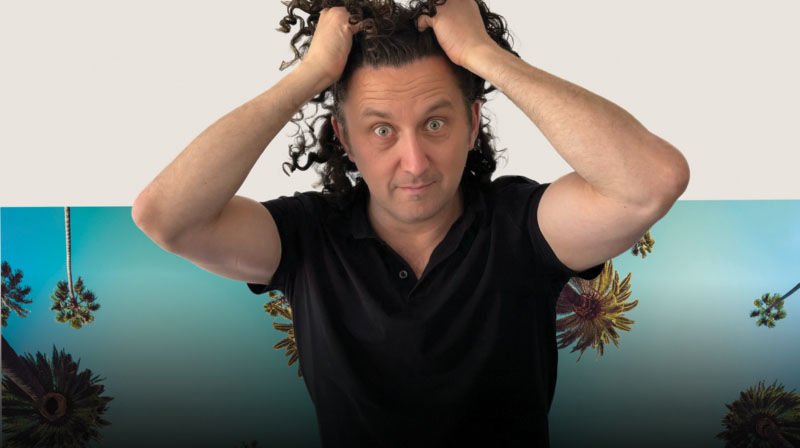
Brain Surgery, Film Noir, Accidental Love: Marcus Freed Is Still Out There

At the very beginning of his one-man show, “Marcus Is Alive,” which I saw last Thursday night at a cozy little theater in Hollywood, Marcus Freed grabs the audience’s attention by throwing out one of life’s ultimate questions:

What if?

Indeed, what if?

Who hasn’t asked that question? Who hasn’t wondered how their life might have turned out had this or that not happened?

In Freed’s case, how would his life have turned out had he not jaywalked on a Friday night in 2017 and found himself on the asphalt with life-threatening brain damage after being hit by a white Lexus?

The play delves into that question and many others.

What makes it interesting is Freed himself: he not only has nine lives, he’s a quirky character with a limitless number of talents and interests, from yoga and meditation to acting, singing, comedy and writing to Torah study and spirituality and, of course, to storytelling.

All of those come into play as he recounts a life dominated by a near-death experience that led to two brain surgeries, agonizing pain and an infusion of love from his family and community.

No matter how crazy his story gets— like the two screws that got loose in his brain after the surgery, or his desperate search for the hit and run driver—Freed finds a way to weave in his search for love. He pokes fun at himself as he recalls his failed marriage proposals, wondering when he will settle down with a soulmate like many of his friends.

But Freed is also an incorrigible philosopher who can’t leave any issue alone. So he muses later in the play that the outpouring of love he received after his accident was a reminder that there’s more to love than romance. Sometimes life sends you accidental love from a communal circle that goes just as deep.

His instinctive drive to stay alive comes with a sense of whimsy. With jazz music playing, he turns into an LA film noir detective when he goes on the hunt for a missing person; at other times, his journey takes him to psychics, rabbis, fortune tellers and other oddball characters. Freed seems at home with all of them. Depending on the scene, he’ll take on a number of accents, from Yiddish to Shakespearean to WASP American.

The play is a dance between the somber and the humorous. Those are tough things to balance, but Freed must pull it off for the play to work. Too serious would be a downer; too light-hearted would lack credibility.

Maybe that’s why at a moment of intense physical pain and frustration at mounting medical bills, Freed breaks down, getting on his knees with a cri de coeur that stuns the audience. As skilled as he is at finding humor in his story, he doesn’t ignore the darkness.

If a search for love drives Freed, there’s also a search to understand death. On that front, he offers questions more than answers, in particular this eternal one: How much of our fate is in our hands and how much is in the Almighty’s?

What’s clear is that whatever fate has in store for Freed, the man loves life. He especially loves it when a group of friends come to his rescue with a crowdfunding campaign that relieves him of his crushing financial burden.

His love of life comes with an existential question that floats throughout the play: Why is he still alive? Why did he dodge all those bullets?

He wants us all to ponder those questions: Why are any of us still alive? What is our purpose?

Freed wonders near the end what his life would have been like had the accident never happened.

He doesn’t know. He can’t know. The only thing he knows is that his near-death moment led him to a poignant story that he now gets to perform on stage, and that’s more than enough reason to stay alive.

For more information, visit https://www.marcusjfreed.com/marcus-is-alive


Brain Surgery, Film Noir, Accidental Love: Marcus Freed Is Still Out There Read More »
Washington’s Promise, America’s Test

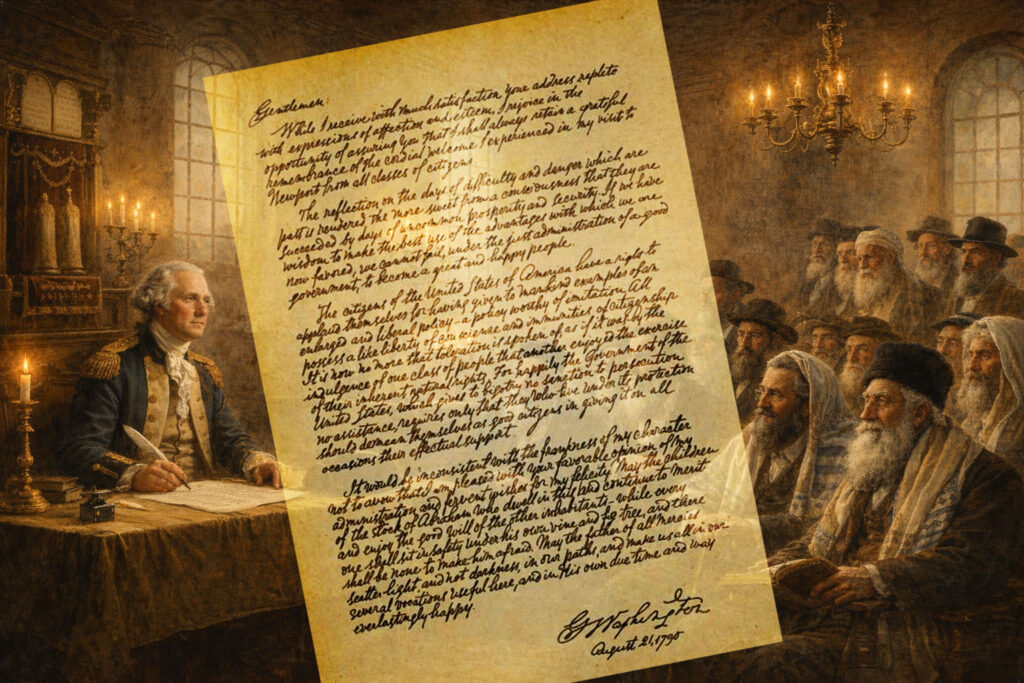
In August 1790, George Washington wrote to the Hebrew Congregation of Newport, Rhode Island. His words were simple, but revolutionary: America would give “to bigotry no sanction, to persecution no assistance.”

Washington wrote that every good citizen should “sit in safety under his own vine and fig tree, and there shall be none to make him afraid.”

It was a promise. A compact between our early nation and its Jewish citizens: equal opportunity and liberty defended for all. I’ve been thinking about this promise as we observe Presidents Day this year, especially as antisemitism has intensified these past few years.

Indeed, some prominent commentators have argued that antisemitism is inevitable and that we need not waste any time fighting it. Instead, we must refocus on deepening our Jewish identity and joy.

This is a false choice, one that flies in the face of Jewish-American history and in what we need to survive. Jewish flourishing in an open society depends on two conditions at once: thick internal vitality and a public square where Jews can participate without intimidation or stigma. Either one without the other is unstable.

The challenges our community face now in America’s 250th year are real and daunting.

In January, an arsonist set fire to Beth Israel Congregation in Jackson, Mississippi—the state’s oldest and largest synagogue. It was the second attack on this house of worship. In 1967, the Ku Klux Klan bombed Beth Israel because its rabbi supported the Civil Rights Movement.

Nearly six decades later, another antisemitic attack. And while fire destroyed the parts of the building, a Holocaust-surviving Torah emerged unharmed—a testament to the fact that while they can burn buildings, they cannot break the Jewish people. But here’s where we are today.

In 2024, ADL recorded 9,354 antisemitic incidents—the highest number recorded since we began tracking incidents in 1979.  On college campuses alone, incidents exploded by 84 percent. A recent survey we conducted with Jewish Federations found that more than half of all Jewish Americans experienced antisemitism in the past year. Fourteen percent have developed exit plans in case things get worse.

This isn’t happening to some abstract “Jewish community.” It’s the grandfather walking to synagogue. The parent at work. The college student in class. The teenager scrolling on social media.

Following the attack on Beth Israel Congregation, Jackson Mayor John Horhn declared that targeting people for their faith is “morally wrong, un-American, and completely incompatible with the values of this city.”

These words matter. We rely on allies like Mayor Horhn. Because the truth is that recently many of our allies vanished when we needed them. Friends went silent. Organizations that claimed solidarity just disappeared. Neighbors who we thought would stand with us instead turned their backs.

So, Washington’s promise — to give bigotry no sanction — feels increasingly hollow as antisemitism flows freely on social mediauniversities still struggle to protect Jewish students, and Jews are violently assaulted on the street.

What’s at stake here extends far beyond the Jewish community. When antisemitism is tolerated (or disguised as political critique) it sends a clear message: bigotry belongs in America after all.

History shows us where that leads. Antisemitism is rarely contained. And when it gains ground, other forms of hate follow. When institutions fail to protect one vulnerable community, they establish a precedent that no community is truly safe.

In light of this, we cannot just hide or turn inward. We must act and claim the promise of our nation’s Founding Father.

At ADL, we’re not waiting for others to act first. We’re filing lawsuits—in 2025 we filed more cases than in our previous 100-plus years combined. We’re training security personnel to protect synagogues and Jewish institutions. We’re monitoring elected officials in cities where antisemitism has been normalized. We’re building coalitions with allies across faiths who are committed to this fight.

Our Campus Report Card grades universities on how well they address antisemitism and support Jewish life—and following ADL engagement, more than one-third of schools strengthened their policies enough to improve by a full letter grade. When Microsoft shareholders faced a BDS-aligned proposal, we mobilized through JLens, leading shareholders to reject discrimination disguised as corporate responsibility.

We’re documenting every incident. Demanding accountability from every institution. Doing what Jewish communities have always done — protecting ourselves when protection isn’t guaranteed.

Of course, Washington’s promise wasn’t just freedom from persecution. It was freedom to build, to contribute, and to flourish—the radical idea that Jews could be fully Jewish and fully American without contradiction.

But we haven’t fully realized that vision yet, which is why our efforts to combat antisemitism remain essential along with reaffirming Jewish values and building strong communities. We must defend our space in the public square and deepen our attachments in our private gatherings and lives. That is how we protect and deepen Jewish life in America.


Jonathan A. Greenblatt is CEO and National Director of ADL (the Anti-Defamation League).

Washington’s Promise, America’s Test Read More »

Thoughts on Radiation

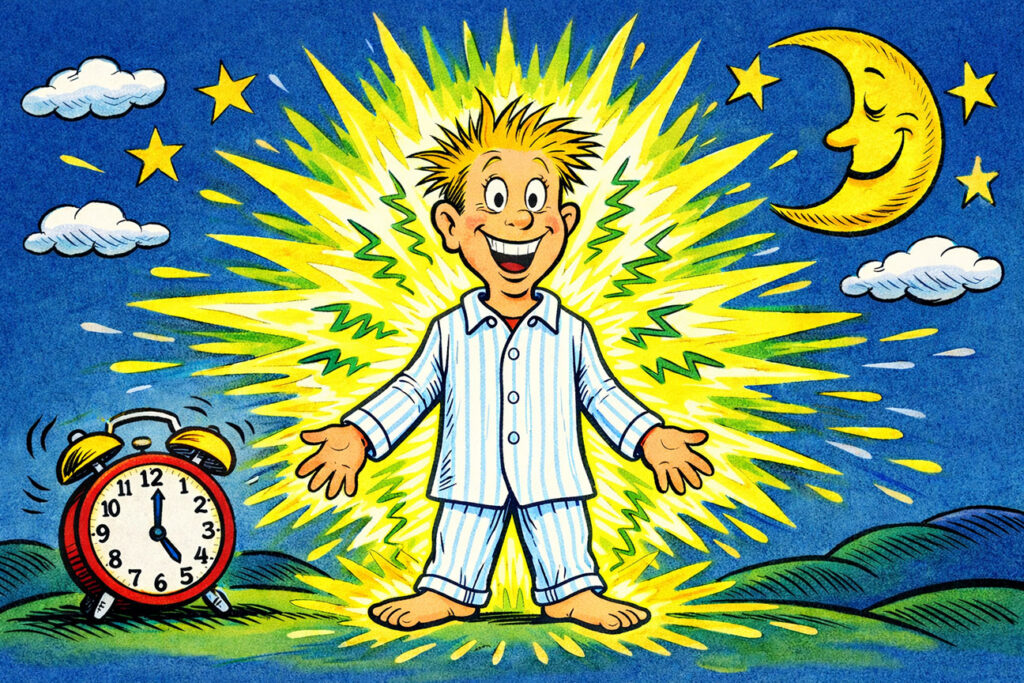
I wake in the night—yes, the middle of night,

When the moon’s still on duty and stars are on site.

My alarm clock goes BEEP! far too early to cheer,

“Radiation time!” says the clock with a sneer.

I shuffle and wobble and mumble and yawn,

While sensible people are still fully gone.

The sun’s not awake, the birds haven’t checked in,

But off I must go for my zap-zap-zap spin.

Now first comes the pressure—oh yes, there is that:

“You must poop,” says the rulebook. Imagine that chat.

I’m barely awake, my eyes glued with sleep,

Yet my colon’s expected to perform on a beep.

Then fill up the bladder—oh fill it just right!

Not too much, not too little, just hold it real tight.

I’m a human balloon, I’m a walking water tower,

I’m a dam with emotions and sixty-four ounces of power.

I lie on the table, quite still as can be,

While machines hum around me like bees near a tree.

They buzz and they whirr and they circle and gleam—

And wouldn’t you know it? I’m starting to gleam.

I glow! Yes I glow! Like a radioactive gnome!

Like a night-light-ish hero who forgot to go home.

You might say, “Good heavens!” or “Is that a new trick?”

Nope—just science and courage and zap-zap-zap—click.

Now hormones, dear hormones, have joined in the fun,

They’ve shuffled the script and rewritten the run.

So my pronouns, you see, have expanded their realm:

Today I’m a they, and I’m owning the helm.

They who are brave.

They who persist.

They who show up even half-conscious and pissed.

(At the alarm, not the people—just clearing that up,

I’m grumpy but grateful and sipping my cup.)

And here’s the best part, the truest by far,

The reason I shine brighter than radiation ever are:

I’m wrapped up in love—oh a spectacular heap!

From family and friends who refuse to retreat.

My community cheers me, they text and they call,

They show up with meals and with jokes and with gall.

They hold me in laughter, in kindness, in care—

So much love that even my bladder says, “Fair.”

So zap me and scan me and wake me too soon,

I’ll glow like a lighthouse, a very full moon.

With poop planned ahead and a bladder on swell,

I’m held by my people—and honestly? That’s what heals.

Thoughts on Radiation Read More »

The October 8th and October 9th Jew

Shabbat Teaching –

Rabbi Mordecai Finley

We Jews, particularly Israelis, suffered a terrible tragedy on October 7, 2023. Much has been written and said about the “October 8th Jew” — the Jew whose identity sharpened overnight, whose sense of solidarity intensified, whose awareness of vulnerability and peoplehood became immediate and urgent. I find myself thinking about what happens after that initial surge begins to settle. In other words, if something awakened on October 8, what must we offer on October 9?

Bret Stephens — the Pulitzer Prize–winning columnist for The New York Times — addressed this question in his recent “State of World Jewry” address at the 92nd Street Y in New York. In that speech, he argued that the Jewish community has invested enormous energy in fighting antisemitism — through advocacy, awareness campaigns, and public defense — yet antisemitism persists. His point was not that defense is unnecessary; security matters deeply. Rather, he suggested that fighting antisemitism has become too central to how we organize Jewish communal life. When we define ourselves primarily in response to those who oppose us, we risk building an identity that is reactive rather than generative.

Stephens therefore called for a rebalancing of priorities: greater investment in Jewish education, literacy, leadership, and institutions capable of sustaining Jewish life from within. Security protects a community, he argues, but identity sustains it.

Zvika Klein — Editor-in-Chief of The Jerusalem Post — approached this same moment from a different but complementary angle in his January 16 editorial, “Future of Jewish Diaspora Should Follow Spirit of ‘October 8 Jewry.’” Klein describes the surge in Jewish engagement after October 7 — synagogues filling, Jewish symbols worn openly, renewed learning, volunteering, aliyah — as a once-in-a-generation rupture. For him, this is not simply a strategic correction but a hinge moment in Jewish history, comparable in scale to 1948 or 1967. Incremental thinking will not suffice. If Jewish energy has awakened, leadership must respond with boldness at a generational scale.

Both Stephens and Klein are responding to the October 8th Jew — the Jew who stood up.

But there is another stage emerging, not for everyone, but for a significant segment of those newly engaged. In my life as a rabbi — and now living in Israel — the question I hear most often is quieter and more personal. It is not only about safety or institutions. It is the question: How do I live a life of meaning within Judaism?

For some, the energy of solidarity gradually deepens into a spiritual search. The rallies end. The headlines shift. What remains is a longing not merely to belong, but to live differently.

Perhaps we might call this person the October 9th Jew.

If the October 8th Jew awakens to danger and belonging, the October 9th Jew awakens to meaning. The October 8th Jew says, “I did not realize how precarious Jewish life is.” The October 9th Jew says, “Now that I am awake, how shall I live?”

Not every newly engaged Jew will ask that question. But many will. They will ask what kind of human being Judaism calls them to become, how to structure their lives around something sacred, how to cultivate compassion, discipline, courage, and responsibility. They will seek not only a stronger Jewish community, but a deeper Jewish self.

Judaism has never understood itself merely as a survival project. Survival matters, but survival is not the purpose. The purpose is to shape lives of conscience, depth, and holiness within the ordinary rhythms of time.

Stephens helps us correct the communal compass. Klein challenges us to build boldly. Yet for those who become spiritual seekers, something more is required. They are not satisfied with belonging alone. They search for wisdom, for practice, for a way of life that carries meaning.

If we do not speak to that hunger, the awakening will fade for them. If we do speak to it, the energy of October 8 can mature into something enduring — a generation not only awakened, but rooted.

And so tonight I would like us to consider: if our institutions grow stronger and our communal vision grows bolder, what does Judaism offer the spiritual seeker? What does it mean to move from identity shaped by reaction to identity shaped by formation?

The October 8th and October 9th Jew Read More »