fbpx

February 7, 2026

A Jewish Goal Line Stand

When it comes to the hatred of global Jewry, unnecessary roughness is not a penalty but rather pay dirt. Many receive great satisfaction treating Jews as tackling dummies—blaming and besmirching them; resenting their success; cheering their losses. Antisemitism comes with a scorecard, and the smart money is always betting against the Jews.

The Super Bowl is upon us, and the entire world will be watching. Along with the action on the field, many will pay equal attention to the TV commercials. They cost more to air and tend to be more slickly produced: a dystopian “1984” for Apple; fashion models guzzling Pepsi-Cola or devouring Carl’s Jr.; celebrities working the drive-thru at Dunkin’ Donuts; Clydesdales hocking Budweiser.

Robert Kraft, the owner of the New England Patriots, which happens to be playing in this year’s Super Bowl, is a proud Jew who started a foundation to combat antisemitism. For the past three years, he has showcased his own Super Bowl commercial to address the spike in antisemitism—largely coinciding with Israel’s war in Gaza.

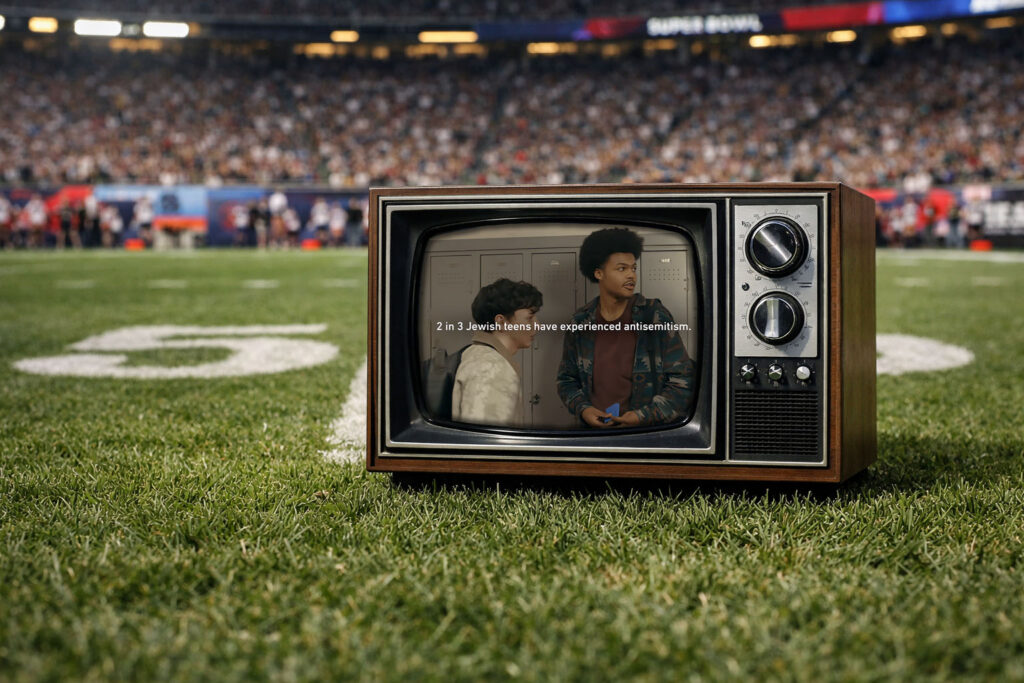
This year’s ad, which debuted the week before the game, features a Jewish boy walking the halls of his public high school, self-consciously mindful that his fellow classmates are snickering at him. He finally realizes that someone had affixed a sticky note to his backpack that reads: “DIRTY JEW.”

Out of nowhere comes a tall African-American teenager, possibly a popular jock, who says: “Do not listen to them. They’re not worth it, bro.” The Jewish teen is befriended and talked out of fighting back. The ad ends with this take-away: “2 in 3 Jewish teens have experienced antisemitism.”

The ad cost Kraft $15 million—a pricey gamble for 30 seconds of TV time. His motivation is admirable. Many Jewish titans of industry and finance have sat in the cheap seats and watched as the unkosher pigskin of antisemitism has bounced around in schools, universities, and mainstream media.

But is this TV commercial, righteous, sentimental and well-intentioned though it might be, the right remedy for these times? Will it make a difference for the 66 percent of Jewish teenagers who claim to have been bullied by Jew-hating juveniles?

Many took to social media, and to their own newsletters and columns, to debate the utility of the ad. Some felt it was inspiring and that Kraft’s goodwill and largesse should be commended.

Others saw it as a predictably insipid surrender to contemporary Cossacks. Why not instead show the audience an ad for the derring-do of the IDF—the “Fauda”-styled rescues; the ingenious detonation of head-separating cell phones; the aerial wizardry that turned grounded missiles into wreckage in Lebanon and decimated Iran’s air-defense systems and nuclear capability?

Or, we could just have Gal Gadot as Wonder Woman gulping Gatorade, winking at the audience, then thrusting her arm forward while stating: “I am just the tip of this Jewish spear.”

No one seemed to pick up the ad’s central piece of misdirection, however. In what public high school in the United States would an African-American jock come to the aid of an ostracized nerdy Jewish boy? The Black-Jewish alliance of the 1960s is no longer a footnote. Blacks are going the way of Kanye West (sorry, apology not accepted), Bobby Vylan, Kyrie Irving, Candace Owens, Tamika Mallory, Alice Walker, Stephen and DeShawn Jackson, Marc Lamont Hill, Nick Cannon, Ice Cube, and, of course, Louis Farrakhan.

In what public high school in the United States would an African-American jock come to the aid of an ostracized nerdy Jewish boy? The Black-Jewish alliance of the 1960s is no longer a footnote.

The number of celebrity African-Americans who stand with Jews are few: Charles Barkley, Amar’e Stoudemire, Chris Rock, Van Jones and Tiffany Haddish (who is Jewish). Those names do not a full roster make, especially if you can’t count bi-racial Jewish celebrities like Lenny Kravitz, Rashida Jones, Drake, Maya Rudolph, Tracee Ellis Ross—who call audibles rather than being audible in support of their people.

Pro-Zionists Martin Luther King Jr., A. Philip Randolph and Bayard Rustin would be appalled.

If you’re a European Jew, Kraft’s Super Bowl ad is laughable. Snickering by a bunch of harmless white kids? That’s your hardship? In France, three children were shot dead by an Islamist outside their Jewish day school in Toulouse. A 12-year-old Jewish girl was dragged inside a shed and gangraped by three Muslim boys. A teenager nearly had his hand sawed off by a gang of Islamists. A college-aged student was tortured and burned alive by an Islamist group shamelessly called the Gang of Barbarians.

These nightmares are not confined to France. In London, cars circle Marble Arch and blare out, “Rape Jewish daughters!” In Copenhagen, a Muslim gunman, aiming for a girl in the midst of her bat mitzvah, killed the synagogue’s security guard.

Sorry to sack this Super Bowl commercial, but what Kraft is showcasing doesn’t quite convey the x’s and o’s of the modern-day pogrom playbook. He’s still in the single T formation. Jews must mount a stronger goal line stand.

Sorry to sack this Super Bowl commercial, but what Kraft is showcasing doesn’t quite convey the x’s and o’s of the modern-day pogrom playbook. He’s still in the single T formation. Jews must mount a stronger goal line stand.

He might as well be promoting saccharine because what he is describing is both fake and too sugary. It reflects the antisemitism of the 1950s—cold shoulders, hushed tones, country club restrictions, college admission quotas. October 7 demonstrated that Islamists don’t mind getting their uniforms dirty with Jewish blood while “progressives”—whose preferred epithet is “dirty Zionist” rather than “dirty Jew”—cheer maniacally from the sidelines.

Schoolyard antisemitism in the Middle East is much worse! The Institute for Monitoring Peace and Cultural Tolerance in School Education issued a report on the textbooks assigned to children in the West Bank. News flash: They are not being taught to simply harass Jews with sticky notes.

Fourth graders learn math by calculating the number of dead Israelis killed by suicide bombers on buses and inside shopping malls. By 14, they discover explosive belts and knives used to slash Israeli throats. The entire educational system romanticizes martyrdom and indoctrinates kids to commit jihad.

Does anyone care about the genocide to the minds of Palestinian children? Super Bowl fans won’t be learning the more insidious side of the eternal war against Jews.

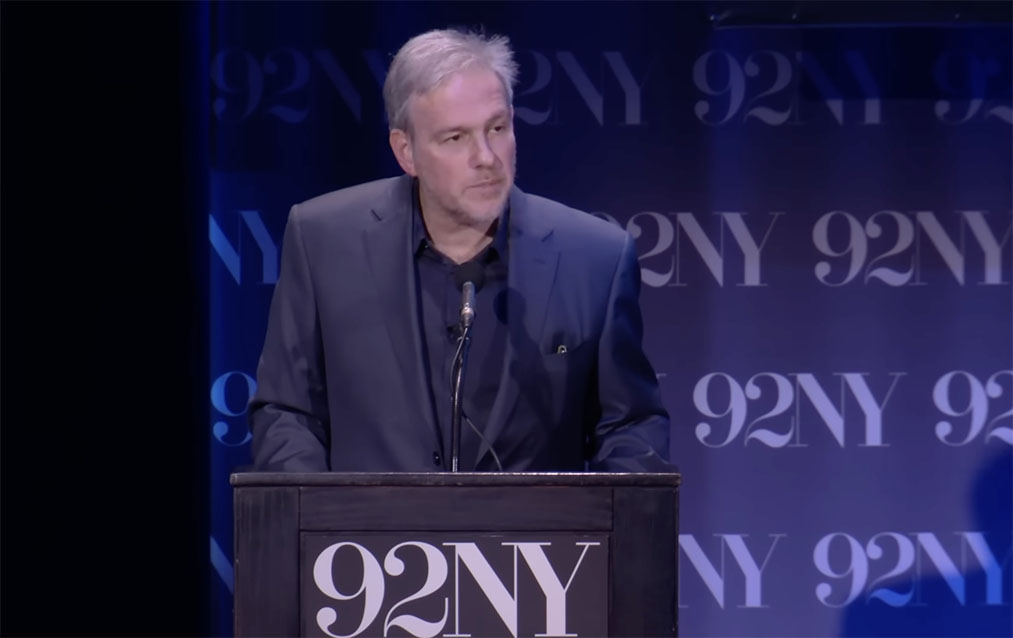
Earlier this week, New York Times columnist Bret Stephens delivered the “State of World Jewry” address at the 92nd Street Y in New York. He called the tens of millions of dollars spent annually fighting antisemitism a failure. He even suggested dismantling the ADL. Better that the money be spent strengthening Jewish education and cultural institutions.

A recent book by Benjamin Kerstein, “Self Defense: A Jewish Manifesto,” calls for a more aggressive style of offense against antisemites, which includes not statistics-gathering but “self-defense techniques [and] weapons handling.”

The problem runs much deeper than any one Super Bowl ad can hope to capture. The highlight reel is too violent—even for football diehards. And too gory for TV audiences gorging on nachos and pizza.

The Super Bowl clock will wind down on the scoreboard and confetti will rain down from the sky. The Most Valuable Player will announce, “I’m going to Disney World.” Everyone will leave the field.

Jews, however—at least the sentient ones—will know that the gladiatorial gridiron allows no exit for them. They must stay alert. And avoid sudden death.


Thane Rosenbaum is a novelist, essayist, law professor and Distinguished University Professor at Touro University, where he directs the Forum on Life, Culture & Society. He is the legal analyst for CBS News Radio. His most recent book is titled, “Beyond Proportionality: Israel’s Just War in Gaza.

A Jewish Goal Line Stand Read More »

Bret Stephens on Building a Jewish Future: What He Nailed, What He Missed

Put yourself in the minds of Jew haters. Whether from the left or right, they don’t just hate Jews– they can’t stand them. They can’t stand who Jews are and what they represent. Above all, they can’t stand how Jews keep taking hits and keep succeeding.

I’m generalizing here to make a point: Much of the Jew hatred we’ve experienced throughout the centuries has been rooted in resentment and envy. That’s a lot worse than a problem; it’s a neurosis. A neurosis is not something you can “fix” with a trip to a Holocaust museum or a class on the history of antisemitism. Envy is not ignorance.

But what if Jews take a more aggressive stance and really go after the haters—call them out, condemn them, make some noise, throw the book at them—will that work? Has it worked?

What to do about the bedeviling question of rising Jew hatred was a major theme of Bret Stephens’s “State of World Jewry” address last week, as he challenged the effectiveness of our community’s fight against antisemitism.

That may be one reason why the speech has generated controversy: It questions the very reason-for-being of some organizations.

“What we call the fight against antisemitism consumes tens of millions of dollars every year in Jewish philanthropy and has become an organizing principle across Jewish organizations,” he said. “[It] is a well-meaning but mostly wasted effort. We should spend the money and focus our energy elsewhere.”

This is not the first time we’re hearing about fighting antisemitism with something more positive– what some call “pro-Semitism”– urging us to focus on inspiring Jews rather than fighting haters.

But Stephens stood out because he went further and deeper with his cri de coeur while marshaling some compelling arguments– among them, the idea that “while antisemitism may be history’s most demented hatred, it is also the world’s most unwitting compliment.”

He led his speech with that idea, quoting a poet in the 1860s who was consoling a provocative artist: “It seems you have the honor of inspiring hatred.”

In that sentence, Stephens said, is “the state of world Jewry in 2026– the Jewish people, Israeli Jews and diaspora Jews, observant Jews and secular ones, right-wing Jews and left, all of us together, all of us ultimately in the same boat. Whether we like each other or not, we have the honor of being hated.”

The list of haters is long: “an axis of the perfidious, the despotic, the hypocritical, the cynical, the deranged, and the incurably stupid.”

All of this animosity can throw us off balance. Stephens prefers to remain calm and ask: “What shall we do with all of this hatred other than to take it as a badge of honor and turn it to our advantage?”

Stephens was arguing that there was something empowering hidden in the very darkness of Jew hatred: “They do not hate us because of our faults and failures. They hate us because of our virtues and successes. The more virtuous or successful we are, the more we’ll be hated by those whose animating emotions are resentment and envy.”

That doesn’t mean we should underestimate the threat and not fight back; it means we should fight smart.

“The proper defense against Jew hatred is not to prove the haters wrong by outdoing ourselves in feats of altruism, benevolence, and achievement,” he said. “It is to lean into our Jewishness as far as each of us can, irrespective of what anyone else thinks of it. If the price of being our fullest selves as Jews is to be the perennially unpopular kids, it’s a price well worth paying.”

It’s hard in one column to do justice to a long speech that was full of inspirational gems such as this one: “The goal of Jewish life is Jewish thriving. And by Jewish thriving, I don’t mean thriving Jews individually speaking. I mean a community in which Jewish learning, Jewish culture, Jewish ritual, Jewish concerns, Jewish aspiration and Jewish identification… are central to every member’s sense of him or herself.”

In short, the speech was bold, thought-provoking and eloquent.

In my view, though, it missed two things.

One, on the fight against antisemitism, it painted with too broad a brush, failing to distinguish between loud fighting and quiet fighting. I agree that our traditional approach of making lots of noise about Jew hatred is generally a waste and can even backfire. As I’ve written before (including in my column on the Super Bowl ad against antisemitism), constantly ringing the alarm makes Jews look weak and is more likely to increase hate than lower it. Exhibit A: No matter how much noise we make, the poison only seems to spread and get worse.

But this loud noise is a far cry from the quieter, more targeted approach to fighting antisemitism, one that is hardly a waste and merits continued support.

This quiet but steely approach comprises anything that enforces laws, rules, policies and regulations that protect the rights of Jews. This could be anything from the sophisticated monitoring and reporting of online Jew-hatred that helps enforce policies to lawsuits against discrimination to correcting the lies and libels against Israel. None of this will cure haters of their envy. It just says: You mess with Jews and cross red lines, you’ll pay a price. This approach aims for impact, not noise.

The second thing I found missing is the value of “positive noise.” As much as I agree that our top priority must be to strengthen Jewish identity, part of that identity is the goodness that Jews bring to the world. A campaign to promote that goodness would be the antidote to the millions we spend telling the world that Jews are hated.

If there are Jew haters on one side and Jew lovers on the other, there’s a group of fence sitters in the middle who might resonate with this Jewish goodness. This is a large group. We can’t forget them.

Ironically, one of the strongest parts of the speech was when Stephens looked beyond the confines of our community and spoke of what Jews mean to America.

“America needs Jews,” he said. “America needs us. America needs us as its witty gadfly and loyal critic and skeptical moral conscience, as the keeper of its tolerant and pluralistic flame, as its nosayer in moments of overweening certitude and its yeasayer in moments of crushing self-doubt.”

Yes, America needs Jews. Let’s own that. While we look inward to strengthen Jewish identity and expand Jewish education and other institutions, let’s remember to also look outward. At a time, for example, when the American Dream itself is being erased, who better than the Jews to bring it back to life? That also must be taught in Jewish schools.

And if reviving the American Dream becomes a Jewish dream that helps shape our Jewish identity and our nation’s destiny, why even think of being “perennially unpopular” when we’ve earned the right to be the very opposite? Becoming more popular is one helluva way to embarrass Jew haters.

“Disagreement is in the lifeblood of our Jewishness,” Stephens graciously said at the beginning of his speech. “And I should add, I possess no monopoly on truth.”

He may get some pushback from some circles, but with this wake-up call to American Jewry, Bret Stephens has advanced one truth we can all agree on: Jew hatred or no Jew hatred, building a thriving Jewish future in America is the essential fight we must keep alive for the rest of this century.


Bret Stephens on Building a Jewish Future: What He Nailed, What He Missed Read More »