fbpx

February 2, 2026

BDS Resolution Going Up for a Vote on February 4 at the University of Nebraska, Lincoln

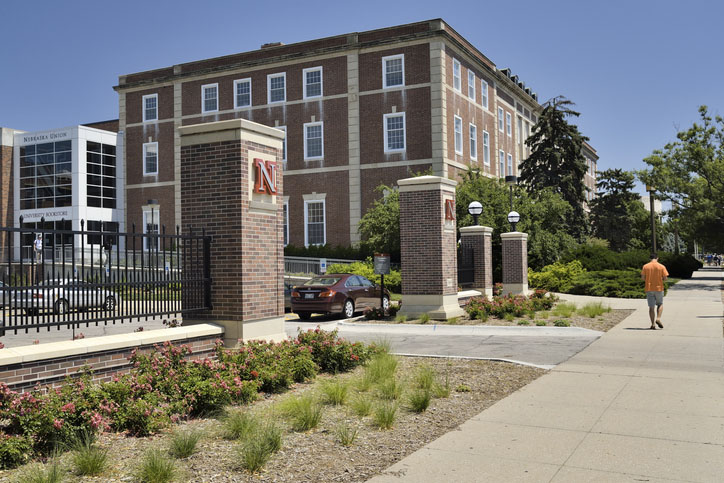
On Wednesday, Feb. 4, the Association of Students of the University of Nebraska–Lincoln (ASUN) has scheduled a vote on a Boycott, Divestment and Sanctions (BDS) resolution to divest from “weapons complicit in the genocide and atrocities worldwide.”

An Instagram post from Students for Justice in Palestine and Lincoln for Palestine stated that students should attend the ASUN Senate Hearing to encourage their school to stop investing in these weapons.

“Currently, the University of Nebraska-Lincoln investment policy does not exclude weapon manufacturers, which results in over $9 million invested into weapons that are killing Palestinians and other oppressed nations,” the post said. “As a university institution, it is antithetical and contradictory for us to continue investments in bombs that have destroyed every university in Gaza and the livelihood of Palestinian students, professors, and administrators.”

“As a university institution, it is antithetical and contradictory for us to continue investments in bombs that have destroyed every university in Gaza and the livelihood of Palestinian students, professors, and administrators.”

The open forum on the resolution, titled the Divest for Humanity Act, is taking place at 6:30 p.m. on February 4. There is an option to submit a statement “telling your student senators why the University of Nebraska System should change its investment policy to EXCLUDE WEAPONS,” according to another Instagram post.

SJP and Lincoln for Palestine allege that arms manufacturers like Lockheed Martin and General Dynamics are “complicit in the genocide of Palestinian (sic), have ties to ICE, and are unethical.” They continue, “UNL’s student government should be in support of divestment as these companies do not reflect UNL’s values.”

The resolution text states that, “Israel has destroyed and bombed all universities in Gaza,” “the United Nations Independent International Commission of Inquiry on the Occupied Palestinian Territory’s investigation has concluded that Israel is committing a genocide in Palestine,” and “UNL students are concerned with the moral implications in investing in weapons manufacturers that are contributing to Israel’s destruction of the Gaza strip.”

In May of 2025, another BDS was put in front of ASUN, but it did not receive the two-thirds majority vote it needed to pass. In May of the previous year, more than 100 students and staff members on campus gathered to partake in the “Liberated Zone for Palestine,” which featured teach-ins, chants, and dances. During it, four demands were made, including ending a UNL-sponsored study abroad program in Jerusalem, prohibiting receiving future funds or grants from Israel, disclosing university investments in Israel, and divesting from them.

Though widespread anti-Israel encampments have not popped up in the news lately like they did in May of 2024, BDS resolutions and votes continue to occur at universities nationwide. During Yom Kippur of 2025, the University of Maryland Student Government Association voted 29-0-1 to pass a BDS resolution, and the previous month, a divestment referendum was presented at the University of Connecticut. Ultimately, students convinced student senators that the questions in the referendum put forth a biased agenda, therefore violating bylaws of neutrality.

BDS has been around at universities for the past two decades. The group’s goal is to get universities to stop investing in Israel, and since October 7, 2023, those efforts have only ramped up. Students for Justice in Palestine and similar groups lead these campaigns, coming up with referendums and resolutions to present to student governments. BDS does not encourage Israelis and Palestinians to work together. Instead, it supports the phrase “from the river to the sea,” which means the eradication of Israel altogether.

At UNL, the newest BDS resolution is being sent to the president of university, the vice chancellor for student life, the chief investment officer at the University of Nebraska Foundation, and the chief financial officer for the university system, among other staff members.

The Divest for Humanity Act text states, “the Association of Students of the University of Nebraska–Lincoln (ASUN) urges that the University of Nebraska System change its investment policy to exclude weapons manufacturer companies that provide weapons, military aid, and military technology to the state of Israel in order to make its endowment consistent with the values, culture, and mission of the University of Nebraska and the needs of students.”

BDS Resolution Going Up for a Vote on February 4 at the University of Nebraska, Lincoln Read More »

‘Reading Lolita in Tehran’: Eran Riklis Brings a Story of Courage and Resistance to the Israeli Film Festival

After director Eran Riklis acquired the rights to the best-seller “Reading Lolita in Tehran,” he called author Azar Nafisi and asked her: “Does it make sense to you that an Israeli director would tell your very personal story?”

Nafisi replied without hesitation: “Wonderful.”

Riklis then asked, “And who would you like to portray you?”

Nafisi quickly answered, “Angelina Jolie.”

Director Eran Riklis (c) Marie Gioanni

Riklis, one of Israel’s most prominent directors, had other ideas. He made a fundamental decision that the entire cast would be Iranian. He couldn’t imagine Jolie playing an Iranian professor, faking a Persian accent. But it wasn’t only that.

“It’s the background, the language, the culture and the deeply personal nature of the story,” Riklis told The Journal. “Many of the actresses in the movie had left Iran with tremendous pain, in flight from the country, and some had left because their families had already left.”

Eran Riklis’s film “Reading Lolita in Tehran” is making its U.S. debut at the Israeli Film Festival in Los Angeles on Feb. 5. The film has already screened at multiple international festivals, receiving positive reviews — and remarkably, no controversy has arisen despite being an Iranian story directed by an Israeli filmmaker.

“To this day, I haven’t encountered any opposition to Israel,” Riklis said. “It’s been so quiet that at a screening in Barcelona, I jokingly told the audience I’d even pay someone to wave a Palestinian flag — just to add a little action to the room!”

Joking aside, the film’s story resonates strongly today. It follows Nafisi, born in Iran in 1948, who spent many of her formative years abroad, starting at age 13, studying in England and the United States. After earning her Ph.D. in English and American literature from the University of Oklahoma, she returns to Iran in 1979, just after the Revolution. She quickly realizes the drastic restrictions imposed by the new regime, particularly on women, including mandatory head scarves and modest dress. In response, she quits her job and quietly rebels, forming a secret reading group in her home. There, she teaches Western literary classics deemed “forbidden” by the authorities — including, of course, “Lolita,” Vladimir Nabokov’s classic novel.

Riklis’s past accomplishments as the director of acclaimed films such as “The Syrian Bride,” “A Borrowed Identity” and “Lemon Tree” likely helped convince the Iranian actresses to join the cast. For the lead role, he cast Golshifteh Farahani, one of Iran’s most prominent actresses now living in France. Zar Amir Ebrahimi, who portrays one of the students, had previously collaborated with Israeli director Guy Nattiv, co-directing and acting in “Tatami.”

Rita, the Israeli singer who was born in Iran and moved to Israel as a child, makes a surprise appearance as Nafisi’s mother.

“In the end, almost none of the actresses I reached out to refused; just a few got cold feet and dropped out of the process,” Riklis said. “I chose a large cast of eight women, and they all came on board wholeheartedly — both because of the story and because they were familiar with my previous films.”

Riklis emphasized the importance of courage for artists. “It’s especially vital for creators not to be afraid to tell a story. Because if we are afraid, what will remain in the world of culture? Risks must be taken.”

When the book was published in Iran in 2003, it was banned. Even so, copies circulated unofficially, often brought back into Iran from abroad or shared privately. Translations of classic Western works, including “Lolita,” have similarly been circulated underground or via samizdat-style distribution, suggesting that readers determined to access banned literature do so.

Likewise, there is reason to believe the film has found its way to Iran.

“I’ve been told by people close to me that there’s a pirated copy circulating in Tehran, and people are seeing it. Iranian communities, like the Israelis, are scattered across hubs in LA, Paris and elsewhere. Almost everyone I know has friends or family who still live in Iran. The film has a life of its own.”

Even though “Reading Lolita in Tehran” tells a story that took place nearly 50 years ago, its themes feel astonishingly relevant today. Riklis said he didn’t try to make it relevant. “When I read the book, I realized that even though it tells a story far removed from my own experience, it’s about a society, about women and a historical situation that is relevant almost anywhere — even in America and in highly democratic countries, and certainly in places that have undergone processes similar to those in Iran.”

Riklis believes that in a world so complex and divided — riven by conflicts between countries, peoples and religions — the story resonates now more than ever. True to his style, Riklis focuses on human stories that cross borders. The characters and the challenges they face feel authentic, drawing viewers in and allowing them to see themselves reflected in the story. It’s this realism and emotional honesty that makes the film feel so relevant, bridging history and contemporary life.

The film, a co-production between Israel and Italy, was primarily shot in Rome. Riklis explained that while scouting locations, he first traveled to Athens but soon decided Rome was the right choice.

“When I visited the University of Rome and climbed the steps of the literature faculty, I turned to my crew and said, ‘We’re filming here.’ I spent a sleepless night afterward, worried that the Iranian consultant would say it didn’t look like Tehran — but he turned to me and said, ‘You’ve brought me back to Tehran. This is perfect.’”

Indeed, many Iranians who have seen the film are amazed it wasn’t shot in Iran. The all-Iranian cast added authenticity, and even the massive protest scene, which used 300 extras, felt genuine.

“While rehearsing, I realized that a third of the extras were Iranians studying in Rome, and when they chanted in Persian, it added an authentic dimension to the film.”

During the making of the film, Riklis remained in constant touch with Nafisi, who now lives in Washington, D.C., where she teaches and writes. He wanted to ensure accuracy while telling the story but was particularly struck by one question:

“I asked her, ‘How is it that a woman like you, with an academic career in the U.S., returned to Iran in 1979?’” Riklis said. “She told me, ‘This is my country, and my family, my parents were there. And we were also happy that the Shah fell because we opposed him.’”

When they realized that Khomeini’s regime was far worse than anticipated, they clung to a hopeful, if naïve, faith that it would not last. Nafisi held onto that hope for nearly 20 years before returning to the U.S. in 1997.

“People go through processes; this is true in many places. People ask themselves, ‘What am I doing here?’ but stay because they love their country, because they are connected to their people. It takes time to understand that maybe your place is elsewhere and that perhaps you need to fight — sometimes outside of your country.”.

There are three screenings of Reading Lolita in Tehran, each followed by a Q&A: February 5 and February 15 at the Fine Arts Theatre in Beverly Hills, and February 7 at Regal North Hollywood

‘Reading Lolita in Tehran’: Eran Riklis Brings a Story of Courage and Resistance to the Israeli Film Festival Read More »

Robert Kraft and the Super Bowl’s Hardest Question

For more than three decades, Robert Kraft has been one of the most powerful figures in the NFL. Not as a quarterback or a coach, but as an owner whose decisions helped shape how the league is built, televised and consumed. Six Super Bowl wins out of 10 appearances. A franchise rescued from relocation in the 1990s and turned into one of the league’s defining dynasties.

As the league heads into another Super Bowl weekend, Kraft does so with a different kind of attention around him. He is a finalist for induction into the Pro Football Hall of Fame in the contributor category, recognition tied to ownership and long-term influence rather than on-field performance. The vote was announced on the evening of Feb. 5. Kraft bought the New England Patriots in 1994 for a then-record $172 million, a move that kept the team from relocating. He later financed the construction of Gillette Stadium without any public funding, a rare practice in American professional sports in the 21st century.

Since then, the Patriots have appeared in more Super Bowls than any other franchise under a single owner. Kraft has served on 17 NFL ownership committees, including the broadcast and media committee since 1997, chairing it for the past 18 years. That role places him at the center of how football reaches the public, how games are packaged and how the league presents itself to a national audience.

That reach matters because the Super Bowl is, year after year, the most-watched television event in American life. Super Bowls dominate lists of the highest-rated broadcasts in history. And any given year, several dozen regular-season NFL games are amongst the most-viewed television broadcasts of the year.

Jewish involvement in professional football has never been absent, but it has rarely been the headline. Since the founding of the NFL in 1920, 18 Jewish players have won a Super Bowl or an NFL or AFL championship, spanning pre-merger titles and Super Bowl era. That group includes Julian Edelman, the only Jewish player named Super Bowl MVP, and Nate Ebner, his teammate on multiple Patriots championship teams. Kraft’s visibility has taken on new weight over the past two seasons — even when the Patriots were not competing for the Lombardi Trophy.

In 2023 and 2024, the Foundation to Combat Antisemitism, backed by Kraft, began using the Super Bowl as a platform to address rising antisemitism in the United States. Those efforts sparked debate within and beyond the Jewish community: was the Super Bowl the right place for that message, and how specific should it be?

The criticism came from multiple directions. Some argued that calling out antisemitism during a night built around entertainment felt out of place. Others argued that broad messaging risked diluting the problem itself. The tension reflected a broader challenge facing advocacy groups: how to reach an audience that may not feel personally connected to Jewish life.

That challenge appears to have shaped a shift in tone.

In December 2025 and during the 2026 NFL playoff broadcasts, Kraft’s Blue Square Alliance — formerly Stand Up to Jewish Hate — aired a television advertisement titled “When There Are No Words.” The spot did not feature celebrities or spectacle. Instead, it posed a series of questions directly to viewers: “What do you say when a Jewish boy is kicked on a New York City sidewalk?” “What do you say when a Holocaust survivor is firebombed on the streets of Colorado?” “What do you say when one in three Jewish Americans were victims of hate last year?”

The ad ended without a directive to change behavior. It closed with a symbol — a blue square — presented as a visible signal of concern in moments when language fails.

This year’s Super Bowl ad has not yet been released, and its content remains unknown. But the decision to air spots during NFL games leading into the postseason suggests a deliberate move away from spectacle and toward directness.

Kraft’s use of high-visibility platforms has coincided with renewed attention on his alma mater, Columbia University, where his philanthropy has long shaped Jewish student life. The Robert K. Kraft Family Center for Jewish Student Life, which opened in 2000, houses Columbia/Barnard Hillel and serves as a central gathering place for Jewish students across denominations and levels of observance. In November 2024, the Kraft Center became the site of protests by pro-Palestinian demonstrators calling on the university to sever ties with Hillel, during an event featuring Israeli journalist Barak Ravid. Protesters carried signs targeting Kraft by name, while Columbia’s administration issued a public statement affirming the Kraft Center as “a vital part of our campus” and a place where Jewish students can explore identity, culture and community. Months earlier, Kraft said he was not comfortable continuing to support the university amid what he described as intimidation and antisemitism on campus.

That move aligns with findings from a December 2025 Blue Square Alliance report examining antisemitism in the United States. The survey, conducted with more than 7,000 adults, found that while the rapid growth of antisemitism has slowed, it remains at elevated levels. More concerning, fewer Americans recognize antisemitism as a serious problem, fewer feel confident intervening when they encounter it, and fewer feel social pressure to speak up.

Only 15% of respondents said they were very familiar with recent events related to prejudice against Jewish people. Nearly half reported that they do not personally know any Jews, or do not realize that they do. To them, antisemitism feels distant, abstract and less urgent than other forms of prejudice. Many haven’t even considered caring — and most of which are not necessarily adversarial to the Jewish people.

The survey also found that only about one-third of Americans say they are very likely to speak up on behalf of a Jewish person experiencing hostility or prejudice. Among younger adults, belief in the ability to make a difference has declined. Messaging aimed at already-engaged audiences may not move the needle if large portions of the country do not see antisemitism as relevant to their daily lives.

Kraft’s position within the NFL gives him access to a stage few others control. But access does not guarantee impact. Super Bowl ads are consumed in seconds, judged instantly and often forgotten by Monday morning.

The question is not whether football can carry social messages — it already does — but whether those messages can meet viewers where they are without asking more than the moment can support. A Super Bowl audience is broad, distracted and not self-selecting. Any message that appears during the game must compete with humor, nostalgia and spectacle.

That reality may explain why recent efforts have focused less on instruction and more on visibility. A blue square does not demand agreement. It signals presence. It acknowledges the problem without assuming familiarity.

Kraft’s Super Bowl legacy is secure. What remains unsettled is whether the Super Bowl — the championship for the most valuable sports league in the world — can serve as a space for confronting antisemitism in a way that resonates beyond one night. That question does not have a clean answer, and it may not have one at all.

The game will end. The ads will cycle out of the news. The attention will move on.

What lingers, though, is the tension Kraft has spent years navigating: how to use influence without overreaching, how to speak without alienating, and how to bring a problem into view for an audience where the majority don’t care at all.

Robert Kraft and the Super Bowl’s Hardest Question Read More »

Why Tanya Tsikanovsky Is Preparing a Run for West Hollywood City Council

Tanya Tsikanovsky never imagined she would become a Republican political candidate. For most of her life, the lifelong Los Angeles resident was active in LGBTQ spaces as she always had: openly gay, proudly Jewish and politically aligned with Democrats.

That changed in 2024, after a confrontation at Dyke Day Los Angeles that she now describes as the breaking point.

On Dyke Day LA 2024, she showed up in Sycamore Grove Park wearing a royal blue T-shirt with the word “Israel” printed in white, shorts and a large black Magen David tattoo on her right arm, near her shoulder and bicep. It was only about eight months since the Hamas attacks on Israel on Oct. 7, 2023.

“I was walking around and felt like a pariah. It was crazy. Then the part that really did it was a  feminine-presenting woman who came up to me. When you think of Dyke Day, you think of women that look like me — ones that are actually visibly dykes or ones that have suffered what it means to visibly walk around as a gay woman.”

She was told by the woman, “You’re not welcome here, why are you here?”

“All because I’m a Zionist,” Tsikanovsky said. “And so they proceeded to tell me that I was ‘a Nazi’ and that my ‘people are perpetrating genocide.’ Some also self-identified as Jews too. So of course, these are the JVP lovelies that are saying that.” She said she saw people wearing shirts that said “(Gay men) for the Intifada,” “death to the Zionists” and “globalize intifada.”

The incident, which she recorded and briefly posted online before it was flagged by Instagram and taken down. The Journal reviewed the video. It also set her on a new path that has pulled her away from the Democratic Party, pushed her deeper into public advocacy than ever before. Some of the first groups to welcome Tsikanovsky were the Log Cabin Republicans of West Hollywood and the Republican Women Federated of Santa Monica.

“For me, being an advocate for gay rights has always been there. And so always feeling ostracized, always feeling like I had to fight something, always feeling marginalized.”

She came out at 14, founded the Gay Straight Alliance at Brentwood School, and spent years working on marriage equality and mentoring LGBTQ youth and is proud of that work.

“It’s extra disgusting that now I’m feeling it from the same community that I spent so many years fighting for and championing. And that no matter which way you slice it, I’m still a gay woman.”

The Dyke Day incident did not happen in isolation. Tsikanovsky said it came amid a pattern of exclusion that intensified after Oct. 7. She left an LGBTQ sports league in West Hollywood where she had played for years and served as a captain. Friends she had known for decades stopped speaking to her.

“People can wear Keffiyeh and watermelon shirts, I literally feel like the rainbow [flag] has been replaced by the watermelon.” The watermelon has been used as a symbol for the pro-Palestine movement for its red, black and green colors — the same as the Palestinian flag. “There’s so many gay Jews — Harvey Milk in San Francisco, Edie Windsor, who is responsible for marriage equality, was a Jew. So many of the milestones for gay rights were because of Jews.”

Tsikanovsky is the daughter of Jewish refugees from the former Soviet Union. She said her father often warned her growing up that Jews would never be fully accepted, no matter how integrated they became. For years, she rejected that view. After Oct. 7 and the Dyke Day confrontation, she said the personal reckoning made her see things differently.

“My dad was right,” she said. “I fought against it and didn’t believe him. And now I do.”

Tsikanovsky said at first, the shift was not about partisan politics. She was not wearing campaign shirts, not evangelizing for candidates and not seeking confrontation. What changed, she said, was how Zionism became a social red line that could not be crossed in queer spaces. She was a campaign organizer for Hillary for President ahead of the 2016 election in Iowa. In 2024, Tsikanovsky formally left the Democratic Party.

“I definitely feel betrayed by my community, but I also felt betrayed by the Democrats,” she said. “I just feel betrayed by so many communities that I’ve been a part of.”

“I definitely feel betrayed by my community, but I also felt betrayed by the Democrats. … I just feel betrayed by so many communities that I’ve been a part of.”

She shifted her focus to “strengthening Jewish confidence and presence.”

“I’m personally really sick of the nice Jew,” she said. “I don’t care to change their mind. I care about other Jews that wanted to be at Dyke Day and didn’t feel safe.”

Since then, Tsikanovsky has become increasingly visible as a speaker and organizer. She has spoken at events hosted by Stand With Us, the Women’s International Zionist Organization of California (WIZO) and The Golda Project.

Her Instagram account, @highlyjewish has ballooned to over 40,000 followers and millions of views — she frequently receives private messages from queer Jews who feel silenced or pushed back into the closet.

“So many messages I’ve gotten from people that are gay have said to me, ‘Thank you for being my voice when I couldn’t be,’” she said. “It makes me feel very sad that they’re so alone.”

Tsikanovsky is preparing to announce a run for West Hollywood City Council ahead of the Nov. 3, 2026 election, though she has not yet filed. Three at-large seats will be contested, two open due to term limits, with former Mayor Chelsea Byers already running and a possible additional vacancy tied to Councilmember John Erickson’s State Senate bid.

“West Hollywood means something to me no other place does,” Tsikanovsky said. “Many of my family came here when they came from the USSR. I grew up playing at Plummer Park with my cousins. And after coming out at 14 and a few years later getting my fake ID, TigerHeat, Rage, and The Abbey became the places that held some of my favorite memories. West Hollywood is a part of my identity. And I want to bring some of what made it so amazing back again,” Tsikanovsky said.

She said she wants to ensure that Jewish residents, including Zionists, are not excluded from public life in a city known for its LGBTQ leadership.

“I’m just calling for unapologetic pride and space. You’re not going to deny me mine in the process of you spewing your hate.”

Her upcoming campaign, she said, is not about purging West Hollywood of dissenting views or policing speech, but about making space for all speech and embracing all members of the West Hollywood community.

“The need to be strong outweighs the fear,” she said. “The only way to beat it is with pride.”

Whether Tsikanovsky’s run gains traction remains to be seen. She is one of countless Jews who once felt secure in progressive spaces now reassessing the degree of power, safety and belonging. For Tsikanovsky, the decision feels overdue.

Her candidacy would place her at the intersection of multiple fault lines: queer politics, Jewish identity, and the ongoing realignment of Jewish voters after 2024.

“All of us have experienced a lot of wow moments from things since Oct. 7,” she said. “I’m not going anywhere,” she said.

Why Tanya Tsikanovsky Is Preparing a Run for West Hollywood City Council Read More »

Steven Spielberg and Other Jewish Notables at the 68th Grammy Awards

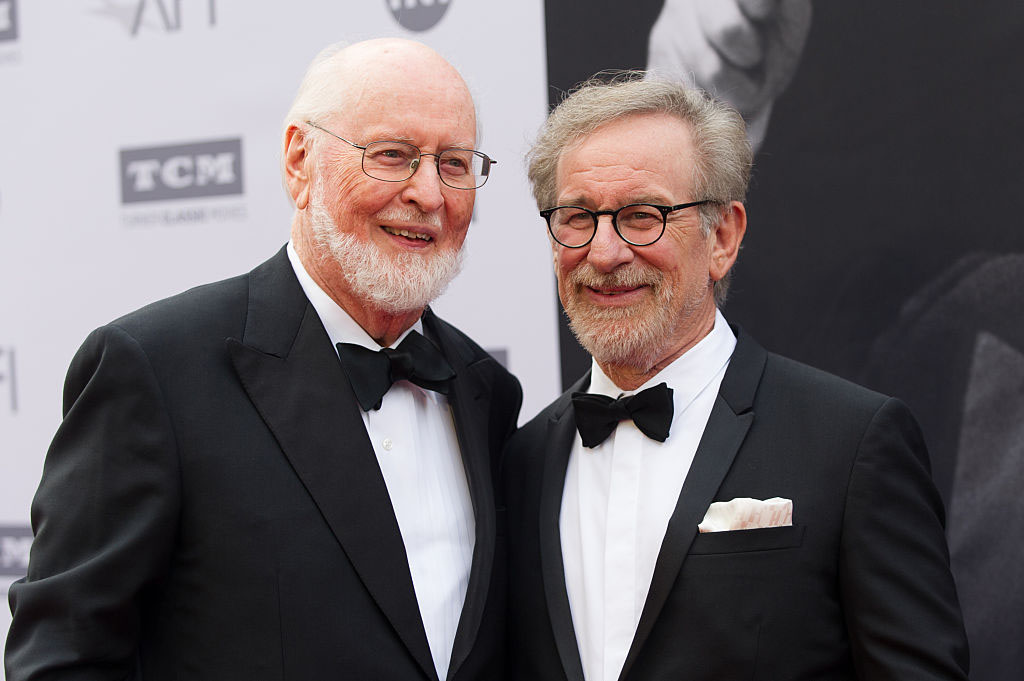
The biggest Jewish milestone at The 68th Grammy Awards went to a filmmaker: Steven Spielberg. The 79-year-old director won his first Grammy, making him only the 22nd person to win an Emmy, Grammy, Oscar and Tony (EGOT) in competitive categories.

Spielberg won the Grammy for Best Music Film as a producer of the documentary, “Music by John Williams,” about his long-time collaborator. Spielberg is now the ninth Jewish EGOT. The eight others are composer Richard Rodgers, composer Marvin Hamlisch, composer and orchestrator Jonathan Tunick, director Mike Nichols, comedian, writer and director Mel Brooks, theater and film producer Scott Rudin and composers Alan Menken and Benj Pasek.

“Thank you to all the Grammy voters, whose recognition of ‘Music By John Williams’ means the world to me and our Amblin team, Darryl Frank and Justin Falvey and congratulations to our partners at Imagine and the Walt Disney Company,” Spielberg said in an Instagram post from Amblin Entertainment. “This acknowledgment is obviously deeply meaningful to me because it validates what I have known for over 50 years: John Williams’ influence on culture and music is immeasurable and his artistry and legacy is unrivaled. I am proud to be associated with Laurent’s beautiful film.”

Also at the Feb. 1 ceremony at the Crypto.com Arena in downtown Los Angeles, Jewish singer-songwriter Jack Antonoff won Best Rap Song for “TV Off,” co-written with Kendrick Lamar. Antonoff entered the ceremony tied for the second-most nominations overall, with seven.

Antonoff was one of several attendees to wear a white pin on his outfit that read “ICE OUT,” in protest of the recent federal Immigration and Customs Enforcement (ICE) raids throughout the United States.

Jewish cellist Alisa Weilerstein was part of the winning team (along with Gustavo Dudamel and the Los Angeles Philharmonic) for Best Contemporary Classical Composition for “Ortiz: Dzonot,” composed by Gabriela Ortiz.

In musical theater, Jewish producers Dean Sharenow and David Yazbek won Best Musical Theater Album for “Buena Vista Social Club,” representing the Original Broadway Cast. The show features dialogue in English, with songs performed entirely in Spanish.

“Our amazing band and cast who perform on our show eight times a week did an amazing job on this record, it was so easy to make,” Sharenow said in his acceptance speech.

Singer-songwriter Paul Simon was among the six honorees in the Recording Academy’s Lifetime Achievement Awards. Over the course of his career, Simon has won 16 Grammys.

Jewish artists who received nominations but did not take home any awards:

San Fernando Valley-native band Haim was nominated for Best Rock Album for “I Quit.”

Comedian Sarah Silverman was nominated for Best Comedy Album for “PostMortem.”

Actor Timothée Chalamet was nominated in Best Compilation Soundtrack for Visual Media for “A Complete Unknown.”

Composer Stephen Schwartz was nominated for Best Score Soundtrack Album for Visual Media  for “Wicked.”

Jewish actor and jazz musician Jeff Goldblum co-presented the award for Best Contemporary Country Album, while Carole King presented Song of the Year.

Recording Academy CEO Harvey Mason Jr., who has spoken publicly in support of Israel and Jewish artists through Creative Community for Peace, introduced Cher, who later presented Record of the Year.

At the 2024 Grammy Awards, the first ceremony held after the Oct. 7, 2023 attacks, Mason gave a speech about music as a shared space. He spoke about the numerous deadly attacks on music fans around the world, including the massacre at Bataclan Concert Hall in Paris in 2015 (89 murdered), the Manchester Arena bombing in England in 2017 (22 murdered), the Route 91 Harvest Music Festival in Las Vegas in 2017 (58 murdered), and the Nova Music Festival in Re’im, Israel, where more than 360 music fans were killed or abducted by Hamas terrorists.

Before introducing a string quartet featuring musicians of Palestinian, Israeli and Arab descent to perform on stage to open the 2024 Grammys, Mason said, “We live in a world divided by so much, and maybe music can’t solve everything, but let us all agree: music must remain the common ground upon which we all stand together in peace and harmony.”

Steven Spielberg and Other Jewish Notables at the 68th Grammy Awards Read More »

SJP’s Antisemitism on Full Display at Sarah Lawrence College

A recent event at Sarah Lawrence College featuring liberal journalist Ezra Klein was deliberately disrupted by student protesters who sought not merely to express dissent, but also to intimidate attendees and prevent the speaker from being heard. At the same time, an antisemitic slur—referring to Klein as a “Zionist Pig”—was painted on a prominently located campus free-expression board. These incidents followed days of visible agitation and organizing surrounding Klein’s visit.

The disruption was not symbolic or incidental. Masked protesters positioned themselves directly outside the auditorium doors, confronting audience members as they entered. They held a huge signs at the audience with the word “Nazi” and they chanted, “Sarah Lawrence, we know you; you protect Zionist Jews.” The chants were not aimed solely at the speaker. They were directed at Jewish students, faculty and others attempting to attend a campus event without harassment. The message was unmistakable: Participation itself marked one as illegitimate.

The protesters’ intent was not to persuade but to deter. Their physical placement at entry points, their attempts at anonymity with masks, and their language all served to heighten intimidation. This was not protest at a distance. It was targeted confrontation designed to make participation in a school event uncomfortable or unsafe. The targeting of attendees rather than arguments—of “Zionist Jews” rather than ideas—is the defining feature of collective punishment, not political protest.

Throughout this, Sarah Lawrence’s president, Cristle Collins Judd, was physically present on stage. She did not intervene as protesters crowded outside the lecture hall, chanted hate at attendees, and created an atmosphere of intimidation. She did not pause the event, address the conduct as it unfolded, or attempt to enforce institutional boundaries in real time. No appreciable visible security was present to manage the situation or protect those entering the auditorium. When the large number of protesters eventually dispersed from the auditorium, Judd turned to Klein onstage and said, “Welcome to Sarah Lawrence College.”

Klein himself attempted engagement. From the stage, he invited protesters to remain and participate in discussion. Rather than accept that invitation in earnest, the protesters—affiliated with Students for Justice in Palestine—left after a perfunctory exchange. The disruption was not a failed attempt at dialogue; it was a refusal of dialogue.

The following day, Judd sent a campus-wide email addressing both incidents. She explicitly identified the slur as antisemitic, acknowledged that the disruptions created an atmosphere of intimidation, and stated clearly that such conduct interfered with the audience’s ability to hear and engage with the speaker. She reaffirmed that intimidation and dehumanization cannot be condoned and referred the incidents for investigation under the College’s conduct process.

That statement mattered. It articulated institutional norms and drew an important distinction between protest and intimidation. But what followed made clear that those norms were being openly rejected.

In a public statement issued on Jan. 29 on Instagram, Students for Justice in Palestine responded to the president’s email not by acknowledging those boundaries, but by attacking them outright. The group asserted that Klein’s talk “necessitated disruption,” describing him as “an apologist of white supremacist views and an accessory to genocidal state violence,” and declaring it their “obligation as people of conscience … to not allow the platforming of racist political pundits to go on unchecked.”

The statement went further, insisting that, “Disruptive as it was, the protest was neither violent nor did it violate safety standards, college policies, or ‘infringe on the rights of others’ in any way.” It accused Judd of “blatant lies wielded to vilify students and manufacture consent for disciplinary charges,” dismissed the antisemitic slur on the free-expression board as “equally ludicrous,” and claimed the administration was seeking to “suppress dissent against Zionism and imperialism at any cost.”

The claim that blocking access, chanting at attendees, and forcing a speaker off meaningful engagement does not “infringe on the rights of others” reflects a worldview in which only certain people are understood to have rights at all.

In a separate slide, SJP warned that if the administration “carries out her threat to bring conduct charges against any peaceful student protestors, we are prepared to contest that effort and protect our students,” concluding with the slogan: “Hands off students. Free Palestine.”

These are not the words of a group seeking clarification or dialogue. They are an explicit rejection of the College’s authority to enforce basic norms of academic life. The statement asserts a unilateral right to disrupt events, denies that intimidation can infringe on others’ rights, and treats disciplinary review itself as illegitimate repression.

For Jewish students, the implications were unmistakable. Many attended expecting the College to provide the basic conditions of safety and order it routinely promises. Instead, they encountered targeted chants, blocked entrances, and an administration unwilling to intervene in real time. They were later told that intimidation had occurred, but only after it had already succeeded.

Jewish students are often told that discomfort is part of political life. What occurred here was not discomfort. Students shared with me that they were deeply concerned for their safety and believe that violence was imminent. What happened was unambiguous: another clear and dangerous case of institutional failure to protect students’ equal access to academic life.

Leadership is not measured by the clarity of statements issued after norms collapse, but by whether those norms are enforced when they are challenged. In this case, disruption was foreseeable, authority was tested, and enforcement was deferred.

Leadership is not measured by the clarity of statements issued after norms collapse, but by whether those norms are enforced when they are challenged.

This was not a failure of foresight. It was a refusal to lead when leadership carried a cost, and the consequences of that refusal now extend beyond a single event to the credibility of the institution itself.

What makes this episode especially clarifying is how little it ultimately had to do with Israel, policy, or geopolitical disagreement. Klein has been openly critical of Israel and of successive Israeli governments for years. He was not targeted because of a particular argument made onstage that night. He was targeted because he could be reduced to a caricature (“Zionist,” “white supremacist,” “genocide apologist”)—labels deployed not to debate ideas, but to delegitimize a Jewish speaker and justify his silencing.

That same logic was extended to the broader Jewish community at Sarah Lawrence. The chants directed at attendees, the dismissal of an antisemitic slur as “ludicrous,” and the insistence that intimidation does not infringe on others’ rights all follow a familiar pattern. Jews are told that their exclusion is deserved, that their fear is fabricated, and that any attempt to name what is happening is itself an act of bad faith. Historically, antisemitism has often relied not on explicit hatred alone, but also on moral narratives that recast the exclusion of Jews as ethical necessity.

Historically, antisemitism has often relied not on explicit hatred alone, but also on moral narratives that recast the exclusion of Jews as ethical necessity.

This is not political protest. It is a tactic of degradation and is evil.

When a group asserts a moral right to disrupt, denies that harassment can cause harm, and portrays enforcement as illegitimate repression, it is not advancing a cause. It is asserting dominance. The purpose is not persuasion, but intimidation; it is not speech, but silencing. The target is not a viewpoint, but a community.

It’s crucial to call this what it is: pure hate toward Jewish Zionists. Antisemitism does not always arrive draped in ancient symbols or explicit slurs and imagery. It often appears in modern language—in claims that Jews uniquely deserve exclusion, that Jewish presence is provocation, and that Jewish safety is a negotiable inconvenience. What unfolded at Sarah Lawrence reflects that reality in a clear and raw form and asserts that Jewish Zionists are not human.

Institutions exist precisely to draw lines against this kind of behavior. They exist to ensure that disagreement does not become dehumanization and that protest does not become persecution. When those lines are not enforced—especially when warning signs are clear—the result is not pluralism, but permission.

This was not about Israel. It was not about politics. It was about whether Jewish students are entitled to the same dignity, safety, humanity and participation as everyone else. On that question, Sarah Lawrence’s leadership hesitated and only reacted once the protests became public and they were forced to act. When institutions treat the intimidation and dehumanization of Jews as a debatable political tactic rather than an enforceable moral boundary, antisemitism does not merely appear on campus—it is empowered.


Samuel J. Abrams is a professor of politics at Sarah Lawrence College and a senior fellow at the American Enterprise Institute. 

SJP’s Antisemitism on Full Display at Sarah Lawrence College Read More »