
fbpx

October 13, 2025

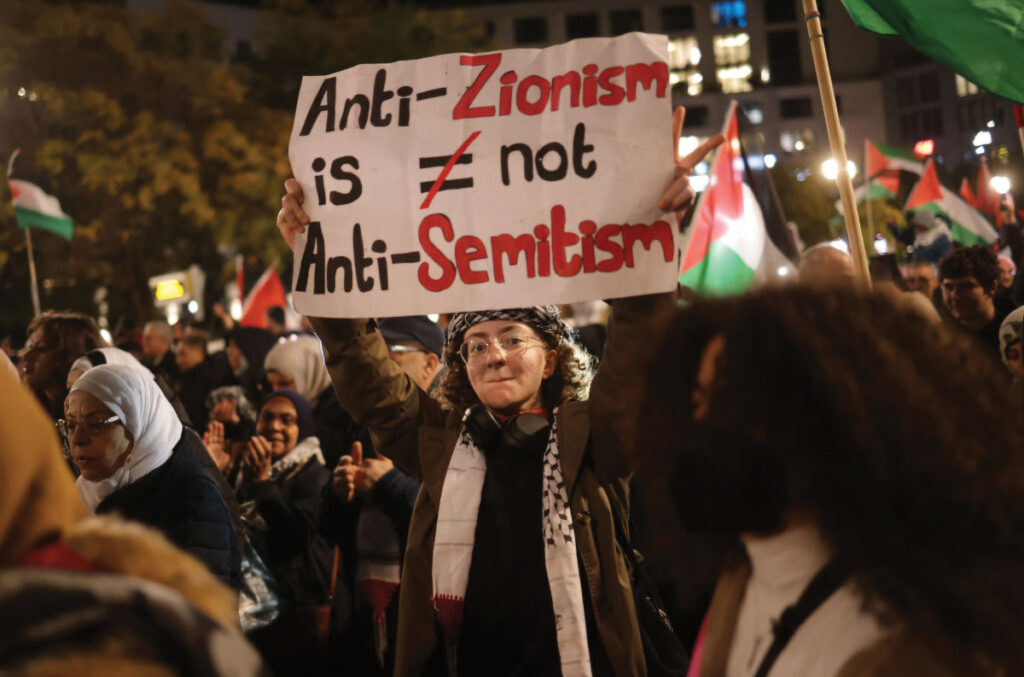
For Peace, End the Anti-Zionism Lie

For many, for the first time in decades, peace in the Middle East feels possible.

The Trump-brokered 20-point framework—now accepted by Hamas under U.S. and Israeli pressure—offers a ceasefire, the release of hostages, and a new political reality in Gaza.

But its success won’t depend only on diplomacy or reconstruction. It will depend on whether the web of lies that has fueled this conflict for generations—the lie that recasts Zionism as the world’s great evil—can finally be dismantled.

If that lie remains, the “peace” now in sight will be little more than a pause between wars.

The Oldest Trick in the Autocrat’s Book

From Caracas to Moscow, Havana to Tehran, dictators and demagogues have long invoked a familiar villain: Zionism. Their fixation has never truly been about Israel or Jews—it has always been about power and fear.

In the modern autocrat’s playbook, anti-Zionism isn’t an ideology but a tactic: a way to unify factions, redirect rage, and disguise failure under the pretense of “solidarity.” It works for the same reason antisemitism has for centuries—it makes hate sound righteous.

For generations, antisemitism served as a pressure valve for rulers. When societies were buckling under corruption or defeat, Jews were blamed—accused of being both powerless and omnipotent. The genius of the lie was its flexibility: it explained everything, demanded no proof, and absolved those in power.

After the Holocaust, open antisemitism became taboo in much of the world. But the instinct to offload guilt onto a Jewish abstraction survived. It simply changed names. The new vessel was Zionism.

Moscow’s Manipulation

This transformation was engineered.

In the 1960s and 70s, the Soviet Union helped to repackage classical antisemitism into a political ideology disguised as “anti-Zionism.” Seeking to weaken both the West and the young democratic State of Israel—a refuge for Jews fleeing oppression—Moscow turned old conspiracy myths into Cold War propaganda.

Through KGB-backed disinformation, Zionism was portrayed as an imperialist cabal, a tool of American domination, even a moral twin of Nazism. Soviet agents and their allies exported this poison through the Non-Aligned Movement and sympathetic media across Africa, Asia, and Latin America.

That campaign gave autocrats everywhere a gift: permission to revive antisemitic myths under the halo of “justice.” The vocabulary changed; the function did not.

Projection for Power

Projection is the lifeblood of authoritarianism. Dictators need binaries—pure and corrupt, oppressed and oppressor—to preserve control. The easiest way to sustain that illusion is to invent a villain.

In Latin America, where corruption and inflation hollow many economies, “Zionism” is invoked as shorthand for foreign manipulation—a scapegoat for homegrown decay. In parts of Africa, strongmen rail against “Zionist imperialism” to pose as anti-colonial heroes while silencing dissent.

Autocrats in Russia and China, though often pragmatic with Israel, use similar propaganda about “Zionist infiltration” and “Western plots.” Across the Arab world, anti-Zionism has become ritual—a moral performance that excuses tyranny. Under the banner of “resistance,” regimes justify oppression and failure.

The Present Moment — and the Challenge of Truth

Now, at a moment of fragile hope, these old lies face their first real test in decades.

The ceasefire and Trump’s 20-point peace plan could finally end Hamas’s rule in Gaza and begin a new chapter for Israelis and Palestinian Arabs alike. But peace will endure only if the ideological machinery that fueled the violence for decades is dismantled.

The ceasefire and Trump’s 20-point peace plan could finally end Hamas’s rule in Gaza and begin a new chapter for Israelis and Palestinian Arabs alike. But peace will endure only if the ideological machinery that fueled the violence for decades is dismantled.

From Tehran to Ramallah, generations have been taught that “Zionism”—and by extension, Jews—are the source of their misery. This Soviet-aided myth, fused with radical Islamist dogma, has created a worldview where hatred feels moral and peace feels like betrayal—as seen among demonstrators who once demanded a “ceasefire” but now chant for Israel’s destruction.

If that mindset survives, no peace will. The greatest obstacle to the region’s future is not the absence of negotiation but the persistence of a narrative that paints Jewish self-determination as original sin.

If “Zionism” remains a scapegoat, reconciliation will remain out of reach.

The Mirror They Fear

When tyrants rail against Zionism, what they see in Israel is not oppression but a reflection of what they most fear.

Israel’s story is not one of conquest, but of return.
Not of tyranny, but of freedom.
Not of empire, but of endurance.

It is the only nation in the Middle East where dissent thrives and power changes hands by election, not by coup or decree—and that is precisely what despots hate.

Dictators project their own corruption onto the Jewish state because Israel’s existence exposes everything they are not: accountable, creative, self-critical, vibrantly free.

They don’t seek to shatter the mirror of Zionism—they seek to stain it. By defaming the belief that Jews, like all peoples, have the right to self-determination, they preserve their power while keeping their people shackled to hate and ignorance.

What Comes Next

With Hamas forced to relinquish power and the hostages finally coming home, the next test begins: whether Palestinian society—and the Arab world more broadly—will confront the indoctrination that turned antisemitism into virtue.

If peace is to last, Palestinian leaders must replace a dominant culture of hate with the ethic of coexistence. They must teach that Jews are not interlopers from the “river to the sea,” but an indigenous people whose return fulfilled history, not theft and who aren’t going anywhere.

Only when that truth is spoken—not whispered—can peace take root.

This moment, tenuous but historic, is the best chance in decades for a Middle East free from Hamas’s tyranny and the ideological poison from Hamas’s ideological predecessors that sustained rejection of Jewish sovereignty long before Hamas existed.

Whether it endures depends less on ceasefires than on courage—the courage to end the lies that have murdered peace for generations.

Because peace built on truth is difficult—but it’s the kind that lasts.


Micha Danzig served in the Israeli Army and is a former police officer with the NYPD. He is currently an attorney and is very active with numerous Jewish and pro-Israel organizations, including Stand With Us and the FIDF, and is a national board member of Herut North America.

For Peace, End the Anti-Zionism Lie Read More »

Oct. 7 Vs. Oct. 13: When Fear Battles Joy

How quickly will we jump back into the fray?

Now that the hostages are finally home and we’ve seen the hugs and the tears and the explosions of joy, how soon will we return to our comfort zone of skepticism and never-ending analyses?

Yes, we all took a time-out for our hearts. How could we not? Have we ever seen a cause in our lifetime that has captured more Jewish hearts than that of the Oct. 7 hostages?

How many times over the past two years have we seen people wear pins and other mementos in their honor?

How many hostage posters have been put up? How many videos of family members have we seen pleading for their release? Liberating the hostages was more than a cause, it became a global solidarity movement.

Then, on Oct. 13, after 738 days of “bring them home,” the hostages who were still alive came home. No more agony. No more primal screams. We quit the yearning cold turkey and started breathing again.

The reunion scenes were overwhelming. I saw a clip of a father who couldn’t stop wailing as he embraced his returning son. He knew he was being filmed. It didn’t matter. Just as was happening across the nation, he had surrendered to the moment.

There are moments when our hearts are forced to surrender. Oct. 7 was one of those moments. The grief, the shock, the horrors, the rage, drowned our hearts.

Our hearts seem to surrender more easily to tragedy. Death is finite. The thought of never seeing a loved one again can make us lose our minds.

It is harder to surrender to joy. Joy is ephemeral, conditional, up for grabs.

Oct. 13 changed that. This was no rudimentary joy. This was joy born from two years of shivering pain, the kind of pain that can’t be described because it is a pain of not knowing, a pain of imagining the very worst.

The wailing of that father who was in ecstasy carried that pain. His heart was helpless at the sight of his son. It could only surrender to the joy, a joy so intense it overtook the part of the brain that stops us from embarrassing ourselves in public.

I can’t recall seeing so many Jews awaiting with such anticipation one event, in this case a day of liberation. That alone should make the delirious Oct. 13 go down in the history books.

Fear, however, is stronger than even intense joy. We see fear as the instrument that keeps us alive. Fear is useful; joy is optional. Fear makes us watch our backs, face evil squarely, trust no one who hasn’t earned it.

Israel would never have come this far without the protective edge that fear provides. It is the fear of losing thousands of civilians from rocket attacks that created the Iron Dome.

Still, the miracle of Israel is not that it has figured out how to survive while surrounded by genocidal enemies. That is miracle enough.

The real Israeli miracle is that it never allowed the imperative of fear to drown out the sanctity of joy.

Israelis fight to the death in order to taste joy.

On Oct. 13, they didn’t just taste it; they gorged.

Now, with the gorging behind us, it’s tempting to move on and return to serious matters.

There is no shortage of serious matters: Who will rule Gaza? Will Hamas disarm? Is the war really over? Will Israel be handcuffed by the “peace deal”? Will new elections bring hope or pessimism? Can the Abraham Accords be expanded? Will antisemitism continue to rise? And on and on.

Those are issues that will dominate the conversations over the coming weeks and months, including my own columns. For now, though, it’s worth wallowing a little longer on Oct. 13.

Just as Oct. 7 darkened our hearts for so long, Oct. 13 has come to brighten those hearts and remind us why they beat in the first place.

Ultimately, our hearts beat not to fight our enemies but to hug our families. Our hearts beat not to bring anxiety to Shabbat tables but to bring joy and holiness.

It is divine timing that Oct. 13 has come at the end of Sukkot, a holiday when joy is not an option but an obligation. After a long month of penitence and atonement, Sukkot reminds us that finding the joy in life is a holy mission.

If Oct. 7 brought home the lesson of never taking fear too loosely, Oct. 13 brought home the lesson that joy itself deserves to be taken seriously.

If the images of Oct. 7 transmitted the fanaticism of a death cult, the images of Oct. 13 transmitted that we are fanatical lovers of life.

Oct. 13 will never make us forget Oct. 7. Nothing can. But because Oct. 7 was all about death and Oct. 13 is all about life, that will be the latter’s eternal edge.

I don’t mind spending a little more time with that.

Oct. 7 Vs. Oct. 13: When Fear Battles Joy Read More »

Trump’s Fragile Gazan Truce

The ceasefire that went into effect on Friday between Israel and Hamas, and the hostage release that took place on Monday—and the still uncertain regional peace the ceasefire may portend—is a monumental achievement from an American president not known for diplomacy. It should have garnered Donald Trump the Nobel Peace Prize. Begrudge all you wish, but he has had a hand in neutralizing eight wars under his watch.

Barack Obama received his Nobel before he spent a single day in the Oval Office. The Norwegian Nobel Committee was very impressed that he had written a book about himself, and another about his father—neither of which had anything to do with world peace. Wars raged all throughout his presidency while he retracted invisible red lines and America withdrew from foreign affairs.

Obviously, they graded on a curve.

The diplomacy that resulted in an end to the war in Gaza began with a massive showing of Israeli military might, and a robust return of American Exceptionalism—which fell out of favor during the Obama and Joe Biden administrations.

Strategic partners materialized. A consortium of Arab and Muslim nations, once implacable in their hatred of the West, and especially Israel, suddenly warmed to more Abraham Accord feelings. The United Nations, with its anti-Israel obsessions, was not invited to join. Countries like Saudi Arabia, Jordan, Pakistan, Indonesia, Turkey, Qatar and Egypt were called upon to pressure Hamas and assent to Trump’s peace initiative.

What swayed them? Israel’s Defense Forces routed Hamas and Islamic Jihad and literally blew the heads off Hezbollah leaders. Bombing Gaza until it possessed the same topography as Mars left a lasting impression, too.

With America’s assistance, Israel calmed the region’s trepidations about a nuclear Iran. The Islamic regime normally relied on neighboring terror groups to do its actual fighting. Israel placed a pox on all of Iran’s proxies.

Israel’s various military maneuvers and covert operations will be studied for centuries. Terrorists were killed in their sleep—while under the protection of Iran and Qatar! Qatar came to realize that allowing Hamas’ leadership to luxuriate in its five-star hotels came at the cost of Israel’s all but certain retaliation.

Nations that once refused to recognize Israel’s right to exist began to question whether solidarity with Palestinians made sense anymore. The depravity of October 7 sickened them, even if they failed to say so publicly. Meanwhile, a forceful and determined United States president made his intentions clear by choosing sides, setting expectations, presenting a 20-point plan, and calling for a Summit in Sharm el-Sheikh.

Many believe these nations came together because of the mounting Palestinian death toll. Not likely. The entire region is long accustomed to seeing dead Arabs—far more than the casualties of war in Gaza. It was unabashed strength, not pity, that mobilized them. Trump summoned them; Israel’s thrashing of its enemies terrified them.

Trump met with the families of hostages, addressed the Knesset, and lapped up all that Israeli love. The Summit will make for a nice photo-op, but don’t expect much more. There are too many obstacles undermining the prospects for a lasting peace.

Trump mainly achieved a truce, a hostage-prisoner exchange, and a tentative Israeli withdrawal. Twenty hostages still believed to be alive have now been returned. Of the 26 thought to be dead, their bodies were expected to be returned. The remains of two additional Israelis, one an IDF soldier that Hamas has been ghoulishly preserving since 2014, may be returned, as well.

But so far, only four have been reclaimed. Israeli intelligence had believed that 10 to 15 bodies will never make it back to Israel. This is an ominous sign.

Meanwhile, Israel will release 250 convicted Palestinian killers, along with an additional 1,700 Hamas terrorists captured during this war. In an earlier exchange, Israel had already freed 2,000 terrorists. Israelis know the risks of such lopsided bargains. Yahya Sinwar, the mastermind behind the October 7, 2023 massacre, was released along with 1,000 of his henchmen back in 2011.

None are expected to take up careers in high tech or humanitarian relief. Terrorism is their chosen profession. Jihad their destiny. Martyrdom, a sacred calling.

This peace plan contemplates that Hamas will demilitarize and accept amnesty in return for departing Gaza—for good. Under no circumstance are they permitted to govern Gaza again. The peace plan also envisions that the entirety of the Palestinian population will deradicalize.

Good luck with that. Hamas was not a party to these negotiations. Their bloody signatures will not appear on any official peace treaty—nor could their bond ever be trusted. They have already hinted that they regard the plan as a mere proposal requiring further negotiation. With Israel already in the throes of withdrawing from the enclave, who will ensure that Hamas is stripped of its munitions?

Hamas is not going away easily, even if some leave. The Muslim Brotherhood’s lasting influence over the hearts and minds of Gazan society is ironclad.

Hamas is not going away easily, even if some leave. The Muslim Brotherhood’s lasting influence over the hearts and minds of Gazan society is ironclad.

The Gazan people, until very recently, remained infatuated with Hamas. And they remain delirious from the October 7 bloodbath. The Palestinian Authority, by contrast, is wildly unpopular in both the West Bank and Gaza. Yet, it is the PA that this peace plan envisions as the ultimate governing authority of the Palestinian people.

It calls for a technocratic Palestinian committee to run Gaza. Are there Palestinians, anywhere, with a demonstrated flare for municipal services that doesn’t include paying bounties to terrorists and skimming the proceeds?

Are there Palestinians, anywhere, with a demonstrated flare for municipal services that doesn’t include paying bounties to terrorists and skimming the proceeds?

As for the “international stabilization force,” assigned the task of ensuring that Gaza does not fall into the hands of jihadists, which countries will be able to instill confidence that Israel’s border with Gaza will be secure?

Lastly, the plan assumes that Israel will one day fully withdraw its military from Gaza. But given the immense trauma that ensued from October 7, culminating in the longest war in Israel’s history, trusting their neighbors is going to be a tough sell.

Israeli Prime Minister Benjamin Netanyahu promised Israelis that the war will continue until Hamas terrorists are no longer among the living. This unfinished business angered the hardliners in his coalition government. But he wisely knew not to jeopardize Trump’s shaky Middle East triumph.

As for deradicalizing Palestinians, after World War II, the people of Nazi Germany and Imperial Japan did not instantly renounce their loyalties to Hitler and Hirohito. Re-education takes time. Generations of Palestinians, starting from the womb, have been taught to kill Jews and destroy Israel. It may never get unlearned.

A gesture of repentance and regret might help. But has anyone heard: “We are mortified by the mass rapes of your teenage girls and the torching of your infants, all done in our name”?

On the contrary. The day when the ceasefire was announced, Gazans were chanting, “Khaybar, Khaybar, ya yahud!”—translation, “Oh Jews, Gazans will finish you soon.”

Does that sound like a people chastened and ripe for deradicalization? The destruction of the Jewish state has been a generational struggle with millennial patience. The global pro-Hamas protesters were of the same mindset. Such murderous objectives don’t just dissipate upon request.

Trump has brought a lull in the fighting and a measure of relief. But one person’s truce is another’s recharging of rage.


Thane Rosenbaum is a novelist, essayist, law professor and Distinguished University Professor at Touro University, where he directs the Forum on Life, Culture & Society. He is the legal analyst for CBS News Radio. His most recent book is titled, “Beyond Proportionality: Israel’s Just War in Gaza.

Trump’s Fragile Gazan Truce Read More »
