fbpx

August 3, 2025

Researchers Say Very Few Professors are Anti-Israel—Should We Believe Them?

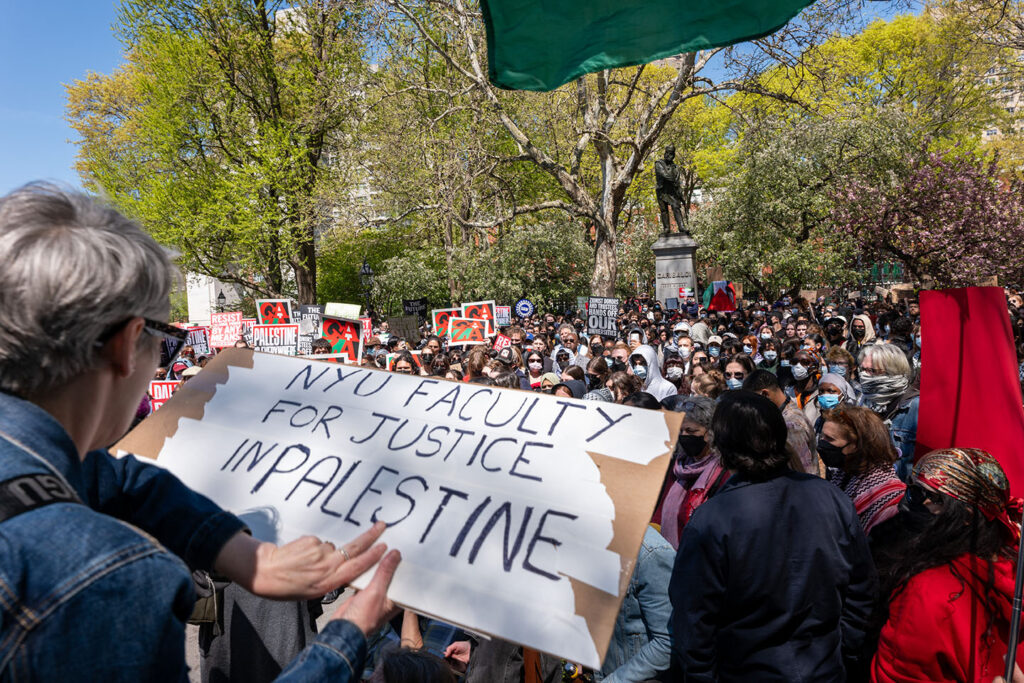
In the wake of October 7, many American Jews have been forced to confront a bitter reality: The institutions they helped build and sustain—elite universities foremost among them—are now home to voices not just indifferent to Jewish pain, but also hostile to the very existence of the Jewish state. So what are we to make of a new Brandeis University study suggesting that hardly any faculty are hostile to Israel, or to Jews, despite clear evidence of a campus climate that feels profoundly unsafe for Jewish students?

The report, published by Brandeis’ Cohen Center for Modern Jewish Studies, surveyed roughly 2,200 faculty across nearly 150 U.S. colleges and universities. According to the researchers, only three percent of non-Jewish professors were “hostile” toward Israel, and just seven percent toward Jews. These are astonishingly low numbers, especially given that just last year, the same research center found that antisemitism on campus was “through the roof.”

In their 2024 report, Antisemitism on Campus: Understanding Hostility to Jews and Israel, the Cohen Center reported that 82 percent of Jewish students believe there are hostile attitudes toward Israel on their campus, and 60 percent believe the same about attitudes toward Jews. Even 33 percent of non-Jewish students perceived hostility toward Jews, and 56 percent saw it toward Israel. These findings, based on student experiences, tell a very different story from the faculty self-assessment.

So how can these numbers coexist? How can a campus climate feel so inhospitable to Jews and yet be populated by faculty who are, allegedly, overwhelmingly tolerant? The answer lies in the definitions and methodologies. According to the Brandeis researchers, only faculty who endorse all or most of a small subset of extreme statements are labeled “hostile.” But this threshold is far too high to be meaningful.

Consider just a few of the actual findings. More than half of the faculty in the sample—54 percent—agree that Israel is an apartheid state. Over one in 10 agree that Jews have too much power (11 percent). Nearly one in 10 (eight percent) would not want to collaborate with a scholar who supports Israel’s right to exist as a Jewish state. And seven percent believe Israel does not have the right to exist. Yet somehow, only three percent are coded as anti-Israel? This is all very suspect; it must be that more than three percent of the faculty are hostile.

Even more troubling is that none of these questions asked faculty if they support the Jewish state’s right to exist, reject academic boycotts, or speak out when Hamas is praised in student demonstrations. Absent such questions, the survey cannot detect the most prevalent forms of anti-Israel hostility: silence, equivocation, and selective outrage.

Social science research has long established that self-report surveys on sensitive political topics suffer from social desirability bias. People often give the answer they think is expected, not what they actually believe—especially in highly ideological environments like academia. Scholars like Timur Kuran have shown how preference falsification can skew public discourse and cloud the ability to detect real belief systems.

It is also crucial to note that many faculty behaviors—the very ones that shape campus climate—are not captured in attitude surveys. The language they use in class, the speakers they invite, the reading lists they curate, the petitions they sign, and the way they respond to controversy all have far greater influence on students’ daily experience than how they check a box on a questionnaire. The Brandeis report does not account for any of this. It invites readers to look away from the real-world manifestations of ideology and instead rest easy with abstract categories that soften reality.

But let’s set aside survey limitations for a moment. Suppose most professors sincerely believe they are not hostile to Israel or Jews. Then the more important question becomes: What do they actually do to support Jewish students?

Do they condemn Hamas when it massacres civilians? Do they speak out when campus protests glorify terrorism and chant for the destruction of the Jewish state? Do they sign letters denouncing antisemitic slogans? Or do they remain silent, even complicit, as Jewish students are harassed, excluded from coalitions, or pressured to renounce their views?

Behavior, not self-perception, is what matters. Yet the Brandeis report makes no attempt to cross-reference attitudes with actions. Did respondents participate in departmental statements after Oct. 7? If so, what did those statements say? Do they assign readings that include multiple perspectives, or only those framing Israel as a colonial oppressor? Do they encourage Jewish students to speak openly, or subtly discourage dissent from prevailing campus orthodoxy?

These omissions are not trivial and undermine the validity of the entire survey. Faculty who say they are not hostile to Israel but who validate false accusations of genocide or remain silent as Jewish students are shouted down are not neutral. They are enabling a climate of fear and alienation.

Faculty who say they are not hostile to Israel but who validate false accusations of genocide or remain silent as Jewish students are shouted down are not neutral.

There is a common adage in sociology: When behavior and self-report diverge, believe the behavior. By that standard, the Brandeis led faculty survey offers a comforting illusion. It tells us that most professors are moderate, tolerant, and open-minded. Maybe some are. But too many equivocate when clarity is needed, and accommodate extremism under the guise of academic freedom.

As Arthur Brooks often notes, true pluralism requires not just civility but also courage—the courage to stand up for those being marginalized, even when it’s unpopular. Jewish students and faculty are not experiencing hostility in theory; they are experiencing it in practice. They are being asked to check their identity at the classroom door, or to navigate their academic lives with the quiet anxiety of those who know they are one step away from being labeled.

Some Jewish students have begun to withdraw from campus life altogether, choosing to remain quiet in classrooms, opting out of student groups, or finding solace only in Jewish spaces. Others continue to speak up—at personal and academic cost. But the damage is already done when these students must calculate, every day, whether the expression of their identity or the defense of Israel will lead to their social and intellectual isolation.

The test of institutional character is not what faculty say in anonymous surveys. It’s what they say and do in public. And on that score, the academy has a long way to go. Like any process of teshuva—repentance and moral repair—reforming the campus begins with honest accounting. That requires recognizing the uncomfortable truth: large numbers of students and faculty hold anti-Israel views, and a smaller but meaningful number express overt hostility toward Jews.

Minimizing that reality through methodologically narrow surveys does no service to the pursuit of truth. And it does real damage to the cause of Jewish belonging and academic integrity. If we want campuses to live up to their mission of open inquiry and civil debate and authentic education that is based on viewpoint diversity and pluralism, the first step is to stop pretending that hostility isn’t there. The second is to act like it matters.


Samuel J. Abrams is a professor of politics at Sarah Lawrence College and a senior fellow at the American Enterprise Institute

Researchers Say Very Few Professors are Anti-Israel—Should We Believe Them? Read More »
Tisha B’Av: Can We Find Pride in Grief?

Jews around the world are mourning today. We’re mourning tragedies that go back centuries—the destruction of two massive Temples, pogroms, Crusades, the Inquisition, the Shoah, Oct. 7, among other tragedies.

How can we mourn all this in one day?

We can’t. We can’t focus on only one target of grief—there are too many.

So I imagine many of us are commiserating over a kind of “package deal” of darkness. It’s all loosely flowing in our heads and hearts as one big, overwhelming idea—the suffering of the Jewish people through the ages.

This year, I found a hidden blessing in this package of grief. Because the package is so big and overwhelming, I was looking for a consolation that was equally big and overwhelming.

I found it the other night when I heard my friend Rabbi Shlomo Seidenfeld say a few words at a friend’s birthday party. I don’t remember his exact words, but the gist was that the enormous grief we feel at Tisha B’av offers a unique opportunity to reflect on something equally enormous—the pride we should feel that we have overcome so many disasters and are still as vibrant and alive as ever.

Yes, the Temples got destroyed, and Rabbinic Judaism came along to take our tradition on the road. Out of the Inquisition came the flourishing of the Sephardic tradition of which I’m a part. We were almost exterminated in the Shoah, and a few years later, we returned home to Zion after waiting and yearning for 1900 years.

Those disasters and tragedies were all too real, but so was the resilience and the faith that enabled us to prevail and keep the Jewish flame alive.

This doesn’t negate the crucial message of Tisha B’av: Let’s make sure those disasters don’t happen again, if we can help it.

But at a time when we’re reminded that so much of the animosity against Jews is not about what we do but who we are, it’s good to know that who we are has taken us this far.

Tisha B’Av: Can We Find Pride in Grief? Read More »

Sydney Sweeney Saga: The Ugly Truth of Physical Beauty

Brad Pitt looks better than I do. So does Richard Gere, Marlon Brando and Paul Newman.

If you put my face next to theirs and asked 500 people to rank our physical attractiveness (leaving my mother out of it), all 500 would say any of them looks better.

Does that bother me? Of course it does! I couldn’t stand my curly hair and sturdy nose growing up. Who wouldn’t want to look like Brando?

So, as I watch the ugly food fights over the Sydney Sweeney “jeans/genes” commercial for American Eagle jeans, I can’t help but wonder: What’s wrong with being objectively beautiful? What’s wrong with admitting the scientific fact that our physical traits come from our genes?

Apparently, Sweeney’s problem is that she’s white, so the leftist woke brigade is trying to turn her into a eugenics-promoting Nazi.

But any woman of any color can be blessed with an elevated beauty gene. Would we be seeing such an outcry if the woman in the American Eagle ad was a beautiful black actress?

Of course not.

I suspect that what may bother some people is that we’ve made such a big deal of “equality” and “inclusiveness” in recent years, it’s hard to stomach the simple notion that some people may be more physically attractive than others.

Well, those people exist. I see them all the time.

But in an era when no one’s allowed to have their feelings hurt and everything comes down to scoring points for your political team, logic and common sense have no place. Indeed it was amusing to see the woke brigades go bonkers over the weekend because they discovered that Sweeney had registered last year as…a Republican!

I guess that was final proof that she’s a Nazi.

Ironically, by making such a fuss over Sweeney’s physical appearance to weaponize it for partisan warfare, her detractors ended up undermining one of the great truths of life: Real beauty is on the inside. It comes from our characters and our personalities, our ability to bring joy and laughter to those around us, our facility to attract others by radiating warmth and love.

That kind of beauty has less to do with our genes and more to do with how we were raised, whether your name is Brad Pitt or Sydney Sweeney.

Sydney Sweeney Saga: The Ugly Truth of Physical Beauty Read More »

The Rock Star’s Jewish Star

HBO premiered its two-part documentary “Billy Joel: And So It Goes,” a feel-good, fan-favorite time capsule for anyone who came of musical age during the prime of Joel’s recording career, which spanned from 1973’s “Piano Man” to 1993’s “River of Dreams”—consisting of eleven LP vinyl albums. (Two other records bookended his body of work.)

The film is a valentine to Billy Joel’s New York City, the balladeer for whom the “lights go out on Broadway” without ever dimming the steadfastness of that “New York State of Mind.” Even after he stopped releasing records, Joel’s longtime association with New York’s venues endured—Carnegie Hall, Yankee and Shea stadiums, and a longtime residency at Madison Square Garden.

His most prodigious and acclaimed (five Grammy Awards) output occurred between 1977-83, a critical time in American culture, which his music reflected, and this documentary faithfully recalls. While best known for his romantic ballad “Just the Way You Are,” so many of his songs were in tune with an American melancholy of shuttered factories, broken barflies, forsaken steelworkers and fishermen, unfulfilled dreams, unrelieved pressures and a general post-Vietnam malaise.

So many of Joel’s songs were in tune with an American melancholy of shuttered factories, broken barflies, forsaken steelworkers and fishermen, unfulfilled dreams, unrelieved pressures and a general post-Vietnam malaise.

But we now have a better appreciation for why Joel understood human longing and disappointment better than most. The film contains a surprise revelation that undoubtedly stunned even his most ardent fans: Billy Joel was born Jewish in the Bronx, and his father was a Holocaust survivor!

Nothing about what we thought we knew led to such a conclusion. His ancestry and family’s connection to the Holocaust went unmentioned in Rolling Stone interviews. His nose appeared permanently broken from boxing Long Island toughs who teased him for carrying around classical sheet music. Fisticuffs and unaltered noses were atypical of Jewish boys in the 1960s.

He sang about Catholic girls wearing “crosses of gold” and waiting too long to lose their virginity. There was a mention of a Mama Leone and a job with Mr. Cacciatore in Little Italy. He barely survived multiple motorcycle and car accidents on Long Island when Jewish guys his age were setting up their dental practices in Great Neck.

This was the world of an Italian scrapper or greaser, not a Jewish piano prodigy.

But the documentary unearthed that his father was a classical pianist from Nuremberg, Germany who, after watching far too many Nazi rallies right outside his bedroom window, eventually fled to the United States. Most of his family was not as fortunate, however. Nearly all were killed in death camps. While Joel was a small boy, his father divorced his mother and returned to Europe, essentially abandoning his son and cutting off contact.

It wasn’t until Joel was an established artist that he tracked down his father, who was living in Vienna. He was surprised to learn that he now had a much younger half-brother. That sibling would eventually become a renowned conductor of classical music orchestras throughout Europe. Suddenly, Joel’s song “Vienna Waits for You” has new meaning.

Sydney Sweeney is not alone with great jeans.

Although it’s only a short segment of the entire documentary, Billy Joel’s Jewish backstory—all those murdered relatives he didn’t know about until he was already a grown man; the damaged Holocaust survivor for a father, an artist who felt lost in America and cruelly retreated to the cradle of Western culture to start his life anew—shaped Billy Joel’s ambivalent relationship with his father and complicated attachment to the Jewish people.

Billy Joel’s Jewish backstory—all those murdered relatives he didn’t know about until he was already a grown man; the damaged Holocaust survivor for a father, an artist who felt lost in America and cruelly retreated to the cradle of Western culture to start his life anew—shaped Billy Joel’s ambivalent relationship with his father and complicated attachment to the Jewish people.

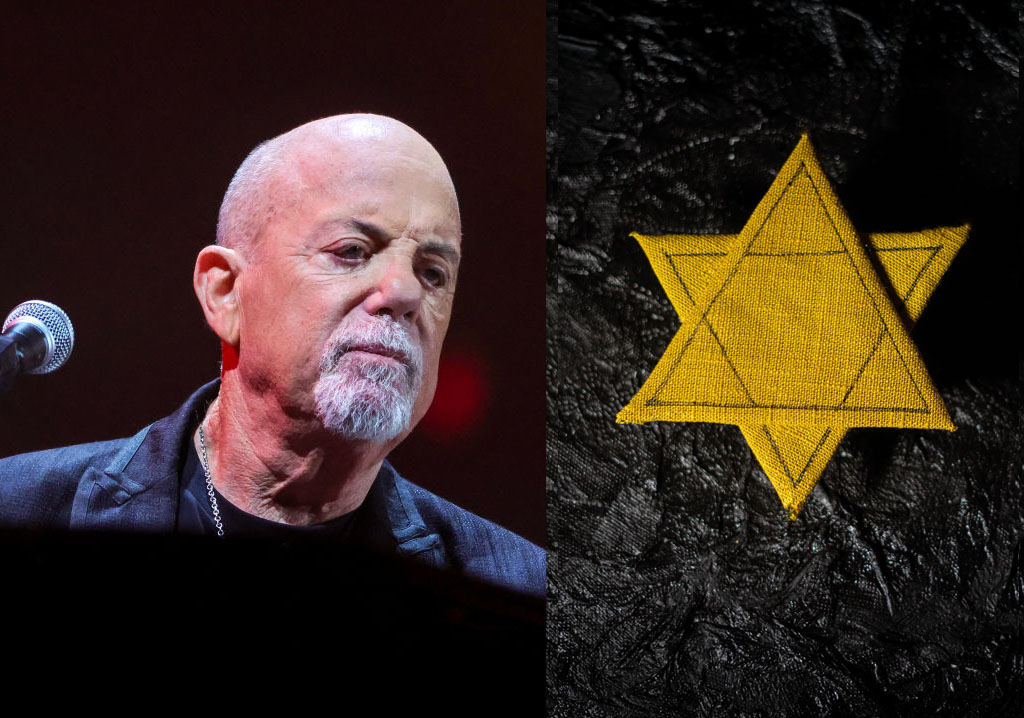
No wonder he kept it all to himself. In 2017, soon after the Unite the Right Rally in Charlottesville, Virginia, where an assortment of right-wing extremists, including neo-Nazis, marched and chanted, “Jews will not replace us!”, Billy Joel took the stage at Madison Square Garden wearing a yellow Star of David patch on his left sleeve and another one attached to the back of his jacket. He didn’t explain his deliberate wardrobe improvisation.

It was a silent preview of what we would all come to learn nearly a decade later.

I fortuitously had an earlier preview, however. Advance knowledge of something I shared with the Piano Man other than a love of pianos. In 1999, I was in Orlando, Florida during Yom HaShoah speaking at its Holocaust Museum. Afterward, at dinner with museum patrons, I was told that Billy Joel had just performed at a benefit for the museum.

I was surprised by the news. Why travel and perform in steamy Florida in May, without renumeration, for a cause that had nothing to do with him? Apparently, Billy Joel had a close friend who worked for Disney in Orlando and had a seat on the museum’s board. Oh, and one more thing: Joel’s father was a Holocaust survivor. The audience in Orlando was told nothing about it. I was instructed to keep my mouth shut.

I did. Now I realize that, at the time, Billy Joel was slowly beginning to come to terms with these family truths. And he was developing some kind of fragmented relationship with father and brother.

Joel is not alone in lifting the nylon curtain and lighting some of the darkness that contributed to his many years of silence. Another wordsmith and giant of Western culture, British playwright Tom Stoppard, received a Tony Award for Best Play in 2023 for “Leopoldstadt,” a fictional retelling of what happened to his family during the Holocaust. He, himself, was a survivor, but left no hint of that history in any of his earlier plays and screenplays—or in interviews and public statements.

“Leopoldstadt” got its name from a street in Vienna, the very same city of high culture responsible for taking hold of Billy Joel’s imagination. (Stoppard’s family was actually from Prague.)

Nowadays the Holocaust has been whitewashed and converted into identity politics talking points. On one level it is being denied as never having happened. At other times it is trivialized as “white privilege” rubbish. Woke teachers treat the Holocaust as an intersectional crime against all minorities—Jews need not apply. Worse still, the Holocaust is being turned against world Jewry itself, with Israel accused of conducting its own Holocaust in Gaza.

As cultural icons of the first order, these recent revelations from Stoppard and Joel are both wrenching and beguiling. And they could not have come at a more propitious moment.


Thane Rosenbaum is a novelist, essayist, law professor and Distinguished University Professor at Touro University, where he directs the Forum on Life, Culture & Society. He is the legal analyst for CBS News Radio. His most recent book is titled, “Beyond Proportionality: Israel’s Just War in Gaza.

The Rock Star’s Jewish Star Read More »