fbpx

August 1, 2025

Learning Torah in Glasgow, or What Caused the Destruction of the Temple?

A sign in a Shtiebelech (small synagogue) in Golders Green, London, caught my eye shortly after I returned from a long stay in Los Angeles. It began with the words: “Due to the situation in Israel…” My mind raced, anticipating the rest of the sentence.

The year was 2002, the height of the Second Intifada. I had just started working for an Israeli tourism company, and I met with leaders of Zionist youth movements from across the Jewish spectrum in England, who had to make a difficult decision: whether to come as they did every year to the summer camp in Israel with their members, or to cancel. In Israel, buses were exploding, and people lived in fear. Even when we lived in Los Angeles, the terror events in Israel were constantly present. In the synagogues there, they responded by organizing a solidarity delegation to Israel, reciting Psalms, or sending money. Everyone, without exception, thought about and worried about the situation in Israel. Meanwhile, the youth movements in England made a unanimous decision: the organizations would go to Israel, but the parents and campers would decide independently what to do.

Then, suddenly, I encountered the following sign in a Hasidic study hall in London: “We invite you to the Kollel in Glasgow.” I thought to myself that the rest of the sentence would be: “to strengthen the people of Israel,” or perhaps “so we can pray, etc.,” but it was different: “so we can learn Torah in peace and tranquility.” And I asked myself – what kind of detachment is this? How could Jews write such a thing?

I was more than two decades younger then, and at the time, it pained me to see this. But I managed and answered myself: “This is a small, disconnected group.” Sad, but what can be done?

Kamza and Bar Kamza: A Society Inherent with Destruction

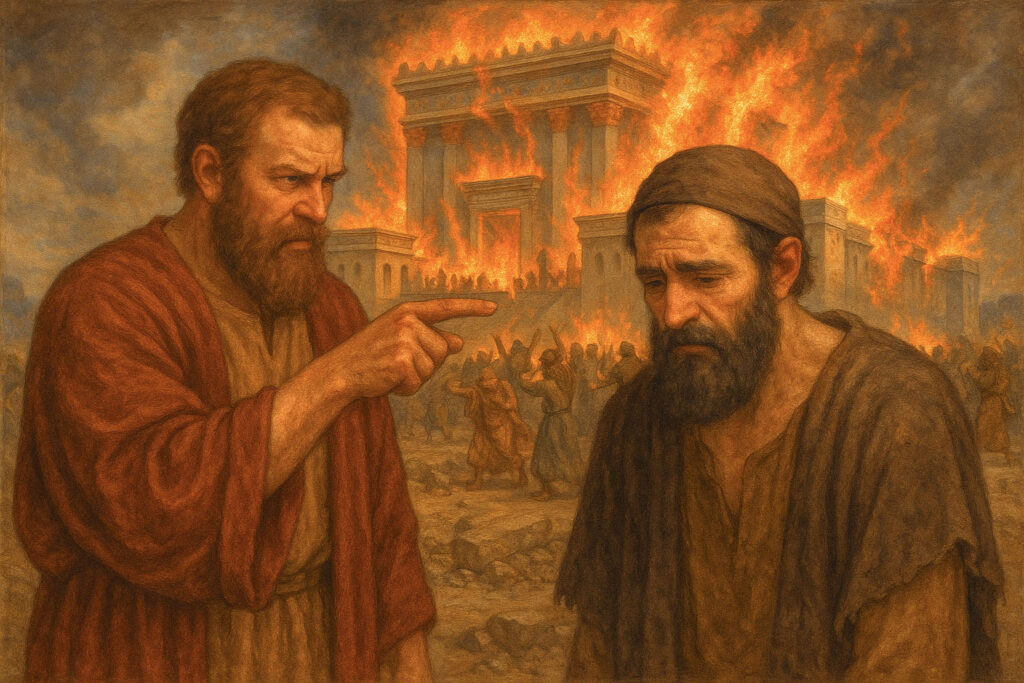
A very well-known story for Tisha B’Av can help us understand the significance of the sign I had seen in London. The story about Kamza and Bar Kamza tells of the destruction of Jerusalem. Many interpretations have been given to the Midrash, but it seems to me that our Sages, may their memory be a blessing, wanted to tell us something fundamental about society: A society preoccupied solely with itself is a ruined one, and there is no longer a need for it.

Let’s delve into this point. The host in the Midrash invites the Sages of Jerusalem as well as “Kamza.” “Kamza” is not his first name, nor even his last name. He represents a social norm: inviting only those who are considered “one of us.” In contrast, others would say about “Bar Kamza”: “He’s not part of the gang.” (The Hebrew word “Kometz” (קומץ) in this context means a closed and limited group).

The Jewish society in Jerusalem, as described in the Midrash, was preoccupied solely with itself. It listened only to its own opinions, to those who were “within the circle.” One could say that this society had an AI system that was programmed to identify only what interested it, and who its “friends” were – that is, those who were similar to it and who thought like it.

This is a sure recipe for failure. Such a society is already in ruins. The physical destruction of the Second Temple was not a sudden event detached from social reality; it was a direct result of the internal social situation. The emotional detachment, the elitism, the inability to embrace the other and the different – all these led to the moral and social collapse that preceded the physical destruction.

Towards a Connected Society

The Faculty of Education at Bar Ilan University, under the leadership of Professor Zehavit Gross, invests heavily in integrating populations from the widest possible spectrum of Israeli society. This year, I had the privilege of being included in a leadership program in memory of Lt. Col. M. (Lieutenant Colonel Mahmoud Kheir El-Din), an Israeli hero from the Druze community who was killed in a military operation in 2018. The program included both Druze and Jews, with the figure of Lt. Col. M. serving as a role model and example for all of us. An independent and advanced State of Israel needs different opinions, diverse cultures, and to integrate as many people as possible from all sectors into academic positions leading to leadership roles in the public sector. This is how Professor Gross led the faculty for many years until her retirement at the end of this past academic year.

It would be simplistic to criticize the sign-writer in London. However, if we think deeply, it might be true that it is very difficult and even dangerous to study when buses are exploding, and sending students to a country in a state of war is not simple; and it might also be necessary to take a break in order to find peace and tranquility. But the real story is about only talking to those who are similar to me. Where do I encounter this? As an edupreneur, an education entrepreneur working with Jewish schools around the world, the answer is: every single day. After examining the situation further, it is possible to understand that the meaning of “Ahavat Chinam” (unconditional love) is not an act of kindness towards the other or an exercise in how to be nice; rather, unconditional love is the ability to appreciate the other for who they are and certainly for what they bring to the world.


Mickey Katzburg is engaged in entrepreneurship, branding and project management and is the founder and director of the World Center for Jewish Education.

Learning Torah in Glasgow, or What Caused the Destruction of the Temple? Read More »
Rebuke and the Bitter Water

Recurrent ceremonies observed with dedication to form promote wisdom. Or we may gerrymander Channukah or Christmas into indictment of Capitalism and the Distribution of Goods; or hijack Passover as a delivery medium for platitudes about Social Justice (whatever that is). But no one ever increased in wisdom from listening to his own opinions, whether from his mouth or that of a rabbi.

The traditional celebration of holidays induces one to reflect on changes in himself. If the liturgy for the Days of Awe does not change, nor the sermons stand in for Journalistic Commentary, the penitent may note a year’s changes in his own understanding of them.

“Reformed” religions all veer toward atheism, as they enshrine the momentary understanding of writ and ceremony as pretext for and so celebration of the individual’s superiority to Divine Will and its expression in Scripture.

All religions are subject to, and products of revision and reformation of course, as they are human, and, so, flawed attempts to codify the metaphysical. Both Chabad and the woke-Reform offer forms called Judaism; and one is free to choose non-alignment, Re-alignment, and various flavors of “free-thinking,” or, worse, its decay into “right-thinking.” But who rose from a religious celebration reasoned into political commentary enlightened or refreshed? No one. What, then, was being celebrated? The superiority of the individual’s wisdom to God’s.

Happy the Jew who reads the Torah every year. Its periodic reexamination can reveal a new, and, so, interesting, understanding. For the intervening year has changed his physiology, and, so, his various desires; it has presented him with new triumphs, failures, and disappointments; and with new concerns and confusions. (See Aging, Challenges of.)

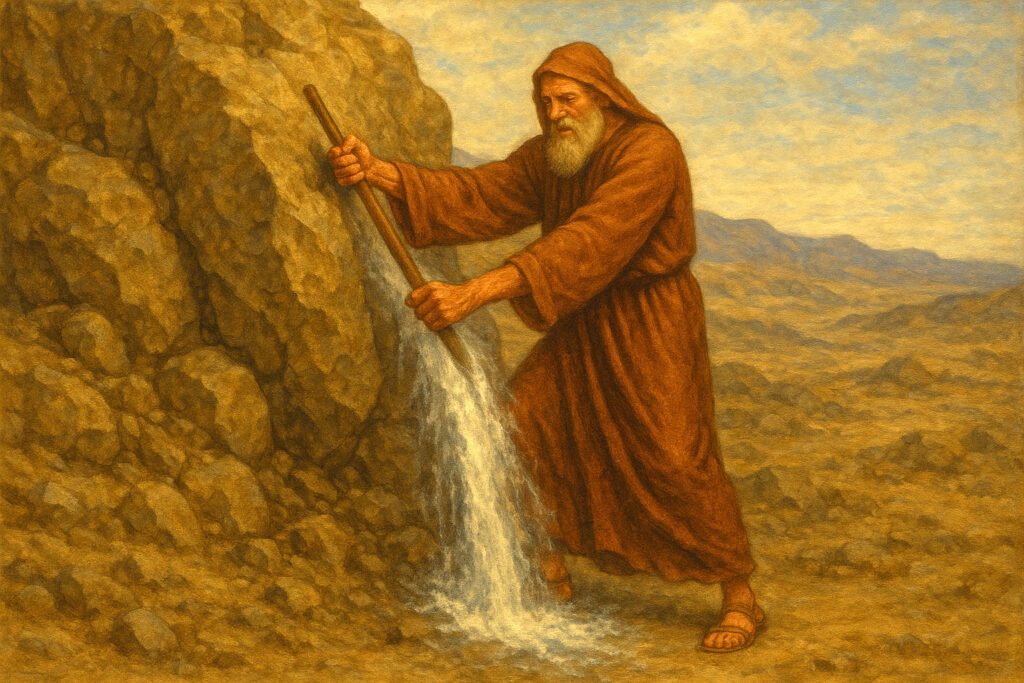
In Exodus 17, the Jews, as always, are complaining about Moses. God has given them Manna, but, camped at Kadesh, they are thirsty, and begin demonstrating against Moses. He cries out to God, “What shall I do for this People? Before long they will stone me.” God tells him to take the staff with which he struck the Nile, march before the People, strike the rock, and water will come out of it. And so it was.

In Deuteronomy 32 Moses is instructed to climb Abarim Mountain and die before entering Caanan with his people. He’s told he will be debarred because he broke faith with God at Kadesh, when he struck the rock. But he was directed to strike it. Generations of commentary explains Moses’s sin was that he struck the rock twice.

But it’s not written in the Torah.

Why did the commentators assert the repeated blows? As they, like millennia of readers, wanted to understand why Moses would be punished for doing exactly that which God instructed him to do.

For years I congratulated myself on a progressed understanding. Moses, it was clear to me, was not punished by exclusion from the Promised Land, but excused, as an example of God’s Mercy. He’d taken the Jews from slavery. He’d protected them and triumphed over every obstacle for the Forty Desert Years in which his only difficulties were the Jews themselves.

God aided Moses against ever tribe, king, and kingdom that stood in the Jews’ way; and, throughout, they carped, rebelled, and mutinied. Throughout the Torah, Moses pleads with God not to destroy his charges in their rebellions and sin. And Moses prevailed. Having brought them to Jordan, to the edge of the Promised Land, God, in His Mercy, spares Moses the knowledge of what the Jews will become in freedom.

That’s how I understood it until this year.

I heartily recommend The Chabad online Torah. Every week’s Parasha is presented in English, and Hebrew, with the Rashi in both languages. Additionally one gets commentary from learned contemporaries.

This last week I found wisdom from The Rebbe on rebuke. It was said that one who was near death could rebuke effectively and acceptably. Why? The Rebbe explained that the elder knew that the rebuked might accept correction from one he need not fear he would encounter afterwards. That is, he need not avoid the rebuker for fear of shame. (We know that Jewish thought equates shaming with murder – in each case the victim turns red.)

At the Jordan, Moses, in his final interchange with God is rebuked. A slight reorganization of the Rebbe’s wisdom is that God does so as it is their final interchange. But if it is a true rebuke, rather than a diplomatic explanation (“I’m exempting you from witnessing the oncoming tragedies”), what behavior prompted it?

My drash: It was not that Moses struck the rock twice – thus, as sometimes explained, doubting God’s Power to effect the miraculous with the one, ordered blow – but that he displaced his fury at the Jews onto the rock.

In the verse previous to his pietrocide, Moses cries out “What shall I do for this people, they will stone me next.” His attack on the rock is understood, by God, by his charges, and, this year, by me, as violent rage against his charges. Here, God, in effect, proclaims, “I commanded you to lead them. I didn’t order you to like them.”

Devar Achar.

REBUKE AND THE BITTER WATER
for The Jewish Journal
by David Mamet

Rebuke and the Bitter Water Read More »

Memory Embrace: A Monumental Act of Remembrance and Justice in Brest

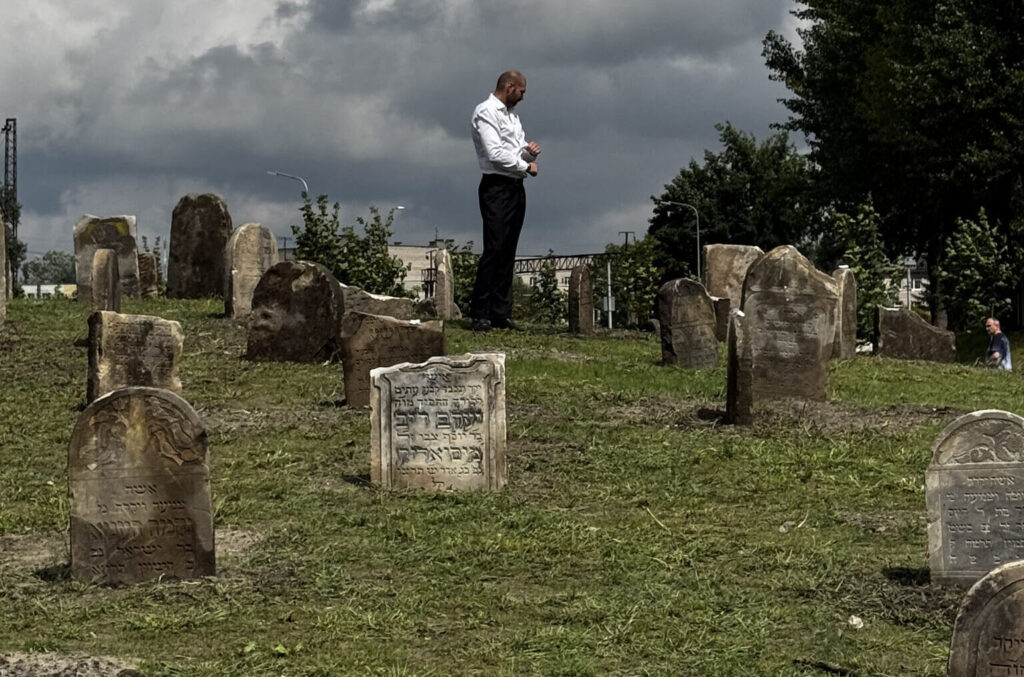
When Stephen Grynberg first stepped onto the grounds of Brest’s old locomotive football stadium in 1997, he wasn’t expecting to find fragments of his family’s past buried beneath the turf. The stadium sat atop what had once been the Jewish cemetery of Brest—his father’s hometown, a center of Jewish life before the Holocaust.

“There was a feeling of such deep and buried sadness amidst the silence of the place” Grynberg said.

More than two decades later, the silence has been broken. On July 28, a striking new memorial—Memory Embrace—was unveiled on a portion of the original cemetery in Brest, Belarus. It is the culmination of a two-decade effort to restore dignity to a sacred site that was destroyed by the Nazis and paved over by the Soviets. The monument, built from recovered headstones, now stands as a public act of remembrance and reclamation.

Photo credit: The Together Plan

Brest, once known as Brisk or Brest-Litovsk, was home to a vibrant Jewish community that helped shape Eastern European religious and cultural life. Founded in 1835, the city’s Jewish cemetery held more than 35,000 graves before the Second World War. But when the Nazis arrived, they murdered nearly all of Brest’s 23,000 Jewish residents and began systematically dismantling the cemetery. The destruction continued in the postwar Soviet era, when the grounds were paved over to build a football stadium, and headstones were used as construction material throughout the city.

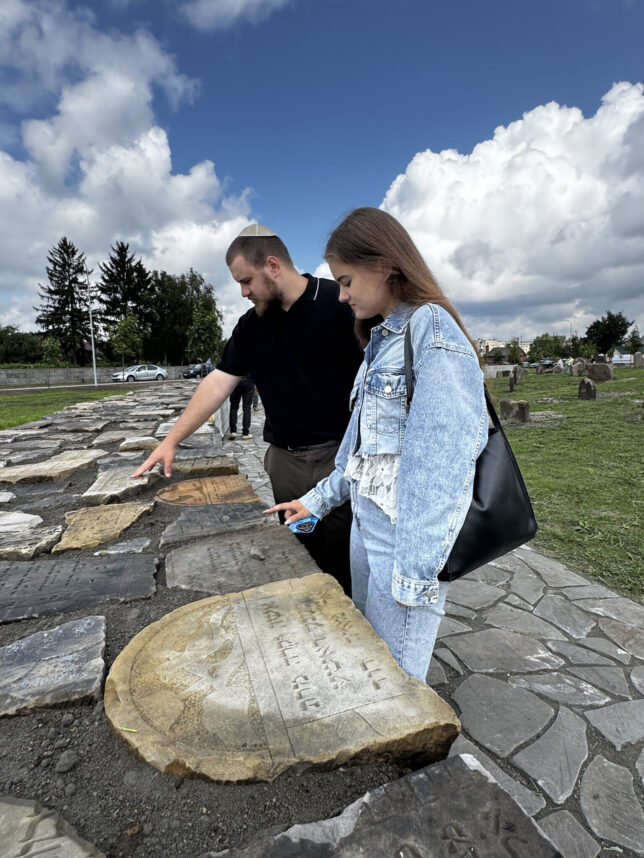
Beginning in the early 2000s, those headstones began to resurface—literally. They emerged during roadwork and renovations, fragments of memory refusing to stay buried. To date, more than 1,200 full and partial stones have been recovered, catalogued, and preserved.

Grynberg, a Los Angeles-based filmmaker and founder of The Illuminate Foundation, learned about the site during his visit to Brest. His late father, Jack Grynberg, was the city’s last living Holocaust survivor. “When I saw the headstones for the first time,” he said, “the idea of returning dignity to this place, to the people buried there, and to the vibrant Jewish community they created was a powerful antidote to the attempted erasure.”

Grynberg helped mobilize an international effort to reclaim and memorialize the site. He partnered with The Together Plan, a UK-based nonprofit led by Debra Brunner, members of the Jewish community from Brest, and Belarusian officials.

To design the memorial, Grynberg turned to Brad J. Goldberg, a renowned artist whose work explores the intersection of memory and material. The two men have known each other since childhood in Denver, where their fathers were friends. That long-standing bond gave the project a personal resonance for both.

The resulting structure, Memory Embrace, features two curving stone walls that cradle a raised mound of earth, both surfaces embedded with recovered headstones. The design invokes both sacredness and shelter—embracing memory within the very soil that once hid it.

“There is this phrase called tikkun olam, about repairing the world,” Goldberg said. “A lot of the work I do is about repairing—cities, towns, places. I’m really hoping this project invokes a sense of sacredness, a sense of peace, and a sense of not allowing this kind of thing to happen again.” For Belarusian Jews who grew up under Soviet rule, where Jewish memory was often suppressed or erased, the unveiling was more than an artistic event—it was a moment of communal reckoning. “Growing up in Soviet Belarus, Jewish history was a shadow—present but unspoken,” said Artur Livshyts, Chairman of the Jewish Religious Union in Belarus. “By consecrating this memorial, we break that silence. This is more than stone and memory; it is an act of defiance against forgetting.”

Brunner, whose team spent years researching the site and building local partnerships, called Memory Embrace a first in the region. “This is a first-of-its-kind memorial in Eastern Europe: bold in scale, concept, and message. It transforms a long-erased cemetery into a sacred site of dignity, reflection, and education.”

As the stones were returned to their resting place,Memory Embrace emerged not only as a tribute to those lost, but as a call to conscience. A physical reminder that dignity can be restored, memory reclaimed, and justice—even delayed—can still take root.

Memory Embrace: A Monumental Act of Remembrance and Justice in Brest Read More »