

fbpx

June 27, 2025

“The Writer:” A Fun Supernatural Graphic Novel Infused with Judaism

When Ben and Max Berkowitz noticed a troubling trend in comic book movies, they decided they had to do something about it.

“Characters who identified as Jewish on the page, as soon as they made the jump to TV or film, their Jewish identity was getting sidelined,” Ben told the Journal. “So we came up with a story where there was no way any studio could remove Jewish identity from it, because it was all Jewish.”

Once the award-winning producing and writing duo (NotABillionaire.com) settled on the concept, the Berkowitz Brothers cold-called their friend actor and “Disney legend” Josh Gad. Gad, who knows every Jewish folktale, “got it” right away, and was excited to partner with them.

“The Writer,” written by the Berkowitz Brothers and Gad, was illustrated by Marvel and DC Comics legend Ariel Olivetti. Dark Horse Comics released it as a four-issue series in trade paperback in April. The supernatural adventure — a la Indiana Jones — follows Stan Siegel, a comic book writer whose life unravels when the fantastical worlds that he writes about start bleeding into reality.

Alongside his fiercely protective mother, Liz (based off of Mom Berkowitz), and his brilliant daughter, Izzy, Stan faces an onslaught of Nazis, demons and mythical creatures drawn from Jewish folklore.

“It dives into themes of creativity, legacy and the power of storytelling … and blends heart, horror and meta commentary on what it means to be a writer,” Ben said.

The Berkowitz Brothers said the response has been overwhelming and humbling.

“Readers have been ecstatic, not just about the story, but about what it represents,” Max told The Journal. “Seeing Jewish characters, culture and folklore at the center of a thrilling, genre-bending comic book has struck a chord, especially during a time of rising antisemitism.”

He added, “Many have described it as refreshing, bold and long overdue; it’s not just entertainment — it’s representation that feels urgent and deeply personal.”

The Jewish Journal asked the Berkowitz Brothers about their graphic novel’s impact, plans for the future and more.

What impact do you hope “The Writer” has?

We hope “The Writer” cracks open the door for more nuanced, layered Jewish stories to take center stage. There’s so much untapped potential in the realm of Jewish folklore and mythology — it’s a treasure trove of complex characters, divine tricksters, moral paradoxes and generational trauma and joy.

Jewish storytelling isn’t linear. It’s layered, full of anxiety and awe, humor and grief. It’s neurotic and mystical, cerebral and emotional. We want this book to show that Jewish identity is not a monolith — and that comic books are a perfect medium to explore that duality.

In what way does this format make the information accessible?

Judaism has always placed a sacred emphasis on the power of words — on storytelling, interpretation, and commentary. Comics are a modern extension of that tradition. They allow ideas to live in both text and image, engaging the reader emotionally and intellectually. In “The Writer,” we fuse myth and modernity in a way that invites even those unfamiliar with Jewish lore to step into a world that’s both fantastical and grounded. Comics, at their best, democratize deep ideas. They are sermons in technicolor.

What’s next for “The Writer”-verse?

While “The Writer” was originally envisioned as a one-off, we intentionally left the ending open and cryptic — because the world we’ve built is full of possibilities. There’s an entire toy box of mythology and storytelling just waiting to be explored. We can’t say too much yet, but we’re cooking up a few things behind the scenes that we’re extremely excited about. This might just be the beginning.

Anything to add? 

Just a thank you. To every reader who picked up the comic, to those who shared it, taught it or handed it to a friend — we see you. This was a story born from love: love of family, of myth, of history, of storytelling itself. We hope it inspires others to write their own stories, to dig into their cultural roots, and to never underestimate the power of a good comic book.

Learn more at www.NABvid.com and follow @BerkowitzBros and @TheWriterComic on Instagram.

Check out the Berkowitz Brothers’ Taste Buds with Deb episode, where Ben and Max dive into their – and “The Writer’s” food connections.

“The Writer:” A Fun Supernatural Graphic Novel Infused with Judaism Read More »
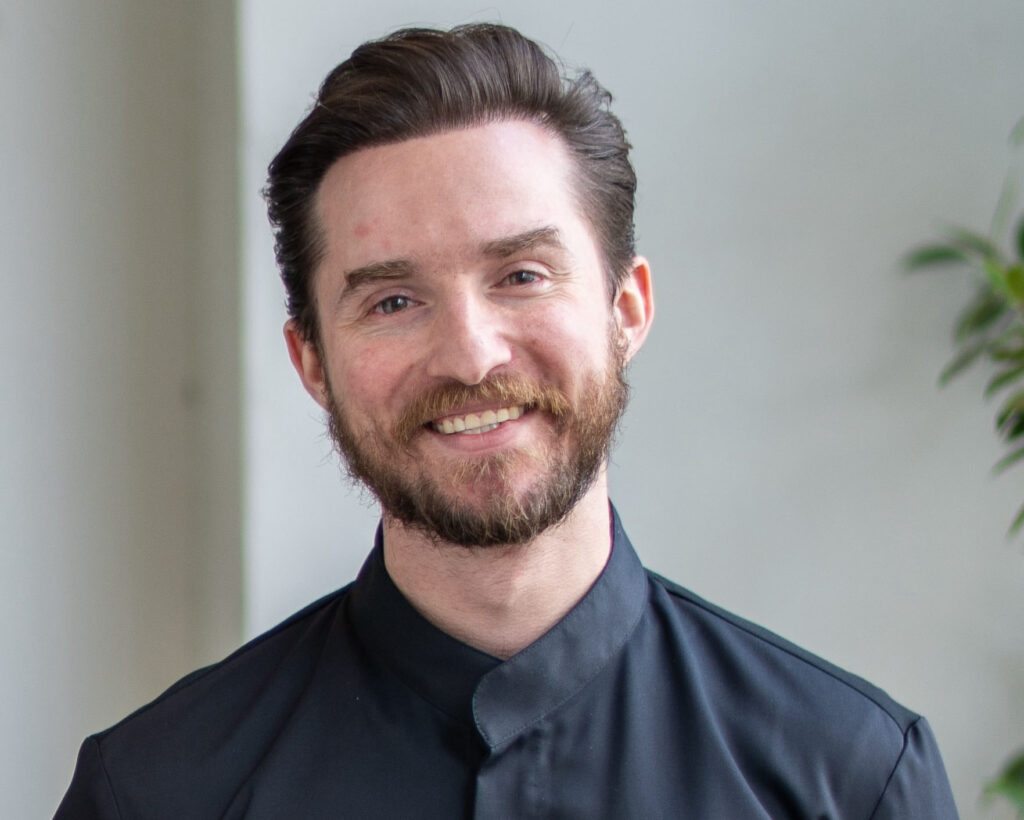
Byron Lazaroff Puck: Spago, Legacy and Short Ribs

Byron Lazaroff Puck, president of the Wolfgang Puck Fine Dining Group, grew up in a flurry of cooking, art and hospitality. This legacy chef is one of the drivers of the future of food.

“There’s a Picasso quote that I love, which is, “Learn the rules like a pro so you can break them like an artist,’ and that always spoke to me,” Puck told the Journal. “To me that means honoring and respecting tradition, the rules, the things that people have worked so hard on to create in the past, and … then also being bold and creative and trying to innovate on top of that.”

Puck is the second son of chef and restaurateur Wolfgang Puck and designer Barbara Lazaroff. Many are familiar with Lazaroff’s annual interfaith seder at Spago that benefits MAZON: A Jewish Response to Hunger. Puck shares his recipe for Passover-friendly braised short ribs below.

“Both of my parents were very supportive at a young age to allow me to experience life and give me opportunities to try and figure out what I wanted to do, whether that was food or hospitality related or something completely aside from that.”

Puck loved art, even as a kid.

“I always wanted to be a painter as a young kid,” he said. “I realized very quickly I was absolutely terrible at it.”

Instead of pursuing that, Puck’s father put him to work, washing dishes at Spago Beverly Hills, at age 12.

“Working in that kitchen and seeing those plates go up on the line and then eventually out to our guests, I always thought was the most amazing thing,” he said. “I quickly realized, ‘If I’m clearly terrible at painting on canvas, maybe I can paint on plates;’ I [had] such an amazing opportunity to learn how to do just that.”

Once that love of food was ignited, Puck never looked back. But it’s the hospitality element that really fuels him.

“It’s not just about serving great food [and] beverages with detail oriented service, it’s about crafting a memory for a person that they can always look back on, whether it’s a 25th or 30th or 50th birthday, an anniversary, a college graduation or a promotion at a job [or] just a regular Tuesday night,” he said. “Every single person that is gracious enough to adorn one of our dining rooms, we want to treat with the utmost respect and integrity.”

Although Puck loves serving great food, that’s not the end goal.

“I love that essence of striving for greatness, but [being the best is] also very subjective,” he said. “What I really wanna be is just your favorite; I want to make and craft an experience that turns into a memory that ultimately brings you back to have it again.”

Puck said some of his fondest food memories from growing up came from spending time in his maternal grandmother’s kitchen.

“Ellie was just an exquisitely beautiful, kind, polite, and wonderful human being and she had, as most bubbe’s should, an epic recipe for [latkes],” he said. ”Anytime Hanukkah rolled around, I got to spend time with my grandmother in the kitchen and learn that recipe from her.”

While Puck has tried to change up her recipe over the years – including making them with ube, Japanese purple sweet potatoes, and Okinawa sweet potatoes – he said, “Nothing beats Ellie Lazaroff’s latkes during Hanukkah.”

Another one of his favorite Jewish foods is gefilte fish. He and his team have worked hard over the years to make a phenomenal gefilte fish recipe.

“It was figuring out how do we elevate [it], how do we keep it traditional, while getting the best quality product … and make it feel like something truly, truly special,” Puck said. “To make people happy and make them feel sustained with great food .. to be able to do that with some of the beautiful traditional items within Jewish cuisine, speaks to your soul … and it’s really beautiful.”

Having a healthy balance of tradition and innovation within a restaurant is what allows you to build a longevity operation. Puck wants to honor what his parents built – a legacy of excellence, persistence and craft – while, as his parents did, being good to others and a helpful influence on up-and-comers.

“There’s room for all of us in this industry,” Puck said. “If there’s any legacy that I want to leave [it is to] put some good back into the world by being able to teach, [guide] … and [create] more amazing human capital.”

Follow @ByronPuck’s food adventures on Instagram and check out WolfgangPuck.com.

For the full conversation, listen to the podcast:

Watch the interview:

Byron Puck’s Passover Short Rib Recipe

1 bottle kosher for Passover Cabernet Sauvignon

2 tablespoons kosher for Passover vegetable oil

6 short ribs, trimmed

Salt

1 teaspoon black peppercorns, crushed

Matzoh meal, for dressing

10 cloves garlic, peeled

8 large shallots, peeled, trimmed, rinsed, split, and dried

2 medium carrots, peeled, trimmed, and cut into 1-inch lengths

2 stalks celery, peeled, trimmed, and cut into 1-inch lengths

1 medium leek, white and light green parts only, coarsely chopped

6 sprigs Italian parsley

2 sprigs thyme

2 bay leaves

2 tablespoons tomato paste

2 quarts unsalted beef stock or chicken stock

Freshly ground Pepper

Pour the wine into a large saucepan set over medium heat. When the wine is heated, carefully set it aflame. Let the flames die out, then increase the heat so that the wine boils; allow it to boil until it cooks down by 1/2. Remove from the heat.

Center a rack in the oven and preheat the oven to 350 degrees F.

Heat the oil in a Dutch oven or large casserole, large enough to hold 6 ribs, over medium-high heat. Season the ribs all over with salt and the crushed pepper. Dust the ribs with about 2 tablespoons of matzoh meal and then when the oil is hot, slip the ribs into the pot and sear for 4 to 5 minutes on each side, until well browned.

Transfer the browned ribs to a plate. Remove all but 1 tablespoon of fat from the pot; lower the heat to medium and toss in the vegetables and herbs. Brown the vegetables lightly, 5 to 7 minutes, then stir in the tomato paste and cook for 1 minute to blend.

Add the reduced wine, browned ribs, and stock to the pot. Bring to a boil; cover the pot tightly and slide it into the oven to braise for about 2 1/2 hours, or until the ribs are tender enough to be easily pierced with a fork. Every 30 minutes or so, lift the lid and skim and discard whatever fat may have bubbled up to the surface.

Carefully transfer the meat to a heated serving platter with a lip and keep warm. Boil the pan liquid until it thickens and reduces to approximately 1 quart. Season with salt and pepper and pass through a fine-mesh strainer; discard the solids.

Presentation: Pour the sauce over the meat. Serve with vegetables of your choice.

This recipe can obviously be made year-round. Feel free to substitute regular wine, oil, and your preferred thickener in lieu of matzo meal.


Debra Eckerling is a writer for the Jewish Journal and the host of “Taste Buds with Deb.Subscribe on YouTube or your favorite podcast platform. Email Debra: tastebuds@jewishjournal.com.

Byron Lazaroff Puck: Spago, Legacy and Short Ribs Read More »

Visiting L.A., Sderot Mayor Discusses Oct. 7 and its Aftermath

Alon Davidi, mayor of Israeli city Sderot, recently appeared at several events in Los Angeles.

On June 9, Davidi, 51, participated in “From the Frontlines of October 7,” a discussion held at Sephardic Temple that was organized by Jewish National Fund-USA (JNF-USA). He appeared in conversation with Dorel Abramovitz, director of development for The Sderot Foundation.

“For us, the seventh of October was a very dark day,” Davidi said, addressing a crowd of approximately 150 at the Westwood synagogue. “In the end, if you want a good future for the area, for Gaza and for the State of Israel—there’s a slogan that says, ‘Free Palestine,’ but I think we need to free Gaza, and to free Gaza is to destroy Hamas.”

Located less than one mile from Gaza, Sderot is the largest Israeli city that was attacked on Oct. 7. It was the deadliest terror attack in the city’s history. In its immediate aftermath, nearly all Sderot’s 36,000 residents were evacuated to more than 100 hotels across the country.

On Oct. 7, Sderot was the “first place terrorists come to kill people,” Aloni said, speaking in a heavy Israeli accent. “The biggest challenge was we did not have any time. Nobody called us. Nobody prepared us and said, ‘Mayor, 10 minutes from now, someone will come.’”

For the next two years, “our life broke down,” Davidi said.

In March 2024, six months after Oct. 7, Sderot and its rocket-proofed schools officially reopened, prompting its residents to begin returning home.

Speaking on Monday evening at Sephardic Temple, the Sderot mayor said the decision to return to Sderot after six months was not an easy one—but it was the “right” one.

Davidi served on Sderot’s city council before he was elected the city’s mayor in 2013. The native of Be’er Sheba, who is from Israel’s political right-wing, was reelected in 2018 and has been celebrated for the resilience and strong leadership he displayed in response to Oct. 7. He’s also been vocally critical of Israel’s failure to protect Sderot and other southern communities that were attacked.

“I’m a Zionist Jew who loves the city of Sderot, our country, the IDF and everyone…[But] the leadership of the country and the army abandoned us on Oct. 7,” he’s previously said.

Sderot’s roots in Israel run deep. The name of the city, “Sderot,” is Hebrew for the word “boulevards.” Israel’s first prime minister, David Ben-Gurion, bestowed the name on the town as a nod to the boulevard of eucalyptus trees that had been planted there. It’s a city and municipality that has long symbolized Ben Gurion’s vision for making the Negev bloom. JNF-USA, which operates an initiative—”Blueprint Negev”—that’s attempting to bring 500,000 new residents to Israel’s Negev region, shares this mission.

“Jewish National Fund-USA has had a long and successful partnership with the City of Sderot for over 20 years — building resilience centers, a bombproof indoor playground, and providing trauma care and community support,” JNF-USA Greater Los Angeles Director Janice Levy said. “Through these efforts, Jewish National Fund-USA has played a pivotal role in strengthening Sderot’s community, ensuring that its residents receive the support needed to heal, grow, and thrive.”

At Sephardic Temple, Levy was among those in attendance along with her husband, the synagogue’s executive director, Avi Levy. Guests sat at banquet-style tables, which were decorated with floral centerpieces featuring Israeli flags. Desserts were served.

The program lasted two hours, during which Davidi’s humor, relatability and optimism shown through.

As part of his visit to Los Angeles, Davidi also met with Beverly Hills Mayor Sharona Nazarian.

Since Oct. 7, life in Israel hasn’t been easy, Davidi said. There’s the ongoing war in Gaza—which he supports—and there’s the lingering trauma facing much of Israeli society.

The father of seven, Davidi said two of his daughters currently suffer from Post Traumatic Stress Disorder, or PTSD, though neither have asked to move from Sderot, he added, proudly.

Even before Oct. 7, daily life in Sderot meant coping with near-constant rocket attacks from Gaza, because of the city’s geographical proximity to the strip. Nevertheless, no one expected what would happen that Saturday in October, he said.

The event at Sephardic Temple started with a video presentation featuring footage from Hamas’ Oct. 7 attack on Sderot. The clips showed terrorists taking over the city’s police station, as six Sderot police officers sought refuge on the station’s roof. Four of the six officers lived through the ordeal.

Ultimately, the battle in Sderot lasted two days, during which time Hamas killed 53 people, including civilians and police officers.

A few months ago, Davidi became a grandfather. At Sephardic Temple, he was asked what his dream for Sderot was. He thought for a moment before he said he hopes that the “Gaza envelope” communities—that is, Israeli towns bordering the Gaza strip—become a place where his granddaughter can live peacefully.

“I wish for my granddaughter to have a quiet life,” he said. “Simple.”

Visiting L.A., Sderot Mayor Discusses Oct. 7 and its Aftermath Read More »