fbpx

March 13, 2025

The Day My Mother Showed Up

I don’t know what overcame me but my hand shot up. 

Having skipped a grade, I was the youngest in my ninth-grade science class. I was used to raising my hand in class and loved to engage with the teacher.

But this time, I immediately felt I had overstepped. 

Out of the corner of my eye, I searched to see if anyone else had extended their arm. 

I was alone.

“Yes?” the teacher asked.

My thoughts roiled in my brain.

“My mother will do,” I said, trying to sound confident. 

“Thank you,” she replied.

The bell rang and class was dismissed. I gathered my books. “Why didn’t you say you had to ask her first?” I thought.

I arrived home and as usual, did my homework, but then uncharacteristically fussed about. I finally approached my mother, chopping onions in the kitchen. 

I swallowed. 

“My science class is going on a trip to the Museum of Natural History in Manhattan.” 

“That’s nice,” she said in a singsong accent. 

English was her third or fourth language after Yiddish, Hebrew, Romanian and German and she often mangled her words and tenses. 

I knew she was attending school at the “Y” to study English. She would laboriously write sentences in her black-and-white speckled notebook but to my eyes, she did not seem to be making any progress at all. 

I cringed. 

What would I say to my friends if they asked “Where is she from?” 

“At least she isn’t Hungarian”, I thought. To my ears, Hungarians sounded like rude Draculas. And thankfully, she wasn’t Polish, like my father and his relatives who took turns amusing each other in an escalating vortex of irony and sarcasm. Once, when a newly wealthy friend had waxed on and on about her manicures and pedicures, my father said “Back home, you also had manicures and pedicures.” 

My mother would never joke about the pre-war years. 

In fact, she seemed to have no sense of humor at all. 

I remained motionless and went on. 

“The teacher asked for a parent to come with us and I said that you would do it.” 

I secretly hoped that she would decline. Instead she looked up and smiled. “You did? When is it?”

That was that. 

The die was cast. 

In days to come, I heard my mother excitedly telephone her sisters and tell them that she was going on a school trip with my class. 

I grew more and more morose. 

The day arrived. 

My mother wore a two-piece fitted suit, heels and hat. 

We walked to the school. 

I introduced my mother to the teacher. 

I wondered if anyone noticed her accent. 

The students chatted excitedly as we climbed the stairs to the elevated train station. 

I glanced at my mother.

She stood in the rear, taking her guardianship duties seriously. 

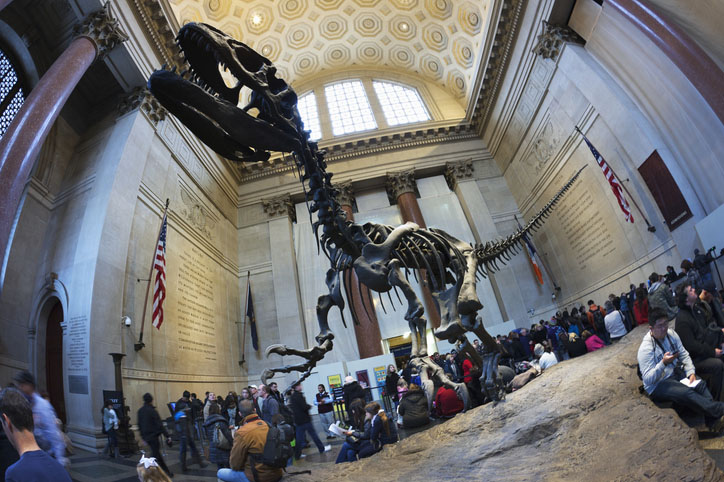
At the museum, we were greeted by the skeleton of an enormous dinosaur, its endless neck reaching to the ceiling of the domed entrance hall. 

“What is she thinking?” I mused as we wandered from room to room. 

The students examined a diorama of prehistoric families gathered around a campfire. 

“Fire is also big,” I thought and then, chastised, realized I was mixing Yiddish and English with a dash of Jewish hyperbole. 

My mother gazed at the mineral cabinets. 

“How does she reconcile the prehistoric world with her world?” I wondered. 

I saw her speaking with her charges.

I realized that she was the best-dressed woman in the museum. 

The day ended but her radiance continued. 

It lasted for a long time. 


Elaine Rosenberg Miller’s fiction and non-fiction have appeared in Adelaide Review, Bangalore Review, Huffington Post, Jerusalem Post, The Forward, TImes of Israel and other publications.

The Day My Mother Showed Up Read More »

House Poor, Life Rich

Buying a house in Los Angeles is expensive, and many who do buy end up house-poor. House-poor is when most of your income goes toward paying for your first heart attack. So, unless your parents are stuffed, the neighborhood kids must often pack up and look for other places outside California. 

My kids told me that present-day Yemenite-Somali Jews are estimated to have no more than five to 10 merchant families—enough for a minyan on Shabbat and endless amounts of sabaayad (Somali flatbread). The weather in Somalia is like the San Fernando Valley. However, housing is much less expensive. A Somali fixer-upper costs between $14 and $20 USD unless you want to live directly in Mogadishu, which can run upwards of $25.  Locals who can’t afford Mogadishu can come to Los Angeles, pitch a tent, and live for free. 

My first live-alone NYC apartment was a studio for $150 a month. I later discovered I was paying more than anyone else in the building. The apartment was so small that the mice were hunchbacked. I had to go out in the street to change my mind. I could only fry one egg at a time. Thank you, Henny Youngman, for those three killer jokes.

No matter how shabby the building was, the apartment was mine, and I was proud I could afford it — a feeling I’ll never forget.

A friend told me his daughter was trying to find an apartment in New York and had at most $4,000 a month to spend. Rent alone would be $48,000 a year. How does a kid just starting do it? When another friend heard our new car cost $60,000, he told me the first home he bought cost the same amount.

The problem with getting older is you remember what things once cost. Older people should never tell a young person what things used to cost; it makes them suicidal.

Though not as cheap as Somalia, New York and Los Angeles were once reasonably priced. In New York, for example, there was a diner called Poachers, where I could get two poached eggs, toast, home fries, and coffee for 99 cents—$1.10 with the tip.

Recently, one of my two sons, who lives in Los Angeles, called to ask if I wanted to go to the movies with them. I told him to buy the tickets and that I would pay him back. We saw “Gladiator II” at the TCL (formally Grauman’s) Chinese Theatre. Three seats, popcorn, and drinks cost over $100. I made them pay for parking. Going to the movies was almost my NYC rent.

Most parents I know ask the same thing: How will our kids afford to live in Los Angeles? The answer is that most won’t. How can they stay here? A teardown in Pico-Robertson costs almost two million dollars. 

Full disclosure: I live in one of those teardowns. Like many, our house is our retirement; you hope the prices keep rising. On the other hand, our kids are moving far away because of it.

Some families can afford to give their kids a few million, and that’s fine. But that is not the case with us. We raised all three boys in a modest home built in 1926 that was less than 1,700 square feet. Unless we were all fighting, thank God, we never felt cramped.

My wife grew up in a lovely house in Texas, and I, a not-so-nice tenement in the Bronx. If I had to, I could live almost anywhere, not so with her. I remember how much she wanted a house and what it meant to her when we got one. Living in Los Angeles around so much money and not having the do-re-mi’s, it’s easy to compare and despair.  

The Pirkei Avot (Ethics of the Fathers) asks, “Who is rich? He who is happy with his lot.” This means true happiness isn’t dependent on material things but on one’s attitude towards circumstances. Although, who’s kidding who? It’s nice to have nice stuff. 

Be grateful for what you have. God willing, your kids will figure it out like you did. But whatever you do, remember that Spirit Airlines does not fly to Somalia.


Mark Schiff is a comedian, actor and writer, and hosts, along with Danny Lobell, the “We Think It’s Funny” podcast. His new book is “Why Not? Lessons on Comedy, Courage and Chutzpah.”

House Poor, Life Rich Read More »