fbpx

January 10, 2025

Are We Drifting Apart?

Last week, I got an email from Rabbi Scott Kahn, who has created the Jewish Coffee House podcast network. He sent me an article he wrote proposing that American Jews stage a mega-rally in front of the UN to demonstrate to Israelis their concern for Israel. He explained that he has questions about “whether American Jews care enough about Israel.” There was an outburst of American Jewish support for Israel after October 7th;  yet slowly but surely,  rallies for Israel have disappeared, visits to Israel have diminished, and charity has decreased. He urged me to push for this rally, “in order to demonstrate to Israelis that the gap between them and their American counterparts is not as wide as many now suspect.”

I saw things differently. We exchanged emails, and eventually decided to do a podcast about the subject.

My exchange with Rabbi Kahn is not just about Israel and America; it is also about relationships. Even the best relationships can fall victim to inertia. While we are busy tending to our own success, we often fail to notice how we are drifting apart from those closest to us. Sometimes the results can only be seen years later.

After Jacob dies, Joseph’s brothers are gripped with fear. They say to themselves: “Perhaps Joseph will hate us, and may repay us for all the evil which we did to him.” They decide to send emissaries to Joseph with the following story: Jacob, on his deathbed, asked Joseph to forgive his brothers.

This is a bald lie. They fabricate this story because they think that Joseph is about to punish them. The brothers then approach Joseph, fall to the floor, and beg for their lives, saying, “We are prepared to be your slaves.”

Joseph cries, and instead speaks to them gently and comforts them.

This interaction is puzzling. Joseph had already reconciled with his brothers seventeen years earlier; and for the entire time after that, Joseph and his brothers had lived together. Everything should have been fine by this point. So why were the brothers still afraid of Joseph?

To answer that question, one must first step back and consider whether Joseph ever forgave the brothers seventeen years earlier. When Joseph first reveals his true identity to his brothers, he says  “I am your brother Joseph, whom you sold into Egypt. And now, do not be distressed and do not be angry with yourselves for selling me here, because it was to save lives that God sent me ahead of you… it was not you who sent me here, but God.” Joseph makes it clear that he sees his slavery as divinely ordained, and no longer blames his brothers for what they did; what remains unclear is whether he actually forgave them.

Rabbi Jonathan Sacks is particularly taken with Joseph’s forbearance, and sees it as transformative. He calls it “the first recorded moment in history in which one human being forgives another.” He wrote several essays on the topic of Joseph’s forgiveness, which he sees as a central Jewish lesson.

But many commentators have taken a very different view of Joseph’s behavior, and for good reason. One must listen to Joseph’s words carefully. He speaks about God’s plan, and that even though the brothers intended evil against him, God changed their plans. Rather than opening his heart to his brothers, Joseph tells them he is ignoring their wrongdoing because he prospered in the end. Rabbeinu Bachya in the 14th century writes that: “…the Torah does not explicitly state that Joseph forgave his brothers…Even though the Torah mentions that he comforted them and spoke kindly to their hearts, which seems to indicate that they were appeased by Joseph, we do not see the Torah explicitly mentioning that Joseph forgave them, nor that he acknowledged that he pardoned their sin and wrongdoing….” Joseph might have reconciled with his brothers, but we have no indication he forgave them.

Perhaps the brothers are insecure for precisely this reason: Joseph had never truly forgiven them.

But other commentaries offer an even more intriguing possibility: Forgiveness is not the same as a happy ending.  In this case, (and many others,) a great deal of dysfunction still remains. Echoes of the initial estrangement can still be heard, years later.

Forgiveness occurs when the person who was hurt releases their resentment and agrees to reconcile with the offender. And Joseph had done that. However, if forgiveness is granted too readily, the offender may still feel a deep sense of guilt; they have not gotten a chance to rehabilitate themselves.

Ironically, the brothers remain uncomfortable precisely because Joseph’s behavior is so saintly. The Malbim describes the brothers’ angst this way:

The greatest revenge against one’s enemy is if, instead of harboring hatred and repaying the harm they caused, one makes them a guest at their table and treats them only with goodness and kindness. This way, the enemy is constantly reminded of the crime they had intended to do.

The Malbim, as well as the Ohr HaChaim, explain that the brothers found their guilt to be unbearable. They wished they had been punished for their crimes instead. The brothers may have been granted forgiveness by Joseph, but don’t feel forgiven. And so the dysfunction lives on.

Guilt leads to significant cognitive distortions. Automatic thoughts take over, and people no longer see reality clearly. In such an environment, small actions can be misinterpreted. And that explains why even seventeen years later, the brothers worry that Joseph will take revenge against them after Jacob’s death.

One Midrash says the brothers began to worry when they saw Joseph, on the way back from Jacob’s funeral, visit the pit the brothers threw him into before selling him. Joseph visited because he wanted to thank God for saving his life; but the brothers took a far more paranoid view. Another Midrash says that their worries arose because Joseph stopped inviting them to dine with him after his father died. Joseph’s intentions were respectful; he didn’t want to seat himself at the head of the table in his father’s place. The Midrash writes: “Rabbi Tanḥuma said: His intention was only for the sake of Heaven. But that is not what they thought, but rather: “Perhaps Joseph will hate us.” In a fraught environment, even an innocuous gesture can create worry.

The brothers can’t see Joseph’s constant goodwill because they are blinded by their own guilt; and Joseph, leading a large empire, is oblivious to the widening distance between them. They may have reconciled when they moved to Egypt, but they never became true brothers. They tend to their father together, they sit together at meals, and live together as one family. But they don’t dare to talk about the elephant in the room, the attempted murder and sale into slavery of Joseph.

And now that Jacob is dead, the cracks in their relationship reappear. They had been together, yet drifting apart, for seventeen years.

Could this happen to American Jews and Israelis? Even before the October 7th war broke out, many worried that the relationship was fraying. There are longstanding fractures between the two communities, over fundraising, aliyah, loyalties, and politics, that go back to the very beginnings of the State of Israel; yet we have always managed to hold those tensions in the background. But unity should never be taken for granted. The two communities live far away from each other, in very different realities. Most American Jews know very little about Israelis, and vice versa.

Now that the shock of October 7th has worn off, American activism is fading, because the situation no longer feels like an emergency. So it is understandable that Israelis, who have suffered enormous trauma, feel alone. At the same time, American Jews have their own struggles with antisemitism and assimilation. Each community is absorbed with meeting the challenges ahead, as they should be. However, this is also the recipe for drifting apart.

But there is also room for optimism. Not everyone is disconnected.

Last year, I spoke to several groups of Israeli leaders who were brought to New York by Gesher, to foster greater understanding between communities. As an American, my questions for the Israelis were about how they were wrestling with wartime problems; but with each group, several Israelis asked me how American Jews are dealing with antisemitism.

I was taken aback. To me, antisemitism is a problem, but nothing at all comparable to Israel’s challenges. So I told them it reminded me of an old Jewish legend:

Two brothers inherited a field from their father and divided it equally. One was married with a large family, and the other was single. At harvest time, the single brother would sneak out at night, take some bags of grain, and toss them into his brother’s field; after all, his brother needed more, because he had a large family to support. The married brother would also sneak out at night and toss grain into his brother’s field; after all, the single brother needed to save money, because he had no children to tend to him in old age. One night, as they were sneaking out with their bags of grain, the two brothers bumped into each other. They realized what the other one was doing, and embraced.

A divine voice called out then and said that this place of love would be the place where the Temple would be built.

Brothers can be there for each other. And when they do, it is truly divine.

And it is this type of mutual concern that I saw during the Gesher visits. And if we can find a way to keep worrying about each other, we won’t drift apart.


Rabbi Chaim Steinmetz is the Senior Rabbi of Congregation Kehilath Jeshurun in New York.

Are We Drifting Apart? Read More »
Pay a Visit to Old Age

Pay a visit to old age
when you climb the highest mountain
in your youth, and feel the rage
that comes with failure of its fountain.

Know, though you ascend with ease,
descent must follow as the night
must follow day, while you would seize
the summit that’s within your sight.

There will come for you a time
when you will also rage like those
who wish that they with you could climb
and share the fountain as it flows.

Visit age before you’re old
to see what happens before death
when in the valley you feel cold,
although no summit cools your breath.

Like a sherpa go beyond
the snows of last year, don’t allow
the past, by feeling of it fond,
to bury vital views of “now.”

Ignore your age and try to see
yourself as others will when age
will alter you, for you can’t flee
your fate, however much you rage.

You can avoid rude rage by finding
in years that you have lived a meaning,
resonances, that while reminding
you of the past, can seem regreening

of gray heads, whom we are told,
in Leviticus, before to stand,
like parents, in their honor rolls enrolled,
together with ones prefixed “grand,”

but not ovot, in Hebrew, ghosts,
as Hamlet did, but to avot,
grandparents, who’re hoar-headed hosts,
gene-donors of our lettered lot.

Before them we’re most glad to rise –
indebted to gene-donors, stand –
although we often are not wise
enough their thoughts to understand,

a gene-fact Joseph could not, which
inspired Jacob when, hands crossed,
he blessed the sons of Joseph, switch
caused by the gene he never lost:

favoritism, fundamental factor,
protecting future Israel’s relics,
a generator in their gene reactor
of favoritism’s double helix.


Gen. 48:17-19 states:

וַיַּ֣רְא יוֹסֵ֗ף כִּי־יָשִׁ֨ית אָבִ֧יו יַד־יְמִינ֛וֹ עַל־רֹ֥אשׁ אֶפְרַ֖יִם וַיֵּ֣רַע בְּעֵינָ֑יו וַיִּתְמֹ֣ךְ יַד־אָבִ֗יו לְהָסִ֥יר אֹתָ֛הּ מֵעַ֥ל רֹאשׁ־אֶפְרַ֖יִם עַל־רֹ֥אשׁ מְנַשֶּֽׁה׃

When Joseph saw that his father was placing his right hand on Ephraim’s head, he thought it wrong; so he took hold of his father’s hand to move it from Ephraim’s head to Manasseh’s.

וַיֹּ֧אמֶר יוֹסֵ֛ף אֶל־אָבִ֖יו לֹא־כֵ֣ן אָבִ֑י כִּי־זֶ֣ה הַבְּכֹ֔ר שִׂ֥ים יְמִינְךָ֖ עַל־רֹאשֽׁוֹ׃

“Not so, Father,” Joseph said to his father, “for the other is the first-born; place your right hand on his head.”

וַיְמָאֵ֣ן אָבִ֗יו וַיֹּ֙אמֶר֙ יָדַ֤עְתִּֽי בְנִי֙ יָדַ֔עְתִּי גַּם־ה֥וּא יִֽהְיֶה־לְּעָ֖ם וְגַם־ה֣וּא יִגְדָּ֑ל וְאוּלָ֗ם אָחִ֤יו הַקָּטֹן֙ יִגְדַּ֣ל מִמֶּ֔נּוּ וְזַרְע֖וֹ יִהְיֶ֥ה מְלֹֽא־הַגּוֹיִֽם׃

But his father objected, saying, “I know, my son, I know. He too shall become a people, and he too shall be great. Yet his younger brother shall be greater than he, and his offspring shall be plentiful enough for nations.”

After completing this poem on 1/6/25, I heard Meir Soloveichik in his 10-Minute Mitzvah Episode 37 “Abraham Lincoln and the Jewish Beard,” a subject he discusses in “Why Beards?” Commentary, 2/1/08, pointing out the significance of the fact that the Hebrew word for “old,” zaqeyn, resonates with zaqan, the Hebrew word for “beard.

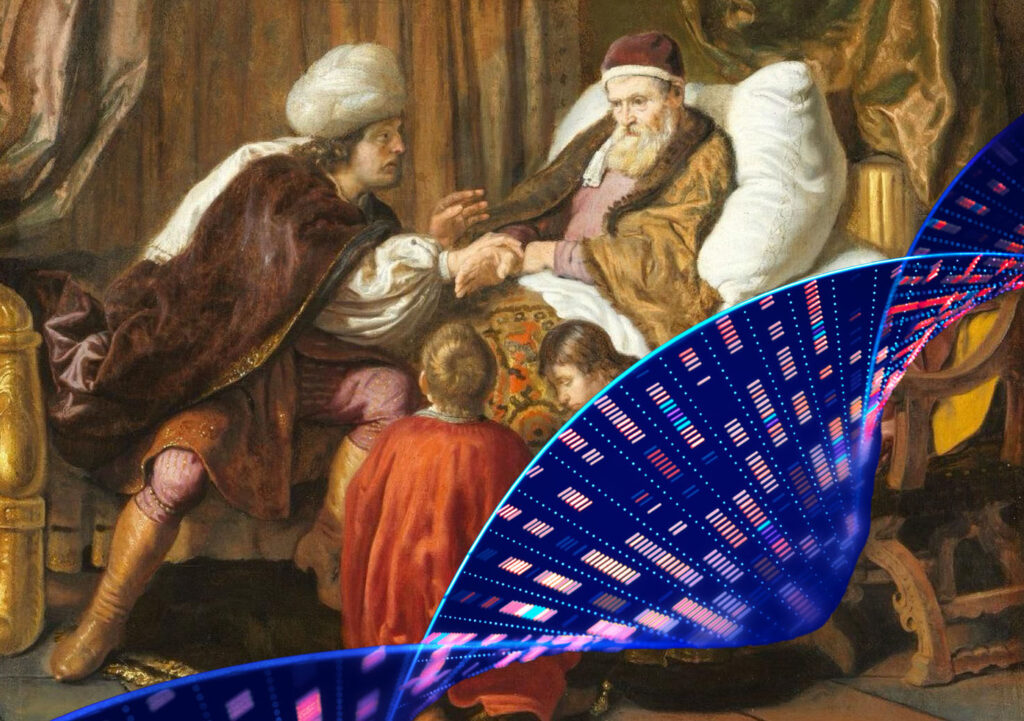
When my daughter, Abigail Hepner Gross, heard me reading this poem, she inspired the last verse, pointing out the link between the way that Jacob crossed his hands while blessing his grandsons Ephraim and Manasseh, and the double helix of DNA discovered by Francis Crick, James Watson and an un-Nobelled Rosalind Franklin.

Lev. 19:31-32 states:

אַל-תִּפְנוּ אֶל-הָאֹבֹת וְאֶל-הַיִּדְּעֹנִים, אַל-תְּבַקְשׁוּ לְטָמְאָה בָהֶם:  אֲנִי, יְהוָה אֱלֹהֵיכֶם.

Turn not unto the ovot, ghosts, nor unto familiar spirits; seek them not out, to be defiled by them: I am the LORD your God.

לב  מִפְּנֵי שֵׂיבָה תָּקוּם, וְהָדַרְתָּ פְּנֵי זָקֵן; וְיָרֵאתָ מֵּאֱלֹהֶיךָ, אֲנִי יְהוָה.

Thou shalt rise up before the hoary head, and honour the face of the old man, and thou shalt fear thy God: I am the LORD.


Gershon Hepner is a poet who has written over 25,000 poems on subjects ranging from music to literature, politics to Torah. He grew up in England and moved to Los Angeles in 1976. Using his varied interests and experiences, he has authored dozens of papers in medical and academic journals, and authored “Legal Friction: Law, Narrative, and Identity Politics in Biblical Israel.” He can be reached at gershonhepner@gmail.com.

Pay a Visit to Old Age Read More »

JFSLA Hanukkah Parties, Stephen Wise Temple’s Blue and White Ball, AFMDA

On Dec. 19, Jewish Family Service L.A. (JFSLA) welcomed approximately 100 Jewish and non-Jewish members of the Los Angeles community to celebrate Hanukkah. The event, held in the Fairfax District at JFSLA’s Jona Goldrich Center, allowed seniors to connect and celebrate together during the holiday season. 

Dozens of seniors turn out to Jewish Family Service L.A.’s recent Hannukah gathering. Courtesy of Jewish Family Service L.A.

Attendees enjoyed a latke lunch, music, dancing and performances by students in the Hillel Hebrew Academy Choir. 

“At Jewish Family Service L.A., Hanukkah is a time to celebrate unity and resilience, it’s an opportunity to come together as a community,” Susan Belgrade, senior director of multipurpose and senior centers at JFSLA, said. “Hanukkah symbolizes the triumph of light over darkness. There is no better way to honor that tradition than by gathering with friends and forging new connections.” 

JFSLA serves tens of thousands of Angelenos, Jewish and non-Jewish alike. The party served as a welcoming opportunity for attendees of all faiths to enjoy Hanukkah traditions and participate in holiday celebrations.

“Although Hanukkah is a Jewish tradition, during the holiday season, we encourage all of our community members to celebrate and learn about its significance in a fun and welcoming way,” Kimiko Kelly, director of the arts, wellness and engagement program at JFSLA, said. “We are proud to foster an environment that encourages seniors of all backgrounds to learn about each other’s cultures and create relationships from a background of respect and appreciation for one another.” 

In addition to the Fairfax senior Hanukkah party, JFSLA hosted a Hanukkah celebration with songs, dancing and arts and crafts at Café Europa, the agency’s social program for Holocaust survivors, on Dec. 17, and hosted a Hanukkah party on Dec. 30 for participants in the special needs life skills program, which provides weekly activities to adults with special needs.


Stephen Wise Temple and Schools’ recent Blue and White Ball recognizes heroes who’ve supported Israel.
Photo by SDK Photo & Design

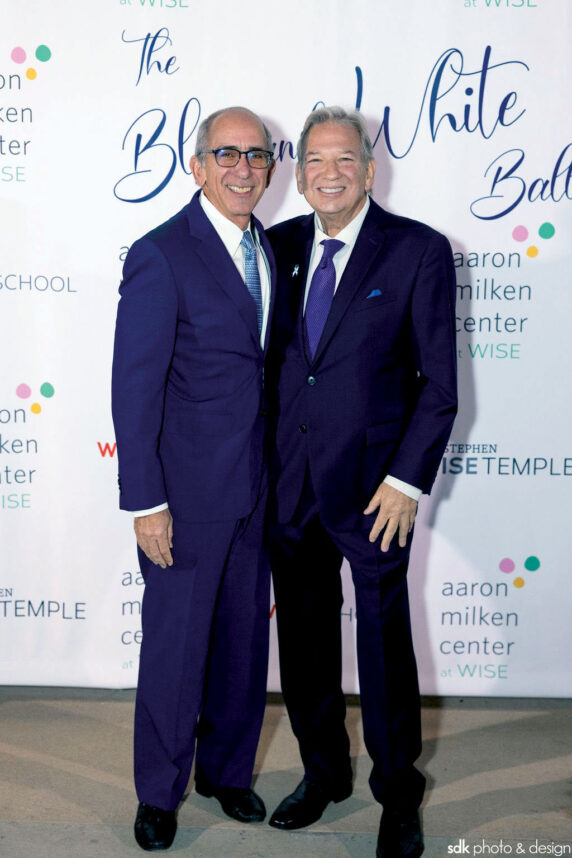
On Dec. 12, Stephen Wise Temple and Schools held the Blue and White Ball, which brought together more than 500 attendees — making it the temple’s most attended gala ever — for an evening of celebration, recognition, and community. Held in the Katz Family Pavilion and Nahmias Plaza, the event honored Rabbi David Woznica for 20 years of transformative leadership and service to the temple.  Steve Bram, the synagogue’s past president, was celebrated for his extraordinary three decades of dedication and contributions. The evening also recognized the heroes of the temple and school community. 

Honorees Steve Bram and Rabbi David Woznica. Photo by SDK Photo & Design

“The honorees’ unwavering advocacy and support for Israel continue to inspire and strengthen our shared mission,” Stephen Wise Temple leadership said. “The incredible turnout underscored the deep bonds and shared values within the Wise community, making the Blue and White Ball a truly unforgettable night of gratitude, connection, and pride.” 


Magen David Adom paramedics Hadas Ehrlich and Oshrit Hadad speak at Beth Jacob Congregation.
Photo by Ryan Torok

Visiting from Israel, Magen David Adom paramedics Hadas Ehrlich and Oshrit Hadad spoke at Beth Jacob Congregation in Beverly Hills about serving on the front lines on Oct. 7. 

On that day, Hadad, 22, was treating a wounded elite IDF soldier, who had been shot all over his body. Hadad was undressing him, searching for his wounds, when the soldier grabbed Hadad’s hand and made an unexpected request: He asked Hadad to recite the shema with him. 

“He said, ‘I‘m a Jew. Even though I’m not religious, I know I’m going to die, so please do my last shema Yisrael with me,’” Hadad recalled.

Eventually, the patient was evacuated by helicopter to a nearby hospital. 

“I don’t know who he is, I don’t know if he survived, I don’t know if he made it,” Hadad said 

While responding to the Hamas-led attack on Israel, Ehrlich, 25, staffed an armored ambulance near Sderot, providing trauma care inside her ambulance to victims. Over 13 hours, she drove back and forth to Sderot a total of 15 times, searching for victims who were still alive—all while there were still active terrorists in the area.

“I’m wearing a bulletproof vest, but I have to put another armor on, an emotional one, because I have to be as sharp as I can, and I don’t know what I’m going to be encountering,” Ehrlich said, sharing her thought process from that day.

Approximately 30 people turned out last month, on Dec. 9, to the Beverly Hills-based synagogue to hear the two speak about their harrowing Oct. 7 experiences. On Dec. 10, the two MDA paramedics also appeared in a private discussion in Beverly Hills with an intimate group of women community leaders.

Their appearances in Los Angeles were organized by American Friends of Magen David Adom, which raises funds, awareness and support for MDA.

JFSLA Hanukkah Parties, Stephen Wise Temple’s Blue and White Ball, AFMDA Read More »

StandWithUs Release Report Calling JVP a “Shield for Hate”

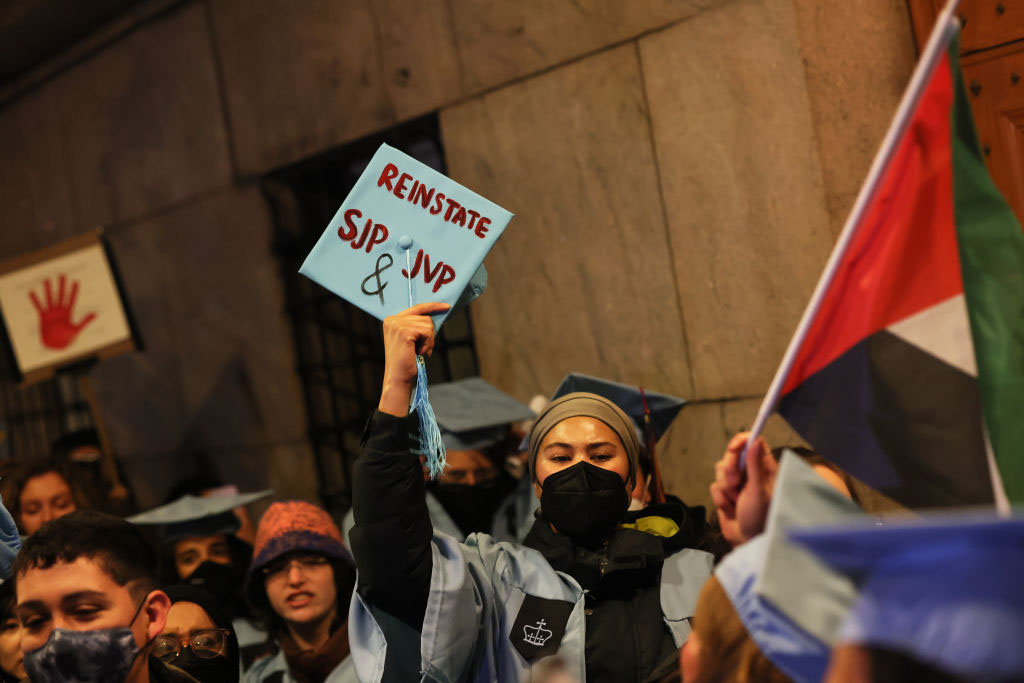
StandWithUs released a report on Jan. 7 accusing Jewish Voice for Peace (JVP) of being a “shield for hate.”

Formed in 1996, JVP openly opposes Zionism and supports the Boycott, Divestment and Sanctions (BDS) movement, as their platform states: “Anti-Zionism supports liberation and justice for the Palestinian people, including their right to return to their homes and land. Anti-Zionists believe in a future where all people on the land live in freedom, safety, and equality.” The report noted a Jan. 2024 post on X from JVP stating that “when we say free Palestine we mean ALL of Palestine.”

“JVP’s framing of Zionism is deeply misleading,” the report stated. “Zionism represents the Jewish people’s age-old desire to be free in their ancestral homeland. On a political level, it is a liberation movement supporting Jewish rights to self-determination in Israel. Many states around the world are built on similar principles, including numerous democracies where there is a majority population, along with legal protections for minority groups. If they were consistent, JVP would demand that all of these countries be dismantled. They would oppose the creation of a Palestinian state, on the basis that Palestinian self-determination is inherently discriminatory against non-Palestinians. However, in practice the one country JVP seeks to tear down is the world’s only Jewish state.”

“JVP’s framing of Zionism is deeply misleading … Zionism represents the Jewish people’s age-old desire to be free in their ancestral homeland.” – from the report

The StandWithUs report contended that if JVP’s goals were realized and Palestinians were granted the “right of return” then “Israel would be replaced by a majority-Palestinian state.” In that scenario “Jews would be forced to live under the rule of parties like Fatah or Hamas, which dominate Palestinian politics. Both factions promote violent antisemitism through schools, media, and other institutions, and Hamas actively engages in genocidal terrorism. Israeli Jews have every reason to believe that dismantling Israel would be extremely harmful to them, and no reason to trust that their rights would be protected in such a scenario.”

The report proceeds to highlight JVP’s ties to and support for terror, noting that the organization has held events with Samidoun, an organization that has been sanctioned by the United States and Canada for fundraising for the Popular Front for the Liberation of Palestine (PFLP) terror group. JVP has signed onto a campaign calling for the release of PFLP Secretary-General Ahmad Sa’adat, who was convicted for assassinating Israeli Tourism Minister Rehavam Ze’evi in 2001. JVP has also endorsed a campaign from the Palestinian Youth Movement (PYM) calling for the release of Walid Daqqa, who died in prison in 2024 after he was convicted for commanding a PFLP cell and that abducted and murdered an Israeli soldier in 1984. Other examples cited in the report included JVP’s call to release a member of Palestinian Islamic Jihad as well as an April 2024 Instagram post supporting the Houthi terrorists in Yemen.

Following the Oct. 7, 2023 massacre, JVP has characterized Hamas’ actions that day as “resistance” and blamed Israel for the Hamas-led attack. JVP has since characterized Zionism as Nazism, a tactic that the report describes as “Holocaust inversion,” which the report defined as “an antisemitic tactic in which the genocide Jews faced in the past is used to promote baseless

hatred against Jews today. In reality, nearly half of the people killed in Gaza have reportedly been members of terrorist organizations. During the war, Israel has sent millions of warnings to civilians urging them to evacuate ahead of military strikes, helped deliver over one million tons of humanitarian aid to Gaza, facilitated medical evacuations, and accepted numerous ceasefire proposals from international mediators. It has also opened dozens of criminal investigations into the actions of Israeli soldiers. While none of these facts make the suffering of civilians in Gaza any less horrific, they once again show how JVP fans the flames of this tragic conflict with disinformation.”

The report goes onto assert that JVP shields anti-Israel activists from accusations of antisemitism, as the group claims that such accusations are aimed at silencing criticism of Israel’s policies toward the Palestinians. But the report alleges that JVP itself has promulgated antisemitism through, among other things, its Deadly Exchange campaign falsely blaming “police brutality against people of color in the U.S. on exchange programs with Israel, led by Jewish organizations such as the Anti-Defamation League (ADL). This echoed a long and deadly history of conspiracy theories scapegoating Jews for the worst injustices in society.” The campaign “helped influence the shooter who murdered Jews in a New Jersey deli in December, 2019,” per the report, and prompted antisemitic statements from figures like Louis Farrakhan and Linda Sarsour.

The report also notes that JVP allows for non-Jewish members and that its rabbinical council consists of a rabbi who met with then-Iranian President Mahmoud Ahmadinejad in 2008 and another who “denied the Oct. 7 atrocities, arguing that the IDF, not Hamas, killed most of the Israeli citizens, and dismissed Hamas’ mass rape of Israeli women.” A California JVP chapter created an image of a seder plate with Hebrew text going from left to right, the opposite direction of how Hebrew is supposed to be read. Additionally, the report points out that “one of the primary locations of the people managing JVP’s Facebook page was Lebanon” and that “JVP’s communications director worked at numerous organizations in Beirut for at least 17 years.” The report also lists several organizations with ties to Lebanon and Iran that JVP has received funding from and calls for further investigation.

“JVP’s harmful rhetoric and alliances make it clear they are not a voice for peace,” StandWithUs CEO and Co-Founder Roz Rothstein said in a statement. “This organization fuels hate and shields extremists from accountability, while doing nothing to bring about peaceful coexistence. To help fight rising antisemitism, the public, media, and leaders across our society must finally recognize JVP’s dangerous agenda and reject it.”

JVP did not immediately respond to the Journal’s request for comment.

StandWithUs Release Report Calling JVP a “Shield for Hate” Read More »

The Sublimity of Insincerity – Thoughts on Torah Portion Vayechi

The Sublimity of Insincerity

Thoughts on Torah Portion Vayechi 2024

©Rabbi Mordecai Finley


There is one passage in our Torah portion that has always bothered me. I’d never heard a satisfactory teaching on this passage until I listened to Avivah Zornberg’s teaching, linked here. (Thank you, Rabbi Manning, for recommending this to me.) I am paraphrasing from Zornberg’s fabulous teaching. (https://www.youtube.com/watch?v=WAbGHlO7AK0&list=PLv2rnAORLiVBR3CtLpbrq-JXwIT9FTVLe&index=17)


Here is the back story. After their father Jacob died, Joseph’s brothers were afraid that Joseph would now take vengeance upon them for selling him to a caravan of Ishma’elites, who passed him on to Midianites, who then sold him into slavery in Egypt. Their solution was to prevaricate:

When Joseph’s brothers saw that their father was dead, they said, “What if Joseph still bears a grudge against us and pays us back for all the wrong that we did him!”

So they sent this message to Joseph, “Before his death, your father left this instruction:

So shall you say to Joseph, ‘Forgive, I urge you, the offense and guilt of your brothers who treated you so harshly.’ Therefore, please forgive the offense of the servants of the God of your father’s [house].” And Joseph was in tears as they spoke to him. (Genesis 50:15-17)

There is no record of Jacob ever having given such an instruction. Teachings in the Midrash assume that the brothers, in great fear, made this up. Now that Jacob was dead, he could not refute their words. Joseph would be obligated not to take revenge.


Why did Joseph cry when he heard this? According to teachings in the Midrash, Joseph knew that his brothers fabricated Jacob’s “last will” out of fear. Joseph cried, according to the Midrash, because even though Joseph and his brothers had reconciled in the previous week’s Torah portion, the reconciliation obviously did not go deep. The brothers assumed that Joseph was lying, and that Joseph saw through them. Joseph cried, the Midrash says, because Joseph realized that his brothers were terrified. The brothers did not believe that Joseph forgave them.


How does Joseph console them? Here is the verse that had always bothered me:

But Joseph said to them, “Have no fear! Am I a substitute for God? Besides, although you intended me harm, God intended it for good, to bring about the present result—the survival of many people. And so, fear not. I will sustain you and your dependents.” Thus, he reassured them, speaking kindly to them. (Genesis 50: 19-21)


Joseph is saying that God will judge them, not he, Joseph. He is also saying that though they intended to harm, God intended good, so in some grand scheme of things sort of way, the brothers are forgiven. What has always bothered me about this verse is Joseph’s palpable insincerity. The brothers meant to do evil, regardless of God’s grande scheme.


I see a version of that insincerity (sincerity being characterized as speaking without pretense) when people say, “This was meant to be.” I believe people mean well when they say that, but that the thought itself is insincere as much as it is meaningless,  Sometimes we aren’t sure what to say when we see suffering. Somehow saying that something is destined, meant to be, is supposed to take the bite out of the stings of life. When I hear this, I sometimes ask, “Meant to be, by whom? Who meant it to be, and for what purpose?”


I don’t think, in general, that things are meant to be. I don’t believe in predestination. I don’t think that everything works out in the end. I don’t believe that immoral acts are justified because some good occurs down the line. We are ravaged by war, destruction, disease, famine and sorrow. None of these are “meant to be.”


The fear of the brothers reveals that the reconciliation with Joseph only went so far. Their fear was matched by a truth in Joseph’s heart, that Zornberg points out:  Maybe God will find a way to forgive them, but Joseph had not forgiven them. I believe, as Zornberg suggests, that despite Joseph’s saying “It all worked out in the grand scheme of things,” Joseph wanted revenge. Not that he would act on it.


Joseph cried, perhaps, not because his brothers did not believe him and they were terrified. Their being terrified perhaps reminded him how terrified he was when they threw him in the pit and then sold him to a caravan of Ishmaelites. Perhaps he cried remembering the trauma inflicted on him. He cried when he remembered what they had done to them. Brothers do terrible things to each other. The Bible tells us so.


A few things here:


The desire for vengeance is natural, or there wouldn’t be a commandment against it. Feelings are involuntary and we must feel our feelings and admit to them in order to deal with them.


We are not obligated to forgive, especially if someone has not apologized nor offered some kind of compensation, if only an apology. In fact, we are taught, we are to seek justice.


Once one sees in one’s heart a desire for revenge, we are taught that we must instead replace that with a desire for justice. First you must know, however, that there is vengeance in your heart, before you can strive to replace the desire for vengeance with the will to justice.


I was relieved by Zornberg’s teaching because from her I learned that Joseph had decided to be insincere, “sincere” in the sense of being genuine.  Joseph wasn’t able to say, “I want revenge; I will settle for justice.”  Instead, Joseph was insincere. Insincerity is better than expressing the desire for vengeance, especially in families. Sometimes when one honestly shares their hurt, the other will not apologize. Sometimes the other will find reasons, exculpations, and excuses. “It’s your fault I did it.” “Well, I had a bad childhood.” Or they will just get angry too.


Instead of saying to his brothers, “Your fear is justified because I would love to take revenge,” Joseph goes to the insincere “it was meant to be” bromide. In this case, insincerity is a great moral accomplishment, compared to the next thing – expressing the genuine desire for vengeance. Insincerity helps us bide our time, work things through within until the time is ripe for working things through with others. Insincerity can be a strategy of patience. Better a banality than a bitter argument. Joseph’s brothers traumatized him. He decided, it seems, not to do to others what was hateful to him.


Thanks to Avivah Zornberg, I am no longer bothered by Joseph’s saying, “It’s okay you tried to kill me and then sold me into slavery. It all worked out in the end!” as opposed to saying what he was really thinking. I am reminded of my 10 Contrarian Commandments for a Good Marriage: “Don’t say what you are thinking. The only thing worse than saying what you are thinking is saying what you are feeling.” These Contrarian Commandments apply, of course, only when your thoughts and feelings are toxic. Calm yourself, find your way to sanity and reasonableness, maybe even to love and empathy, and then share your thoughts and feelings. You might realize, by the way, that you had a part in things, too. Justice might entail your doing a little apologizing on your end.


In the meantime, a little insincerity can go a long way.

The Sublimity of Insincerity – Thoughts on Torah Portion Vayechi Read More »