fbpx

January 3, 2025

Over 20 Million Watch Noa Tishby’s Menorah Lighting Videos with Celebrity Guests

Over the eight nights of Hanukkah, author and activist Noa Tishby may have just set a record for most-viewed menorah lightings of all time. On each night — Dec. 25, 2024 through Jan. 1, 2025 — Tishby posted a new video of her lighting a menorah with a different celebrity friend. As of January 3, the total number of views of each video across Tishby’s and her guests’ platforms is over 20.4 million.

It was part of a project produced by Eighteen, Tishby’s nonprofit that she started in 2024. Eighteen’s mission is to use “media, social media, culture, events and education” to exemplify “what it means to be a loud and proud Jew and Zionist [by] promoting Jewish pride and displaying Jewish and Israeli customs and traditions to audiences around the world.”

Tishby asked her eight celebrity guests to join her in short videos celebrating one of the most joyous Jewish customs of the year. Their total combined social media followers is over 150 million across Instagram, YouTube, Facebook, X and TikTok. With Christmas overlapping with Hanukkah for the first time since 2005, Tishby used this as an opportunity to lead by example with Eighteen’s mission.

“Bringing light to the Jewish community and sharing our joy with the world was so needed after such a challenging year, and I am honored to have celebrated Hanukkah alongside such incredible entertainers,” Tishby told the Journal. “With each candle of Hanukkah, we expelled the darkness and any hate we received was quickly cast into the shadows as each video went viral.”

Tishby—an actress, activist and television producer—came to the U.S. when she was 23. After years of being the go-to person for her friends’ questions about Israel, Tishby published her first book, “Israel: A Simple Guide to the Most Misunderstood Country on Earth” in 2021, a new York Times bestseller. In November 2022, Tishby was tapped by then-Israeli Prime Minister Yair Lapid to be the Special Envoy for Combating Antisemitism and the Delegitimization of Israel. She was dismissed in April 2023, four months after Benjamin Netanyahu assumed office.

After the biggest single-day massacre of Jews since the Holocaust on Oct. 7, 2023, Tishby became one of the most vocal and well-known voices fighting the social media war being waged against Israel and the Jewish people. She has put an emphasis on bridging divides between the Jewish community and others, as well between fellow Jews. Audiences have been responding to her message. This past spring, Tishby co-authored “Uncomfortable Conversations with a Jew” with Fox Sports anchor Emmanuel Acho, which also became a New York Times bestseller.

“Jews are such a small percentage of the world’s population and often falsehoods and biases are easily spread about us because of this,” Tishby said. “These [Hanukkah] guests are some of the best of their industries – acting, modeling, comedy, news and pop culture – and they have amassed massive followers, so I’m incredibly grateful for their willingness to open up about their Hanukkah stories and traditions. Together, we showed the world outside of our echo chamber how fun and cool this Jewish holiday really is.”

While the most viewed “menorah lighting” YouTube video is of The Maccabeats singing “Candlelight,” its 17 million views have been amassed over fourteen years. The millions of views Tishby and her guests have received over the eight nights of Hanukkah are only going to grow and reach audiences far outside the Jewish community.

On night one, Tishby lit the menorah with Academy Award-winning actress and Goop owner Gwyneth Paltrow. She told Tishby that her last name was shortened from Paltrowicz and that she comes from 17 generations of rabbis.

“We always light the menorah,” Paltrow told Tishby about Hanukkah at her home these days.

Actress Mila Kunis, whose family immigrated from the Soviet Union (present-day Ukraine) where they had to hide their religion, lit the menorah with Tishby on night two.

“The thing about being Jewish is it’s like a choose-your-own-adventure … there is no right or wrong way to be Jewish. My kids very much identify with the religion aspect of it, I’m like, ‘okay, guess we’ll do Shabbos and we’ll do the candles.’ There is so much beautiful tradition in it.”

Mayim Bialik was Tishby’s guest on night three, and the former “Jeopardy!” host gifted with a blue “ugly Hanukkah sweater” depicting two dreidels and the words, “This Is How We Roll.” Tishby arrived sporting a black sweater reading, “This Is My Hanukkah Shirt.”

She told Tishby that there are “so many incredible things about being Jewish, there’s so many joyful things, there’s so many things worth celebrating that are part of our birthright. It’s a sense of belonging, even if you don’t know where you belong.”

On night four, Tishby and comedian Iliza Shlesinger lit the candles. Shlesinger opened the video by saying that she has a little bit of a beef with Hanukkah.

“Hanukkah — and I’m here to die on this hill — is actually the most American holiday,” Shlesinger said. “The fact that we have failed to capitalize on this just shows that we clearly don’t run the media, otherwise, everything would be about Hanukkah and Mensch on a Bench would’ve been before Elf on a Shelf.”

It is a story of triumph over evil, triumph after desecration, of rebuilding, of resistance. It’s basically the American Revolution, but with food that’s more fun. We are the ones who should be putting up the Christmas lights.”

Journalist Van Jones joined Tishby on night five — his first time ever lighting a Hanukkah menorah. They spoke at length about relations between the Black and Jewish communities.

“The cultural DNA of the Jewish community is about repairing the world, the cultural DNA of the Black community is justice for all — not justice for some, justice for all,” Jones said. Throughout that whole last century, it was disproportionately Black folks and Jewish folks on the front lines deepening democracy, defending democracy. We need each other. And the world needs us to be together.”

Supermodel Cindy Crawford hosted Tishby on night six, lighting the menorah and eating sufganiyot. “For a shiksa,” Crawford said at the start of her video, “I have a lot of menorahs.” Crawford’s husband Rande Gerber is Jewish, and she spoke about how the massacre at the Nova Festival on Oct. 7 could have happened at Burning Man or Coachella — festivals her children attend.

On night seven, Tishby lit candles with actress and comedian Tiffany Haddish at Stephen Wise Temple. Haddish discussed the discovery of her own Jewish roots and how she celebrates Hanukkah with different friends each night.

“And every time we would get to the prayer, every time there would be a certain song, my whole heart would fill up,” Haddish said. “And I felt like my soul felt happy, feel joy, feel like a hug around me on the inside, like I’m where I’m supposed to be… It’s what brings me joy, it’s what makes me happy. So why wouldn’t I share it or say that’s who I am?”

For the eighth and final night of Hanukkah (and New Years Day), “Wonder Woman” actress Gal Gadot came to Tishby’s home to light candles and reflect on the lessons of the Festival of Lights.

“I think that it’s very symbolic, especially nowadays where the entire world is going through different turbulence,” Gadot said. “I think that there’s something beautiful about families getting together and lighting candles, bringing light and hope. It’s fun. It’s important.”

While there were thousands of positive reactions from viewers across Instagram, YouTube, X, Facebook and TikTok, not even the goodwill of the holiday season could keep the trolls away from the discussions. Tishby addressed the hate by saying, “While the vitriol spewed in the comment section was few and far between, it proves that the hate that is claimed to only be towards Israel is really geared at all Jews and anyone who stands with us. Hanukkah reminds us that we will survive and thrive once again and that we must continue to have strong Jewish pride.”

Looking back at the week and the year ahead, Tishby expressed gratitude for each of the eight people who not only shared a night of Hanukkah with her, but set an example for their millions of fans.

We proved to the world that there’s not one right way to be Jewish and that everyone  is welcome. That was my goal with this project – to spread love and light and I know we accomplished that.” – Noa Tishby

“I am so grateful to my eight special guests who all readily accepted the invitation knowing that they may be opening themselves up to hate,” Tishby said. “The family traditions and personal stories that were shared further bonded us as we discovered our similarities and learned about our differences. We proved to the world that there’s not one right way to be Jewish and that everyone is welcome. That was my goal with this project – to spread love and light and I know we accomplished that.”

Over 20 Million Watch Noa Tishby’s Menorah Lighting Videos with Celebrity Guests Read More »

Wikipedia Editors Title Article “Nuseirat Rescue and Massacre”

Wikipedia editors decided to rename the “2024 Nuseirat rescue operation” article to “Nuseirat rescue and massacre” after enough editors insisted that the only way the article title could be neutral is if “massacre” is included.

The operation, which occurred in June, involved Israeli forces rescuing four hostages in the Gaza Strip. The Hamas-run Gaza Health Ministry (last year, Wikipedia editors imposed a near total ban on the using the “Hamas-run” qualifier) has claimed that more than 200 Palestinians were killed during the raid. Anti-Israel editors were aghast that “rescue operation” was used in the article title when it was first written in June, prompting editors to write a separate article titled “Nuseirat refugee camp massacre,” with the rationale being that another article was needed to discuss the “massacre” aspect of the operation.

On Oct. 12, there was a consensus (meaning the result of a discussion based on numbers and site policy arguments) to merge the two Wikipedia articles into one, though as of publication time, the “Nuseirat refugee camp massacre” article still exists. Shortly after the verdict to merge the stories, a discussion known as a “Requested move” (RM) suggested that the “2024 Nuseirat rescue operation” article be renamed to “Nuseirat rescue and killings.” But that was not enough for anti-Israel editors, who vehemently insisted that “massacre” needed to be in the title in order for the article to be neutral. Wikipedia titles are derived from the most commonly used terms in reliable sources (WP:COMMONNAME), and anti-Israel editors argued that United Nations human rights experts like U.N Special Rapporteur on the Occupied Palestinian Territories Francesca Albanese, Oxfam International, Doctors Without Borders, Norwegian Deputy Foreign Minister Andreas Motzfeldt Kravik, European Union High Representative of the Union for Foreign Affairs and Security Policy Josep Borrell all called the operation a massacre, as did sources like Al Jazeera, +972 Magazine and Middle East Monitor. The editors argued that these sources outweigh mainstream media sources that avoided using the term “massacre.”

Middle East historian Asaf Romirowsky, who heads Scholars for Peace in the Middle East and the Association for the Study of the Middle East and Africa, called Albanese “a known antisemite,” citing a report from UN Watch documenting all the “antisemitic lies that she has been spreading with her latest tour on American college campuses.” This is the “whole Palestinian Hamas operating system that basically has created this kind of entire ether that allows them cascade this information out there using these very trigger words, using the so-called ‘neutrality’ of the United Nations,” he added. “This is the same organization who denies the fact UNRWA has been complicit with Hamas ––and that they are Hamas … all these vehicles is where Hamas turns to when they are trying to put pressure on Israel and using the so-called international humanitarian aid network of organizations because they all buy into the Hamas propaganda, hook, line and sinker.” Romirowsky further contended that “the Palestinian cause within U.N. circles is religion, and it doesn’t matter if the source is coming from Hamas or the Palestinian Authority, they [are] seeing this binary perspective where Israel can do no right and the Palestinians can do no wrong.”

He also pointed out that actor Scarlett Johansson stepped down from her position as an ambassador to Oxfam after the organization took issue with her ad for SodaStream; SodaStream has a factory in an Israeli settlement, and Oxfam opposes trade with Israeli settlements. “The assumption and the illusion that these NGOs are neutral groups is a fallacy,” Romirowsky said. “They all come with their own politics, they all come with their own set of donors, using the banner and flag of human rights, but they are not neutral parties and they’ve never been neutral parties.”

People like Albanese and Borrell wouldn’t “get their jobs if they weren’t part of the echo chamber” and they “have an axe to grind,” he argued.

Two Wikipedia editors told me that the organizations like the U.N. and Oxfam should not be given any more weight on Wikipedia than mainstream media news outlets that did not call the Nuseirat rescue operation a “massacre.”

Regarding the media outlets cited by editors in favor of using “massacre” in the title, Romirowsky said that those outlets are part of the “traditional arteries of the left to try to depict this world vision.”

Supporters of using “massacre” in the title contended that because an RM to change the separate “Nuseirat refugee camp massacre” title failed, the term “massacre” is therefore notable enough in reliable sources to be included into the merged article. They also cited the Gaza Health Ministry figures that more than 250 Palestinians were killed in the operation as reason for using “massacre” in the title.

“The whole idea that they’re using the Gaza ‘Health Ministry,’ that’s synonymous to Hamas,” Romirowsky said. “So basically you’re saying that you’re relying on the Hamas narrative to describe what is happening, which is totally detached from reality. Hamas has its own interests as far as aggrandizing everything … they’re looking to create a sense to put pressure on Israel by aggrandizing the numbers when they themselves are responsible for the devastation in Gaza. It’s all Hamas. Let’s be clear: This is part of the Hamas strategy.”

Editors who contended that the use of “massacre” violated Wikipedia’s neutral point of view (NPOV) policy were outnumbered, and the verdict was consensus to rename the article “Nuseirat rescue and massacre.”

“This is part of a concerted campaign to manipulate the narrative and thus rewrite history,” one Wikipedia editor told me. “The day of the rescue operation — they couldn’t simply let that be the story that four hostages were rescued so they had to rebrand it as a massacre in the refugee camp … and their main focus was butchering as many people as possible. They just happened to rescue four hostages. If Entebbe happened today, it would probably also be called ‘Entebbe airport massacre.’ Their MO is to deny that injustices occurred to us, but then take these said same incidents and repurpose it for themselves and their own narrative.”

An editor who grew disillusioned with Wikipedia after making thousands of edits told me that “even if some high-quality sources said a massacre happened, that still wouldn’t make it the COMMONNAME. Once upon a time, something like this would be called ‘Nuseirat operation’ or something neutral like that, it would describe the rescue and allegations of a massacre. But since experienced editors know very few people read beyond the title and lead, these guys are using their numbers to corrupt them both.”

Another editor told me that “a ‘massacre,’ by definition, is not a scientific classification. There are obviously many cases in which the term may be applied unambiguously, but that is not the situation here, nor in many of these contentious article title debates. All we are witnessing is subjective determination wholly driven by the politics and bias of the invoking party, specifically around what they wish to emphasize and ignore. The two sides doing their best to stack the optics deck with charged language to vilify the other side and win some endless PR war. They know that these article search results populate at the top of Google, and are widely cited and quoted by journalists and on social media. They so desperately want their authorship and preferred terminology to enter into common parlance and usage before everyday people have even had a second to think about whether the designation is true, or even appropriate to talk about it in that way. In the case of Nuseirat, what we know is that there was a rescue operation, as well as a reportedly sizable civilian casualty rate. I’m not sure if calling it ‘Nuseirat rescue and massacre’ is appropriate, and I don’t think most of the people who participated in the RM cared about finding the most appropriate solution as well. What we have now is a weird ‘Frankenstein’ result that only highlights the schism and unhealthy detente between sides with profoundly differing perspectives and agendas.” The editor contended that Wikipedia’s manual of style should be revised so the word “massacre” is “removed from general use in article titles when there is any ambiguity or intractable debate, or subject to far stricter criteria.”

One editor told me that the arguments put forward by those who wanted “massacre” in the title were “a stretch but it almost doesn’t matter because so many people bought it,” as there were “4-5 more supporters than opposers … the supporters of that name were particularly unified in their support — in fact, unusually so, so much so that they even carried a name that wasn’t even the one proposed. Which is possible to do but unusual.” The editor believes that the discussion had “all the hallmarks of canvassing and coordination, which we know they are doing on Discord.”

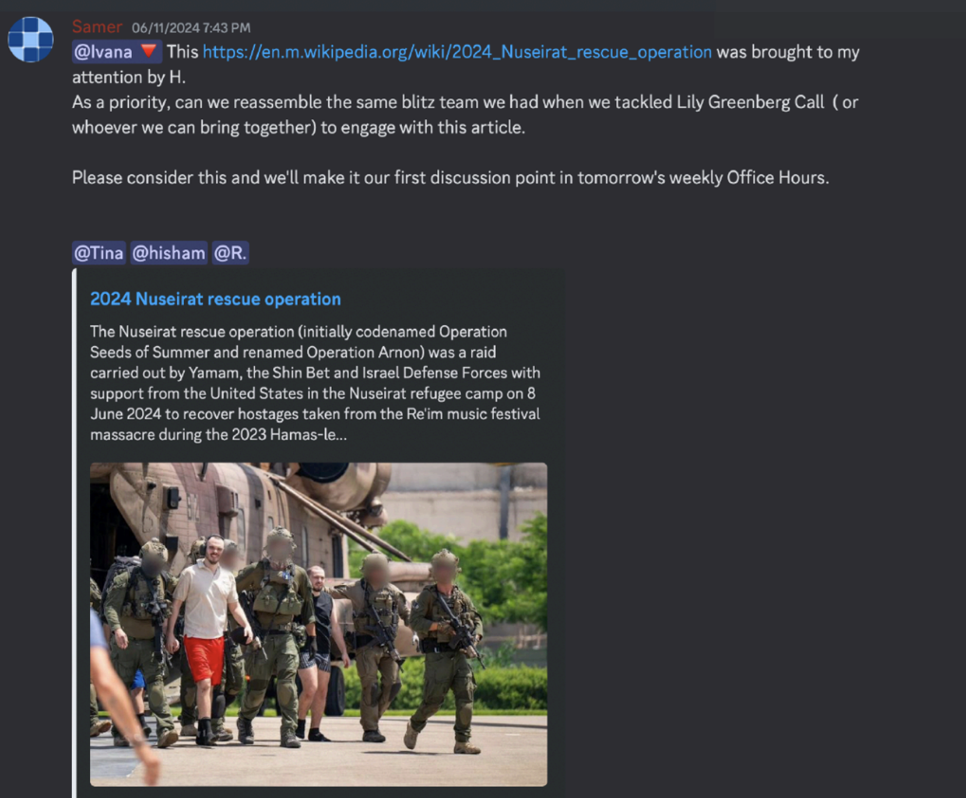
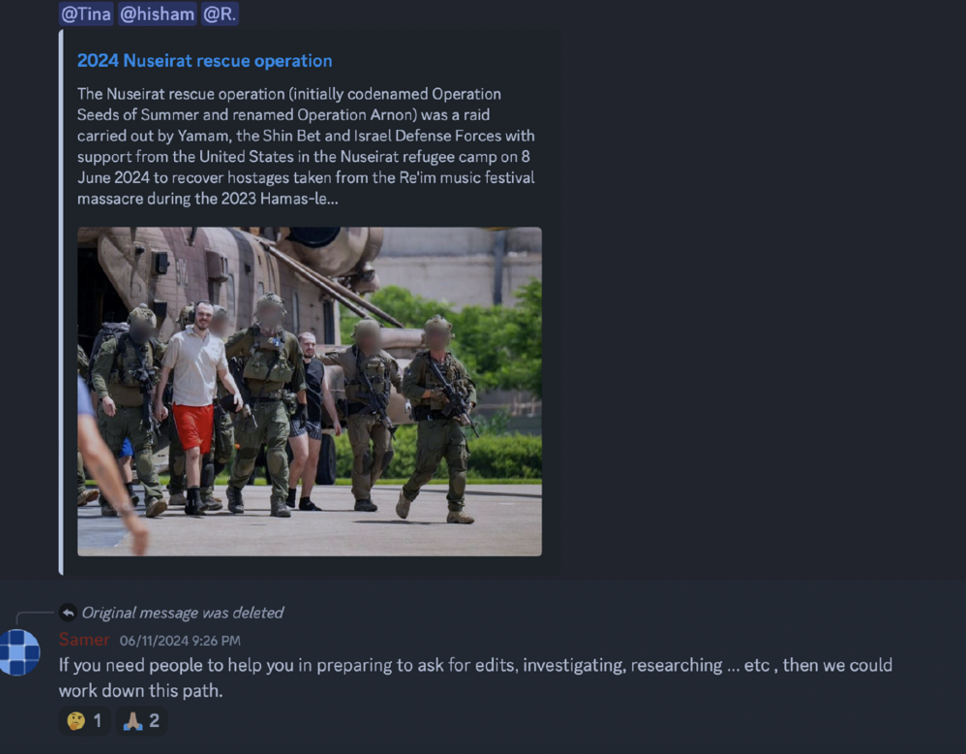
The editor is referencing reports of a Discord server titled “Tech for Palestine” that featured a Wikipedia collaboration channel in which anti-Israel editors coordinated edits to myriad articles; offsite coordination violates a Wikipedia guideline known as “canvassing.”

Interestingly, one of the editors involved in the RM discussion, “Ïvana,” was indefinitely banned from Wikipedia on Dec. 9 over her reported involvement in the Tech for Palestine channel. Screenshots purportedly taken from the channel in June where “Samer,” one of the leaders of the channel, alerted users to the existence of the initial “2024 Nuseirat rescue operation” article in June and tagged Ïvana, who was billed in the channel as “our resident Wikipedia expert.” Samer also discussed reassembling their “blitz team” to address the article. It is worth noting though that the timestamps of Samer’s messages were timestamped as being on June 11 and Ïvana had been involved in talk page discussions on the “Nuseirat refugee camp massacre” article prior to that.

The channel went private in September after “The Wikipedia Flood” blog highlighted the channel, and the activities in the channel received further scrutiny on Wikipedia after a viral piece in Pirate Wires, a site that covers the intersection of tech, politics, and culture, detailed some of the specifics of the coordination. Ïvana was one of a handful of editors who were sanctioned over it, though she received the most severe sanction of the lot.

“(Wikipedia) has lost its ability to maintain healthy debate and not fall victim to organized agenda.” – Wikipedia editor

An editor described the Tech for Palestine channel to me as “a major canvassing operation” and that “Nuseirat was a target of that operation.” All this shows that when it comes to contentious topics, Wikipedia “has lost its ability to maintain healthy debate and not fall victim to organized agenda,” the editor argued. “Tech for Palestine was exposed because its organizers were sloppy … how many other better organized canvassing operations are out there? And how many of them were involved in recent contentious RM’s like Nuseirat? Me and many other people would like to know, and it’s beyond troubling that arbitrators and admins have little-to-no ability to expose such groups or stop such operations.”

Wikipedia Editors Title Article “Nuseirat Rescue and Massacre” Read More »

A Miserable Life

There is only one acceptable answer to the question “How are you doing?” It is meant as small talk, offered with the expectation of receiving some empty positivity in response; and so we offer an upbeat reply, such as “great,” “wonderful,” or “amazing.”

Not so Jacob. When he arrives in Egypt, Joseph takes him to meet the Pharaoh. When Pharaoh asks “How old are you?” as a way of making conversation, Jacob gives this bitter response:

“…few and evil have been the days of the years of my life, and they have not attained to the days of the years of the life of my fathers in the days of their pilgrimage.”

Jacob didn’t say “I’m great.” His life had been awful. He had fled from a brother who wanted to murder him into the arms of a father-in-law who cheated him and worked him day and night in harsh weather conditions. In the end, Jacob had armed confrontations with both that were luckily defused at the last moment. He returns to Israel, only to have his daughter Dina abducted and raped, his beloved wife Rachel die in childbirth, and the disappearance and presumed death of his favorite son Joseph. And now, he and his family are about to begin a long exile in Egypt.

Jacob had a miserable life.

Even so, some commentaries take Jacob to task for his negative response, which they consider ungrateful and impious. One Midrash writes that God responds:

Jacob had said, “With (just) my staff I crossed this Jordan” when he fled Esau; and God did so much good for Jacob afterward to help him prosper. Yet Jacob said to Pharaoh, “Few and evil have been the days of my life.” God responded: “Have I ever caused you evil, Jacob, that you speak so?”

Another Midrash goes further, and says that God shortened Jacob’s life because of this response.

But most commentaries refuse to condemn Jacob; what he says isn’t impious, it is honest. They note that Jacob must have looked exceptionally old; and his response, that his life has been filled with heartbreak, explains why he was so broken and worn. Jacob’s life of misery can be seen on his face.

The Torah wants us to know Jacob lived a miserable life; that is why it shares with us this otherwise unimportant exchange. It does so because what Jacob does before he dies is heroic, and we need to pay attention to how he navigates the final chapter of a broken life.

Jacob recognizes that this final chapter is critical. After he is reunited with Joseph, he exclaims, “I can die now, now that I have seen your face, because you are still alive.” Of course, Jacob doesn’t want to die at that moment; but being reunited with Joseph, even in the twilight years, is enough to make his life feel full. The ending changes everything; in the story of our lives, the final chapter defines the entire book.

Even though it is too little, too late, Jacob gets a measure of comfort from his reunion with Joseph. But what truly redeems Jacob’s life of suffering is something else: binding himself to the future of his family and his people.

Jacob, in his final days, has his eye on the ultimate final chapter. He adopts his Egyptian-born grandchildren as his own, and blesses his children. More importantly, he speaks to his children about the “end of days,” and exhorts them to grab hold of their destiny as a people. Jacob becomes the father not just of a family, but of a nation. And in doing so, Jacob transcends his own tragedy-filled life and connects himself to his nation’s destiny and future redemption. For this reason, the Talmud (Taanit 5b) remarks “Jacob our forefather never died.” Jacob teaches us that building a legacy allows one to touch eternity.

This lesson becomes a foundation of Judaism. Rabbi Joseph Soloveitchik wrote, “The first concept of immortality as coined by Judaism is the continuation of a historical existence throughout the ages.” To be a part of a Knesset Yisrael, the Jewish community, is to merge one’s individual existence with that of an eternal nation. Isaiah (56:3-5) speaks about the eunuchs who had come to join the Jewish people, who considered themselves a “withered tree” because they would not be able to have children of their own. He comforts them by saying that God will give them “a place and a name (yad vashem) better than that of sons and daughters; I will give them an everlasting name that shall not be cut off.” The eunuchs will not be forgotten, and will have a permanent place in the holy of holies.

I am an inveterate optimist; and I have spent much of my career encouraging people to hold tight to hope. And hope is often the answer; but not always. Not everyone gets a happy ending to their personal story. It is easy to forget that in the agony of exile, generations of Jews suffered silently through lives that were short and painful. It is for them that Jacob offers this lesson of immortality.

And we must remember them. Without the lonely, anonymous Jews who persevered, none of us would be here today. Every Jew stands on the shoulders of others who didn’t live long enough to see the return to Zion.

When I visit Israel, I always take a moment to imagine that I am being accompanied by my grandfather who died in the Holocaust, who never got a chance to visit Israel. I wouldn’t be anywhere without him; and each step I take on the streets of Jerusalem belongs to him as well.

No Jew ever walks alone; we stand shoulder to shoulder with ancestors who never stopped dreaming of the Jewish future, even when their own future was bleak. And after a grueling war that has claimed the lives of far too many who were far too young to die, we once again take on the sacred task of creating a legacy for those who have fallen.

A few months ago, we celebrated in synagogue a baby girl who had just been born; she was named Eden Carmel, in memory of two hostages who had been killed the previous week.  It might seem unusual for new parents to name their child after complete strangers; but not if they’re Jewish. To us, those who have fallen since October 7th are part of our family, and their story is our story.

And their everlasting name with live on with us.


Rabbi Chaim Steinmetz is the Senior Rabbi of Congregation Kehilath Jeshurun in New York.

A Miserable Life Read More »