

fbpx

December 29, 2024

Sixty Years Ago, A Crime-Solving Rabbi Appeared: Remembering Harry Kemelman’s Rabbi Small Series

Sixty years ago, a middle-aged English professor named Harry Kemelman wrote a most unlikely bestseller. “Friday the Rabbi Slept Late”—a murder mystery involving the body of a woman found in the parking lot of a synagogue—won an Edgar first best novel prize from the Mystery Writers of America. It went on to spawn a thirty-plus-year series: After “Friday the Rabbi Slept Late” (1964), Kemelman published “Saturday the Rabbi Went Hungry” in 1966 (spoiler: it was Yom Kippur), “Sunday the Rabbi Stayed Home” (1969), and on through the days of the week and beyond until finally, in 1996, “That Day the Rabbi Left Town,” the same year Kemelman left this earth. The books sold millions of copies and were widely loved.

“Friday the Rabbi Slept Late,” as would its successors, follows the conventions of the “cozy mystery” novel. The main character is an amateur sleuth, Rabbi David Small, and it takes place in an enclosed community, Barnard’s Crossing, a fictional Massachusetts town not far from Boston. It includes minimal sex and violence, and a bloodless murder, and is resolved neatly. Yet “Friday” was an unlikely bestseller because rather than use the bulk of its pages to provide clues or suspects for its crime, it instead spends far more time teaching readers about the role of a rabbi, the logic of the Talmud (“pilpul” becomes a favorite term of the police chief, Irish Hugh Lanigan, who loves to roll it across his tongue), and the politics of synagogues (oh, the politics!).

The Rabbi Small series is effective at capturing Jewish life in the American postwar era, that moment of change, that moment of suburbanization and comfort and surprisingly easy assimilation, that moment in which the past—and it’s a particularly nostalgic, Eastern European past, a past that was at the exact same time, in 1964, being mythologized in “Fiddler on the Roof” on Broadway—and the present-day American reality were really coming to a head. Our hero, a newly ordained, Conservative, Ashkenazi (and highly Ashkenormative) rabbi hired by a wealthy community, is a liminal, almost Janus-faced figure. On the one hand, Rabbi Small looks back to a time when the rabbi’s job was to learn Jewish law and sit judgment over his people. And on the other hand, he is young, beardless, and interested in youth culture (even, in the third book, weed). He is a man about to start a family when the series begins, and we see him learning to be lenient about Halacha, for instance, permitting and even encouraging others to accept the use of electricity on Shabbat and holidays.

Rabbi Small describes himself as wanting to be a rabbi like his father and grandfather, a rabbi who would influence his congregants. But in the period of flux that was the 1960s, he worried that he (and other rabbis, along with the classical traditions of Judaism) no longer had a meaningful role: “I’m beginning to think,” he says early on, “that there is no place for me or my kind in a modern American Jewish community. Congregations seem to want the rabbi to act as a kind of executive secretary, organizing clubs, making speeches, integrating the temple with the churches.” Rabbi Small refuses interfaith work, social action, and other “trends” that he doesn’t think are his job.

I picked up the first Rabbi Small book soon after semi-hate-but-also-love-watching “Nobody Wants This,” aka the “hot rabbi show.” Rabbi Noah Roklov, played by Adam Brody, is kind, thoughtful, and remarkably good at listening to and learning from other people; that is not, I thought right away, how rabbis are usually presented in popular culture. Or are they? Fictional rabbis, I realized, vary. They are at times strict and fiery orators, like that of Modernist writer Henry Roth in “Call it Sleep” (1934), or in Philip Roth’s “The Conversion of the Jews” (1958), or in the Bukharan community portrayed in the film “Yismach Chatani” (“The Women’s Balcony,” 2016). They are sometimes providers of comic relief, as in the French bigot-turned-rabbi and Arab-leader-turned-rabbi in the iconic French film “Les Aventures de ‘Rabbi’ Jacob” (1973), or ancient figures, reminding that we must hold fast to our heritage, like Rabbi Isidor Chemelwitz in Tony Kushner’s “Angels in America” (1991) (played brilliantly by Meryl Streep for HBO, 2004). There are, more recently, even variations of the “beautiful” and “fertile” (or infertile) “woman rabbi,” as in Charlotte Mendelson’s female pioneer-graduate of Britain’s Leo Baeck College in “When We Were Bad” (2007) or Rabbi Raquel on “Transparent” (2014-19). Their representations tell us much about the ways not only rabbis but also Jews in general have been seen and see themselves (or want to see themselves) in the world around them. They also give us insight into evolving ideas of gender, class, race, ethnicity and sexuality, national and community norms, and religious leadership in multicultural, often secular, contexts.

I picked up the first Rabbi Small book soon after semi-hate-but-also-love-watching “Nobody Wants This,” aka the “hot rabbi show.”

I had the opportunity to talk about Rabbi Small at a rabbinical college recently. The students were incredible: keen, engaged, enthusiastic. Even the professor-rabbi at the back of the class, who, like the students, had never heard of Harry Kemelman, was rapidly taking notes on the wisdom of Rabbi Small. But then one student raised his hand and asked why, why, when we could learn so much the period in which they were written as well as their timeless insights, were so few people now reading these books?

I looked around the room. The students—this was at a Reform seminary—comprised men both gay and straight, non-binary individuals, and, as a clear majority, women. I thought of Rebbetzin Small, whose main job in the series is to wash dishes, or worry about how dishevelled her luftmensch husband appears, or hover over him as he eats the food she prepares for him. I thought of Rabbi Small denigrating the Women’s Lib Movement as a “shift in fashion.” There are very good reasons they’ve lost their popularity.

But, if I’m honest, I’m still enjoying them. And I’m heartened to see they’ve inspired books that tell us a lot about our time, like Rachel Sharon Lewis’s “The Rabbi Who Prayed with Fire” (2021), featuring a Northeastern city (Providence), a crime (arson), and a rabbi (who is a queer woman), which, as soon as I’m done with Kemelman’s series, I can’t wait to read!


Karen Skinazi, Ph.D. is Associate Professor of Literature and Culture and the director of Liberal Arts at the University of Bristol (UK) and the author of “Women of Valor: Orthodox Jewish Troll Fighters, Crime Writers, and Rock Stars in Contemporary Literature and Culture.”
Sixty Years Ago, A Crime-Solving Rabbi Appeared: Remembering Harry Kemelman’s Rabbi Small Series Read More »

Jimmy Carter, Former President Who Brokered First Arab-Israeli Peace Accord, Is Dead at 100

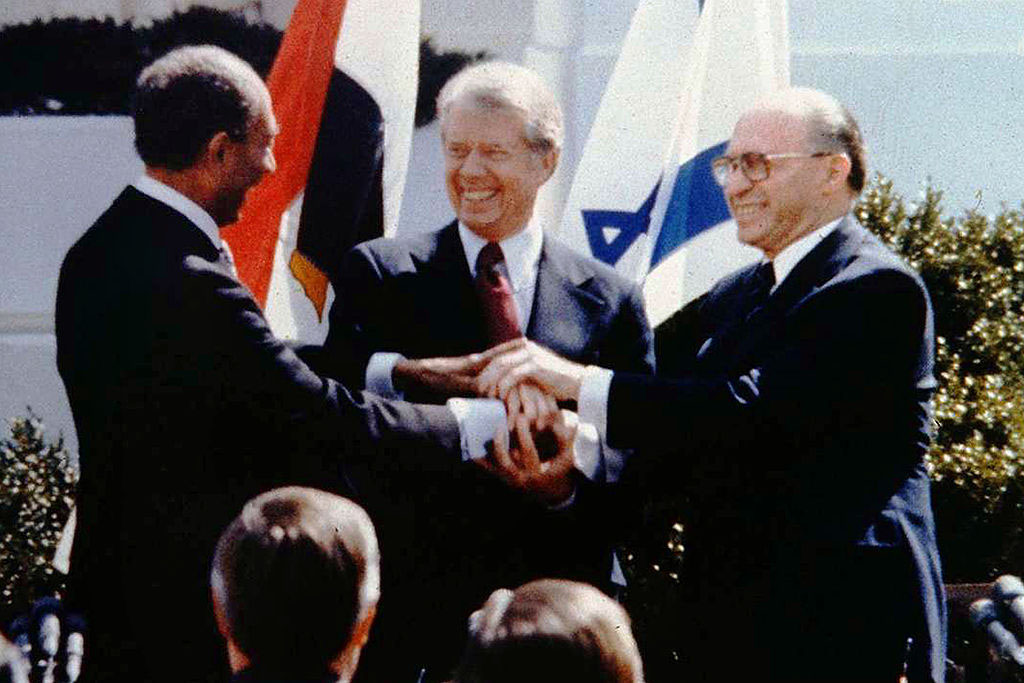
WASHINGTON (JTA) – Jimmy Carter, the one-term president who brokered the historic Camp David Accords between Israel and Egypt but earned pariah status in some corners of the Jewish community for his criticisms of Israel, has died.

Carter, who had remained active into his final years despite a 2015 diagnosis of liver cancer, died Sunday at 100 at his home in Plains, Georgia, his nonprofit announced.

Carter’s work at Camp David in 1978 led to the first peace treaty between Israel and an Arab state and radically changed the landscape of the Middle East, diminishing — for the first time in Israel’s history — the threat of regional war. Over 13 days, Carter personally authored 23 drafts of the accord and negotiated separately with both sides after it became clear they could not reach an agreement directly.

Carter grew increasingly critical of Israel in the years after he left the Oval Office, culminating with the 2006 publication of his book “Palestine: Peace Not Apartheid.” While arguments over the book led some in the Jewish world to accuse the former president of antisemitism, others saw the fight as obscuring a legacy that should be heralded.

“It’s unfair not to see Carter in the full context of what he achieved,” said Stuart Eizenstat, who served as Carter’s chief domestic policy advisor and is now the State Department’s special advisor on Holocaust issues. “He should have been a heroic figure.”

In 1978, against the advice of his advisors, Carter invited Israeli Prime Minister Menachem Begin and Egyptian President Anwar Sadat to the presidential retreat in the Catoctin mountains near Washington. Carter’s approval ratings were then at an all-time low, the economy was in shambles, and neither Begin nor Sadat seemed primed to reach the kind of agreement that would justify such an expenditure of presidential time and goodwill. But Carter’s gamble worked.

“Carter was the hero of Camp David,” said Aharon Barak, the longtime chief justice of the Israeli Supreme Court and a former chief advisor to Begin. “We were sitting I think eight or nine days together. We ate, we did a prayer, we thought of problems, and [we] would sit and sit until late late at night. Which other president of the United States would be willing to do this?”

Carter wanted the agreement to include a timetable for the end of Israeli settlements, but in the final deal the issue was set aside. In recent years, his undisguised frustration with the growth of settlements, and with the Israeli government more generally, earned him opprobrium that bordered on vitriol in the Jewish world.

Carter was often unsparing in his critiques of Israeli leaders, settlement policy and the continued Jewish presence in the occupied territories. Israeli Prime Minister Benjamin Netanyahu pointedly did not meet with Carter during the former president’s 2015 recent trip to Israel. Carter, in turn, told the press that a two-state solution was nearly out of reach as long as Netanyahu remained in power, while Hamas, the militant group regarded as a terrorist organization by the United States, was interested in peace.

But it was his 2006 book that most rankled the Jewish community. The text was widely criticized as lopsided in its assessment of the failure of peace negotiations. In no small part it was the use of the term apartheid itself, a word he later walked back and became reluctant to use in public.

“The title is to de-legitimize Israel, because if Israel is like South Africa, it doesn’t really deserve to be a democratic state,” said Abraham Foxman, then the national director of the Anti-Defamation League. “He’s provoking, he’s outrageous, and he’s bigoted.”

In 2009, in a letter released exclusively to JTA, Carter offered an “Al Chet” prayer of atonement for any words that may have “stigmatize[d] Israel.”

Carter was an early and fervent advocate for the rights of Soviet Jews. After Natan – then Anatoly – Sharansky was arrested in 1977, Sharanksy’s wife Avital lobbied the White House to publicly “prove” her husband was not an American spy. In an unusual move, Carter agreed to state publicly that Sharansky was not involved in espionage.

In 1978, Carter laid the groundwork for the U.S. Holocaust Memorial Museum with the creation of the Presidential Commission on the Holocaust. Chaired by Elie Wiesel, the commission recommended the establishment of a national Holocaust museum in Washington.

During the 1979 Iranian revolution, Jewish Iranians attempting to flee to the United States hit obstacles in consulates abroad. Eizenstat and White House Counsel Robert Lipschutz successfully lobbied Carter to create a special — ostensibly temporary — visa that enabled some 50,000 Iranian Jews to enter the United States after the fall of the shah. The visa status was ultimately also used by Iranian Christians and Bahais.

But the years of his presidency, beset by economic woes and the Iranian hostage crisis — in which 52 Americans were held by Iranian students for 444 days — took the glow from his foreign policy wins. Carter’s failure to secure reelection in 1980 is often attributed to his perceived fecklessness in Iran. In that election, Carter won only 45% of the Jewish vote, a historic low for a Democrat.

James Earl Carter, Jr. was born in Plains, “a small town in South Georgia with 683 people in it,” as Carter liked to say. Like his father before him, Carter was a peanut farmer. He married Rosalynn in 1946. The couple had four children.

Carter felt quite keenly the need to address the violent racial history of the south. He did not join the White Citizens Council when he returned from eight years in the Navy. It was 1953, his father had just died and Carter was shifting gears to life on the farm. His political career began on the school board. He went on to the Georgia State Senate and eventually the governor’s mansion.

When he became governor of Georgia – also a position he would hold for only one term — he famously announced, “The time for racial discrimination is over.” He saw himself as a champion for the oppressed.

A deeply religious man, Carter was unabashed in describing his relationship with God while on the presidential campaign trail in 1976. On his first trip to Israel, in 1973, Carter asked to dip in the waters of the Jordan River. In meeting then Prime Minister Golda Meir on that same trip, he wrote in his 2006 book, he warned her that nothing good had come for the Jews when they had turned from God. The secular prime minister, he reported, was bemused.

In the 45 years since he lost his 1980 reelection bid to Ronald Reagan — the longest post-presidency in U.S. history — Carter was widely celebrated for his work on human rights, hunger reduction and the pursuit of free elections around the globe through the Carter Center, the Atlanta-based nonprofit he founded in 1982 with his wife.

Carter’s religious commitments were part of his motivation to seek peace in the Middle East and for his post-presidential work on poverty and conflict resolution. He was a member of the Elders, a global collective of elder statesmen working on peace and human rights. In 2002, he was awarded the Nobel Peace Prize.

“In Judaism, we say ‘Kol Yisrael arevim zeh bazeh.’ (All Jews are responsible for one another),”  Tamara Cofman Wittes said in a 2015 interview when she was director of the Center for Middle East Policy at the Brookings Institution. “I think for President Carter, that was a sentiment that applied to all humanity.”

Jimmy Carter, Former President Who Brokered First Arab-Israeli Peace Accord, Is Dead at 100 Read More »

The Judeo-Christian Ties That Bind

This is only the fifth time since 1910 that the first night of Hanukkah coincides with Christmas. Not quite a Hanukkah miracle, but a welcome symmetry with the Gregorian calendar.

It’s also a timely reminder of the Judeo-Christian bond. After all, Jesus Christ is claimed by both religions—yes, for different reasons, but why get into that now. The fellowship between Christians and Jews in the United States has nearly always been a mutually reassuring one. In 1790, President George Washington visited the Touro Synagogue in Newport, Rhode Island. On that same day he penned a letter promising American Jewry that their religious liberty, and their rights as citizens, will always be secure in the United States.

In 1992, an antisemite from Billings, Montana tossed a cinderblock through the window of a Jewish home that had lit its Hanukkah menorah for all to see—a tradition that, historically, gets suspended during periods when hostility toward Jews in the Diaspora is on the rise. It both shook, and took, that Montanan Jewish family by surprise.

It shocked the Christians of Billings, too. In response, nearly 10,000 church-going Montanans purchased and lit their own menorahs, proudly displaying them on their windowsills. Many showed up to Jewish homes for a tutorial on the lighting ritual and prayers. Far too many, in fact. Jewish homes had neighbors standing on their lawns waiting for their turn to come inside. Others guarded the local synagogue.

We are now living through very delicate and confusing multiethnic and anti-Western times. The solidarity between Christians and Jews has never been more important. It is perhaps bashert that our respective calendars cooperated to mark the moment.

American Jews have endured threatening protests and hateful actions since Israel began its retaliation against Hamas following the October 7 massacre. Jewish students and faculty have been harassed. Signage and megaphones calling for the rape and murder of Jews—whether they live in Israel or elsewhere—have made Western societies resemble the streets of Tehran. London, Paris, Berlin, Stockholm, Brussels and Madrid are overrun with Islamists who wish to topple governments, impose Sharia law, and weaken Judeo-Christian ties—if not entirely eliminate these religions.

Jews fear wearing religious garments or any insignia of peoplehood or connection to Israel. A soccer match in Holland was outdone in excitement value to a pogrom awaiting Jews on the streets of Amsterdam. Target practice against Hasidim has been going on since even before the pandemic. Jewish businesses have been defaced, and cemeteries desecrated by Hamas supporters. Posters of the Israeli hostages have been ripped from lampposts in cities around the world. A Hanukkah menorah lighting ceremony was canceled in Williamsburg, Virginia. Why? Well, . . . it might offend Muslims.

The Jews of Hollywood have predictably kept their heads down, as if they are all auditioning for a remake of “Gentleman’s Agreement.” The risk of standing up to antisemitism, or appearing to root for Israel to finally rid the Middle East of radical Islam, has turned agents and publicists into a propaganda arm of Hamas.

Suddenly, notable foreign policy antisemites like Mark Ruffalo, John Cusack, Lena Headey, the Hadid sisters, Pedro Pascal, Susan Sarandon and Billie Eilish are treated like brainy fellows at a think-tank.

What a shame Angelina Jolie learned absolutely nothing from her father, the lifelong Zionist, Jon Voight.

Meanwhile, anti-Western Islamists are back at it again in Europe. Yet another drove a car into a Christmas market, this time in Magdeburg, Germany, killing five, including a nine-year old. It happened in Trier, Germany in 2020, when a Muslim motorist ploughed through a crowd, also killing five, including a nine-week-old baby. An Islamist in Strasbourg, France opened fire on a Christmas market in 2018. In 2017, in Potsdam, Germany, police disarmed a bomb filled with nails (an Islamist’s signature calling card) hidden inside a Christmas market. There was a truck ramming in Berlin in 2016 that killed fifteen. A man driving a van mowed down ten people in Nantes, France in 2014; that same year in Dijon, France, a man shouting “Allahu Akbar” rammed his car into a Christmas market.

And these are only the ramming of vehicles! There have been scores of Islamist knife attacks all throughout Europe, as well as devastating bombings and shootings.

Open borders are just so festive and fun. Merry Christmas, Europe, courtesy of your most appreciative asylum-seekers. It’s a shame you never bothered to ask at your border: “Do you hold any beliefs that are fundamentally incompatible with liberal democracy and pluralism?”—or more directly, “Do you hate the West?”

Merry Christmas, Europe, courtesy of your most appreciative asylum-seekers. It’s a shame you never bothered to ask at your border: “Do you hold any beliefs that are fundamentally incompatible with liberal democracy and pluralism?”—or more directly, “Do you hate the West?”

Meanwhile, just in time for the holidays, a Palestinian newspaper, Al-Quds, featured an op-ed by a PLO official reminding his readers that Christianity owes its existence to Palestinians because Jesus was “the first Palestinian martyr.” His argument concluded with an ancient canard: the Jews who killed Jesus went on to kill many more Palestinians. (Palestinian Authority President, Mahmoud Abbas, was the first to make this association in 2013.)

The history here is a little off. Jesus was not born in a nation called Palestine governed by Arabs. No such place has ever existed. Moreover, Islam didn’t even come into existence until 700 years after Christ!

Just a few minor details.

Now, back to Europe for more antisemitic, anti-Catholic fantasies—this time supplied by the Vatican! This year’s Nativity scene featured baby Jesus lying on a bed covered in a keffiyeh. The display was created by Representatives of the Palestinian Embassy to the Holy See. It was eventually removed, but not before Pope Francis, who has accused Israel of genocide in Gaza, prayed in front of it.

The Vatican’s embrace of Palestinian terror is no worse than a mural of George Floyd in Manchester, England, and a tweet sent out by the Palestine Museum in Connecticut, in which Floyd is draped in keffiyeh, a Palestinian flag as backdrop.

I thought cultural and religious appropriations are forbidden these woke-filled days.

Most people don’t remember that Jerusalem was not Israel’s united capital until it reclaimed the Old City back in 1967. For the first 19 years of Israel’s existence, the West Bank and the Old City were completely occupied by Jordan. And guess what: the Church of the Sepulcher in Jerusalem, and the Church of the Nativity in Bethlehem, didn’t fare so well.

It was only when Israel reclaimed the West Bank that both houses of Christian worship were restored. Israelis then became the caretakers of Christian worshippers.

Judaic and Christian traditions are both under attack by encroaching Islam. Let’s take a cue from this year’s calendar: These ties that bind need reinforcement.

Judaic and Christian traditions are both under attack by encroaching Islam. Let’s take a cue from this year’s calendar: These ties that bind need reinforcement.


Thane Rosenbaum is a novelist, essayist, law professor and Distinguished University Professor at Touro University, where he directs the Forum on Life, Culture & Society. He is the legal analyst for CBS News Radio. His most recent book is titled “Saving Free Speech … From Itself,” and his forthcoming book is titled, “Beyond Proportionality: Is Israel Fighting a Just War in Gaza?”

The Judeo-Christian Ties That Bind Read More »