fbpx

November 22, 2024

UC Regents Say They’re “Deeply Dismayed” By Findings in UCLA Antisemitism Report

During their Nov. 14 meeting, the UC Board of Regents discussed the report published in October by the Task Force to Combat Antisemitism and Anti-Israel Bias at UCLA, calling the findings “deeply troubling.”

As previously reported by the Journal, the report found that 75% of Jewish students, faculty, administrators and staff believe that the “antisemitism is taken less seriously than other forms of hate and discrimination at UCLA”; the Task Force also took the university to task for allowing the anti-Israel encampment, which the report described as “a source of antisemitism,” to fester for as long as it did.

Regent Chair Janet Reilly said she was “deeply dismayed at the findings” of the report. “It describes a situation that should be horrifying to every fair-minded person,” she said. “There is no circumstance under which our students, faculty and staff should suffer the effects of such toxic bias and discrimination. While we applaud the efforts at the campus to address this insidious problem, there should be no mistake about our primary reaction to this report before us. The circumstances described are intolerable and we’ll do everything we can to address the underlying issues.”

UC President Michael Drake called the report “deeply troubling” and that he has been working with Interim Chancellor Darnell Hunt on improving the campus climate. He highlighted how his office implemented a series of directives implementing stricter measures on campus protests, establishing the Systemwide Office of Civil Rights, and allocating $7 million toward combating antisemitism, Islamophobia and other forms of prejudice.

Regent Richard Leib, who said that countless members of his family were killed during the Holocaust, asked, “how it can be that 70 years after World War II, so many Jewish students, faculty members and staff do not feel safe or feel welcomed” at UCLA and why “their voices expressing fear, anxiety and anger have fallen all on deaf ears.” He continued, “my impression of this report is, I feel like we’ve lost our way. We are failing in our mission and responsibility as a university and as a society … this is not a simple problem of enforcing our rules, we need to take stock and do everything in our power to restore our campuses to safe places where students can learn and thrive.”

Leib commended the Task Force on the thoroughness of the report and noted that the fact that 70% of the respondents in the report cited the encampment as a source of antisemitism “demonstrates why no encampments should have been allowed to persist at any of our campuses.” He recounted walking through the remnants of the encampment after it had been cleared and seeing the “alarming” antisemitic graffiti throughout the area. “I can understand why some Jewish students felt UCLA treated antisemitism secondary to other forms of discrimination because of the slow response in removing some of these hateful comments,” although he acknowledged that “after the encampment was removed, they went full speed ahead and did remove them, so that was good.”

He expressed support for the report’s recommendations and that the university has already begun implementing the recommendations and expressed astonishment that the

Academic Senate did not recommend any faculty members for discipline who “joined the encampment” or lectured on topics outside of the focus of the class and made political statements that offended students.

Lt. Gov. Eleni Kounalakis (D) said that “there is something very deep and worrisome about the antisemitism that has sort of broken to the surface within our system and the conclusions that it is going to take a lot of work to deal with this issue in an ongoing way.” Jewish students’ concerns their safety “has been rooted in differences in differences in student positions on a foreign war” and that “in many ways, students by virtue of their ethnicity or their faith are being held responsible for things they shouldn’t be held responsible for.” She added that they “have quite a bit of work to do going forward” to address the “underlying problem here.”

“There is something very deep and worrisome about the antisemitism that has sort of broken to the surface within our system and the conclusions that it is going to take a lot of work to deal with this issue in an ongoing way.” – Lt. Gov. Eleni Kounalakis

Regent Jonathan “Jay” Sures asked Chancellor Hunt how many complaints UCLA received on antisemitism compared to anti-Islam and anti-Arab Hate since the Oct. 7, 2023 massacre; Hunt replied that he didn’t have the exact figures with him but that the university did receive “hundreds” of complaints “on both sides.” The university’s Office of Diversity, Equity and Inclusion (DEI) is investigating the cases, but the “due process” involved has caused the investigations to take some time. Sures then asked Hunt if there has been “formal punishment” against students, faculty or staff as a result of the complaints, to which Hunt said that he wasn’t aware of any so far. Hunt added that the university “submitted data to Congress” about a few weeks ago about the statuses of the cases and that “some of these cases can take up to a year to resolve.”

Regent John Perez said that he was “frustrated with how it got to this point” as well as the “both sides-ism that doesn’t pay adequate attention to any of the issues at hand.” He recalled that when he chaired the Los Angeles Human Relations Commission after 9/11, they took efforts to protect vulnerable Muslim communities. “Nobody asked me then to speak out against antisemitism because I was speaking out against Islamophobia and targeting of Muslims in a way that was unfair and unjust and based on something they had nothing to do with,” Perez said. “But yet too often when we talk about the perniciousness of antisemitism in our community and in our campuses, we’re compelled then to talk about something.” The day after the Oct  7, 2023 massacre, calls to condemn the terror attack were “met with a both-sides approach. Yes we should concern ourselves with all expressions of hate and of violence and of death but to do it in a reflexive way that denies the crisis of the moment is problematic. I don’t want us to conflate these two issues, I’d like us to deal with both of them, appropriately, seriously and with appropriate focus.”

Judea Pearl, Chancellor’s professor of computer science at UCLA, National Academy of Sciences member and president of the Daniel Pearl Foundation, told The Journal that “disappointingly, none of the discussants mentioned ‘Anti-Zionism’ (or ‘Zionophobia’) — the primary cause of campus hostilities and that “Drake and Hunt continue to tout the ‘Dialogue Across Differences’ initiative as the ultimate fix for campus problems, ignoring repeated warning that the leadership of this initiative is dismissive, if not antagonistic to fundamental beliefs and sensitivities shared by the majority of the Jewish faculty on UC campuses.”

UC Regents Say They’re “Deeply Dismayed” By Findings in UCLA Antisemitism Report Read More »

Wounded Redeemers

Altruism is not a given; many have argued against it. Social Darwinists, inspired by the theory of evolution, argued against helping the poor. Charity, they maintained, runs counter to the “survival of the fittest.”  Helping the weakest in society would only undermine progress by allowing the unfit to procreate. Ayn Rand attacked altruism as collectivism in disguise, a made-up virtue that allows the mediocre to undermine individual greatness. Nietzsche blamed the Jews for having introduced a “slave morality,” which focuses on caring for the weak; the focus of society should be to empower greatness. He explains that “A nation is a detour of nature to arrive at six or seven great men.” Individual greatness is the ultimate goal; altruism can only get in the way.

Judaism follows a very different path. It certainly respects the importance of individualism. Rabbi Jonathan Sacks once asked the British historian Paul Johnson what struck him most about Judaism. Johnson responded that it “was the most successful example he knew of that managed the delicate balance between both – giving equal weight to individual and collective responsibility.”  But Judaism’s central passion is empathy and kindness. The Talmud says that “performing acts of kindness” is one of the distinguishing virtues of Jews. This statement is not a mere homiletical flourish; the idea is grounded in the narratives of Parshat Vayera and Chayei Sarah.

Abraham’s family practices kindness. He welcomes strangers, as does his nephew Lot; so does his great-niece and future daughter-in-law Rebecca. This stands in distinct contrast with Sodom, a place that “had plenty of bread and untroubled tranquility; yet she did not support the poor and the needy.” (Ezekiel 16:49)

Abraham does support those in need. He runs to greet guests and bows to them with respect. He offers them a bit to eat and then runs around his home to prepare them a feast.

Rebecca does the same. Abraham’s servant asks Rebecca for a drop of water. Even though he is a supplicant, Rebecca treats him with great respect, and tells him “Drink, my lord”; and she gives him more to drink than he asked for. She holds the jar while the servant drinks, to make it easier for the tired, thirsty man. Unbidden, Rebecca draws water for the servant’s camels. All the while, the text lingers over the way Rebecca hurries and runs to help this stranger.

This focus on the details of Abraham and Rebecca’s hospitality is the text’s way of saying: This is important. Kindness is the Jewish way.

Philosophers and theologians will offer multiple rationales for altruism. First, it is critical for social bonds, and the healthiness of any society; ultimately, we will all depend on the kindness of others at one time or another. It is also a moral obligation to transcend selfishness and seek goodness for the community as a whole. From a religious perspective, to give is divine, and man is meant to emulate God. And, in a passage that anticipates the insights of positive psychology, Maimonides writes that “there is no greater and more beautiful happiness than to bring joy to the hearts of the poor, the orphans, the widows, and the strangers.” Giving makes the giver happier.

Altruism is a universal value. However, exile will transform Jewish altruism, and a new perspective, forged in crisis, will take hold.

After leaving Egypt, the former slaves never forgot what it was like in a hate-filled society. They carried within the command “You too must befriend the stranger, for you were strangers in the land of Egypt.” And we do exactly this at the Seder; in the first paragraph of the Haggadah we call to the wandering strangers in the street “Let all who are hungry come in and eat; let all who are in need come and join us for the Pesach.”

Suffering brings with it an obligation to find a meaningful response. Rabbi Joseph B. Soloveitchik wrote, “The Halakhah teaches us that an ‎afflicted ‎person commits a criminal act if he allows his pain to go for naught and to remain without ‎meaning ‎or purpose.” If so, the suffering of exile brings lessons that must not be neglected. And it is here that kindness will take on a critical role, not just as a response to a bitter past, but as a road map to a better future.

The primary theme of the Book of Ruth is kindness. As the Midrash explains: “Why was the Book of Ruth written? It is to teach you the extent of the good reward for those who perform kindness.” Ruth, the Moabite, marries an Israelite man who moved to her country. After all the men in the family die and lose all of their wealth, Ruth’s former mother-in-law Naomi decides to return home to Israel. Naomi tells Ruth to stay behind in Moab, where she can return to her former life; but Ruth remains loyal to Naomi, and insists on accompanying her home. In Israel, Ruth’s loyalty catches the eye of Naomi’s relative, Boaz; and he too is inspired to continue the name of the family by redeeming the family’s fields and marrying Ruth. Ruth’s actions set off a cascade of goodness. During a profound crisis, her consistent compassion changes everything.

The punchline of the book comes at the end. In a short, dry genealogy, we are informed that Ruth, this poor stranger, is the progenitor of King David. Ruth’s kindness not only repairs her family; it brings redemption to the world.

In the aftermath of exile, we recognized the power of a broken heart. It listens for the cries of the stranger and orphan, and is the first to hear the call of redemption.

The Messiah himself is a product of exile, wounded and sick. The Talmud tells how one Rabbi, Yehoshua ben Levi asked Elijah about when the Messiah would come. Elijah responded: “Go ask him,” and explained that the Messiah is sitting outside Rome, one of the poor who suffer from illnesses.

The Messiah himself is broken-hearted. But even in his pain, he looks to redeem everyone else. At the end of the Talmudic passage, Elijah explains to Rabbi Yehoshua ben Levi he can tell the Messiah apart from the other poor invalids because “all of the others untie their bandages and tie them all at once, but the Messiah unties one bandage and ties one at a time. He says to himself: Perhaps I will be needed, and I don’t want to be delayed.”

What an inspiring image. The wounded Messiah, even when readjusting his bandages, never loses focus on working for redemption. And the challenge to all of us, amidst the turmoil of our own suffering, is how to be wounded redeemers ourselves.

After 13 months of war, Israel is filled with anguish. Remarkably, despite their own heartbreak, some insist on changing the world with kindness. Recently, a video was posted of Rachel Goldberg, the widow of Rabbi Avi Goldberg, who fell in battle a few weeks ago. After the conclusion of shiva, Rachel went to a hospital to play the violin for families of wounded soldiers in the intensive care unit, and give them some encouragement.

There is no better demonstration than this of what it means to be a wounded redeemer.

And it is through the kindness of these wounded redeemers that redemption will come.


Rabbi Chaim Steinmetz is the Senior Rabbi of Congregation Kehilath Jeshurun in New York.

Wounded Redeemers Read More »

Life Torn and Sewn Together Comments on Torah portion Chayyei Sarah 2024 (adapted from previous versions)


Life Torn and Sewn Together (comments on Torah Portion Chayei Sarah) 2024

Comments on Torah portion Chayyei Sarah (adapted from previous versions)


Pain, regret, hurt, and betrayal form part of the backdrop of the book of Genesis. Those tragic moments often produce visions of God and the appearance of angels. Sometimes moments of unimaginable fulfillment arise.


Of the many sad, heart-wrenching and ultimately beautiful stories in Genesis, one of the most distressing is that of Hagar. We see Hagar three times in the Torah, in Genesis 16, Genesis 22, and, according to the Midrash, in our Torah portion, Chayyei Sarah, but under the name Keturah.


We met Hagar as the maidservant of Sarai (before she became Sarah) in Genesis 16. When Sarai could not conceive, Hagar was given to Avram (before he became Abraham) as a concubine. Hagar conceived, but Sarai felt slighted. Sarai mistreated Hagar, and Hagar fled down Highway 61, and found herself near a spring of water in the desert.


An angel of God intervened, and counseled Hagar to return to Sarai. The angel assured Hagar that her own offspring will increase beyond measure. The child of Avram whom she is carrying will be named Ishma’el, “God hears,” because God has heard her prayer. We are told that Hagar gives a name to the God who spoke to her through the angel:


And she called the name of Adonai who spoke to her “You are the God Who sees me,” for she said, “Even here I saw after I was seen.” Therefore, the well was called, “The Well of the Living God Who Sees Me.” (Genesis 16:13-14)


We don’t know why Hagar must return to Avram and Sarai, but it seems that some great part of the plan that the God of the Bible has in mind requires that Hagar submit herself to Sarai.


Hagar returned and bore Avram’s son Ishma’el at the end of Genesis 16. In Genesis 17, Avram is circumcised, and the covenant is established. Avram’s name becomes Abraham and Sarai’s name becomes Sarah. In chapter 21, Abraham and Sara have a son and name him “Yitzchak,” laughter.


We also meet Hagar again in Genesis 21, some years after she was saved by the angel in Genesis 16. By this time, Ishma’el was a teenager. In this chapter 21, Sarah saw something unseemly happening between Ishma’el and his younger half-brother Yitzchak. Sarah insisted that Hagar and her (and Abraham’s) son Ishma’el be banished into the desert. The offense that Yishma’el committed is not quite clear, other than it is a play on the name “Yitzchak” – laughter.


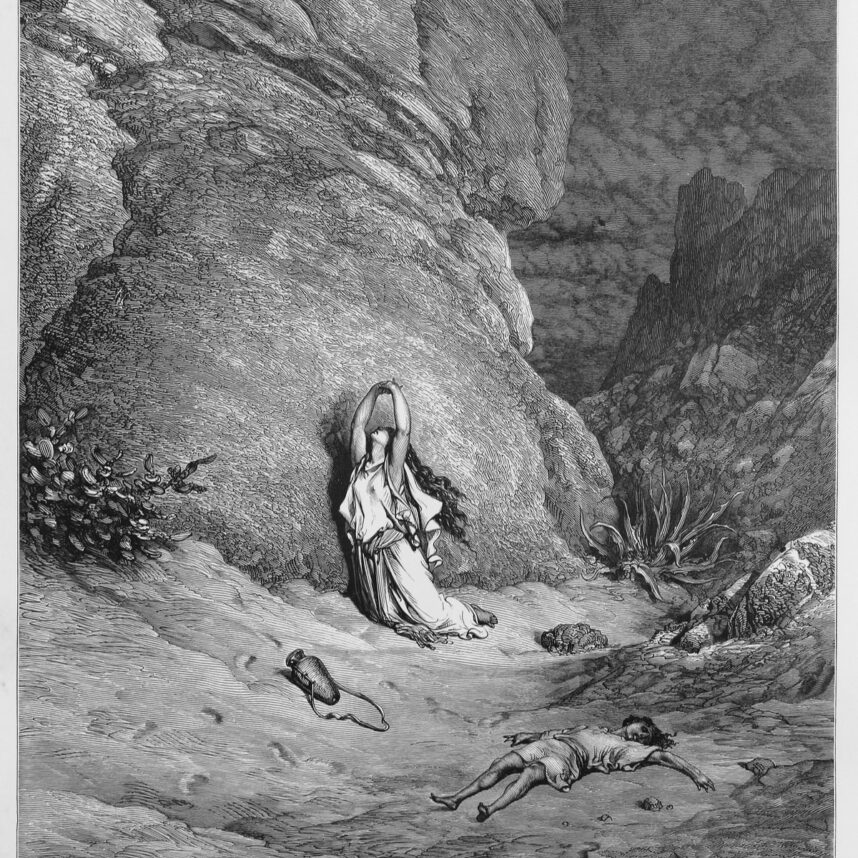
In Genesis 21, Hagar was devastated again. Back in Genesis 16, Hagar fled the mistreatment of Sarah, but she returned to the fold and submitted to Sarah. Here, in chapter 21, she is banished with her son. Hagar stumbled through the desert near Be’er Sheva (on my map, just off Highway 61), and suffered a spiritual collapse. Hagar ran out of water and resigned herself to the fact that she and her boy will die. The angel intervenes again. God opened her eyes, and Hagar saw a well of water. She and her son were saved.  The reader assumes that she has returned to the place, to the well, and to the angel of the first angelic intervention – “The Well of the Living One Who Sees Me.”  Twice forlorn and stranded, twice saved by the power of sight.


The rabbinic tradition insists that Hagar’s story does not end here. In this week’s Torah portion, after Sarah died, Abraham married a woman whose name is Keturah – “Incense.” In the Midrash (Genesis Rabbah 61:4), Rabbi Judah says “Keturah is Hagar.”


The brevity of this statement – “Keturah – Zo Hagar” (Keturah is Hagar) is directly disproportionate to its interpretive brilliance. In that brief utterance of Rabbi Judah, many things are brought to light.


It seems that the Midrash, through Rabbi Judah, tells us that Abraham loved Hagar. The desperation of barrenness that caused Abraham and Hagar to be thrown together, however begrudgingly, produced a forlorn intimacy. Perhaps their love was simply that of two people who quietly asserted their humanity in the midst of some vortex of pain and destiny. Sarah’s barrenness brought them together. Sarah finally bearing Yitzchak drove them apart. Now Sarah’s death released a force that took each of them by surprise. We don’t know, but we are bidden to imagine.


Rabbi Judah’s assertion, in no way supported by the biblical narrative, helps shape a rabbinic theory of love and alternative lives. Rabbi Judah seems to conceive of a God who holds blessings in store that might have seemed to be sheer fantasy.


Had the Bible had its way, Hagar would have gone her way, and Abraham would have married an Incense Woman of consolation. Rabbi Judah cannot accept this. In saying, “Keturah is Hagar,” Rabbi Judah insists that loose strands of the narrative urge themselves back on each other.


Hagar’s son Yishma’el nearly died – but Ishma’el was Abraham’s son as well. Both of Abraham’s sons, Yitzchak and Yishma’el, nearly died at his, Abraham’s own doing. Imagine the tear and trauma in Abraham’s heart – he attempted to kill both of his sons, only to be stopped by angelic intervention. Is such a man worth loving?


Might we assume that Hagar/Keturah loved her stepson Isaac like a son, in spite of what Isaac’s mother had done to her? Might we assume that Hagar/Keturah herself was stricken when she heard that Abraham had taken Isaac up to the mountain to be killed as a sacrifice to God? She and her son Yishma’el almost died at the hand of Abraham. Isaac almost died at the hand of Abraham. Why doesn’t Hagar hate Abraham? Rabbi Judah has us ask different questions. How did she forgive him? How did their love survive?


The text does not report Abraham’s weeping when both his son and his concubine, Ishma’el and Hagar, were cast from his life seemingly forever. Perhaps that inconsolable heartache – and guilt – had led Abraham to take Isaac for a sacrifice. (This is indeed one of my interpretations of the Binding of Isaac – his anger at God and Sarah, his own horrific acquiescence, producing unbearable guilt and shame, all causing Abraham to imagine that God wanted him to kill Isaac.)


From Rabbi Judah’s assertion, we can only infer why Hagar had to return to Sarah.  So that the love between her and Abraham could be sealed? So that Ishma’el and Isaac could forge a friendship based on their wounded father, their wounded mothers, a friendship that was torn but not shredded, and now could be sewn back together?


Life can rip us apart. Rabbi Judah wanted us, the readers of the Bible, to be able to sew fragments back together.


Hagar had almost witnessed her son Ishmael’s death, due to Sarah, Abraham, and the will of the God of the Bible. An angel of God intervened. Abraham had almost killed his son Isaac, due to the will of the God of the Bible, but an angel of God intervened. Hagar and Abraham shared a horror, but also an angelic miracle rooted in that horror.


Sarah and Hagar’s sons’ lives were shaped by that horror. We can only imagine their trauma. Was their attending their father’s funeral together in this week’s Torah portion a way to face that trauma? We don’t have a record of what the two men said at their father’s funeral. Perhaps Abraham’s complicity in their near deaths was not addressed directly in the eulogies they gave.


We do know from the Bible that after the funeral, Isaac decided to settle at a place called “The Well of the Living (God) Who Sees Me” – it seems certain he went to live with his half-brother and stepmother, Hagar/Keturah.


We must assume that Isaac took his new wife Rebecca there. We might assume that Rebecca got to know Isaac’s stepmother Hagar, and his half-brother Ishma’el, very well. The stories Rebecca heard from Isaac, Hagar, and Yishma’el are recounted in the yet to be written Midrash of Rebecca. (I hope to write it.)


I am in awe of the genius of Rabbi Judah.

Life Torn and Sewn Together Comments on Torah portion Chayyei Sarah 2024 (adapted from previous versions) Read More »