fbpx

November 8, 2024

ELNET-US President: Antisemitic Violence in Amsterdam Reminiscent of Oct. 7

David Siegel, president of the U.S. affiliate of pro-Israel European Leadership Network (ELNET), told The Journal in a phone interview that the antisemitic violence that occurred in Amsterdam on the evening of Nov. 7 was reminiscent of the Oct. 7, 2023 massacre.

According to various media reports and video footage on social media, around 100 men assaulted Israelis walking out of a Maccabi Tel Aviv soccer match in what appeared to be a preplanned, coordinated effort. The Israeli government sent planes to rescue the victims. More than 60 people have been arrested following the violence.

“There were organized gangs that literally entrapped Israelis all over the city and you saw the footage, it really reminds you of Oct. 7 because they were also proudly broadcasting all of this on social media as it was happening and throwing people into the river and kicking people when they were down, women, men kids… and it went on for many, many hours, unfortunately,” Siegel said, declaring that “Nov. 7 is a date that people are going to remember for a very, very long time.”

Richard Priem, interim CEO of the Community Security Service (CSS), told The Journal that he has been hearing from various contacts that the events of Nov. 7 were “a premeditated attempt by a large group of people connected through multiple chat groups over different platforms to deliberately, as they call it, hunt Jews in the city center.” Priem, himself born and raised in Amsterdam and whose grandparents were Holocaust survivors, elaborated that the individuals involved in the attacks “suppressed and ambushed Israeli tourists” and that video footage circulating on social media has been confirmed showing “violent assaults, there were people thrown in the canals under the guise of antisemitic chants and rhetoric, car rammings of Israeli tourists.” Another video on social media showed a Ukrainian tourist being “aggressively questioned” if he’s Israeli. “Based on the amount of people that have ended up in the hospital, based on the footage we’ve seen of people being knocked unconscious … it’s quite severe.”

Siegel said that “the injured are out of the hospitals and are on their way to Israel, if not already landing. “So for now, the crisis is over, but now the test begins: Are authorities there actually going to seriously investigate this? Are they going to collect evidence and cooperate with Israeli law enforcement?” While European leaders have provided “very powerful statements,” such statements “are really just the beginning and it’s not enough, and I think we should all expect and demand serious law enforcement action in all the countries that are facing this problem in Western Europe.”

Local authorities have said that “they had advanced warning, that they had 800 law enforcement [officers] in the streets,” continued Siegel, “it is a big city, it’s questionable if that was enough … it certainly wasn’t, because this went on for far too many hours with very large numbers of people involved. That’s going to be investigated.”

Priem said there were there have been previous examples showing the failure of Amsterdam “to nip this in the bud,” with the first example being protesters chanting anti-Israel and antisemitic slurs in response to the opening of a Holocaust museum in March; Priem criticized the city “for allowing this kind of intimidation to happen.” The second was when it allowed an anti-Israel protest nearby an event commemorating those being held hostage by Hamas; according to Priem, the protesters were positioned where they could harass and assault those coming and going from the event. As for what occurred on Nov. 7, Priem criticized the government for being “utterly unprepared” and not taking the threat seriously enough despite various warning signs.

Some on social media linked to an Oct. 15 ELNET report documenting how Hamas is active in the Netherlands. “There’s been an ongoing problem of NGOs cloaking themselves as humanitarian or what have you,” Siegel said, alleging that such organizations are actually “pro-Iranian, or proxies of Iran, pro-Hamas and other terror organizations that are fundraising all over the world, and certainly in Europe. So what we tried to do in this report is to highlight that aspect and bring governments, parliaments to look at this more seriously and understand that there’s still a lot of work that needs to be done.”

There is “no doubt” in Siegel’s mind that there’s a serious concern that the events of Nov. 7 in Amsterdam could be replicated elsewhere in the West, including in the United States. “You saw in the streets of L.A. We see it in the streets of New York all the time … if you see demonstrations in the heart of New York with Hezbollah flags and ISIS flags and Hamas flags, this indicates that something is very, very wrong in this situation.” Priem said that “the tactics employed by anti-Israeli extremists in Europe are often taken and deployed here in the United States as well,” recalling when a car convoy with Palestinian flags in London was shouting that they were going to attack and rape Jewish women in 2021; shortly thereafter, a similar car convoy in New York City throwing “firecrackers at passersby and again intimidating and harassing the Jewish population.” “When the Jewish population thinks about security … we have to be aware that Jews can be targeted on their way to locations as well and we need to be smart and proactive,” he added.

Siegel warned that Europe “is not fully prepared” on both the civilian and the defense sides in terms of “societal resilience, law enforcement, the assets, the investments you need to put into place so these events don’t happen again … this is a real existential crisis for several of these countries and cities.” He argued that the events of Nov. 7 should be a “wake-up” call for the continent.

But Siegel acknowledged that some European countries have taken important actions, pointing to how 32 of them have adopted the International Holocaust Remembrance Alliance (IHRA) definition of antisemitism and that on Nov. 7, the German Bundestag (parliament) “passed a very, very important set of declarations, resolutions on antisemitism, on BDS, on how it should be illegal, how they should withdraw any public funding from institutions or organizations that are engaging in these kinds of activities.”

Siegel also pointed out that “there’s been a whole awakening in Europe” in terms of “securing their own borders, vetting extremists that are coming into their countries … the discussion in the new [European Union parliament in]Brussels after the elections is all about, how do we defend ourselves, both externally and internally, and internally means: looking at who is coming in and are they abiding by the laws, and are they there legally or not.” He cited Germany as an example of a country “getting really tough on extremism,” as both Hamas and Hezbollah are outlawed there and “imams that are associated with Iran are being deported” as are noncitizen protesters who broke the law. “You’re already seeing this happen, and a lot more has to take place in this regard.”

He called on European countries to increase sanctions on Iran and put more pressure on the Iranian Revolutionary Guard Corps (IRGC) and designate it as a terror organization.

“So there’s just a whole set of issues that need to take place … to combat hate, antisemitism and funding for terrorism,” Siegel said.

“This not a Europe-specific problem, it’s a worldwide problem,” Siegel continued. “In our eyes, it’s like the eighth front. Iran attacked Israel on seven fronts, starting on Oct. 7, and here we are dealing with the eighth front which is the rest of the world and it’s very organized and it’s a serious threat.”

ELNET-US President: Antisemitic Violence in Amsterdam Reminiscent of Oct. 7 Read More »
How Capitol Hill Used to Be: Remembering Hawaii’s Daniel Inouye at 100

As we emerge from the 2024 election, it’s worthwhile to look back at a time when values like integrity and bipartisanship were much more common than today on Capitol Hill. Few figures embody that era better than the late Senator Daniel Inouye of Hawaii, a Democrat who would have turned 100 on Sept. 7. Known as a patriot, war hero, as well as a steadfast supporter of Israel and the Jewish people, Inouye’s life serves as a reminder of how Washington, D.C. once operated.

When Inouye passed away in December 2012 at age 88, he became the first Senator in 23 years to lie in State in the U.S. Capitol Rotunda. Over 50 senators had died between 1989 and 2012 — including Ted Kennedy, Robert Byrd, Ted Stevens, Alan Simpson, and Gaylord Nelson. None were given that distinction upon their passing.

For many today outside of Hawaii and D.C., Inouye’s name may only be familiar from landing at Honolulu’s airport, which was named after him in 2017. But Inouye was a Washington legend. He was Hawaii’s first U.S. House Representative after it became a state in 1959, and later its third U.S. Senator ever. Over his five decades in the Senate, Inouye served as chairman of the Appropriations and Intelligence Committees. He was prominently featured in the media for his work on the Watergate and Iran-Contra investigations. He even ascended to the role of President Pro Tempore of the Senate, making him third in line to the presidency during his last two years.

Before entering politics, Inouye enlisted in the U.S. Army at age 17 in World War II as a member of the 442nd Regimental Combat Team, a segregated Japanese-American unit—and the most decorated unit in U.S. military history. During a battle near San Terenzo, Italy in 1945,  Second Lieutenant Inouye, then age 20, was shot in the right elbow while clutching an unpinned grenade. His arm detached, but his severed hand still clutched the unpinned grenade. He knew that his dismembered hand could relax at any moment and set off the explosive. So as he continued to bleed under enemy fire, Inouye managed to pry the grenade from his severed hand and toss it a safe distance away. Still, while bleeding profusely, Inouye continued to protect his platoon with what President Bill Clinton later called, “gallant, aggressive tactics” and “indomitable leadership” upon bestowing Inouye with the Congressional Medal of Honor in 2000.

Inouye would often tell the story about how in the first few days after losing his arm, while in a field hospital, he was approached by a military chaplain who was performing last rites on gravely wounded soldiers. When the chaplain reached Inouye, he refused, saying, “No, I’m not going anywhere.”

While recovering from his injuries in a military hospital in Michigan after the War, Inouye met a fellow serviceman named Bob Dole (R-Kan.). The two began a friendship that would continue when they served on opposite sides of the aisle in the U.S. Senate. The hospital would later be named after Inouye and Dole, as well as Senator Philip Hart (D-Mich.), a wounded D-Day veteran who served with them in the U.S. Senate.

During WWII, Japanese-Americans were labeled “enemy aliens” and forcibly relocated to internment camps; for Inouye, joining the Army was “a way to prove loyalty.” He would later question if he could have made that same choice had he been interned.

Rabbi Itchel Krasnjansky of Chabad in Hawaii, who knew Inouye well, told The Journal that Inouye’s commitment to the Jewish people and Israel took root while he was recovering from his wounds sustained in World War II.

“[Inouye] told me his hospital roommate was a Jewish soldier, and they talked a lot about the Holocaust,” Krasnjansky told The Journal. Krasnjansky has led Honolulu’s Chabad since 1987. “It really got to him — he couldn’t understand why a people who contributed so much to society had been treated so terribly.” This experience helped lay the foundation for Inouye’s lifelong friendship with the Jewish community. Krasnjansky recalled that among many of the artifacts celebrating Hawaii in Inouye’s office, there was a menorah, a shofar and a painting of the Kotel in Jerusalem. Krasnjansky recalled the joy it brought him when Inouye brandished personal memorabilia from Israeli leaders, including signed photographs from Prime Ministers Shimon Peres and Yitzhak Rabin.

Krasnjansky fondly recalled every time he saw those items in the Senator’s Honolulu office. “He told me that the world owes the Jewish people a debt of gratitude for everything — all the contributions that Jewish people have made throughout history,” Krasnjansky said. “And what they got in return was persecution and pogroms.” After the founding of Israel, while at George Washington University Law School, Inouye even became a registered Israel Bonds salesman.

”I am convinced that it is in our best, national interest to make sure that a strong, viable Israel continues to exert its influence in that part of the world,” Inouye told The New York Times in 1985, adding that the Israelis are ”the only reliable ally we have in that part of the world.” At the time, Inouye estimated that there were only about 500 Jewish families living in Hawaii. Today, there are an estimated 7,000-10,000 Jews residing in Hawaii.

As a U.S Senator, Inouye used his influence with his friends — Republican and Democrat — to secure funding for Israeli defense initiatives such as the Iron Dome missile defense system. He also directed funds toward Jewish causes, including support for a Jewish orphanage in France.

Inouye’s final visit to Israel was less than a year before his death. There, he attended the dedication of the Israel Center for Excellence Through Education, a boarding school in Jerusalem.

Following his passing, Israel honored Inouye in 2014 by naming a facility of the Arrow anti-missile defense system after him, the first time a foreign national received such a tribute in Israel. At the dedication ceremony, an olive tree was planted in Inouye’s memory.

“In missile defense, Senator Inouye was a great supporter of David’s Sling and Iron Dome,” former U.S. Ambassador to Israel Daniel B. Shapiro said at the ceremony. “He was also instrumental in bringing Israeli technologies to the American military, technologies that have saved the lives of countless American military personnel and contributed to the success of American military missions.”

As new faces arrive on Capitol Hill this January, and as divisions continue to deepen in American politics, it’s important to remember how Inouye’s colleagues lauded his ability to command respect and live up to the U.S. Senate’s supposed reputation of being “the world’s greatest deliberative body.”

“Senator Inouye was a quiet force in the U.S. Senate,” Iowa Republican Senator Chuck Grassley said after Inouye died in 2012. “Because he was restrained in his demeanor, when he spoke, he commanded attention. He was well-respected in the Senate for his lifelong statesmanship and for his early displays of courage and sacrifice for our country.”

Senate Minority Leader Mitch McConnell (R-Ky.) described Inouye as “the kind of man, in short, that America has always been grateful to have, especially in her darkest hours, men who lead by example and who expect nothing in return.”

Inouye’s last neighbor on the seventh floor of the Hart Senate Office Building in D.C., Senator Jon Tester (D-Mont.), said in a eulogy that, “Dan’s connections stretched across every state.” Tester then described an inspiring photo that was prominently displayed in Inouye’s office, featuring Inouye, President (and former Senate Majority Leader) Lyndon B. Johnson (D-Texas), Senator Mike Mansfield (D-Mont.), Senator Ted Stevens (R-Alaska) and then-New Hampshire Attorney General (and future Republican U.S. Senator) Warren Rudman. “On that photo, Mansfield, then Majority Leader, had written, ‘To my friend Senator Dan Inouye, with admiration, respect, and affection.’ I can’t say it any better than that.”

The Jewish Institute for National Security of America said that Inouye “proved to be the kind of hero the world needed to defeat the evil that was Nazi Germany” and described him as “one of the most respected legislators to ever serve in Congress.”

In today’s polarized political environment, Inouye’s story is a model of leadership grounded in humility, bipartisanship and a commitment to getting things done for the American people and its allies— including Israel. His life and career serve as a standard for what anyone in American public service could — and should — strive to be.

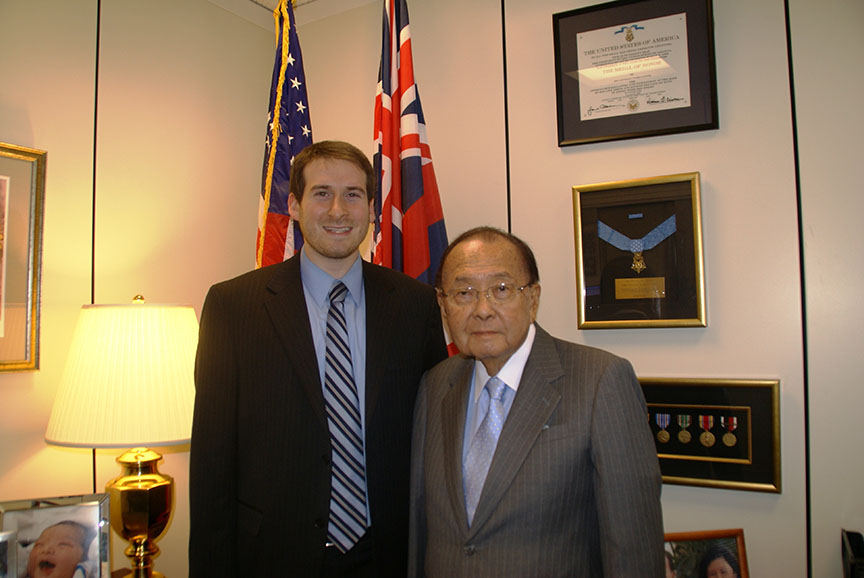
The writer in 2011 with Senator Inouye.

How Capitol Hill Used to Be: Remembering Hawaii’s Daniel Inouye at 100 Read More »

Am I Missing My Calling?

It was my first year in the rabbinate. Ron, a local Minister I had just met, asked me: “When did you receive your calling?” I was tongue-tied, with just the vaguest idea of what he even meant. When people would ask me back then “When did you decide to become a rabbi?” I would jokingly say: “I haven’t decided yet.”

Ron’s question was foreign, yet familiar. Ministers are expected to be called by God because one cannot enter a sacred vocation without being invited first. Divinity schools all have web pages exploring questions like “How do you know you’ve been called to ministry?” And each minister has a story to tell. One told me she had received her call as a teenager, when, during a church service, a voice told her “You should do this.” And so she did.

Rabbis don’t talk this way. Let me explain why.

Undoubtedly, multiple Jewish sources support this idea in the abstract. In the Tanakh, when Mordechai calls on Esther to save the Jewish people he says “Perhaps you have come to this royal position for a time such as this?” In other words, Esther’s destiny was to save the Jewish people. The 12th-century Sefer Chasidim explains that each Jew has a unique Torah insight to add to the world, one known only to them. The founder of Chasidut, the Baal Shem Tov, said that “each soul that God sends down to this world has a mission that must be completed.” Each of us has a unique purpose in life.

However, the beginning of Parshat Lech Lecha offers an important insight into the concept of calling. Abraham is abruptly chosen by God to build a great nation and transform the world. No background to this choice is offered. This is puzzling. As Rabbi David Tzvi Hoffman put it: “Why doesn’t the Torah hint at all as to why Abraham was specifically chosen by God?

Even the earliest commentaries struggle with this question. Midrashim tell the stories of young Abraham, who searches for God, destroys his father’s idols, and defies the wicked King Nimrod. They portray him as someone deeply deserving of divine revelation, a man in search of God who eventually receives His call. They answer this question by writing a prequel to the Biblical story.

Other commentaries focus on the biblical text, trying to explain the seemingly random choice of Abraham. The Maharal of Prague argues that the very randomness of it indicates that God’s choice of Abraham was unconditional, a matter of God’s will; it was not based on any merit, and therefore is unchanging. God chose Abraham because he desired to choose Abraham.

A dramatic answer to this question is found in the Sefat Emet. He explains, based on the Zohar, that God’s call went out to all of humanity; Abraham was the only one to answer.

In other words, Abraham wasn’t called by God because he was exceptional; he was exceptional because he accepted God’s call. To challenge isn’t to hear the call; it’s to have the courage to pursue it.

Perhaps this is why Rabbis don’t seek out a divine sign before joining the rabbinate. Like every calling, all those who want to take part should come and take part.

Yet even so, Ron’s question has always bothered me. To pursue one’s mission is the highest religious obligation; so why don’t we ever think about our calling?

Because we are too comfortable. Contemporary society can point to remarkable successes in science, technology, and economics. What humanity has achieved in the last 300 years is nearly miraculous. But it has led to spiritual mediocrity.

Success has heightened our natural craving for stability and comfort. Vulnerability frightens us. Ironically, because life is generally quite good, we are less capable of coping with challenges than previous generations who endured more. No one wants to make dramatic changes when life is perfectly balanced.

Comfort can dull the soul; it is far easier to pursue wisdom passionately when sleeping on the floor and eating bread and water. Kierkegaard called the bourgeois of his time “philistines,” a derisive way of pointing out that their supposed sophistication actually turned them into crude bores. As he put it, “The philistine tranquilizes himself with the trivial.” Materialism is obsessed with maximizing even the smallest detail, improving on things that need no improvement. And in the chase to find the best of everything, we forget what our true mission is.

Rabbi Soloveitchik adopts this critique. He writes that the “The philistine personality leads a narrow shut-in existence, focusing all his efforts on a single object: self-preservation. . .” This, he explains, is not about the specific dictates of the Torah; it is about self-absorption. One may have great piety, but still be a philistine.

We are all “philistines” in this sense. It would be difficult for us to walk away from home, leaving jobs and friends behind.  And that’s why most people don’t pick up and go on a journey when God asks.

But Abraham did.

In the last 13 months I have met quite a few “quitters,” people who left behind their jobs and businesses to devote themselves to others. A young man who left his job in New York to return to his army unit. A middle-aged man in the food business who flew to Israel and ended up never leaving; he is now spending all of his time helping children affected by trauma. Two Israeli women who dropped everything to establish centers for evacuees. And these are just examples; so many others have done the same.

One of these “quitters” is a woman who left an excellent job in hi-tech to care day and night for the children orphaned by this war. She is getting new job offers regularly; people advise her to consider them, because her project is nearing a turning point, and she can now hand it over to others.

But she won’t consider job offers right now. She had battled cancer just a few years ago; and she is certain that she was given extra years in order to fulfill her mission.

That is a true calling.

All of these remarkable “quitters” heard God’s call and immediately said yes. They are Abraham’s disciples, who know that in life there is a choice between embracing your mission or being a mediocrity.

They chose their mission.  And the rest of us have to ask ourselves:

Am I missing my calling?


Rabbi Chaim Steinmetz is the Senior Rabbi of Congregation Kehilath Jeshurun in New York.

Am I Missing My Calling? Read More »