fbpx

June 10, 2024

If Kosher Ifs and Ans Were Pots and Pans

If ifs and ans were pots and pans

we might of pol. sci. men be sans,

and were there for “perhaps” an app,

who’d need a Middle Eastern map?


If there were two states would there be

for Israelis and all non-

Israelis a solution we might see

except through barrels of a gun?


In Hebrew “if” is im, beginning

with aleph, ending with a mem.

If Jews miraculously stopped sinning

the world would still them all condemn.


Although im’s letters are the first

of “Aaron” and of “Moses,” they

predict we can’t prevent the worst

from “ifs,” though for the best we pray,


the benefit of doubt not given

for problems that we are accused

of having caused, and unforgiven

when certainly —- not if! —- accused.


Keeping pots and pans quite kosher

is easier than preventing views,

that cross right lines or left ones, gaucher,

from harming —- not perhaps —- the Jews.


In “A Rabbi’s Commentary and Contemplation, 5/30/24, Behuqotai – The Magic of “If,” Rabbi David Wolpe writes:

Mark Twain, whose manuscripts are nearly illegible due to all the changes and revisions, once wrote, “The difference between the almost right word and the right word is really a large matter, ’tis the difference between the lightning bug and the lightning.”

For a word to be lightning, it does not need to be long. In this week’s Torah portion, the 19th century sage, Mei Hashiloah, Rabbi Mordecai Yosef of Izhbitza, focuses on two letters: the word “if,” which begins the portion: “If you walk in my ways.” (Leviticus 26:3) He explains that “if” signals the uncertainty of one who seeks to follow God’s ways, for “the will of God is very deep.”

The more we explore “if,” the more lightning we find in the word. “If” in Hebrew is im and contains all possibility in it. “If this had happened.” “If that had not happened.” “If I had said this.” “If I had not said that.” But the word im contains an even greater power in Jewish history.

Im” is spelled aleph mem. The Mincha Belulah (16th century) teaches that in liberation, there was an im – an if. The name Aaron begins with an aleph and Moses with a mem. So too with Purim: Esther begins with an aleph and Mordecai with a mem. Finally, Eliyahu, the herald of the end times, begins with an aleph and Moshiach, the Messiah, begins with a mem. The aleph and mem of im carry within them past and future redemption.

Unfortunately, Israel is hardly ever given the benefit of the doubt for problems caused in im situations. Since October 7, 2023, such  situations more typically lead to the condemnation of Jews than to their redemption.


Gershon Hepner is a poet who has written over 25,000 poems on subjects ranging from music to literature, politics to Torah. He grew up in England and moved to Los Angeles in 1976. Using his varied interests and experiences, he has authored dozens of papers in medical and academic journals, and authored “Legal Friction: Law, Narrative, and Identity Politics in Biblical Israel.” He can be reached at gershonhepner@gmail.com.

If Kosher Ifs and Ans Were Pots and Pans Read More »

The Torah is Yours

It is said in the midrashic work Shemot Rabbah, and elsewhere, that the Torah was revealed to each person uniquely according to their own capacity and understanding. I imagine it sort of like this:


A Thought Experiment: A Poem for Shavuot 

by Rabbi Emily Stern


The Torah is nothing if not yours

Because this is how it was when we stood at Sinai

When you heard that booming voice through the hugely porous air

So loud, so clear. The sound is a kind of fruit

Your ears are made of, but you never knew.

You eat it and have no time to wonder,

“Is this true?” because

The voice you hear is familiar, eerily familiar.

It reminds you—oh, that’s it— of being in the womb

Before you entered this world.

These are the same voices you heard muffled around you

For those months while you formed.

This Torah is nothing if not yours.


And the voice morphs into your grandmother’s call

At the bottom of the stairs saying

“Breakfast is ready. Come and get it!”

Your heart’s humming, but it’s too high pitched.

You strain to hear

And slowly come to realize it’s your favorite song.

You anticipate the words as you remember who you are.

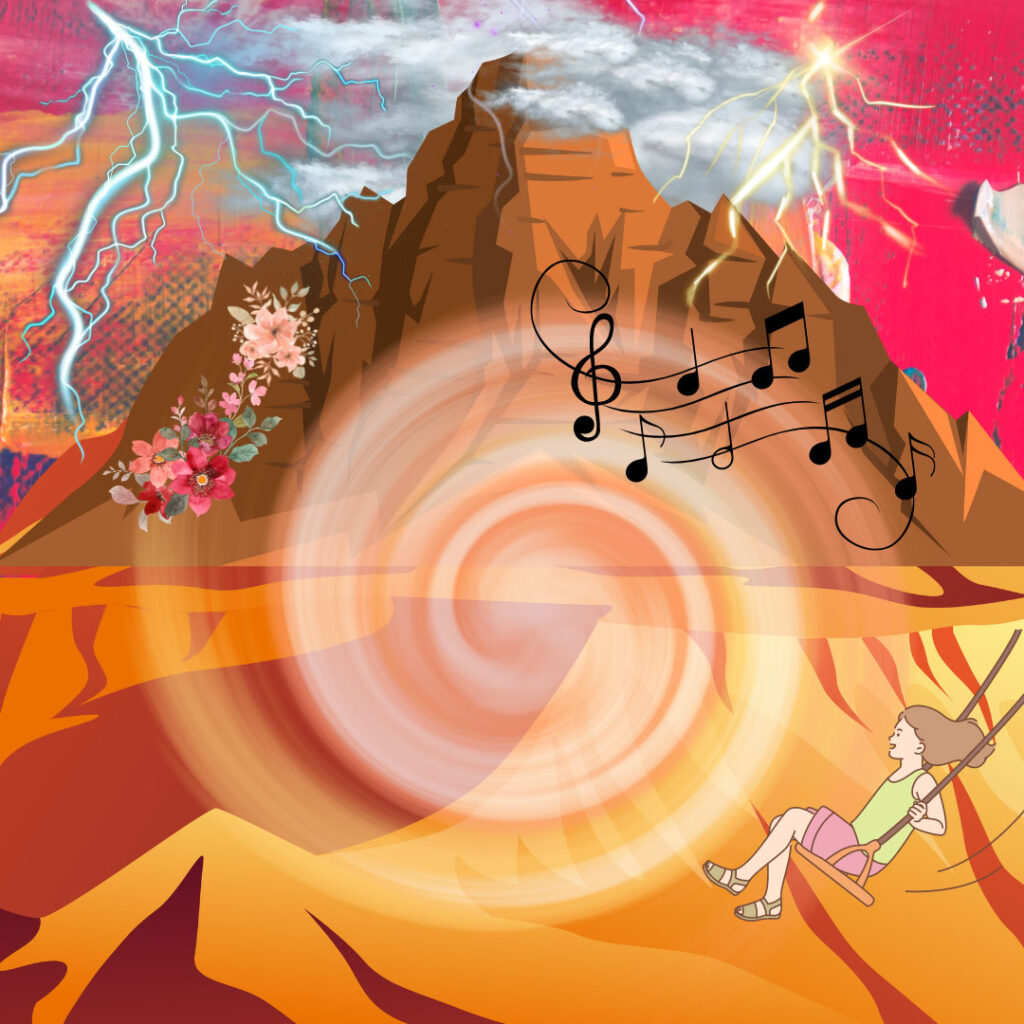
You peer at the top of the mountain

And look up at the cloud resting there.

You distinctly remember seeing that shape.

Oh, it’s the butterfly that flew by you

On your fifth birthday. You didn’t even know you remembered.

And in the thunder

As you sit and listen,

You are watching shapes become a very complicated mathematical equation

In front of your face.

And you stretch your mind to solve for “x”

Only to discover the answer, the only possible answer

Is the presence of the deepest part of you.

And the answer to every question was always your own essence.

It’s like a key that unlocks something, and you are woken from this slumbering

By a flash of lightning.

You know so well, too well,

It’s a flash of inspiration in your head

That you once were a sperm colliding with an egg.

You watch yourself meet yourself

And you know it was the first time you ever felt true love.

Your face is shown to you

Like a mirror but not backwards.

It’s the first time you’ve ever really seen your own face

Made of swirling colors too bright to see with your eyes

Or even your mind.

It’s so impossible to contain

That color becomes a smell

The smell of smoke from the mountain.

And heat from the fire burns your face

And you’re suddenly inside that volcano

You saw a picture of  in third grade

That you imagined someday you would visit.


And you know… someone knows your language

It’s too much Intimacy to bear.

And you reverberate there

Suspended beyond all worlds.

It almost is embarrassing to be so known

To be so seen

In these words

Called Torah.

And you know… this Torah is nothing if not yours.

The Torah is Yours Read More »

UNPACKED Launches French YouTube Channel to Combat Antisemitism and Misinformation

Since Oct. 7, misinformation about Israel and the Jewish people has been running rampant online. From disparaging videos on TikTok, YouTube and Instagram to hateful comments on Facebook and X, all the major platforms have experienced an overwhelming influx of antisemitic and deceitful content.

One non-profit that’s always worked hard to dispel myths about Israel and the Jewish people is UNPACKED, a division of OpenDor Media, which creates engaging, informative and inspiring Jewish- and Israel-related educational media for young people. It has more than 242,000 followers on its YouTube channel in English; now, it’s launched a French version as well, featuring videos that were translated by native French speakers. The new channel, called “On déballe!”, which means “We unpack,” features French versions of its videos on topics like Ethiopian Jews, the Dreyfus Affair and Napoleon’s involvement in the Jewish community.

“There is an urgent need to reach people with content that provides credible information and understanding,” said Andrew Savage, CEO of OpenDor Media. “As well as a moment of great need, this is also a moment of real opportunity. Young Jews are feeling more Jewish than ever before. And Jews and non-Jews want to understand all things related to Israel, and Jews. In that context, we have an opportunity and an obligation to ensure that understanding is being shaped by credible, thoughtful content. We believe doing so moves hearts and minds in a way that counters misinformation and antisemitism.”

“There is an urgent need to reach people with content that provides credible information and understanding.” – Andrew Savage

Right now, antisemitism is a growing problem in France. According to a study by Tel Aviv University and the ADL, in 2023, France experienced a near-quadrupling of antisemitic incidents in 2023; in 2022, there were 436 incidents, and in 2023, there were 1,676. That was the highest increase in antisemitic incidents among countries that have reliable statistics.

At the same time, worldwide, French is the fifth most spoken language, and more people are starting to speak it. By 2050, there will be a projected 750 million French speakers, and in the U.S., curriculum in French and English are becoming increasingly common.

“Given that impact at scale is an integral part of our mission, the idea of branching out into other languages has always seemed a good one,” said Savage. “And, given that we already have the assets that simply need to be translated/rerecorded in other languages, branching out into other languages is likely to be a cost-effective means of expanding our market.”

At first, UNPACKED, which creates articles, podcasts and videos for Instagram, Facebook and TikTok, experimented with cheaper and faster options that relied on AI tools or dubbing to recreate the videos in French. Ultimately, they decided to opt for the more expensive option of rerecording the videos with native French speakers as hosts and with the animation reedited to French text.

“We’ve also been working hand in hand with a partner who is living and active in the Jewish community in France to identify which videos it makes sense to translate,” Savage said. “The result is a more authentic and high-quality product that feels like it’s been produced for its audience by those who understand that audience, rather than as an afterthought. Where appropriate, we’ve also made slight changes to scripts to reflect local interests and context.”

So far, the channel is showing promise. Between months one and two, the number of views tripled, and in the third month since the launch, views quadrupled. Currently, the most popular video is “What Happened to Mizrahi Jews of Arab Countries?” or “Qu’est-il arrivé aux JUIFS MIZRAHIM des PAYS ARABES?”, which is about Jews from countries like Morocco, Tunisia and Iraq who lived under Muslim rule and often had to flee due to persecution. The English version, which was released in 2022, has 332,660 views.

While “On déballe!” is UNPACKED’s first venture into content in other languages, according to Savage, there are plans to replicate the model in Spanish, German and Russian.

“We would love to both continue to grow the French language YouTube channel and also to expand onto other platforms and to create podcasts, short and longer form videos, and web articles in the same way UNPACKED does in English,” he said.

For now, UNPACKED’s goal is to stick to their mission, ensuring that they continue to operate on a content-first approach to inform young audiences – whether or not they’re Jewish.

“We find that our approach resonates because it both informs and educates whilst, at the same time, entertains and inspires,” said Savage. “Our hope is that, through the launch of our French language content, we can share the beauty as well as complexity of Zionism and Judaism, and help people understand Jewish history, culture and values.”

UNPACKED Launches French YouTube Channel to Combat Antisemitism and Misinformation Read More »

If Only Israel Would Invade New Caledonia!

Illegal settlers! Occupied territories! Colonialism! Police brutality! Those accusations have been shouted with passion from tents on college campuses across America in recent weeks. But do those concerns apply only in select circumstances? Because an overseas conflict that should rouse the ire of the nation’s protesters has so far failed to attract their interest.

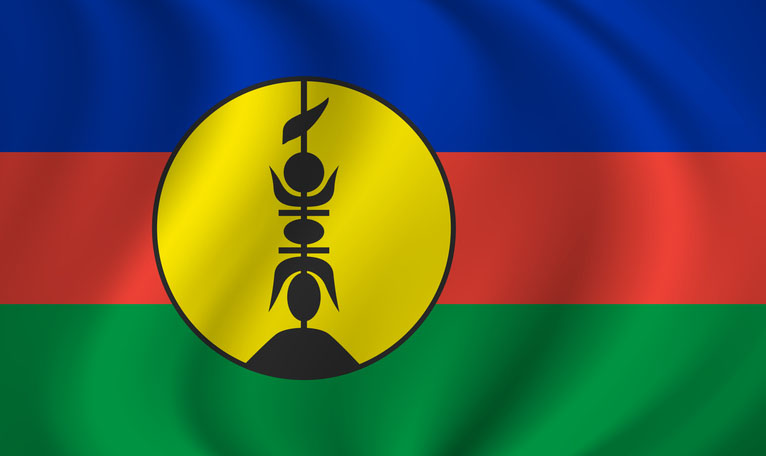
The site of the conflict that dare not speak its name is New Caledonia, an island nation 900 miles east of Australia. In recent months, the indigenous tribes there have been waging a battle for independence against the French colonialist authorities.

For nearly two hundred years, France has been illegally occupying the island country, exploiting its vast nickel reserves, and settling French citizens there irrespective of the wishes of its indigenous inhabitants, the Kanaks. Unlike Israeli Jews, who have strong historical, legal, and religious ties to the land where they live, the French settlers in New Caledonia are just white Europeans who have pushed their way into somebody else’s country without permission.

In fact, the very name of the country is a sham. The British explorer James Cook, sailing in the vicinity in 1774, thought the mountains resembled the terrain of the Caledonia region of his native Scotland. Not surprisingly, the native Kanaks would prefer a name more authentic than the one a seafaring Scotsman chose for them.

The French seized New Caledonia in the 1850s because they needed a distant territory to serve as a penal colony. Thousands of French criminals finished their sentences and then took up residence in the country. Once again, the Kanaks had no say in the matter.

Major news outlets that have been devoting disproportionate attention to Gaza have paid scant attention to what’s been happening in New Caledonia. Last week, the New York Times belatedly reported that the French have been pouring security forces into the country to suppress the fight for independence. And the French parliament is enabling recently-arrived French citizens in New Caledonia to vote in future referenda, which could tilt the results against independence. The Times noted that a widely-circulated video shows French police officers “forcing a Kanak protester to his knees so that one officer could kick the man’s head.”

This must all come as quite a surprise to readers of the New York Times. Until last month, there had been just one article in the Times about the New Caledonian independence struggle in the past ten years.

The major human rights groups that are so concerned about Gaza likewise have not shown much interest in the human rights of the Pacific island’s natives. Amnesty International issued its first-ever press release about New Caledonia last month. The last time Human Rights Watch issued a news release mentioning New Caledonia was thirteen years ago—in a complaint about Israel arresting a Palestinian Arab rock-thrower who claimed he was in New Caledonia at the time of the attack.

What about America’s leading professional associations? In recent months, numerous groups of academics and other professionals who have no ostensible connection to the Middle East have been issuing denunciations of Israel for defending itself against Hamas.

The National Women’s Studies Association, the American Sociological Association, the American Psychological Association                     and the American Studies Association , among others, have weighed in with bitter, one-sided criticism of Israel. These groups are vigorously opposed to “colonialism” and “illegal settlers” when there’s a way to accuse Israel. But when there are no Jews to blame, they don’t seem too interested.

What about all the angry college students? Surely those who have been marching for Gaza are equally outraged about white Frenchmen oppressing brown Pacific islanders. After all, many of the placards at the Gaza rallies and the manifestoes issued by their sponsors rail about the evils of colonialism.

Yet colonialism in New Caledonia doesn’t trouble the Arab-American and Muslim students who are leading the campus protests. Despite their lofty slogans about opposing all oppression, the only targets of their hatred are Israel and Jews.

Nor are the Kanaks on the agenda of the fellow-travelers who populate the rallies and tent encampments. The students who denounce Israel because it’s exciting and popular to join the mob seem to have no interest in what the French are doing. Apparently, if Instagram influencers aren’t talking about New Caledonia, it just doesn’t count.

The professors are silent, too. All the faculty members whose letterheads acknowledge that their universities sit on the land of indigenous people (yet never offer to actually vacate that land) have turned a blind eye to the plight of the indigenous tribes of New Caledonia.

The same seems to be true of the Jewish anti-Zionist students who are the frequent subjects of media attention. Setting up tents outside French consulates wouldn’t facilitate their acceptance into the social and political circles to which they aspire. Hating Israel, and only Israel, is the price of admission.

So pity the poor Kanaks. Their country overrun by foreigners, their natural resources plundered, the very name of their country imposed by a Scottish explorer of long ago—they are the very epitome of People of Color battling White Colonialists. But they can’t get anybody interested in their plight—because there’s no way to blame Jews for their suffering. If only Israel would invade New Caledonia, the Kanaks might yet have a chance.


Dr. Medoff is founding director of The David S. Wyman Institute for Holocaust Studies and author of more than 20 books about Jewish history and the Holocaust. His latest is Whistleblowers: Four Who Fought to Expose the Holocaust to America, a nonfiction graphic novel with artist Dean Motter, published by Dark Horse / Yoe Books.

If Only Israel Would Invade New Caledonia! Read More »

The World’s Deafness to ‘Bring Them Home’

“Bring Them Home!”

As slogans go, that’s a pretty good one.

There’s even a similar-sounding ballad from the Broadway musical “Les Misérables”: “Bring Him Home.” The message in each is the same: Return what was taken and bring to safety.

Desperate pleas come with their own poignancy and resonance. A declarative demand usually gets peoples’ attention. Often it becomes internalized: “Mind the Gap.” “Stop.” “No Trespassing.”

You don’t need to tell me twice.

“Bring Them Home!,” however, may be catchy, but it hasn’t quite caught on. There are dog tags that promote the message—in both Hebrew and English. I wear one, but most Jews are on notice that such partisan public support for Israel can be risky—unless you’re standing among a critical mass of Zionists. In these openly antisemitic times, wearing a yarmulka or Star of David can result in unwelcome harassment and, in some cases, beatings—regardless of whether or not you are a Zionist. Being a Jew is a provocation all its own.

French Jewry, along with their co-religionists in Stockholm, Brussels, Madrid, Copenhagen, London and Berlin, have lived with this reality for nearly two decades. American Jews are new to this global reception. Until the campus chaos, bridge and tunnel disruptions, and public spectacles at city council meetings and Christmas tree lighting ceremonies, American Jews were insulated from these violent expressions of antisemitic hate.

Americans were still blithely deluded by an earlier refrain of counterfeit currency: “Islam is a religion of peace.” That one, laughably, still gets recited. Although there must be some peace-loving Muslims, one would be hard pressed to place Islam and peace in the same sentence with any degree of geographic certainty.

Different messages from “Bring Them Home!” receive better airplay. These are the new sounds on city streets and college campuses. Admittedly, the choirs consist mostly of enraged Muslims drunk on their mother’s antisemitic milk. Along with brainwashed college students, they never seem to flub the words.

Different messages from “Bring Them Home!” receive better airplay. These are the new sounds on city streets and college campuses. Admittedly, the choirs consist mostly of enraged Muslims drunk on their mother’s antisemitic milk. Along with brainwashed college students, they never seem to flub the words. There’s all that rehearsal time in mosques around America. And in lectures, professors seem to know nothing about any academic subject aside from Jew-hating activism. So we hear all this noise pollution, roared with great verve and alacrity:

“Al-Qassam, you make us proud; kill another Jewish soldier now!”

“Jews, Jews, Go Back to Poland!”

“We say justice, you say how. Burn Tel Aviv to the ground!”

“There is only one solution, intifada revolution!”

And that addictive ditty beloved by jihadi wannabees: “Hamas we love you. We support your rockets, too!”

Amid these chart-toppers, “Bring Them Home!” doesn’t leave people humming.

And, yet, four of the hostages still held captive by Hamas were extracted from Gaza this past Saturday. In broad daylight, no less, from two separate buildings, culminating in a firefight between Israeli special forces and Hamas terrorists.

Nearly 300 Palestinians (including terrorists, although the absolute numbers are always subject to the mathematical mischief of Gaza’s Health Ministry) were allegedly among those killed. To no one’s surprise, the hostages were locked inside the apartments of civilians who were charged with standing guard. Yet another example of Gazans serving as an auxiliary fighting force. They are a far cry from “innocent civilians.”

Meanwhile, the IDF demonstrated that “Fauda” is not just a nail-biting television drama about counterterrorism. Such brave commandos exist—the derring-do of highly motivated, patriotic Jews. That’s what 2,000 years of persecution climaxing in the Holocaust can do to a people.

Given these recent events, talk of ceasefires, without the return of the remaining hostages (or their remains), is the gibberish of a senile American president, and the colossal misjudgments of those with plummeting GPAs, faulty scholarship, and job-killing rap sheets.

Had there been a ceasefire, the four hostages would still be in Gaza.

Remember the gory details of 10/7? The horrific imagery, the unimaginable suffering, the unspeakable savagery?

We will soon learn what was done to the rescued. The terrified face of that young girl, now back home, but on October 7 abducted on the back of a motorbike, reaching helplessly for her boyfriend. That image has been seared into the minds of every Jewish father and boyfriend, the world over.

Hamas is never going to voluntarily return anyone. Barbarians don’t make humanitarian gestures. And Western nations critical of Israel’s war aims in Gaza, including the United States—along with Spain, Norway and Ireland, which recently rewarded terrorism by recognizing a Palestinian state—were never going to unleash a whirlwind of hurt on Hamas in order to “Bring Them Home!”

Progressives are not going to board planes and set up encampments in Egypt, alongside the Gaza border, coughing up their lungs and going on hunger strikes, until Hamas surrenders—in a dramatic demonstration of their solidarity with Jews. The global media will continue to fixate on Israel’s war of self-defense, giving it another name. Preposterous allegations of genocide will continue. A legally unenforceable arrest warrant, issued against a democratic leader, will tarnish the community of nations while mass murderers operate with impunity.

Israel could just wait around for divine intervention. But Yahweh tends to go his or her own way when it comes to favoring the Chosen People. The Red Sea parted, but once only.

All that Israel can depend on is its own fighting spirit, and Senator Jon Fetterman, and all those righteous Republicans—public officials and citizens—from red states, and other great allies like Douglas Murray.

What’s behind the indifference to “Bring Them Home!”? Age-old antisemitism, of course. But there’s more. The progressive left, that motley alliance of Islamists and Jew-haters bathing in an alphabet soup of BLM, DEI, and LGBTQ, reject the very notion of a Jewish nation.

To them, Jewish invaders stole Palestinian land. They are not interested in examining the historical and legal record—the biblical Kingdom of Judea, which reigned 1,800 years before anyone had ever heard of the Prophet Mohammad. Why would they adopt a slogan that acknowledges Israel as the ancestral homeland of the Jews?

One way or another, Israel will reclaim its people. And, hopefully, the IDF will not abandon the moral imperative of punishing everyone responsible and complicit in these darkest days since the Holocaust. Last week’s Celebrate Israel Parade was a more somber affair. But there was a Parade, as a symbol of tribal cohesion, and remembrance.

If bringing the hostages home is going to take place, only Israel can be relied upon to accomplish it. Rescuing their own has always been, in yet another “Les Mis” showstopper, “the music of a people who will not be slaves again!”


Thane Rosenbaum is a novelist, essayist, law professor and Distinguished University Professor at Touro University, where he directs the Forum on Life, Culture & Society. He is the legal analyst for CBS News Radio. His most recent book is titled “Saving Free Speech … From Itself,” and his forthcoming book is titled, “Beyond Proportionality: Is Israel Fighting a Just War in Gaza?”

The World’s Deafness to ‘Bring Them Home’ Read More »