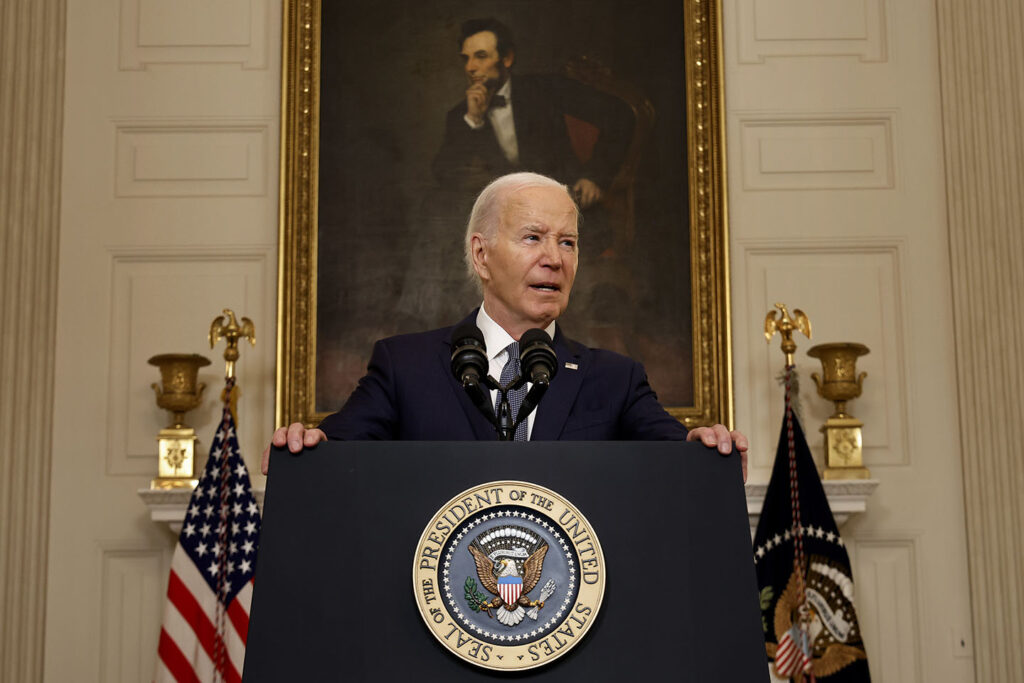
Perhaps I heard it wrong. But I could swear that President Joe Biden just delivered a televised address at the White House about the war in Gaza. (Note, no matter how loud it is shouted by well-meaning ignorant people, or Jew-haters who side with savages, there is no “genocide” in Gaza.)
Biden proposed a multi-part peace process, allegedly initiated by Israel, that would include a six-week ceasefire, followed by an Israeli withdrawal from Gaza, the exchange of some of the Israeli hostages (and the remains of the dead) for captured Palestinian terrorists, culminating in the rebuilding of Gaza.
Regarding the release of Hamas terrorists, one must remember that Yahya Sinwar, the mastermind behind the massacre on October 7, was set free in just such a negotiation back in 2011, where he was among 1,027 prisoners exchanged for one Israeli. A young soldier, Gilad Shalit, was returned to his family where, hopefully, the ensuing 13 years have been kind to him. But how many of those 1,027 accomplished terrorists participated in 10/7? Would the massacre have even occurred if Sinwar was still imprisoned?
I believed that Biden was mistaken in claiming the proposal came from Israel. Due to advancing age and a mind that was never all that nimble to begin with, I assumed that couldn’t have been the case.
And it appears I was right. Israel knows its enemy, and the region in which it is tragically located. It might be the Holy and Promised Land from the Old Testament, but ever since 1948, the Jews who rebuilt their original homeland have been encircled by the worst neighbors imaginable—people who would gleefully burn down their own houses for the satisfaction of seeing the Jewish state in flames.
Israel is an imperfect democracy, but it nonetheless is a liberal, cosmopolitan, largely secular society filled with a wealth of rational, deliberative Jewish brains. If Biden has some notion about how to end this war, he should consider this easy-to-remember axiom: “Cease-stupid, not ceasefire.”
Biden’s staged appearance was doubtlessly intended for the Muslims of Dearborn, Michigan, a key battleground state. Pathetically, he has been treating them as a constituency, rather than as a fifth column. To many he is called “Genocide Joe.” He won’t receive their support no matter how obsequiously he prostrates before voters who, quite honestly, prefer an Islamic caliphate to a liberal democracy.
Think I am exaggerating? Ask Europeans how things have worked out for them.
Any proposal that gives Hamas time to reconstitute, pretend to be diplomats and “peacemakers,” and continue to win the affection of the Palestinian people, is tantamount to handing Israel a suicide vest. You can rebuild Gaza, but you can’t prepare it for statehood if its chief national project is purging the world of Jews—wherever they might be.
Any proposal that gives Hamas time to reconstitute, pretend to be diplomats and “peacemakers,” and continue to win the affection of the Palestinian people, is tantamount to handing Israel a suicide vest.
The grotesque crimes committed on 10/7 must result in the killing or capturing of everyone who took part—including the 550 “innocent civilians” who rampaged the kibbutz Nir Oz, where they raped and abducted Israelis, even selling some to Hamas. These are all criminals who committed barbaric acts.
The West is unused to seeing barbarism up close. That’s one of the reasons some disbelieve what happened on that day. What kind of people would do such things? One-word answer: Gazans. Our laws are inadequate to address these crimes. Extraordinary measures are necessary. Atrocities, after all, are not the same as ordinary murder. All perpetrators should receive what they deserve—no discounts, do-overs, excusing, leniency and, most assuredly, no permanent ceasefire.
The equivalent number of Americans that would have to be killed in order to match what occurred on 10/7 is approximately 42,000—American babies beheaded and burned alive, and girls gang-raped and mutilated. Imagine the scale and moral dimension of losing that many American civilians—and in such a manner.
Meretricious antisemites who occupy and disrupt college campuses, city streets and bridges, and who pledge their allegiance to Hamas while replacing the American flag with a fictional Palestinian one, are completely unmoved by 10/7. How might America have responded to such an unfathomable loss?
Most Israelis seem to agree that the hostages, or their remains, must be returned. But under no circumstances should the fighting be abated. Before the IDF puts down its weapons, Hamas and its enablers must receive their just deserts and cease to exist. That’s the only acceptable ceasing. The moral universe demands no less.
But it raises the question: After six months, why is a single Hamas terrorist still alive? The derring-do days of the Six-Day War are, apparently, over. Israel once vanquished four Arab armies in less than a week. Egypt, Israel’s fiercest nemesis at the time, never got a plane off the tarmac. Entire squadrons were destroyed by Israeli airstrikes.
In the five earlier wars with Hamas, these terrorists were dispatched in a matter of weeks. Each war left Gaza in ruins, but somehow Hamas survived to rebuild its arsenals and groom yet another multitude of willing human shields. In 2014, President Barack Obama aggressively pestered Israel to exercise “restraint.”
Regrettably, they did just that. Israel left Gaza without obliterating the entirety of Hamas’ stockpiled weapons, detonating all of their tunnels, and eliminating all of their battalions.
It is also true that Hamas is no longer just a ragtag bunch of genocidal Islamists misfiring rockets. They more resemble a real army these days. Iran helped to raise their game with advanced weaponry, sophisticated surveillance and terror tunnels that are more lavish than any apartment building in the Strip.
Worried about starvation in Gaza? Where do you think all of those billions have gone?
Given this new reality, can the IDF ultimately complete this job, knowing the mandate that Hamas can no longer terrorize Israelis? And how long will it take?
Meanwhile, for the morally lazy—those prone to leaving crucial tasks undone— consider this: A four-year-old, red-headed boy, Ariel Bibas, last seen wearing a Batman t-shirt, is still being held hostage. His fate, that of his baby brother Kfir, and his parents Shiri and Yarden, remains unknown.
Yes, Palestinian babies have been killed in this war. But that’s only because their parents, at Hamas’ behest, have placed them in harm’s way. Who other than Islamists would behead and kidnap Jewish children, and seal the fate of their own?
Message to Joe Biden: No further talk of a ceasefire until a Batmobile races across the Negev Desert to bring Ariel home.
Thane Rosenbaum is a novelist, essayist, law professor and Distinguished University Professor at Touro University, where he directs the Forum on Life, Culture & Society. He is the legal analyst for CBS News Radio. His most recent book is titled “Saving Free Speech … From Itself,” and his forthcoming book is titled, “Beyond Proportionality: Is Israel Fighting a Just War in Gaza?”
Just as the Israeli government (across all branches) has failed in recent times to fulfill its basic mission, unable to see and grasp the obvious, the American Jewish establishment has failed in its mission as well. We have failed to equip our youth with basic knowledge of Jewish history, to help them see the inherent and unique value of our tradition, and, just as significantly, to enable them to grasp the importance of the land of Israel as an integral, inseparable part of Judaism.
For the last few generations, American Jews have taken for granted their acceptance into mainstream American society and have become integrated into American culture, economy, academia and media. The vast majority of American Jews originated from Europe, having fled after a millennium of antisemitism, persecution and pogroms. They found America to be the welcoming “Golden Country,” or Goldene Medine as it was known in Yiddish. They and their descendants thrived in all aspects of American life. The narrative, which became part of their identity, was the narrative of the antisemitism and abuse they suffered elsewhere—with the Holocaust taking center stage as the paramount experience within it.
That story came to shape their past, present and future.
Many believed that the evidence of past atrocities—the survivors’ stories, movies and documentaries, museums and memorials—would surely protect the Jews from another catastrophe forged in hate. An annual day of remembrance was dedicated, as well as a national museum in the country’s capital, to ensure that the message was preserved and transmitted.
But by placing an emphasis on the hate directed toward Jews, focusing primarily on the Covenant of Fate, we neglected the Covenant of Destiny—a destiny tied to the land of Israel, the magnetic pole that holds the Jewish people in orbit around a broader narrative that shaped a nation, a faith, a culture and a history.
Because of this misplaced focus, our youth have often been robbed of a critical piece of their identity. We have weakened their connection to an ancient tradition that should resonate not only with them but also with the world at large. As the Covenant of Destiny has fused with the broader Judeo-Christian culture, it has remained ill-defined and stripped of its unique identity.
At the same time, Jewish education in America has largely ignored another key thread of the Jewish experience. As parents, we too often leave the task of educating our children to the educational establishment. In America, that generally means synagogues and Hebrew schools founded by Jews of European descent. In pulling from their European tradition and history, many educators have failed to see beyond their own ancestry and neglected to highlight the contributions and culture of Middle Eastern Jews for their students.
Non-European Jews make up a huge proportion of the world Jewish community. In fact, more than half of the Israeli population is indigenous to the Middle East, many tracing their ancestry in the region back to ancient times. Yet students of Middle Eastern descent who are educated in America often feel like history has skipped over them. They don’t hear of the abuse Jews faced under despotic Islamic theocratic rule. They don’t learn that Islamic law relegated Jews to dhimmi status, making Jews second-class citizens, requiring them to pay a special head tax, and forcing Jewish orphans to convert to Islam.
While they might learn about the migration and exchange of ethnic populations throughout the West after World War II, they might not know that exchange of populations also occurred in the Middle East. Almost the same number of Jews fled Arab lands for the area between the Jordan river and the Mediterranean as the number of Arabs who left Israel for the newly independent nations of Jordan, Syria, Egypt and Iraq, which banded together to try to destroy the nascent Jewish State.
Arab countries were emptied of their Jewish populations, while tiny Israel still retains a sizable Arab population.
By focusing solely on the European Jewish experience, American Jews have ignored an essential component of Jewish history, a crucial piece of context, and a key element of the story.
By focusing solely on the European Jewish experience, American Jews have ignored an essential component of Jewish history, a crucial piece of context, and a key element of the story.
We are now at a watershed moment, in Israel and throughout the global Jewish community. In many places, including the United States—which for generations Jews took for granted as a safe haven—our children feel threatened and unsafe. Many are lost and unmoored, lacking a deep connection to this strong central narrative that could provide a foundation of strength and stability from which to project a positive identity.
This crisis presents an opportunity for the North American Jewish community to rethink, reorganize and change the existing paradigm. By teaching a more inclusive curriculum—one that includes the complex history of Israel and the Jews indigenous to the Middle East—we can expand our students’ understanding of what it truly means to be Jewish and nurture a deeper bond with the Jewish homeland.
There are many ways to integrate the history of Jews who are indigenous to the Middle East into existing curricula. The art of photography is one method that can help us challenge this reality. For example, The Jewish Lens is working to create a new set of highly flexible and accessible educational materials that use photography to focus on the history of Israel and the millennia-old Jewish connection to the land. Crafted with diverse age-groups and backgrounds in mind, these materials may be used in classrooms as well as informal educational settings, including college campuses, summer camps and families. As a starting point, this approach will help young people understand that Jews around the world have long looked toward Israel and Zion with hope and steadfast resolve—and have worked hard in recent decades to build a vibrant and inclusive country. They will see Israel as an integral part of the complex tapestry of Jewish heritage.
Rather than reflexively adopting a defensive stance, we can meet this moment by opening our young people’s minds to the breadth and richness of Jewish identity and history. Let’s not miss this painful opportunity to create a better and promising future.
If there’s one theme that’s come to dominate the rhetoric of the past few years it’s the notion of the binary, that way of looking at the world through a prism of only two possibilities. Nowhere is this impulse more pronounced than in questions of identity. It’s a lens through which one’s ethnic, racial, or national identity places them in the rigid categories of oppressed or oppressor, and it follows that these two categories are respectively good and evil. There is no middle ground, no dialogue, no murky gray zone—no uncomfortable space.
It’s an anti-intellectual sleight of hand, the trickery of which eludes even some of the most careful thinkers—because, after all, our world is not an easy world these days, and it’s much simpler to consider only two options and be done with it. We have traded complexity and nuance for something less philosophically cumbersome.
The trouble with this thinking is that everything in our world defies its illogic. People are no longer just one thing, if they ever were to begin with. For one, the migration and movement of people along with the fluidity of national borders make it impossible, even nonsensical, to assign immovable meaning to one facet of a person’s identity.
A new art exhibition at the Jewish Museum in the old ghetto of Venice, Italy, urgently reminds us that there is forgotten value in the nuances of identity, and brings to the forefront the possibility for “stories and cultures to meet and exchange.” In conjunction with Opera Laboratori and Shifting Vision, the exhibition, “The Contours of Otherness,” which opened April 21 and runs in conjunction with the Venice Biennale (through October 27), is curated by Jemma Elliott-Israelson who works with Shifting Vision. It’s the first exhibition for which Elliott-Israelson is lead curator, and for her, the idea of identity and migration, and how one’s “identity dissolves or resolves over time when you migrate” was key in coming up with the premise of the show.
Jemma Elliott-Israelson. Courtesy of Shifting Vision. Photo by Lodovico Felizzano
“Migration can be many things,” Elliott-Israelson told me in a conversation I had with her and two of the artists whose work is featured in the show: Amit Berman and Elisheva Reva. Elliott-Israelson is both Israeli and Canadian, and has lived freely in many places around the world though she now resides primarily in Italy. But migration isn’t always voluntary. Sometimes we’re forced to migrate because of famine and poverty, or political or social issues. There are “many different reasons why we move,” she says, “but the fact is that everybody does move now, so how do we reconcile issues related to our identity,” whether social, cultural or religious? And what does it mean to explore the otherness of ourselves in addition to those around us?
There could hardly be a better space to respond to these questions than in the old Jewish ghetto of Venice.
For Elliott-Israelson, the ghetto is a “kind of encasement for holding that kind of identity, that otherness.” And certainly Jews are no strangers to the sensation of being different, and to the nuances of identity that come along with that. Jewishness is an identity that’s always in flux, in movement. Throughout history, Jewish identity both remains the same and changes wherever it is found. American Jews, for example, are different from European Jews, and Jews from Morocco or Ethiopia are different from South American or South African Jews. And yet we all read from the same Torah and eat the same bread on Shabbat. Iranian Jews may put scallions at their Seder table and Jews from Yemen may not use a Seder plate at all, but every Jew says “Next year in Jerusalem” at the end of the Passover Seder: difference conjoined with sameness.
“You take the essence of yourself wherever you go,” says Elliott-Israelson, and “that can be preserved in certain instances and also attacked … and maybe you accept this changing of yourself through language and customs or culture.” Perhaps this is why Jewish identity can be hard for outsiders to grasp: It is constantly moving and shifting, even as it stays the same. Though Jews are adept at assimilating into other cultures, we seem to always keep a large part of our cultural and religious identity with us.
Perhaps this is why Jewish identity can be hard for outsiders to grasp: It is constantly moving and shifting, even as it stays the same.
The Venetian Ghetto, established in 1516 when it was decreed that Jews must be segregated from the rest of the population, was Italy’s (and Europe’s) first ghetto. It’s a place where the history of people “othering” Jews is old and dark. And nearly 500 years later in the 21st century, it stands not only as a reminder of how ancient is the othering of Jews, but also as a touchstone to today’s growing antisemitism. The ghetto embodies both past and future. But the present, as this exhibition shows, is full of possibility and hope. There’s “a lot of youth in the show,” says Elliott-Israelson, “and it’s a great juxtaposition.”
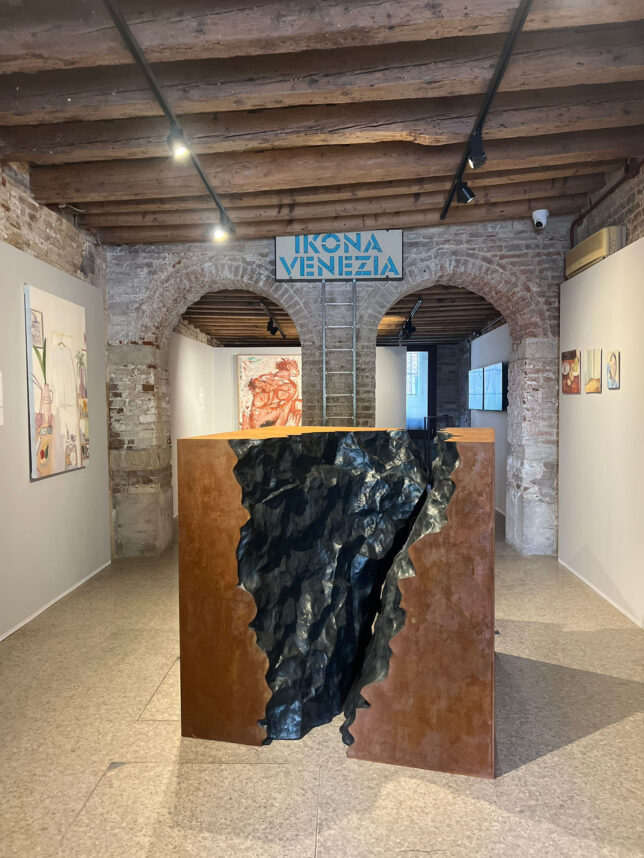
The show features the work of ten artists including Jonathan Prince, Amit Berman, Elisheva Reva, Flora Temnouche, Danny Avidan, Lucas and Tyra Morten, Lihi Turjeman, Deborah Werblud, Laure Prouvost, and Yael Toren. All works address the themes of migration, identity and cultural memory, and despite the fact that many reference Jewish identity in some way, the show has a deeply universal appeal and also reflects the broader theme of the Biennale, which is “Strangers Everywhere” (“Stranieri Ovunque”).
Jonathan Prince’s piece for the show. Courtesy of Shifting Vision
As Elliott-Israelson points out, migration and ghettoization often go hand in hand. The shape of otherness is sometimes molded by those who migrate. From Toronto to San Francisco to London to Los Angeles, every major city has communities that have recognized their difference and chosen to segregate themselves into ethnic neighborhoods. “It’s not always a bad thing,” said Elliott-Israelson. “It’s not that they don’t engage with the larger world, but there is an aspect of wanting to preserve their cultural identity through living in the same area.”
Sometimes it’s about survival. When you migrate to a foreign country you adapt quicker when you have a community of people who speak your language and who can help navigate bureaucracies. It’s also about community. Being close to those who share your traditions and foods and way of seeing the world makes it easier to navigate otherness. In Los Angeles, for example, you’ll find Chinatown, Little Armenia, Little Ethiopia, Koreatown and Croatia Place among many others. These are enclaves of both otherness and belonging. And don’t forget the Pico-Robertson and Fairfax-Hancock Park communities, populated by large clusters of Jews, mostly Orthodox (another layer of identity).
Jewish identity, especially for those Jews who take it seriously, is about being the perpetual other, about being both at home and not at home wherever we are. It’s about being separated, literally and metaphorically, even when we have successfully integrated into another culture or country. There’s a kind of movement inherent in the relationship between the Jew and the place where he or she lives. It’s a constant negotiation, a tension and a pulling back and forth.
Jewish identity, especially for those Jews who take it seriously, is about being the perpetual other, about being both at home and not at home wherever we are.
One of the dark ironies of Jewish history is that Jewish identity is often imposed on those Jews who crave its erasure. We’re seeing that phenomenon at work today with the surge in antisemitism. Those who hate Jews don’t discriminate between Jews who take their identities seriously and those who don’t.
Historically, Jews often enact a kind of “self ghettoization … it’s not a religion that wants people to convert to it,” she says. “It’s not inclusive by nature, and we have to know that about ourselves. It’s part of the religion and culture,” and the show plays with its identity and borders and contours.
With “The Contours of Otherness,” Elliott-Israelson wants us to reflect on “when otherness is imposed and when we take it on ourselves to feel different.” Sometimes “we don’t want to be accepted and sometimes we do but it’s complicated, so I wanted this show to be something artists could approach through their work from that lens and not necessarily have to speak to the Jewish aspect of it, though some did in a meaningful way … but that’s also Jewish identity.” Elliott-Israelson sees the show as “holding space for all of those things.”
The question of whether all art is political is one that will never be fully resolved. The tendency to immediately associate a set of political beliefs with where a person, especially an artist, comes from is especially pronounced right now, especially when it comes to Israel. But for Elisheva Revah, who lives and works between Tel Aviv and Paris and was raised in the Judah Mountains of Israel, it’s not just about where you were born; it’s about all the complex strands of identity that are woven together.
“I’m not only Jewish,” she says, “my father is Moroccan, my mom is German, very German, and those two cultures have so much beauty and wisdom in them. I was born in Israel, my parents were artists, hippies, and they became religious so I went through Orthodox school and I was nourished from so many different cultures and I have so many roots.” All of these roots are part of her everyday life and creative work. “I gain a lot of power and strength from connecting to my roots,” she says.
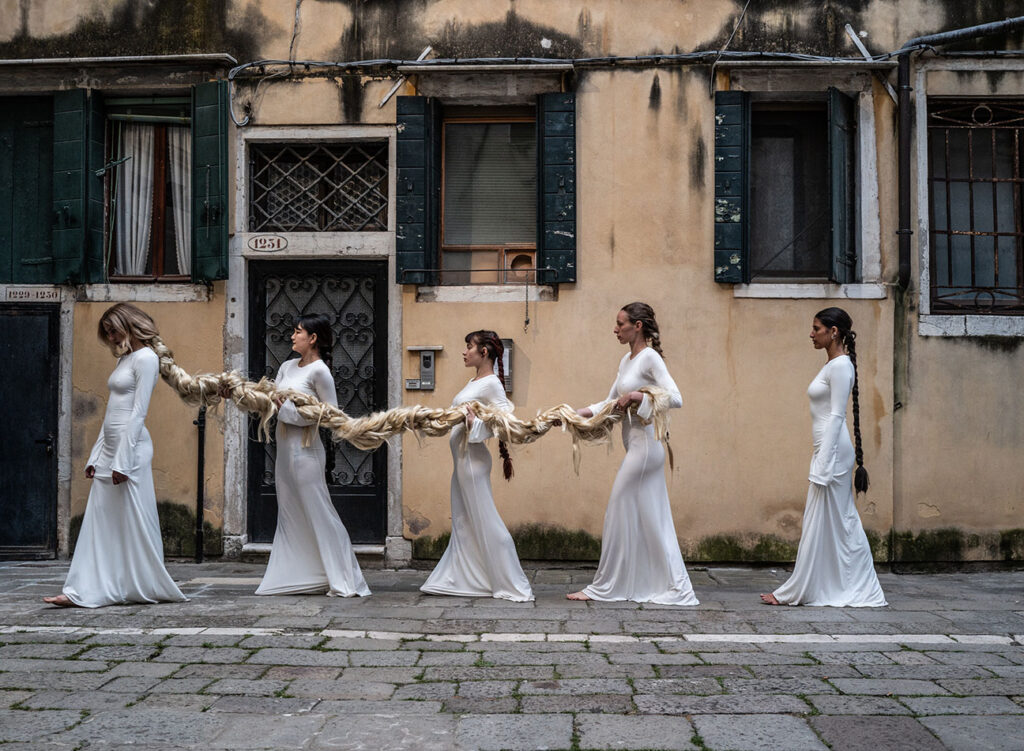
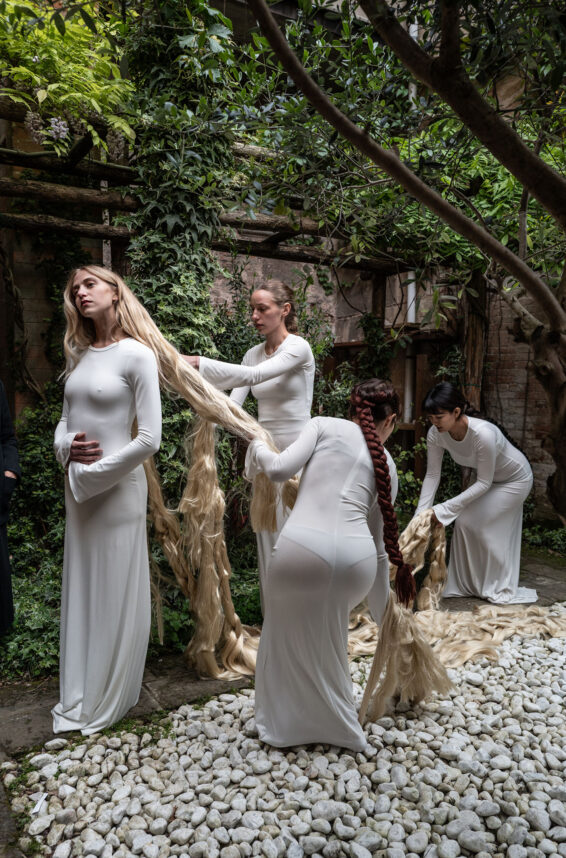
The exhibition features Revah’s “Challah,” a performance in which she recreates the feminine act of weaving bread for Shabbat. Revah was trained as a professional dancer, and while much of her work involves the body, the focus is primarily on the mystery of femininity and womanhood as a particular form of otherness. For Revah, there’s a mystery to femininity, and that’s not a bad thing because, as she says, not everything needs to be known.
Image Credit: JR
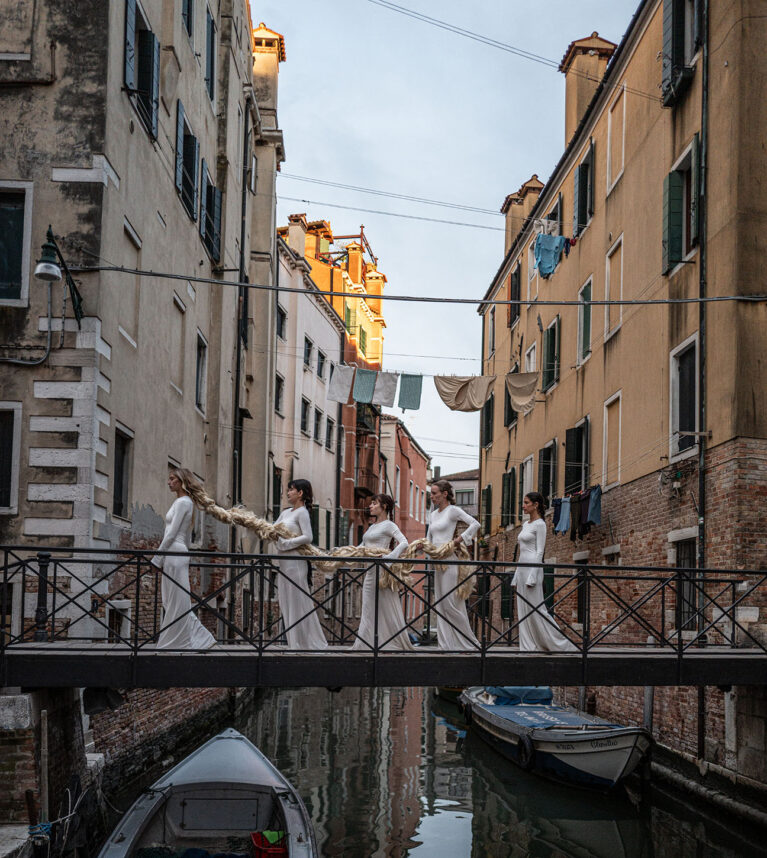
The performance plays on a screen during the exhibition, but I was able to watch it live in the garden of the ghetto’s Spanish synagogue. Revah brings new life into the space with this performance in which we see four women, dressed in white with long braided hair, kneading a giant mound of dough for challah, sometimes even using their bodies to push and pull against it, molding and forming it with urgency and intensity. As they finally braid the challah, we realize that the mundane has been the sacred all along. The feminine act is a spiritual one. There is a sense of mystery and longing as we watch the women move their bodies as if in a dance while they continue to braid. The performance is a prayer of sorts. The act of making challah is, on the surface, simple. But Revah reveals the spirituality of this ritual.
Image Credit: JR
Shabbat is one thing that sets Jews apart from the world, but while Revah’s work performs this otherness, it simultaneously insists that we, “all have the same rituals that are happening in slightly different ways.” “Challah” is “about femininity, it’s about nourishment, it’s about the mystery of the woman … and that can relate to any woman, and even men.” It’s about bringing something “that has an essence that anyone can relate to,” through the lens of her own culture. “Because I come from a blend of very different cultures, I see that all cultures are the same.”
Image Credit: JR
Watching the performance of “Challah” is truly a special experience. But the artist’s reflections on the performance add an important layer of understanding. In our conversation, Revah recounted the days leading up to the performance at the show’s opening as she considered what she had chosen to perform. It’s a quiet performance. Rather than listening to sounds, we listen to the absence of sound as we watch the women work. Before, she said, “I had done performances that were very powerful, like birth. I would shout and give birth to something, something that is more dramatic and expressive. And I panicked because I said, ‘I’m going to Venice, to the Jewish museum, and I’m working on dough? This is what I’m going to do? I’m going to just sit there and work with the dough? And I had moments of panic, but then the answer came to me and I realized that, yes, especially now the only thing I have to do is to bring something that is a symbol of what I have to bring to the world. I don’t have to shout.”
There is a lot of shouting today: on campuses, on social media, all around the world. The noise is deafening. “There is much less power in shouting,” says Revah. But “I see a lot of potential in women’s energy. It’s not out there. It’s not loud. And especially today, with what is going on in the world, I feel there is so much need for this inner process and there is so much power in the quiet.” But it’s not just about being quiet; it’s also about mystery.
There is a lot of shouting today: on campuses, on social media, all around the world. The noise is deafening.
“I think we are lacking mystery today,” says Revah. Considering the social media obsession with airing everything from the latest meal eaten to the most offensive grievances, I can’t help but agree. “Not everyone needs to know everything all the time,” says Revah. “The symbol for the woman is the moon, which is not out there all the time. It must be revealed, and it comes and it goes and it’s the light that keeps shining in the dark.”
Identity doesn’t need to be screamed to be real.
Art can whisper its agenda without having to be political. It can be about healing the world, about connecting to one’s history, memory, and tradition and then drawing on those things to create rather than destroy. The process of creating is also about drawing from the past, from everything that is already present. It’s about reflecting on who we are and where we have been, and bringing those insights to the world in a new way. Revah does this in a way that is magical.
Throughout history, despite endless persecution and discrimination, Jews have insisted on creating rather than complaining. Consider Hollywood: In the early-twentieth century, men like Louis B. Mayer, the Warner brothers, Adolph Zucker and Carl Laemmle who were first- and second-generation Jewish immigrants were drawn to the film industry because it was one of the only avenues open to them given the rampant antisemitism in the U.S. With the advent of World War II and the Holocaust, things only got worse for Jews. But these creators, artists and visionaries kept putting art and entertainment into the world. In a post-Oct. 7 world, with echoes of past tragedies loud than ever, the artists of “The Contours of Otherness” are doing the same thing.
I hope that “when people meet me,” says Elliott-Israelson, “they meet an Israeli that they see is open and kind and cares for humanity and I don’t have to be labeled as any one thing. But through my work I’m doing something good and it’s enough, it’s enough. I’m contributing something positive to the world as an Israeli: the quietness and just doing your own work. But it’s a difficult moment because there’s a lot of noise and it can feel like you’re being constantly misunderstood and misrepresented, being spoken for by people who don’t know anything about the situation.”
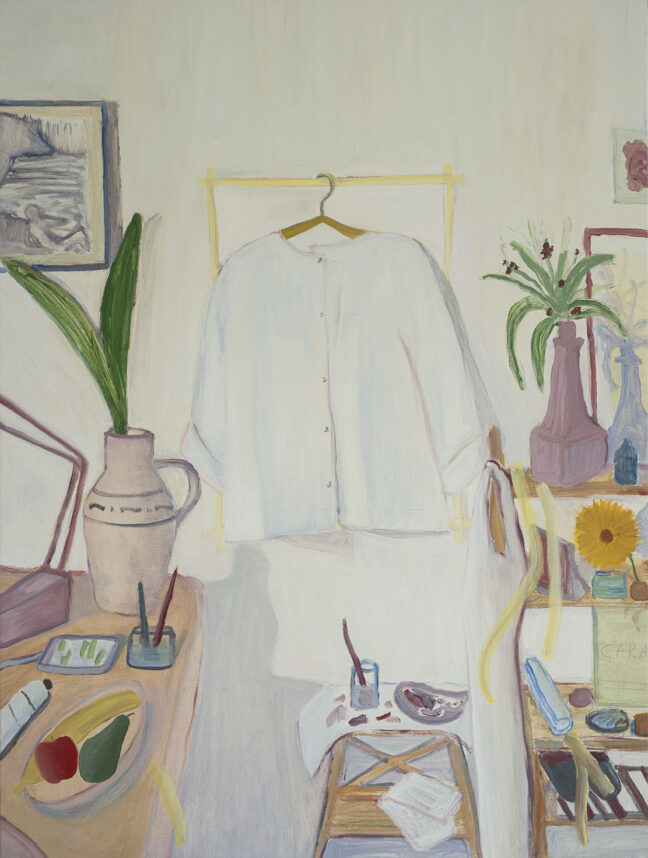
Art can of course be political, it can be about healing, it can be about beauty for the sake of beauty; but it can also educate. It can draw us into a space of dialogue even with images of everyday things. Amit Berman, a painter and photographer based between Tel Aviv and Italy, is a master at this. He typically begins with photography, and these photographs become inspiration for his paintings. His piece for the show is called “A Transferable Safe Space.” The title is evocative of a history in which Jews have often had to migrate, to bring with them their places of safety and recreate them wherever they find themselves.
Amit Berman. Courtesy of the artist. Photo by Guy Hamiel
But part of the beauty of Berman’s piece is its universality. There’s nothing definitively Jewish about the painting, at least not on the surface. A white shirt that happens to be the shirt Berman paints in every day hangs, empty, against a wall. I see “a body in the empty shirt,” writes Elliott-Israelson, “either a shell of a former self or a self that’s waiting to be inhabited with something new.” Or perhaps it’s both.
We know that we are looking at an artist’s space because there are brushes and paint visible—not placed carefully away, but in use. We see both stillness and motion, a visual metaphor of “the tension between the need to preserve one’s roots and the need to adapt to a new context.” The title answers the question of what kind of space we are looking at: It’s one that is safe, and it’s one that travels with the artist.
At first, the idea of a safe space being transferable feels antithetical to the idea of feeling safe. But Berman’s painting depicts an unstable moment in his life when he found stability in creating. “The whole idea of safe spaces for me is about my rituals, my habits, my passions and the ability to preserve it,” says Berman, who grew up in Israel, but as a child traveled extensively. As an adult, he became a flight attendant for three years. For him, moving around the world was familiar, and whenever he stopped in a city during a layover, he wanted to be alone and to look at things, “to feel the place.” He would establish rituals that kept him safe wherever he went. “I felt very stable everywhere, I felt like it was my home.” Having been based much of the time in Italy, he has a strong connection to the country and to the people. Berman remembers being in Milan during the beginning of the COVID pandemic, and “it was very dramatic and very hectic and it was the beginning of it in the western world, and I made a decision to stay by myself there.” At the time he was working for Israeli Ministry of Foreign affairs, in security, and he decided to stay even though everyone was told to go. “I decided to stay because I felt safe in my space and what you see in the painting is my apartment in Milan when it started to become my home studio and when I found serenity and harmony and sense of stability and safety in that space.”
“The whole idea of safe spaces for me is about my rituals, my habits, my passions and the ability to preserve it,” says Berman.
But if there’s harmony and stability in this piece, there’s also a sense of tension. Berman resumed working on this piece—he’ll often start something and return to it much later—around the time he had to change his studio in Tel Aviv, and the finished product is a reflection of the tension between two different moments—one of change and one of stability. “For me, it’s very important to have this sense of movement in every work I do, in every painting I want to preserve this sense of movement,” says Berman. It can be “physical movement, if you can see a body, or if you can feel that the space has just been visited or left behind or the sense of anticipation, the sense that something is arising.”
Amit Berman. “A transferable safe space,” 2023. Image Credits Courtesy of the artist
I spent some time looking at Berman’s other work, and was especially struck by the titles of his pieces, which are often in contrast to what we see in the image. A title can keep us in or out of a work of art. But Berman’s invite us in and guides us in how to see his work. They ask us to see his work in a way we otherwise might not have. They invite us into a conversation.
One painting, “By the rocks of doubt,” depicts two men embracing against the sharp lines of the sky, sea and sand. There is a disconnect between what we see and what the title asks us to see. We’re asked to look beyond the image in which a feeling of doubt is not readily apparent. Likewise, in “sometimes I feel sadness for no apparent reason,” bright and vibrant flowers stand against a bright blue background. There’s nothing inherently sad about the image, but it is something to which many people can relate. “Sometimes,” says Elliott-Israelson of Berman’s drawing, “I’ll be in the most beautiful place and a wave of anxiety or dread or sadness comes over me, and I think this is a very real and very universal thing.”
“I don’t want to feed the meaning to the viewer or tell them what it’s about,” says Berman, “I want to have this dialogue.”
As I perused Berman’s work I played a game with myself in which I would look at the painting before the title and decide what it was about. Then I would return to the title, and every time I was surprised because there was a disruption of what I thought I was seeing. But that’s where real dialogue comes in—it disrupts and compels us to think and question and grapple with meaning and truth.
I asked the artists and curator what they would like people to carry away with them after the show. “I want them to take the fact that we are, even with this beautiful otherness, even with different identities and origins … all human and very much similar,” says Berman. “For me, half of my life is in Italy and my friends there aren’t Jewish but Italian and Christian. I felt a sense of isolation in the beginning, but it’s important to have this interaction, to show the similarity. It’s about building the safe space.” As an Israeli, he wants to build a bridge for people “who may feel intimidated by contacting us or being by our side because being by our side doesn’t mean to support any ideology or political statement. It’s just being human and being a friend … that’s the kind of interaction I’m looking for.”
“When I create my performance in the video art,” says Revah, “I’m searching for other women to participate. Everywhere, even in Venice I was looking for women, and they were ready to take part. None of my Venice performers were Jewish. There was a Korean girl, a Ukrainian girl, one Italian who lives in Paris, and one Italian from Venice but they were all feeling very connected to my work and were willing to take part. I believe that even if I’m using my own roots and my own world to create something, the essence is femininity and every woman can relate … I want people to feel that power of the feminine.”
“The point of the show,” says Elliott-Israelson, “is that not everything is so binary. That’s the whole point. These concepts are not binary, your identity is not binary, most people are not from one place. I could feel more Israeli on one day and much more Canadian on another day and it’s all fine. That’s really what we are trying to communicate with the show in many ways.”
“The point of the show,” says Elliott-Israelson, “is that not everything is so binary. That’s the whole point.
It’s a complicated time to put together a show like this; perhaps it’s also the moment where it’s most necessary. “I know people will view this show through the prism of October 7,” says Elliott-Israelson, “but, and this is personal to me, I’m not making constant explanations for what’s happening in a war where I don’t have control over anything. I do want to be positive about being Jewish, about being Israeli. I think Israel is a beautiful country with beautiful people and it has very hard parts, but I want to spread my joy. This is who I am and these are the artists who I know and these are the beautiful things that they are creating and there’s a pure positivity about this that has nothing to do with politics. And I’m just trying to make a difference in my own corner by saying I am a young, international Jewish Israeli curator and these are the things I’m trying to create. And I hope that people can enjoy them just through that, through the prism that is coming from a really good place. I tried really hard to make this show as non-political as possible … I tried to make it something that anybody could come to and see some of these works and feel something.”
Monica Osborne is a former professor of literature, critical theory, and Jewish studies. She is Editor at Large at The Jewish Journal and is author of “The Midrashic Impulse.” X @DrMonicaOsborne