
fbpx

May 6, 2024

Gaza Masquerade Parties Can’t Mask Ugliness

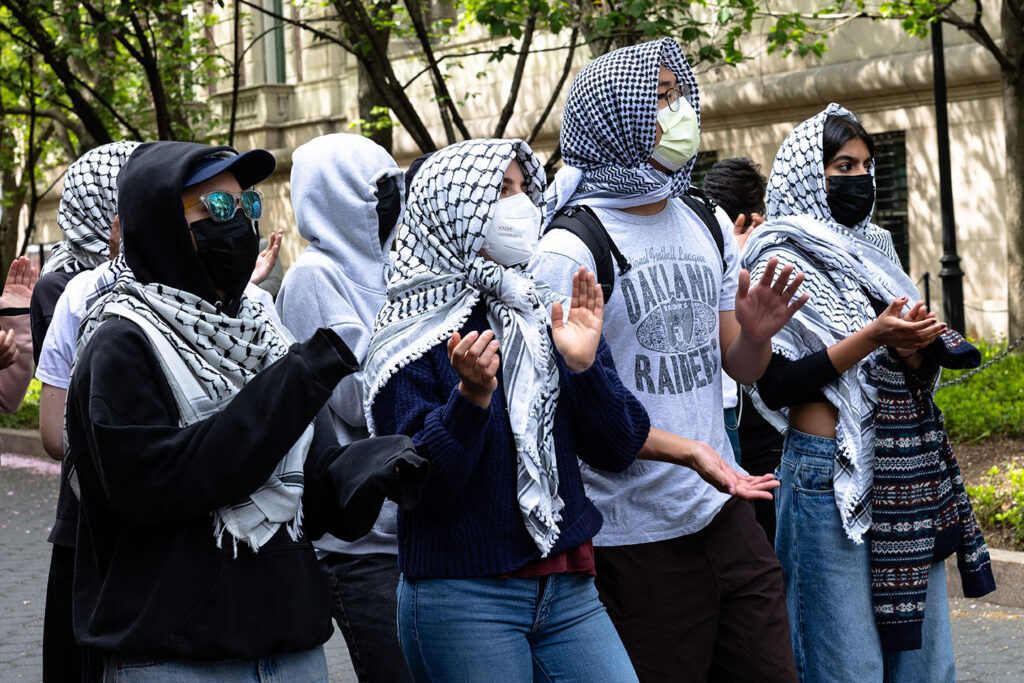
The nationwide masquerade party known as the Gaza Solidarity Encampments, which embroiled colleges in chaos and served as reminders of the Jew-hating violence of 1930s Germany, may have also previewed what protesting Islamists and Marxists (two otherwise irreconcilable groups) have in mind as a next act.

The Arab Street is moving campus by campus and street by street. Very soon they might be standing outside your door. If their takeover of campus buildings is any indication, they won’t knock politely.

Prepare yourselves for a lot of broken glass. Kristallnacht came to Hamilton Hall at Columbia. Practice your call to prayer. Wrap yourself in your very own keffiyeh. Standing out as an infidel only invites decapitation.

Don’t be surprised if someone who lived within these encampments one day makes a backpack go boom. Those cheering for Hamas are made of the wrong stuff.

Ask the people of Paris, London, Stockholm, Brussels, Berlin, Madrid and Copenhagen how things have worked out for nations that volunteered to be safe havens for Muslims. What was safe for Muslims became miserable and murderous for the people who welcomed them.

When American flags are dismounted and set aflame, stomped upon, and replaced with flags belonging to rogue terrorist entities (Hezbollah and Hamas are not nations), and a statue of George Washington has been outfitted in the full regalia of a jihadist outlaw, a clear message is being sent: We want to see Tel Aviv, and Tennessee, both burned to the ground.

Israel and its war in Gaza always was, and remains, a distraction, a loss leader in a far more ambitious undertaking: the demolishing of the world’s democratic order. The aim is a global caliphate, and Western societies are in the way.

The Biden administration is doing its part by announcing that it will be admitting Gazan refugees into the United States. Egypt, co-religionists and next-door neighbors, won’t admit a single Gazan through its border. It is well aware of Gaza’s chief natural resource. But the United States, always open for more diversity, would like to boost its terrorism numbers.

Lovely.

Israel, hopefully, will finish the job in Gaza. It knows what must be done. Not so sure about the United States, however. The warning signs were unmistakable, beginning with the burning of an American flag in Dearborn, and protests that featured “Death to America!” chants. On colleges, legions of Hamas hangers-on, essentially latchkey kids, instigated by ax-grinding professors and outside agitators, mindlessly attached themselves to an antisemitic cause they neither understand nor realize has no love lost for them.

What kind of students—Ivy Leaguers, no less—would be so easily manipulated? And, who, exactly, inhabited those designer tents?

The frontline messengers and foot soldiers have largely remained a mystery: wearing masks, refusing to speak to the press, camera shy, shouting slogans, shoving Jewish students and screaming obscenities at police.

You can tell a lot about students wearing masks. For one thing, masks conceal all sorts of ugliness. Remain anonymous while within a mob. Without the mask, deviancy will more likely be punished. And the mass gathering of the similarly embittered takes the sting away from all those fraternities and sororities that already rejected them. Speaking of Greek, the protesters are unlikely Phi Beta Kappa.

The perceived shadowiness of the keffiyeh mask, and the failure of university presidents to enforce their codes of student conduct, left these students with feelings of invincibility. All personal responsibility abandoned. Hating Jews without consequence. Openly calling for their deaths, enshrined as a First Amendment right.

Talk about faulty education. Freed from all inhibition. Surrounded by antisemites in arms. With faces covered, ignorance and hate are far too easily unleashed. And no fact-checkers to be found despite the presence of so many professors, all light graders, chanting the same thing.

Such identification with terrorism, in a nation that survived 9/11, should have resulted in the immediate forfeiture of their student status. If they are holding student visas, expedited deportation. Screaming, “We are Hamas!” and “Long Live the Intifada!” suggests that you have severely misjudged the moral categories and chosen the wrong side in a ferocious rivalry between good and evil. You might as well enroll yourself in a Palestinian terrorist pilot program.

It makes sense that the match was lit on the campus green. Many of these students had already been exposed to anti-Western, anti-American, anti-Zionist propaganda since middle school. College humanities departments are dominated by “academics” hired principally to satisfy DEI agendas and poison impressionable minds. Activists abusing a tenure track to recruit doctrinal disciples.

How else to explain curricula that includes such garbage courses as: Northwestern’s “Unsettling Whiteness”; Pomona’s “Queering Childhood”; and Brown’s “Humanity or Nah? Blackness, Gender, Resistance, and Memory in Monuments, Maps, and Archives”?

Meanwhile, Middle East Studies departments have become extremist outposts for Islamists holding PhDs.

Students are no longer taught to think critically and independently. Only uniformly—in lockstep groupthink, with overlapping intersectional grievances. The ignorant are so easily indoctrinated. College campuses became ground zero for cult-like zombies reciting social justice mantras, dancing in circles, and making a dash for porta-potties in which to discharge all that excess Kool-Aid.

Since late last week, over 2,000 arrests were made on over 50 campuses. A good number of those were not affiliated with any university. How were outside agitators allowed to hijack campus facilities and hand out permission slips to commit violence against Jewish students? Trustees ought to know.

Still, the vast majority were students, old enough to know better. Will they receive diplomas for their final project? Are they invited back to campus in the fall?

What possessed them to choose Gazans as the people most deserving of their time and emotions? After all, many hot-spots around the world have generated actual genocides, and far more collateral damage, than Gaza. Yet, not a single chant or signage for Syrians, Yemenites, Uyghurs and Sudanese, nor any that read: “Bring the Hostages Home,” or “Hamas: Surrender!”

Instead, the students camped out for weeks, ignored exams, flirted with expulsions, and risked arrests—all the while doing the bidding of terrorists who beheaded babies and gang-raped girls their own age.

They professed their right to peaceful protest, yet called for the killing of Jews. They wanted to showcase their revolutionary grit, but demanded bottled water, gluten-free food and sunscreen. They broke-and-entered university buildings, held unlawful assemblies and scuffled with the police, yet complained about getting arrested and demanded amnesty. They insist on defunding the police, but when counter-protesters emerged, they demanded police protection.

Even children are more mature than this.

Before Gaza bewitched the student body into believing that Jews can be tormented carte blanche, the purveyors of identity politics decreed that speech is violence. Nowadays, violence is free speech—if directed against Israel, and Jews everywhere.


Thane Rosenbaum is a novelist, essayist, law professor and Distinguished University Professor at Touro University, where he directs the Forum on Life, Culture & Society. He is the legal analyst for CBS News Radio. His most recent book is titled “Saving Free Speech … From Itself,” and his forthcoming book is titled, “Beyond Proportionality: Is Israel Fighting a Just War in Gaza?”

Gaza Masquerade Parties Can’t Mask Ugliness Read More »

By Putting Feelings Before Truth, Universities Created a Time Bomb

There was a stunning video clip last week of a UCLA provost who came to meet with protesters at their encampment. He had come in good faith, wanting to discuss their grievances. What he got instead was sheer animosity, as students chased him away with insults.

We’ve been seeing this kind of chutzpah spread through college campuses in recent weeks, with demonstrators ransacking buildings and destroying university property. There seems to be no fear whatsoever of consequences.

How did college students get so brazen?

A good place to start is with a movement that started about ten years ago and revolved around protecting college students from “microaggressions.” Suddenly, any student with the smallest grievance became empowered– as long as they were part of an identity group considered “oppressed.”

“Something strange is happening at America’s colleges and universities,” Greg Lukianoff and Jonathan Haidt wrote in “The Coddling of the American Mind,” a seminal 2015 essay in The Atlantic. “A movement is arising, undirected and driven largely by students, to scrub campuses clean of words, ideas, and subjects that might cause discomfort or give offense.”

This scrubbing has come at a price, as the movement to erase emotional discomfort, which culminated in the pervasive, victim-driven DEI bureaucracy, came to dominate the primary mission of a university—the pursuit of truth.

We’re seeing the inevitable result of this ticking time bomb with today’s rabid protesters: There is zero interest in pursuing truth and every expectation that they will be protected and their demands will be met.

Students have been taught by feckless college leaders that victimhood is where the power lies. Except for Jews, who have typically been put in the privileged “oppressor” group, self-proclaimed victims from marginalized groups know they’re always right.

“A lot of college students in this generation… there’s a lens they use to kind of evaluate the world,” New York Times columnist Frank Bruni said in a recent interview. “And it’s one in which people who have less money, people who have less power, sometimes people who have darker skin must inherently be wronged and are therefore most likely to be in the right.”

Yes, even terrorists.

We saw that play out right after the massacre of October 7, when, as Bruni says, “you saw a lot of young people not even take a moment to really acknowledge what had happened in Israel, and how horrific that was. They just kind of immediately applied this paradigm and began advocating not just for Palestinians, but in a perverse way, at times for Hamas.”

The same people obsessed with “microaggressions” against minority groups were indifferent to macroaggressions against Jewish students, while celebrating terrorism against those deemed “oppressors.”

Beyond this blatant double standard against Jews, scratch the surface of the campus rage and you’ll see a temper tantrum from whiny kids who are used to getting their way. Those entitled souls have been conditioned by universities who have consistently coddled them while indoctrinating them in anti-Israel bias and undermining the messy search for truth.

In another Atlantic essay titled, “American Universities are Post Truth,” Josh Barro argued that “A lot of the research coming out of [elite universities] does not seem to aim at truth, whether because it is politicized or for more venal reasons. The social-justice messaging they wrap themselves in is often insincere. Their public accountings of the reasons for their internal actions are often implausible. They deceive the public about the role that race plays in their admissions and hiring practices.”

As they were treating students with kid gloves in a grand show of virtue signaling, elite universities might have been hoping no one would notice. They must have known, deep down, that instead of nurturing curiosity, they were nurturing grievance and anger.

As that anger is turning more and more violent, college leaders are dazed and befuddled. Some are trying to appease the protesters with negotiations, while others are calling the police. But as commencement ceremonies are being cancelled left and right, hysterical protesters continue to make absurd and unrealistic demands.

The coddled generation has exploded in fury, and they have turned on the very institutions that coddled them and kept uncomfortable truths at bay.

On the surface, these protests are anti-Israel and anti-America and anti-Western, which is dangerous enough. But let’s not forget that at their root, the protests are also anti-truth.

On the surface, these protests are anti-Israel and anti-America and anti-Western, which is dangerous enough. But let’s not forget that at their root, the protests are also anti-truth.

This is what happens when you teach kids that they are the most important people in the world– as long as they represent a favored victim group— and that you will do everything you can to address their tiniest complaints to make sure they never get hurt.

Who’s getting hurt now?

By Putting Feelings Before Truth, Universities Created a Time Bomb Read More »

Taste Buds with Deb Celebrates One Year, A Triple Chai of Eps

This month marks one year since the launch of the “Taste Buds with Deb” podcast. Every Wednesday, I release a new 20-ish minute episode, which is a bite-sized conversation about food, cooking and community. Most of my guests shared recipes too! What makes this milestone even more special is I just released my 54th – aka my triple chai – episode.

I have received food for thought from old friends and previous Jewish Journal interviewees; new friends and connections; chefs, restaurateurs, bloggers, authors and media personalities from around the world.

As a writer, I love being able to share the stories of others. I also love having engaging conversations. This podcast gives me the opportunity to do both. And nothing brings people together like their love of food and cooking.

Here are some of the things that stood out from each of my triple chai conversations:

Babka King chef Shimi Aaron: Food that looks beautiful makes you want to eat it more.

Swell App’s Deborah Pardes: Food is a medium for connection.

Samantha Ferraro: Little Ferraro Kitchen: You can tell a lot about a person based on what’s on their kitchen table.

Arthur Smith, “Hell’s Kitchen,” and author of “Reach:” Cooking is like sports.

Baking It’s Norma Zager: Chocolate is like a basic black dress: it goes everywhere and it goes with everything!

Author Robbie Samuels, “Croissants vs Bagels:” Food makes the perfect metaphor.

Judi Leib: Whisk in the Southern: You can simplify a fancy recipe or fancy up a simple one.

Rabbi Avi Finegold: A daiquiri is the simplest cocktail to make and the hardest one to master.

Seasoned Moments’ Michal Levison: Food is a bridge to connection.

Danny Corsun, Culinary Judaics Academy: Choose recipes that aren’t intimidating; know that it’s okay to mess up.

Faith Kramer, “52 Shabbats:” Even when your intention is to have a nice meal, you don’t necessarily need to make restaurant perfect food.

Spice king Lior Lev Sercarz: Seek out quality spices to incorporate into your cooking.

Brad Mahlof, The Great American Recipe: No one starts off as an amazing cook; it takes practice, so don’t get discouraged.

Nicky Pitman, Shemesh Farms: There’s nothing like it when something tickles your taste buds.

Abby J Leibman, CEO, MAZON: The preparation of food is itself a ritual that is both calming and uplifting.

Debbie Kornberg, Spice + Leaf: Cooking should be a joy!

Dr Alona Pulde and Dr Matthew Lederman, “Wellness to Wonderful:” To achieve optimal health, you need to keep things simple.

Dawn Lerman, author, “My Fat Dad:” Healthy cooking is easy; don’t shy away from it.

Rachel Gordin Barnett and Lyssa Kligman Harvey, authors “Kugels & Collards:” Have conversations about food and its place in your family histories; don’t forget to write down the recipes.

Chef Doug Weinstein: Making fancy stuff, like chocolate and sweets, is fun but very involved; bread is simple and you can get lost in the process of making it.

Lisa Niver, “Brave-ish:” You don’t need to cross oceans to have new food experiences.

Sephardic Spic Girls Sharon Gomperts and Rachel Emquies Sheff: There is power in food and food memories.

Jonathan Bernhard. JIFA: Once you develop the knowledge-base and skillset, plant-based cooking becomes second nature.

June Hersh, “Iconic Jewish Food:” The stories that are built around the foods that we eat have a wonderful provenance; that’s what makes them so especially satisfying.

Mandy Silverman, Mandylicious: The first step to making good challah is to have the right mindset.

Dana Shrager, Dana’s Table: Use new seasonings to give traditional flavors a modern twist.

Author Mitch Albom: When you incorporate a meal into a conversation, it becomes more human.

Annie Korzen, “The Book of Annie:” Say “Why Not?” to every opportunity that comes your way.

Chef Susan Feniger and filmmaker Liz Lachman, “Forked:” In any project, be passionate; love what you do!

Chef Alon Shaya: Recipes are a wonderful vehicle for conversations about difficult subjects.

Ilana Muhlstein, 2B Mindset: A few small swaps can make a huge impact on your confidence, energy and weight-loss results.

Sivan Kobi, Sivan’s Kitchen: Food is a love language.

CW Silverberg, “Schmoozing & Cruising:” One of the most basic, fundamental dishes is roast chicken.

Pam Stein, In Pam’s Kitchen: Baking with alcohol involves trial and error.

Illustrator Lisa Brown, “The Latke Who Couldn’t Stop Screaming:” Food is universal and cross-cultural.

Chaya and Yossi Segelman, Our Big Kitchen LA: Food volunteerism is a beautiful conduit to bring people together.

Michaele Weissman, “The Rye Bread Marriage:” Literally breaking bread is a pastime that endures.

Dianne Jacob: “Will Write for Food:” To make your food less boring, use more salt.

The TeaBook’s Noah Bleich: Drinking tea leads to PositiviTEA! There’s an innate happiness factor.

Judy Elbaum, Leave it to Bubbe: Colombian chicken soup is the ultimate comfort food.

Amy Steinhaus Kirwin and Rebecca Edana, “Two Jews Making Food:” When you share food, you share your heart with others.

Poet Jehanne Dubrow, “Taste:” Taste and scent work together to tap into the part of the brain where you access memory and emotion.

Michael W Twitty, “Koshersoul:” You can learn your way across the globe based on the smell of someone else’s kitchen.

Sonya Sanford, “Braids:” Jewish food differs in any region, based on what is available to people and the cultural trends are.”.

Amy Kritzer Becker, What Jew Wanna Eat: If you are hosting and people offer to bring dishes, let them!

Phil and Lily Rosenthal, “Just Try It:” When you step out of your comfort zone, that’s when the magic happens.

Micah Siva, Nosh with Micah: A nosh is something you can’t stop eating.

Jamie Pachino, consulting producer, “So Help Me Todd:” There’s something about family dinner that transcends cultures, even when portrayed on a television show.

Katie Workman, The Mom 100: Comfort foods inspire a visceral reaction, and there’s nothing like it.

Joel Haber, 18 Jewish Foods podcast: Food is a window into discussion of culture and history.

Joan Nathan, “My Life in Recipes:” Recipes can connect you with your past … and with future generations.

Shani Seidman, CMO, Manischewitz: We take a lot of pride in our traditions; we want to share goodness and joy over food with anyone who wants to sit down with us.

Beth Lee, OMG Yummy: Preserved lemons can change your life.

Chico Menashe, CEO, Asif: Culinary Institute of Israel: Israeli chutzpah – the combination of creativity, innovative thinking and daring – is a main ingredient in the kitchen.

New episodes of Taste Buds are released each week via Facebook, LinkedIn and @TheDEBMethod on YouTube. Subscribe to “Taste Buds with Deb” on your favorite podcast platform and share your love of cooking and food at Facebook.com/groups/TasteBudsWithDeb.

Taste Buds with Deb Celebrates One Year, A Triple Chai of Eps Read More »

The Nazis at George Washington U.

The recent image of a pro-Hamas student at George Washington University brandishing a poster calling for a final solution” was horrifying. But it was also deeply ironic. Because on the very same campus in Washington, DC, where that Nazi slogan was invoked last month, actual Nazis were repeatedly welcomed in the years before World War II.

In October 1933, Gustav Struve, an official of Nazi Germanys embassy in Washington, spoke on the GW campus under the auspices of  the universitys German Club. In February 1934, Gerrit Von Haeften, Third Secretary of the German Embassy, visited GW to address the German Clubs Valentine party. And in May 1937, two Nazi representatives, the wife and daughter of the German embassys Chancellor, Franz Schulz, participated in an event on campus sponsored by GWs International Studies Society.

Friendly attitudes toward Nazi Germany appear to have permeated the campus. The visits by Nazi officials proceeded without any sign of objections or protests—unlike, for example, at Columbia University, where hundreds of students held multiple protest rallies when the Nazi ambassador, Hans Luther, was invited to that campus in 1933.

Both the German Club and the International Studies Society at GW held screenings of films which were procured through the German Consul,” according to the student newspaper, The Hatchet. At least one of the events also included displays of foreign flags; the Hatchets coverage included a large image of Nazi Germanys swastika flag.

That was in April 1937–four years after Hitler came to power, after the Nazi regimes boycott of Jewish businesses, the nationwide book-burnings, the Nazi takeover of German universities, the mass firing of Jews from most professions, and the mob violence against Jews in Berlin and elsewhere. It also was after the enactment of the Nuremberg Laws in 1935, which stripped German Jews of their citizenship.

Yet The Hatchet, which was published by the university, continued to run advertisements from the Nazi governments tourism department and touted upcoming summer tours by GW students to Europe that included visits to Nazi Germany.

During those years, GW maintained a junior-year student exchange program with the Nazi-controlled University of Munich, despite the purging of Jewish faculty, implementation of a Nazi curriculum, and mass book-burning at the Munich school.

The Hitler regime viewed such exchanges with American universities as a way to soften the Nazisimage abroad. The Nazi official in charge of sending German students to American universities was quoted, in the New York Times, as describing the German students in such exchanges as political soldiers of the Reich.” But that did not deter GW from participating in the program.

GW was not the only American university to sponsor student exchanges with Nazified German universities, as Stephen Norwood documented in his book, The Third Reich in the Ivory Tower. But not every American school with ties to Germany turned a blind eye when the Nazis rose to power and took over the countrys universities. Williams College, for example, terminated its student exchanges with Germany as a protest against Nazi policies. GW did not.

Some GW students who spent a year at the University of Munich returned with upbeat reports about the new Germany. GW student Mary-Anne Greenough, for example, stated in a 1937 university newsletter that during her year in Germany, she attended the Naziscelebration of the anniversary of Hitlers failed 1923 putsch; she said she found the eventworthy of admiration.”

Some GW faculty who visited Germany during the 1930s likewise came back with positive descriptions of the Nazi regime. Assistant Professor of Philosophy Christopher Garnett, returning from a visit to Germany in 1934, reported to the campus historical society that [t]he optimism which permeated the Germans, even those who at first opposed the present regime, is almost unbelievable.” Such apologetics whitewashed Nazi outrages and made Hitler more palatable to the American public.

The time has come for the GW administration to acknowledge that it was wrong for GW to invite Nazi representatives to campus and to maintain student exchanges with Nazi-controlled institutions.

But that is not all.

In 1985, GW presented an honorary doctorate to Mircea Eliade, a noted scholar of comparative religion. Before Eliade was a scholar, he was a Nazi collaborator.

During the 1930s, Eliade authored viciously antisemitic articles in the extremist Romanian periodical Cuvantul, raving about the alleged Jewish onslaught” threatening Romania. He actively supported the fascist paramilitary group known as the Iron Guard, and when the Romanian government cracked down on Iron Guard activists in 1938, Eliade was among those whom it imprisoned.

After the Iron Guard came to power in 1940, Eliade was appointed as one of its diplomats in London. (British officials privately called him the most Nazi member of the legation.”) The Iron Guard regime actively collaborated in the mass murder of Romanias Jews. Particularly gruesome,” the U.S. Holocaust Memorial Museum notes, was the [Iron Guards] murder of dozens of Jewish civilians in the Bucharest slaughterhouse. After the victims were killed, the perpetrators hung the bodies from meat hooks and mutilated them in a vicious parody of kosher slaughtering practices.”

Eliade continued to defend the Iron Guard after the war, praising it in his 1963 autobiography. For some reason, that didnt deter GW from giving him an honorary doctorate in 1985. The time has come to revoke that honor.

Two years ago, public concern over racism in the United States prodded the George Washington U. administration to remove the name of its longest-serving president, the late Cloyd Heck Marvin, from the student center because he advocated racial segregation. And last year, the administration changed the school moniker from Colonials” to Revolutionaries” because of the many injustices associated with colonialism. GW should now show similar sensitivity to the concerns of its Jewish students and faculty.

Ninety years after actual Nazis were warmly welcomed at GW, extremist students on its campus today are invoking the infamous Nazi phrase final solution” —meaning mass murder of Jews. Thats a blatant violation of the GW Student Code of Conduct. Section V (F) prohibits acting in a way that threatens, endangers, or harasses others, including verbal, written, or any other form of communication.” Violators are subject to a range of possible punishments, from a warning to permanent expulsion. Its time for George Washington University to implement its own rules.

Acknowledging the error of GWs friendly attitude toward Nazi Germany in the 1930s, revoking Mircea Eliades doctorate, and taking meaningful action against todays violators of the Student Code of Conduct is the path to restoring order, and decency, at George Washington University.


Dr. Medoff is founding director of The David S. Wyman Institute for Holocaust Studies and author of more than 20 books about Jewish history and the Holocaust. His latest is Whistleblowers: Four Who Fought to Expose the Holocaust to America, a nonfiction graphic novel with artist Dean Motter, published by Dark Horse / Yoe Books.

The Nazis at George Washington U. Read More »

Elisha Wiesel and the Elie Wiesel Foundation Host Disrupting Uyghur Genocide Conference

The Uyghur people have faced ongoing human rights abuses and genocide in China. However, it has largely been ignored in the media, and China has, for the most part, gotten away with these crimes.

Elisha Wiesel, son of Holocaust survivor Elie Wiesel, wouldn’t stand for it. That’s why he and the Elie Wiesel Foundation partnered with the World Uyghur Congress and the Uyghur Human Rights Project to hold the Disrupting Uyghur Genocide Conference and bring awareness to this issue. On April 17 and 18 in New York City, Wiesel came together with Uyghur leaders to discuss the ongoing plight of their people in China, taking lessons learned from the Holocaust and educating attendees on how to fight back against the oppression.

“The Elie Wiesel Foundation decided to relaunch an ‘activist’ stripe of our work, reflecting my parents’ long-standing history as activists who tackled hard problems, ranging from standing up to the Soviet Union for their refusal to let Soviet Jews emigrate, to their conference in Belfast where Catholics and Protestants attended, during the ‘troubles’ to the series in Petra, where they, with King Abdullah of Jordan, brought together PM Olmert and PM Abbas,” Wiesel told the Journal. “Our feeling was that the Uyghur genocide was the most under-reported, under-invested human rights tragedy occurring on the planet.”

“Our feeling was that the Uyghur genocide was the most under-reported, under-invested human rights tragedy occurring on the planet.” – Elisha Wiesel

Wiesel, a former Wall Street executive, carries on his father’s mission to stop hate in all its forms. In recent years, he spoke at the United States Holocaust Memorial Museum about protecting the LGBTQ community, organized a Washington, D.C. rally against antisemitism and went in front of the United Nations to speak about the persecution of the Uyghurs. Now, he’s trying to spread the message about the Uyghurs in a time when the Chinese government suppresses any information on it.

“It’s hard for the media to cover a topic where the CCP [Chinese Communist Party] has successfully imposed a media blackout,” he said. “It’s one of the reasons the CCP is winning to date. The other reason is that celebrities, who might be tempted to speak out against Darfur or Sudan or Myanmar, often have dollars and cents at stake with their next movie or pair of sneakers poised to earn millions of dollars in the Chinese market.”

The conference featured panels including  “’Never Again’: The Uyghur Genocide and Learning from the Holocaust,” “Preserving Uyghur Cultural Identity” and “Learning from the Jewish Diaspora Experience,” “Beyond Concentration Camps: Forced Assimilation & China’s Colonial Boarding Schools” and “TikTok, Social Media and the CCP’s Agenda to Control Information.” Speakers such as the President of the Uyghur American Association, Elfidar Iltebir; Director of Holocaust, Genocide, and Interfaith Education Center at Manhattan College, Mehnaz Afridi; former Ambassador-at-Large for Global Women’s Issues and the former U.S. Representative at the United Nations Commission on the Status of Women, Kelley Currie and Mihrigul Tursun, a Uyghur camp survivor, participated in the panels.

“It was chilling to hear survivors describe how the totalitarian, repressive CCP regime ripped apart families, pitted members against each other and disappeared their relatives who refused to cooperate,” Wiesel said. “It was sickening to hear the accounts of rape and forced sterilization.”

While some action has been taken to stop China from committing these atrocities, Wiesel believes there is much more to be done.

“It starts with putting pressure on U.S. corporations,” he said. “The good news is that Congress voted 428-1 for the Uyghur Forced Labor Act. Now corporations must do more to evidence that their supply chains are free of slave labor. And consumers need to include these human rights elements in their purchasing decisions.”

People can write to their local congressperson, urging them to stand up for the Uyghur people, and they can follow @forcedlabourfashion and check a brand’s report card before buying at forcedlabourfashion.org/report-cards.

Wiesel has been dedicated to human rights work for years, and post-Oct. 7, that fight has intensified. Like all Jews, the past seven months have been full of uncertainty, fear and anxiety.

“At first, I didn’t sleep because I was having nightmares,” he said. “Then I didn’t sleep because advocacy for our brothers and sisters in Israel became a second full-time job, an advocacy I should never have had to do except for the evil Oct. 8, which followed Oct. 7, where the Jewish people were blamed for the atrocities perpetuated on us.”

Though Wiesel said that this is the worst time for Jews he can remember, he is dedicated to staying in the U.S. and continuing to advocate for his community.

“My father loved the United States and everything it stood for,” he said. “So do I, and I refuse to give up on it. The American Jewish community has helped shape it and I believe we can continue to be a force for good in this incredible country.”

Ensuring that the community stays strong begins with educating the next generation and passing down Jewish traditions, which Wiesel believes have been forgotten.

“We have a generation, my generation and the one just above mine, which became overly assimilated and let our kids grow up with no notion of how precious our gifts are — living in the free world, having a Jewish tradition, having Israel,” he said. “We need to find a way to connect on this with the college-age students and twenty-somethings who have lost the plot.”

For his part, Wiesel’s going to continue his work with the Jewish and Uyghur communities and beyond, following in his father’s footsteps to make the world a better place for everyone.

“[My father] spoke enough words on many topics during many different contexts — and more importantly he spoke through his actions,” he said. “He believed in a Jewish future, raised a Jewish family and stood by Israel no matter how many on the world stage clamored for her to be punished and ostracized. I am choosing to do the same.”

Elisha Wiesel and the Elie Wiesel Foundation Host Disrupting Uyghur Genocide Conference Read More »
