fbpx

March 20, 2024

Uniting for Humanitarian Action: Ukraine and Beyond, Two Years On

In 2022, while on a humanitarian mission to the Ukraine border, I met a Ukrainian family who narrowly escaped from Mariupol. With both their dreams and home destroyed, they moved to Israel, ready to begin again. More than 15,000 Ukrainians did the same – and then found themselves caught in another war.

While the fate of American support for Ukraine and Israel hangs in the balance of political election-year posturing, the commitment of ordinary citizen volunteers demonstrates the power of action in the face of repression.

Having hidden in a basement in Mariupol without water or electricity, once the sirens sounded in Israel, Sara and her three children, 14, 10 and 4, one with autism, never left the house. Terrorized by memories, Sara knew they had to leave – again. Last month marked two years since Russia’s attack on Ukraine and a decade since the Russian occupation of Crimea. While the fate of American support for Ukraine and Israel hangs in the balance of political election-year posturing, the commitment of ordinary citizen volunteers demonstrates the power of action in the face of repression.

Sara and her family left for Greece for a few months of peace with the help of some of the same networks that helped Ukrainian refugees move to Israel, including the UA Support Team (UAST). 

People out, supplies into Ukraine

UAST is a grassroots network linking 375 people across 20 countries in Europe, the United States and Israel to help Ukrainians survive and escape the war. Leveraging the collaborative efforts of these individuals and across the globe, UAST members provided safe evacuations for Ukrainians and delivered supplies where they were needed most. They connected individuals who were ill and injured to medical treatment, and found shelter for women, children, and elderly refugees.

When Russia invaded Ukraine in February 2022, Southern California civic strategist Shawn Landres started connecting people in his transatlantic network across Europe. “I didn’t want to deal with multiple siloed networks getting into Ukraine humanitarian work and missing opportunities because people didn’t know each other existed,” he recalled. 

The foundation of the UAST network is a secure, private communication platform that allows volunteers to contribute skills and resources. Early on, Landres set ground rules: Confidentiality, no solicitation, no fundraising, and no military aid. The network took swift actions, communicating through secure text-messaging apps and functional threads, such as Evacuations and Supplies and Logistics. Anyone wanting to join UAST needed an existing member to vouch for them and 24/7 moderation redirected off-topic messages. 

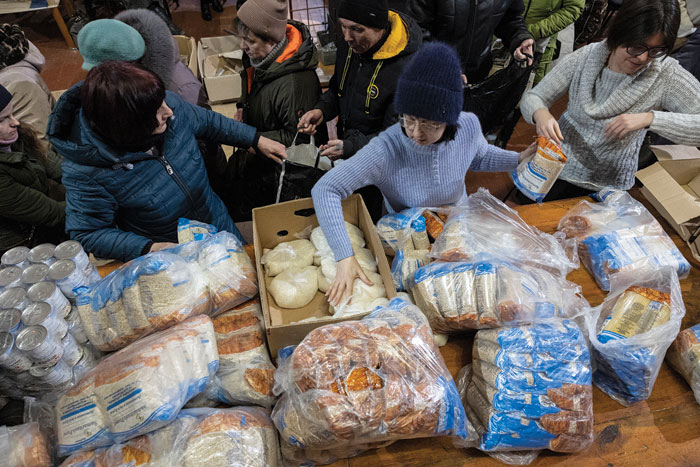
By late 2022, one UAST team that connected without ever meeting in person had evacuated 4,630 women and children from central and southern Ukraine. The same team delivered 392 pallets of food and 60 pallets of medicine and medical supplies to people, including Holocaust survivors, who had been isolated in or displaced from their homes. 

UAST volunteers have purchased and delivered power generators, sexual assault trauma kits, surgical tools, and cash transfers for safe evacuation and basic needs. 

As Ukrainian refugees spread throughout Europe, Israel and North America, UAST volunteers connected arrivals with local assistance, sometimes even housing them or helping them find jobs.

Pivoting quickly to assist in Israel

As a member, I have watched UAST move quickly and efficiently, first in Ukraine and later in Israel. Within hours of the Oct. 7 attacks, the first messages appeared on UAST from a Ukrainian activist asking if Israelis needed medical aid and supplies from abroad. Two days later, the network had created Israeli-focused subgroups to verify aid requests, arrange travel, and assist foreigners in crisis.

Working alongside and frequently in collaboration with large-scale institutional relief efforts, Landres noted, “We aren’t a network to raise money or raise anyone’s profile — we’re a network for getting the work done.” 

Footage Foundation co-founder Kristen Eglinton, an experienced humanitarian aid executive, said she quickly found “deep and sustainable partnerships and collaborations” through the network.

UAST was able to pivot quickly in response to Israel’s emergency needs through lessons learned from 18 months of prior work. “We had an existing cohort of experienced Israeli volunteer aid workers dedicated to Ukraine,” Landres said. “We knew we could quickly and effectively return that support.”

Two years into the expanded conflict, the Ukrainian government’s capacity to manage emergency medical and infrastructure needs has rebounded. UAST has shifted its attention to where needs remain. It did the same in Israel where Sara and her family received assistance to take their family to Greece for a few months. They now are back in Israel, where they continue to receive assistance to rebuild their lives. 

A new paradigm for humanitarian action

Many UAST volunteers, including Jeff Kaminsky of Chicago, joined the network because they couldn’t let these conflicts be someone else’s problem: “I asked myself: What can I do? I had to find a way or create a way to help,” Kaminsky explained.

UAST is one of many such networks of volunteers, and its story is relevant as a new paradigm for global humanitarian action. While other versions of the same operational model are increasingly common, including Maman, which also uses messaging groups to crowdsource volunteer assistance, UAST has remained unincorporated and does not fundraise for itself or others.

Larger international aid groups such as OLAM have cited UAST as a frequent collaboration partner on the humanitarian response in Ukraine. Project Kesher Ukraine’s Executive Director Vlada Nedak called UAST a “responsive and effective network of people,” noting “the ripple effect of such efforts is enormous.” 

It has been said that a single twig snaps easily, but not a bundle. These organizations and individuals couldn’t have the same impact alone. But by working together, pooling their skills and resources, they could achieve the impossible.


Wendy Gerber is Senior Partner, Brand Consulting for Kantar. She participated in a humanitarian mission to the Ukraine border in 2022 and is a member of the UAST Network. Gerber has written for numerous publications including the New York Daily News and Newsday.

Uniting for Humanitarian Action: Ukraine and Beyond, Two Years On Read More »

What Can I Do to Make Your Life Easier Today?

Today I went to the pharmacy and asked if my prescription was ready. I needed the ear-infection medication urgently so that I would be able to fly to a business engagement. Looking harried, the pharmacist said that she was alone in the pharmacy and that it would be ready in 15 minutes. I sat down to wait. After about five minutes, she said it was ready. Making conversation, I asked her if her staff had called in sick, and she replied, “Sometimes they don’t even call in.” She looked stressed and weary. I realized that she had done me a favor to fast-track my pills under challenging circumstances, so I asked her, “What can I do to make your life easier today?” Surprised, she said, “Nothing, I’m fine.” But the light had come back into her eyes, and she was smiling. As I walked away, I realized that I had made her life easier just by asking her that question.

Big-picture problems plague the planet: war, climate change, divisive elections. There’s not a lot any of us can do to improve those situations. Unless we hold positions of institutional influence, we feel powerless to combat the world’s evils. But we can, as the Torah teaches us, focus on our “four amos.” An “ama” is a measure of about an arm’s length. Our “four amos” is the area a few arms’ lengths around our own body: It is our sphere of influence and the lives we touch within it.

Without forgetting that there is a bigger world, we can intentionally set out to bring peace and light to our interactions with the people around us, whether they are family members, retail clerks, baristas, work colleagues, or strangers on the street. 

Without forgetting that there is a bigger world, we can intentionally set out to bring peace and light to our interactions with the people around us, whether they are family members, retail clerks, baristas, work colleagues, or strangers on the street. Starting from right where we are, we can radiate acts of chesed, or lovingkindness in our four amos.

We can start small, say, with a smile. The Talmud says of Yochanan ben Zakkai, the greatest rabbi of his generation, that “no one greeted him first, even the Gentile in the marketplace.” because he always greeted them first. Seeing every person as a reflection of God’s image, he greeted them pleasantly as soon as he saw them. This idea is elaborated in Pirkei Avot, the teachings of the Sages, where we are enjoined to greet everyone we meet with a friendly expression.

If we want to go a step further, we can actively look for reasons to say something sunny. The person checking out your groceries could have called in sick today, but they didn’t. You can thank them for being at the store to help you. Your spouse is wearing something that suits them. Tell them so. You know your colleague worked hard on a presentation – ask them how it went. 

Focusing on our “four amos” puts our attention on things we can control. I try not to worry about situations where I have no control; this is challenging, but it prevents me from ruminating about world events that I can do nothing about. I ask myself, “What can I do with the tools I have?” Maybe I will donate money or write to an elected representative. Perhaps I can make a meal for a sick person or call someone lonely. Or maybe I can observe someone in distress and ask them, “How can I make your life easier today?”

Even the greatest social and political changes begin with individual people exerting influence on their immediate sphere. By focusing on our own zone of influence, our four amos, we keep from feeling overwhelmed by world events and take responsibility for the place where we can make a difference in the lives of others: right here and right now.


Elizabeth Danziger is the author of four books, including “Get to the Point,” 2nd edition, which was originally published by Random House. She lives in Venice, California.

What Can I Do to Make Your Life Easier Today? Read More »

How Ancient Persians Essentially Saved Judaism As We Know It Today

This time of year, many non-Persian Jewish friends remind me that as an Iranian Jew, “my holiday” is just around the corner. It’s true that Persian Jews feel a little possessive of Purim. Esther and Mordechai are even said to be buried in a tomb in what is now the city of Hamadan in Western Iran. 

But several years ago, one of my Ashkenazi friends offered a bold declaration during a Shabbat meal: “Tabby,” he announced, “Purim isn’t only a Persian Jewish holiday. It belongs to all of us, because all of us were there in Persia with you.”

For a moment, a hush fell over the table as guests looked squarely in my direction for any semblance of offense. In an age when wokeism has hijacked much of our mental processing, was this Ashkenazi man, who had wished me a “Good Shabbos,” and who sat within arms’ reach of a pungent bowl of German-style brined herring, appropriating my history as a Persian Jew? 

Could he actually claim such ownership of Purim? And what was next? Ashkenazi Jews chasing one another with scallions during the “Dayenu” recitation of the Passover seder, in true Persian and Afghan Jewish-style? (One can only hope.)

Everyone waited for my reaction. After a few seconds, I smiled, slammed my hand on the table (the herring was a safe distance away) and shouted, “Of course! You were there as well!”

I immediately understood what my friend meant. And in this week’s column, I want to share three Purim-related arguments with non-Iranian Jewish readers that will hopefully help them view Purim through a new lens:

First, there is a possibility that they, too, can trace their ancient lineage back to the Jews of the Persian Empire, even if their descendants were Ashkenazim. Second, every Jew today owes ancient Persian Jewry a debt of gratitude for having essentially saved Judaism and Jewish learning. And third, at a time when the regime in Iran has never been more dangerous and provocative against the Jewish state, it was precisely the ancient Persian empire that also played a role in saving Judaism. 

Jews settled in the land of Persia (Iran) on four different occasions: in 609-611 BCE, following the first Exile of 722 BCE, caused by the Assyrians; in 538 BCE, following the second Exile of 586 BCE, caused by the Babylonians; in 70 CE after the destruction of the Second Temple by the Romans; and in the 17th century as a result of the Spanish Inquisition and dispersion of the Jews into the Ottoman Empire and later into Iran. 

After the second Exile, when Nebuchadnezzar II’s armies destroyed the First Temple in 586 BCE, most of the Jews were taken into Babylonian captivity as slaves. There were no Ashkenazim, Sephardim or Mizrahim: only Jews. That’s what my friend meant when he said that we were all in the ancient Persian provinces together. 

While there were still some Jews left in Judea, there were some who went to Egypt, Elephantine Island, and other North African locations. However, the Persian Empire gained administrative control over Judea. The Jews who returned to Jerusalem after the construction of the Second Temple eventually fell under Greek and then Roman control and, later, were dispersed throughout Europe and the territories that eventually became known to us as Eastern Europe.

When you’re Jewish, it’s all in the family. We truly are one big, extended family. 

The second Exile could have spelled the end of Judaism. “Everything was lost, including [nearly] all of the scrolls and vessels,” Dr. Houman M. Sarshar told me. Sarshar is an independent scholar with numerous publications about the history of Jews in Iran, including “Esther’s Children: A Portrait of Iranian Jews” (editor) and “Jewish Communities of Iran: Entries on the Judeo-Persian Communities of Iran” (editor).

Cyrus the Great, founder of the Persian Empire, conquered Babylonia and performed a historic miracle for the Jews within his jurisdiction: He proclaimed religious freedom throughout his lands, freed the Jews from slavery and actively allowed them to return to Jerusalem. 

But everything changed for the Jews in Babylonian captivity just 47 years after the First Temple fell. Cyrus the Great, founder of the Persian Empire, conquered Babylonia and performed a historic miracle for the Jews within his jurisdiction: He proclaimed religious freedom throughout his lands, freed the Jews from slavery and actively allowed them to return to Jerusalem. 

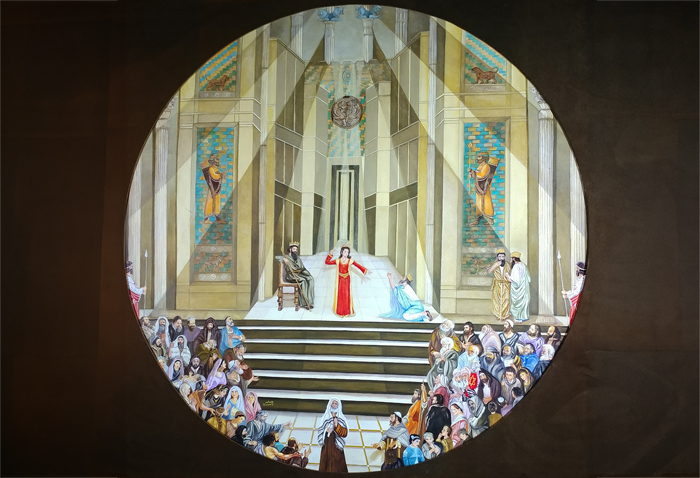
Cyrus even gave the Jews the choice to either stay or go back to Jerusalem. Although he had promised to rebuild the Temple, unfortunately, he died before realizing this dream. It was achieved later, between 521-516 BCE, when the Persian king Darius I rebuilt the Second Temple (paid by the Persian empire’s treasury) and sent back the articles taken from the Temple. Incidentally, Darius’ son, Xerxes, is Ahasuerus, whom Queen Esther marries in Megillat Esther.

This is why I love to describe the non-Jewish Cyrus and Darius, who have a special place in the hearts of Iranian Jewry, as two of the world’s earliest Zionists. 

Even the Book of Ezra references Cyrus the Great, and Cyrus’ magnanimity allowed Jews to return to Jerusalem in less than five decades (the prophet Jeremiah had declared the Exile would last 70 years). Of course, not all Jews returned. Many stayed within Persian territories, and that is why, considering the first Exile annexation, about 2,600 years later, they still consider themselves Iranian Jews today. 

I hope readers remember this incredible history the next time they meet an Iranian Jew, whether in Israel, Toronto, America or hopefully one day, back in Iran. 

Other ancient Persian leaders helped Jews in extraordinary ways. With the blessing of the Persian King Artaxerxes I or II (in the Book of Ezra, it is not clear which), Ezra and his followers were sent back to rebuild the city of Jerusalem.

Ezra was a Jewish scribe and priest who was born in Babylonia after the First Temple was destroyed. The level of Jewish assimilation and intermarriage that Ezra witnessed in Jerusalem caused him to tear his clothes and mourn. 

Back then, Judaism was a sacrificial religion, until Ezra made Judaism a scribal religion by replacing the “sacrifice” with “prayers” Yet the laws were still an oral tradition until Yehuda Hanasi, who first codified the oral interpretations of the earlier rabbis (the tannaim) in six sections called the Mishnah in 200 CE Hanasi was the last of the tannaim.

In Jerusalem, Ezra was later joined by Nehemiah, whom the Persian king Artaxerxes I/II appointed as governor of Jerusalem, and after many years, Jewish communities again flourished there during the Second Temple period. 

Persian Jewish history is rife with paradoxes: For every Haman or rapidly antisemitic ayatollah, there was a Cyrus or a Darius.

The Persians saved the Jews a second time by giving shelter to the amoraim (Talmudic commentators) in their academies, who compiled the Babylonian Talmud. The late Dr. Habib Levy, the legendary Iranian Jewish historian who was born in 1896 in Qajar-era Iran, and painstakingly wrote the first Iranian Jewish history book in Persian, often emphasized the role of Persian Jews in Judaism. This book was later abridged and translated into English as “The Comprehensive History of the Jews of Iran: The Outset of the Diaspora.”  

In his book, Levy claims that the Babylonian Talmud should have been called the “Iranian Talmud,” based on the fact that one-third of its vocabulary is in Middle Persian (called Pahlavi). It should be mentioned that the Jews at that time spoke Eastern Aramaic.

Sarshar emphasized the Persian connection with regard to Ezra and other ancient Jewish leaders so passionately I felt compelled to challenge him: Were Ezra, Nehemiah and other Jews who were born in Babylonia truly Persian or Babylonian? Weren’t they simply Jews who were in Babylonian exile for a few decades before returning to Israel? 

“That’s an ongoing argument, and people generally fall in one side or the other and there is little hope of converting any of them,” he said. “My position is that they were Persian/Iranian Jews. And there are reasons for this, one of which being the complicated problem that always comes up in antisemitic discourse whereby Jews are never considered citizens of their countries and thus presumed spies/agents of some conspiracy cabal to betray the lands in which they live (e.g. the Dreyfus affair in France). So as far as I’m concerned, they were all Iranian Jews.” 

Sarshar then made a fascinating observation: “Another argument is the current state of Iranian expats in the U.S.,” he said. “It’s been just over 40 years since we all left Iran, and well over 25 years since everyone considers themselves and their children Americans. So why would it be any different 2,500 years ago? Especially since 2,500 years ago (psychologically), 40 years was a much longer span of time than it is today.”

If I could meet Ezra today, I would ask him if he considered himself a Persian Jew. I would also hand him a bright green scallion and invite him to my Passover seder. 

If I could meet Ezra today, I would ask him if he considered himself a Persian Jew. I would also hand him a bright green scallion and invite him to my Passover seder. 

Dr. Lior Sternfeld, co-author of “Jews of Iran: A Photographic Chronicle,” told me there is no question as to “the centrality of Iranian Jewry in preserving and developing Judaism.” Iran, Sternfeld said, “was the most important political power of that time, and one that had closest relations with the Jewish community all over the region.”

If you’re bewildered to learn that Iran once had the best relationship of any country with Jews worldwide, don’t blame the Purim liquor; it’s the truth. 

Of course, as Jews, we must never forget that nations, whether ancient or modern, may offer us blessings, but ultimately, we remain on earth because of a millennia-old promise that G-d made to our forefathers. The ancient Jews viewed even the worst disasters, such as the fall of the First Temple, with remarkable clarity, because they saw the hand of G-d in history. They also saw those who controlled them, even the Babylonians, as necessary conduits to a greater purpose that G-d had in mind for them. 

This year, it will be extremely difficult to celebrate Purim with a heart filled only with joy, especially in Israel. But may we always possess the resilience and the clarity of our ancestors, who understood precisely why Judaism is so precious. 

In fact, their clarity reminds me of an 1899 short essay by Mark Twain, in which he wrote, “All things are mortal but the Jew; all other forces pass, but he remains.”

Purim Sameach.


Tabby Refael is an award-winning writer, speaker and weekly columnist for The Jewish Journal of Greater Los Angeles. Follow her on X and Instagram @TabbyRefael 

How Ancient Persians Essentially Saved Judaism As We Know It Today Read More »

Jamie Pachino: “So Help Me Todd,” Food on TV and Chocolate Chip Cake

There’s something about family dinner that transcends cultures, even when portrayed on a television show.

“Almost every episode is family dinner,” Jamie Pachino, a consulting producer on CBS’ “So Help Me Todd,” told the Journal.

The show, starring Marcia Gay Harden and Skyler Astin, is about Todd, a “failure to launch-ish” son (Astin) who goes to work as an investigator at his mother Margaret’s (Harden’s) law firm.

“They all come around to Margaret’s condo and … the hilarity ensues or there’s a sudden break in a case or whatever, but it’s always around dinner,” Pachino said.

There’s a reason food feels like a supporting character on the show.

“Food just comes in all the time,” Pachino said. “We talk about it in the writer’s room, it shows up in a lot of the scenes where people are eating or people are talking about eating.”

For instance, in the second episode of the season (202), which Pachnio wrote, she added a goofy, but relatable, food bit.

“Margaret and her love interest [are] sitting on the stairs of the courthouse splitting a sandwich,” Pachino said. “The showrunner was like, ‘Make it crazy.’”

The sandwich had beets, arugula, dates, alfalfa sprouts, shallots, etc.

“[Margaret] looks at him like he’s nuts and he goes, just taste it,” she said. “Props made that sandwich and the actors ate that sandwich, take after take.”

Whereas Pachnio could not vouch for the actual taste of the sandwich, she added, “They’re very good actors.”

An award winning playwright, screenwriter and TV writer, Pachino started her career as an actor and morphed into playwriting, which led to writing for film and TV.

“I fell madly in love with it because [TV writing] is about as close to theater as you can get when you’re working in this industry, because it’s really collaborative,” she said. “The writers have a lot of control in a way that they don’t necessarily have in features, and little by little, I’ve been working both in network and in cable and in streaming.”

Pachino has written more than a dozen plays, seen in four countries, as well as feature films for Disney, DreamWorks, Lionsgate, Vanguard Films and Walden Media. Her TV credits include “Sneaky Pete” (Amazon), “The Brave” (NBC), “Chicago PD” (NBC), “Halt and Catch Fire” (AMC).

She cites her late father, who happened to be a great lawyer and writer, as the major factor in her storytelling gene.

“He could tell a Jewish joke like nobody’s business,” she said.”He had that rhythm of how you tell a Jewish story; how you take your time, where the punchlines are and how you call things back and he gave amazing speeches.

Pachnio says she has put food in almost everything she’s ever written.

“There’s a long running joke … when I started out playwriting, there would either be bourbon or Chinese food in every play,” she said.“Chinese food is a hundred percent from my Jewish upbringing.”

Pachnio’s family kept kosher, and they had plates for meat, milk and takeout Chinese food. When she was in Junior high school, Pachino’s father started making homemade Chinese food once a month.

“It was the only time he ever cooked; he got books and he did research and it was so delicious,” she said. “When I was in college, and I moved into an apartment … the first thing that I started cooking was Chinese food.

“My love of cooking was born out of Chinese food in a Jewish home,” she said.

Pachino still loves to cook.

“It’s my relaxation,” she said. “I find it really creative.”

Pachino, who has put in her 10,000 hours of writing and cooking, finds similarities between the two processes.

After you’ve done something for so long, there’s a trust that everything will come out okay, so you may as well just start.

“My husband lovingly refers to me as the “MacGyver” of the kitchen,” Pachino said. ‘He’s like, ‘She can open the refrigerator and there’s like cauliflower and a ball of string and suddenly poof dinner.’”

Although Pachino does not bake much, one of her favorite recipes is her mother’s chocolate chip cake, which she made for almost every Jewish holiday when Pachino was growing up.

“It went first off at the dessert table,” she said. “It’s the best and the easiest cake in the world.” The recipe is below.

“My daughter, who went through a big baking phase, came up with this great twist on it,” she said. “We put it into little cupcake tins and then she made [a dark] chocolate ganache to ice it with; highly recommended.”

Watch “So Help Me Todd” Thursday on CBS and on Paramount + and learn more about Jamie Pachino at JamiePachino.com.

For the full conversation, listen to the podcast:

Gloria’s Chocolate Chip Cake

Westend61/Getty Images

1 box yellow cake mix

1 box vanilla instant pudding

4 eggs

1/2 cup water

1/2 cup vegetable oil

1/2 cup sour cream

4 oz German chocolate bar, grated

6 oz semi-sweet chocolate chips

powdered sugar for dusting

Preheat the oven to 350 degrees. Grease and flour a bundt pan.

In a stand mixer, mix yellow cake mix, vanilla instant pudding, eggs, water, oil and sour cream at medium speed for 2 minutes.

Hand fold in grated chocolate and chips until blended.

Bake for 50 minutes or until an inserted knife comes out clean.

Let cool. Dust with powdered sugar to serve.

Easy to freeze and enjoy later too!


Debra Eckerling is a writer for the Jewish Journal and the host of “Taste Buds with Deb.Subscribe on YouTube or your favorite podcast platform. Email Debra: tastebuds@jewishjournal.com.

Jamie Pachino: “So Help Me Todd,” Food on TV and Chocolate Chip Cake Read More »