fbpx

February 23, 2024

LAUSD School Board Frontrunner Apologizes for Liking Antisemitic Social Media Posts

Kahllid Al-Alim, who is considered to be the frontrunner for in a Los Angeles Unified School District (LAUSD) board race, issued an apology on Tuesday for calling a Nation of Islam (NOI) book “mandatory reading.”

Al-Alim is running for Board District 1 to replace board member George McKenna, who is retiring; the district includes Castle Heights, Crenshaw and Mid City. Al-Alim has racked up endorsements from United Teachers Los Angeles (UTLA), the Democratic Socialists of America-Los Angeles and the L.A. County Federation of Labor. Educators for Israel, under the X handle “@JewTLA,” posted a series of screenshots that they claimed showed “dozens of #antisemitic, anti-Israel posts” from Al-Alim’s personal X account, which appears to no longer exist. One such screenshot showed Al-Alim calling the NOI book “The Secret Relationship Between Blacks and Jews” “mandatory reading in community schools.” The book, according to the Anti-Defamation League, “blames Jews for promoting a myth of black racial inferiority and makes conspiratorial accusations about Jewish involvement in slave trade and the cotton, textiles, and banking industries.”

“I want to apologize for my posts about the [Louis] Farrakhan book,” Al-Alim said in a statement posted to his campaign website. “I was wrong. I have connected with educators and community members and have since learned about the issues. I fully rescind that post. It has no place in our schools.”

“I have connected with educators and community members and have since learned about the issues. I fully rescind that post. It has no place in our schools.” – Kahllid Al-Alim

Erica Huerta, Al-Alim’s campaign manager, told LAist regarding the NOI book post, “Before the campaign even officially started, that was one of the tweets that we recognized. We tried to delete it.”

Al-Alim also apologized in his statement “for my likes on social media of graphic content. It was inappropriate. I will never do that again.”  The Los Angeles Times reported that Al-Alim appeared to like “sexually oriented” posts, which included “a woman in a see-through halter top is holding a machine gun.”

The Educators for Israel’s X account also highlighted purported likes from Al-Alim on social media posts that included  a post from October 2022 that read, “Jeffrey Epstein was Jewish. The bank did not cancel him. And the Jewish community did not condemn him for his criminality” and an Dec. 2022 post that said, “Go talk to a white Jew. Most don’t consider Beta Israelites to be ‘real Jews’ just like they don’t consider blacks to be real Jews.”

More recently, Al-Alim liked a post from December 2023 stating that “it’s fascist-nating [sic] how Israel manages to rationalize anything it does in Gaza and any number of innocents killed as self-defense.”

“I have spent my life fighting against antisemitism, anti-Arab hate, Islamophobia, and all forms of oppression,” Al-Alim added in his campaign statement. “I have spent my life fighting for the equality of all people. There is a very long history of Jewish and Black people backing each other and working in solidarity for justice. I want to continue that important work.”

Huerta, who told LAist she is one of many Jews who are on Al-Alim’s campaign, told LAist, “His goal was never to run for office. Any missteps in the past, I think, should be taken, you know, with that understanding that Kahllid is truly a community member and a grassroots activist … We’ll definitely learn from his mistakes ongoing.”

UTLA said in a statement to the Times, “Kahllid Al-Alim’s reported social media activities are offensive and unacceptable. They are inconsistent with what we have seen of Kahllid as a decades-long organizer for education justice. Elected leaders should exemplify professionalism and set a positive example for those they represent. His reported social media conduct falls short of these fundamental ideals.” The teachers’ union added that they “have contacted Kahllid Al-Alim to make clear our position on both the content and nature of his posts. We have demanded a public response from him today. UTLA is considering our next steps.” UTLA’s statement was issued just before Al-Alim’s, according to the Times.

UTLA announced on Friday that their board of directors “voted to immediately suspend any campaign activities in Board District 1,” per the Times. However, the union did not officially revoke their endorsement of Al-Alim, as that requires “a formal multi-step process,” the Times reported.

Also on Friday, the Westside Current reported that Al-Alim allegedly shared a Facebook post in 2015 referring to the Sandy Hook families as “actors.” The Current cited a post on X from Siamak Kordestani, which included a screenshot of the alleged post from Al-Alim.

Community leaders have condemned Al-Alim’s social media activity. Assemblymember Rick Chavez Zbur (D-Hollywood), the California Assembly’s Democratic Caucus chair, posted on X, “Antisemitic hate has no place in our schools. We need leaders and educators who value and affirm every student, not those who use tropes to divide our communities. I strongly oppose Kahllid Al-Alim’s campaign for LAUSD Board of Education.”

Los Angeles City Councilmember Bob Blumenfeld posted on X, “Anti-Semitism and hate in all forms should not be tolerated or enabled in our schools. Children need to know they can walk and learn in peace at school regardless of their background or identity.”

California Senate candidate Christina Pascucci (D), a former KTLA journalist, also posted on X, “A leading candidate for LAUSD school board, Kahllid Al-Alim, who is endorsed by the teachers’ union and backed by the DSA, has spread hateful messages against Jews, wants to abolish police, and liked sexually explicit images online. If you live in West LA, or anywhere in district 1, please pay attention when you vote for school board. This is unacceptable behavior for anyone leading our children. As someone who’s passionate about bringing quality education back to California, I cannot stand for this.”

The Journal’s requests for comment to Al-Alim’s campaign through the campaign website were not immediately returned.

UPDATE: Al-Alim addressed the recent reports of his social media activity in a Sunday Instagram video.

“I posted and liked items that do not reflect what I believe,” Al-Alim said. “One of these posts also lifted up antisemitic content, including the book ‘The Secret Relationship Between Blacks and Jews.’ This book depicts Jewish people incorrectly and reinforces dangerous views of Jewish communities. I have worked with Jewish parents, teachers and community members for many years and I’m sorry for amplifying these ideas.” He added that he understands that “amplifying these dangerous ideas” has “harmed people and undermined the vital collective work we are doing to advance justice for all people.”

Al-Alim also said that he stands “firmly against the oppression of Jewish people” and that “many groups of people have harmed or oppressed other people and Jews should not be singled out and blamed for causing harm that is systemic.” “I know that Jewish people have been historically blamed and targeted. I also know that Jewish people are currently blamed and targeted,” he continued. “This behavior is serious, real and dangerous for Jews and for all mankind.”

Al-Alim added that “there’s a long history of both collaboration and conflict between Black and Jewish communities that we must learn from so we can respect each other and create a more just world together.”

LAUSD School Board Frontrunner Apologizes for Liking Antisemitic Social Media Posts Read More »

Holocaust Survivor on Rising Antisemitism: ‘I Never Thought I Would See What I’m Seeing Today’

A few years ago, the Claims Conference released results of a study it commissioned that revealed that among Gen Z and millennials in America, 63% did not know how many Jews were murdered in the Holocaust. How is this possible, especially when Holocaust education is mandated in more than 20 states?

Holocaust survivor Sami Steigmann, 84, said that’s not actually the case. A teacher at a school where for seven years he annually addressed assemblies of more than 700 students told him that Holocaust education is not actually required for all students.

“A lot of politicians like to use big words with no teeth,” Steigmann told the Journal. “I speak at many schools. At one, in Bayonne, New Jersey, a teacher there created a genocide and Holocaust curriculum that was approved by the state. I asked him how many students took the class and he told me it was 50. It was an elective. So ‘mandated’ does not mean the whole school is learning about it. They are unfortunately learning many false things from social media.”

Steigmann believes he has reached about 250,000 people and once answered questions about the Holocaust for 16 hours straight on the social media app Clubhouse.

“At times I am very tired, but if there is an opportunity to speak to people, I become energized and am able to do it,” he said. “This is my mission. This is what I live for, and it keeps me going.”

The New York City resident said recent events have been surprising, including Ivy League Presidents refusing to say calling for the genocide of Jews would be against school policy, the horrific brutality of the Oct. 7, and the death of Paul Kessler, a Jewish man in Los Angles who was holding an Israeli flag when he was assaulted during an altercation between pro-Israel and pro-Palestinian protestors.

“I never thought I would see what I’m seeing today,” Steigmann said. “It’s a crazy world.”

While the world was shaken by the terrorist attack against Israel on Oct. 7, Steigmann said he was only half-surprised. “I was not shocked that Hamas wanted to murder,” he said. “I was surprised by the capacity of their attack, the complete brutality of all that they did, and that they also recorded it.” He noted that Hamas would fire thousands of rockets at Israel, which would in turn, attack and destroy some tunnels. “I said for a long time we should not expect different results with the same tactics,” he said. “I knew one day there would be a war. Israel did not want to go in but the attack of Oct. 7 forced Israel to do so. The Iron Dome has intercepted the majority of the rockets, but no other country would accept such attacks.”

“I knew one day there would be a war. Israel did not want to go in but the attack of Oct. 7 forced Israel to do so. The Iron Dome has intercepted the majority of the rockets, but no other country would accept such attacks.” – Sami Steigmann

At a recent anti-Israel protest in Manhattan, Steigmann confronted members of the fringe group Neturei Karta, Hasidic Jews who say there should be no Jewish rule of Israel until the messiah comes. The group has been criticized for meeting and protesting with those who call for Israel’s destruction.

“There was one guy who [had a] sign of a star of David with a swastika in it,” Steigmann said. “I told him I was a Holocaust survivor. He didn’t care. I asked if there was no Israeli government, would it be safe for Jews to live there? He said ‘yes.’ I said, ‘why didn’t you open a yeshiva in Gaza?’” Steigmann said the person told him to go away.

Steigmann believes newscasters or celebrities who speak out of ignorance do a lot of damage. He cited  “The View” host Whoopi Goldberg, who infamously claimed the Holocaust was not about race. He also said it was wrong for New York Democratic Congresswoman Alexandria-Ocasio Cortez to call migrant detention facilities “concentration camps.”

When he saw college presidents publicly refuse to say calling for the genocide of Jews was against the code of conduct, it was evidence that this is not a new problem, but rather, one that has arisen due to many years of indoctrination. “Many will graduate as ‘educated idiots,’” he said  “because they have only been told one side — that Israel is wrong.”

Born December 21, 1939, in Czernowitz, Bukovina, which was part of Romania, he was sent to Mogilev-Podolsky, a labor camp in what is now Ukraine. His father at one point gave away his winter coat for a loaf of bread so the family would not starve. His parents told him that Nazis did medical experiments on him, the pain he still experiences a reminder of their cruelty.

For many years he would not speak about the Holocaust. But in 2003, he visited the U.S. Holocaust Museum attending an event for survivors and their families and he met someone who was held at the same labor camp. When he spoke to an elementary school, a student wrote him a letter about how his story was touching and she would relay it to her children.

Steigmann also said comparison to Nazis, or calling people like former President Donald Trump, “Hitler” are completely inappropriate. “There was only one Hitler,” Steigmann said. “It is not right to make comparisons for political gain or any reason. Also, there was only one group called the Nazis in history. People today who share their beliefs are called neo-Nazis. In terms of comparisons, Hamas should be compared to ISIS.”

Mainstream media, social media and podcasts are full of lies that claim including that Israel is committing a genocide and that it is purposely targeting civilians, he said. Many who falsely claim Israel is an apartheid state have no idea that that more than 1.5 million Arab residents live in Israel proper. “Israel will never win the PR war. But it is still important to educate as much as possible.”

As a general rule, Steigmann will speak to any group because he believes it is important for everyone to be educated about the Holocaust; he recently spoke to a group of Scientologists. “The only person I will not sit down and have a discussion with is a Holocaust denier, because such a person has a closed mind,” he said.

Asked what he would do if he was given a huge budget to make a movie, he said he would make a documentary about how it was possible for the Holocaust to occur. He recently saw the “The Zone of Interest” a drama about Auschwitz Commandant Rudolf Höss that has been nominated for five Academy Awards, including Best Picture. The film doesn’t show Jews but has several shouts and moments where gunfire can be heard. “I don’t see why it deserves an Oscar nomination,” Steigmann said. “It was boring. As a Holocaust survivor, I don’t think it has any educational value.”

Steigmann has one creative idea he thinks could help in terms of Holocaust education. There should be a book about the Holocaust read by families who gather together on Yom HaShoah, or Holocaust Remembrance Day. He compares it to the Haggadah read at Passover seders.

Despite the tragedy, death and suffering in the world, Steigmann said people must not lose hope.

“I have been an optimist, and I will die an optimist,” Steigmann said. “There is a lot of evil in the world but there is also a lot of good. There are people who lie but there are also people who speak the truth. Every day when I wake up, I try to see if there is a way I can reach people. I am planting the seeds. I know I will not see the growth of the trees in my lifetime. But all that I do is in the hope that people will learn from history and that people will grow up and learn to treat people the right way instead of being taught to hate. All of the important changes in the world were made by young people. For all the darkness we see now, I think there is still a brighter future ahead.”

Holocaust Survivor on Rising Antisemitism: ‘I Never Thought I Would See What I’m Seeing Today’ Read More »

An Ever-Present Void

Moses is not mentioned in Parshat Tetzaveh, the only such instance in the last four books of the Torah. This point, first mentioned by the Baal HaTurim, is a favorite of elementary school teachers looking for fun facts, and pulpit rabbis looking for sermon topics.

On its own, this observation is purely an exercise in poetry; in reality, multiple factors determined the division of Torah readings, and the fact that one short Parsha ended up without Moses’ name is not all that strange.

What does matter is not whether Moses is “missing” from the Parsha, but our perception of it. The fact that this question is constantly repeated says a great deal about the reader; Moses is not mentioned, and it’s noticed.

Even when Moses is gone, he leaves behind an ever-present void.

Many of those who comment on Moses’ absence relate it to his date of death, which according to the Talmud (Kiddushin 38a,) was on the seventh of Adar; and most years, Tetzaveh and the seventh of Adar are on the same week. (This year they are a week apart.)

The seventh of Adar is included on a list of fast days compiled by the Baal Halakhot Gedolot, an 8th-century work. While these fasts have long fallen out of practice (Rabbi Yoseph Karo writes they had already been discontinued by the 15th century,) the fast of the seventh of Adar continued to be practiced by burial societies (Chevra Kaddishas.)  They would assemble together for morning services, and recite special selichot prayers about the tasks of a Chevra Kaddisha. At night, they would join together for a special meal in honor of their service to the community.

The connection between Chevra Kaddishas and Moses is twofold. First, Moses was buried in an unmarked grave by God Himself. In each burial, the Chevra Kaddisha follows in God’s footsteps, and does a true act of kindness. (Because Moses’ grave is unknown, the Israeli rabbinate designated the seventh of Adar as the memorial day for soldiers whose burial places are unknown.)

The second reason is that Moses is a role model for Chevra Kaddishas; as the Jews left Egypt, Moses made certain to take with him Joseph’s bones for burial in Israel. Even 400 years later, Joseph’s bones were not seen as a funerary relic of the distant past; he was seen as family. And this is the very mission that every Chevra Kaddisha is tasked with: to ensure that those who are gone are never forgotten, and receive a proper burial.

It is a profoundly holy task. On our missions to Israel, we visited the Shurah Army Base, where the bodies of the 1200 people murdered on October 7th were processed for burial. The scenes that played out there in the first few days of the war were gut-wrenching. Rabbi Benzi Mann, who has been serving at Shurah since October 7th, spoke about how every refrigerated truck in the country, including dairy transports covered with advertisements for chocolate milk and yogurt, were conscripted to transport bodies; to this day he feels uneasy seeing dairy trucks on the highway. When Benzi would open the trucks’ doors, there were so many bodies piled up that blood would come pouring out.

But despite the traumatic circumstances, these incredible reservists worked day and night to ensure the dead got a proper burial, and their families had a chance to wish their loved ones farewell. The dedicated Chevra Kaddisha at Shurah did everything possible to treat the dead, and their families, with love.

Rabbi Mann related a conversation between Rabbi Ephraim Mirvis, the Chief Rabbi of England, and President Isaac Herzog of Israel; Rabbi Mirvis told President Herzog he had visited Shurah. President Herzog replied that it was an awful place, “the gates of hell”; the very imprint of Hamas’ depraved crimes was on the body of every person murdered.

Rabbi Mirvis responded that on the contrary, Shurah was the “gates of heaven,” and a place of awe; it was a place where holy volunteers had heroically restored dignity to the deceased and their families.

The task of the Chevra Kaddisha is to ensure the body is treated with respect. In preparation for burial, they do what is called taharah they can to clean the body and purify it, and recite prayers for the soul of the deceased. (In the case of those murdered on October 7th, many of the usual procedures were suspended; murder victims are meant to be buried in their clothes. However, the prayers and the arrangement of the bodies in the coffin remain the same.) Other societies may cremate remains, or toss them away; Tibetans practice a “sky-burial,” in which bodies are placed on the mountaintop to be eaten by vultures. Judaism takes a different view, and sees treating the body with respect as the highest priority.

The Chatam Sofer explains (Teshuvot  2:328) that the taharah procedures are to show respect for man, who is created in the “image of God.” Even the dead body continues to carry a reflection of the divine image. The Chatam Sofer reminds us that by offering proper respect for the dead body, one offers respect for the living.

Jewish funerary and mourning rituals are not about closure and putting the death behind us. On the contrary, they are about preserving our connection to those who have passed away. We want to build a bridge from this world to the next, and to continue to keep our loved ones in our hearts.

This is what Avishai Margalit has called “the ethics of memory”. While the philosophical basis of this idea is complex, it is very much a part of the Jewish tradition. The ritual of Shiva and the prayers of Yizkor and Kaddish all articulate the same idea: we must continue to remember those whom we love. We remember because to love someone is to love someone forever; we remember because we could never forgive ourselves for forgetting.

On the last day of our most recent mission, we visited Har Herzl, Israel’s military cemetery. Two sections have been designated for this war’s fallen soldiers. We went on a rainy day and it seemed like the stones were crying. All around us were the graves of people in their twenties and thirties, who once had a bright future ahead of them. A young widow, married for just two months, was sitting next to her husband’s grave; he was 23 years old. Our guide Michal spoke about the soldiers she knew in the section, who were friends from her neighborhood and school. Michal is far too young to know such tragedy; but now she does. Like every Israeli, she has gone to shiva after shiva, comforting and bereaved all at once.

On Har Herzl this overwhelming sense of loss, this endless void is most profound. There is no grief like the grief of losing a young child at the height of their potential.

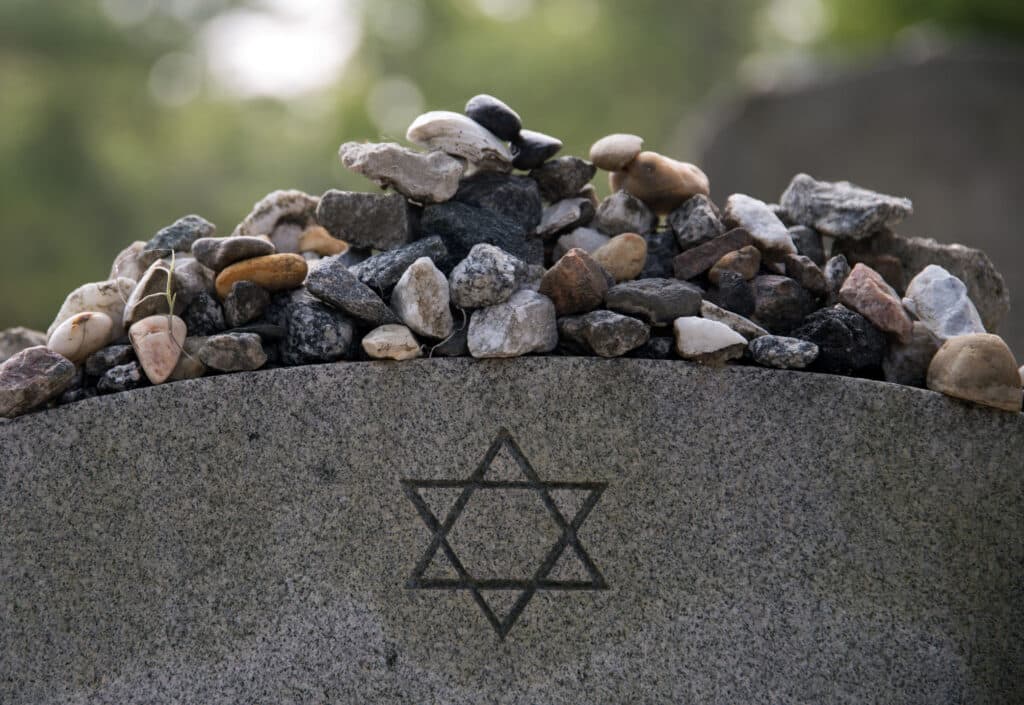
But at the same time, there is a recognition that within this absence those who have died will be ever-present. Virtually every grave was decorated by the families in tribute to their loved ones. Bottles of scotch, Israeli flags, soccer flags, photographs, letters, and miniature Torah scrolls. They are declarations that the fallen will never be forgotten. At every simcha, every Seder, every family get-together, they will be remembered. There may be a gaping void in the mourners’ hearts, but within that void, the memories of their loved ones are ever-present.

The Bible says “Put me like a seal over your heart, like a seal on your arm. For love is as strong as death.” (Song of Songs 8:6). These bereaved families have declared that their love is forever, tied to the heart with an eternal bond. Nothing, not even death, can take their love away.

They will always remember them. And so will we.

May their memory be for a blessing.


Rabbi Chaim Steinmetz is the Senior Rabbi of Congregation Kehilath Jeshurun in New York.

An Ever-Present Void Read More »