fbpx

November 17, 2023

Ventura County DA Announces Manslaughter, Battery Charges Against Alleged Paul Kessler Killer

Ventura County District Attorney (DA) Erik Nasarenko announced that his office is charging the suspected killer of Jewish protester Paul Kessler with involuntary manslaughter and battery causing seriously bodily injury. However, they currently do not have requisite evidence to charge the suspect with a hate crime. The suspect has pleaded not guilty.

Sheriff Jim Fryhoff began the press conference by announcing that they arrested Loay Alnaji, 50, without incident at his Moorpark residence in connection to Kessler’s death on one count of involuntary manslaughter. Fryhoff said that the Sheriff’s department had interviewed more than 60 witnesses and reviewed 600 pieces of evidence, including “numerous hours of video” on electronic devices. The investigation is not yet complete, so Fryhoff encouraged anyone with information to come forward.

Nasarenko then said that the DA’s office approached the investigation “with an open mind” and that “never treated the fact that criminal charges would be a foregone conclusion.” But after reviewing the evidence, they decided to file the two charges against Alnaji, which include special allegations that Alnaji “personally inflicted great bodily injury upon Paul Kessler.” These offenses count as strikes under California’s three strikes law, “which makes punishment prison eligible,” Nasarenko said.

The DA explained that involuntary manslaughter means that a person was killed “without malice.” “We received no evidence no statements no information whatsoever that the defendant arrived at that intersection … with the intent to kill, injure or harm anyone,” Nasarenko said. However, Alnaji engaged in “reckless conduct that carried with it a high risk of death or great bodily injury,” Nasarenko alleged. The battery charge means “willful touching of another in a harmful or offensive way that results in significant or serious bodily injury.”

Nasarenko said the  “task was to search for the truth and to achieve clarity in this case and that is what we have done,” adding that this was not easy due to the “disparate, often conflicting interpretations and statements and the fragmentary nature of the evidence.” But ultimately they were able to file charges after “additional important pieces of information came forward” regarding “new physical and forensic evidence as well as findings regarding the injuries to the left side of Paul Kessler’s face,” Nasarenko  explained. Additionally, the DA’s office was able to establish “a clear sequence of events leading up to the confrontation” between Alnaji and Kessler due to video and photo evidence. The medical examiner’s office had concluded that Kessler suffered nonlethal injuries to his face and lethal injuries to the back of his head that were consistent with a fall.

Murder charges were not filed against Alnaji because the DA’s office concluded that Alnaji had “no intent” to murder anyone, according to Nasarenko. Regarding hate crime charges, the DA said that they currently do not have enough evidence available “meet the elements of a hate crime” but they are continuing to investigate the matter.

Nasarenko acknowledged that the under the criminal justice system, just because someone has been charged with a crime does not mean that they have actually committed said crime and that every individual has the right of presumption of innocence and due process under the law.

Alnaji pleaded not guilty at his arraignment Friday afternoon. His lawyer, Ron Bamieh, succeeded in lowering Alnaji’s bail from $1 million to $50,000 but failed to get his client released on recognizance.

Speaking outside the courthouse to reporters after the arraignment, Bamieh argued that video footage would clear Alnaji. “While [Kessler] may have been pushed or hit by a megaphone, that’s not what caused his fall,” Bamieh claimed, per The New York Post. “When he fell, my client was six-to-eight feet away from him, and that will be the evidence that we present when we finally get this thing in front of a judge and jury.” The lawyer posited that Kessler may have “tripped on that sign or something,” per The Los Angeles Times.

Bamieh also alleged that Kessler was shouting obscenities at pro-Palestinian protesters and “he put his phone in the face of my client and my client brushed the phone away,” the Thousand Oaks Acorn reported.

Bamieh described his client as a “a man of peace, who abhors violence, and believes in the truth of persuasive arguments and education, never violence” in a statement, per the Associated Press (AP).

At his press conference, Nasarenko said that he and Fryhoff spoke with the Kessler family for about half an hour on Thursday. “They are mourning, they are grieving, and they are asking for privacy during this very difficult period,” Nasarenko said. “We have heard about Paul Kessler and his positions about Israel, his political activism but I want to share with you just a few other details about Paul Kessler because in this process we should never forget that a human life was taken and a victim exists.” An experienced pilot, Kessler worked in medical sales and flew himself to his medical sales and marketing classes at satellite college campuses. He was married for 43 years and leaves behind a son. “We want to continue to remember and honor Paul Kessler and the tragic loss of life that has occurred,” Nasarenko  said.

He proceeded to thank Muslim and Jewish leaders in Ventura County for showing “restraint” during the investigation. “Their comments have been measured, the respect for the criminal process has become well known, they trusted law enforcement to arrive at this point,” Nasarenko  said.

During the Q&A portion of the press conference, Nasarenko  was asked about the status of the megaphone that was allegedly used to hit Kessler in the head; Nasarenko  replied that he could not comment on the status of the location of evidence.

As for the possibility of a hate crime charge, Nasarenko  said that the DA’s office is looking to see “whether or not the acts — the impact, the force — was accompanied by specific hate speech, specific statements or words that demonstrate an antipathy a hatred towards a specific group. We don’t have that at this point.”

Alnaji’s preliminary hearing is scheduled for December 4.

Ventura County DA Announces Manslaughter, Battery Charges Against Alleged Paul Kessler Killer Read More »

The Magic of the Twice-Dug Well

Where was Gerar located? Determining the location of biblical cities requires careful evaluation of archeological, historical, and literary evidence. It is both an art and a science, and because of that, opens the door for multiple opinions.

Several archaeological sites, or “Tels,” have been identified as Gerar. Eliezer Oren of Ben Gurion University has argued that Tel Haror, located between Ofakim and Netivot, is Gerar. It is a large city, and the location also seems to correspond to an ambiguous description given by the Church Father Eusebius in the 4th century.

Many other archeologists and Bible scholars take a different view. In the 1920s W. J. Phythian-Adams and Flinders Petrie identified the excavations at Tel Jemmeh with Gerar. They did so because a Byzantine village, Umm Gerar, (essentially the same name,) was nearby.

Yehuda and Yoel Elitzur, (father and son Bible scholars,) note that the biblical record corresponds with this identification. Gerar is described in the Tanakh as being close to Gaza, which is true of Tel Jemmeh but not of Tel Haror. Tel Jemmeh also is a place of abundant well water, which is characteristic of cities closer to the coast. A place like this is somewhere that one would naturally go to during a famine. Tel Jemmeh best fits the biblical description of Gerar.

Gerar’s location was just a matter of academic interest until a month and a half ago; but it is now part of the geography of tragedy. The area of Tel Jemmeh is about a mile from Re’im, where the Nova Festival took place and over 350 were murdered. It is also very close to many of the Kibbutzim that were destroyed during the horrific, depraved Hamas massacre. Gerar is near to all of these sites of tragedy; and after October 7th, this text speaks to us with a different voice.

Genesis 26 begins with Rebecca and Isaac leaving home in a famine in search of food. They arrive in Gerar, on their way down to Egypt; but God tells them to stay there and not leave the Land of Israel.

In Gerar, they become extremely successful, to the point that the local people are jealous. The Philistines stop up all of the wells in Gerar that Abraham had dug; Abimelech the local king tells Isaac: “Go away from us, for you have become far too big for us.”

And so Isaac moves into the Valley of Gerar, and there “Isaac dug again the wells of water which they had dug in the days of Abraham his father, (for the Philistines had stopped them up after the death of Abraham.) He called them by the names which his father had called them.” Isaac digs two more wells, but the Philistines claim them as well; finally, after digging a third well, the Philistines leave him alone. Isaac continues on to Beersheba; finally, after all this, Abimelech comes to offer Isaac a treaty.

Every commentary approaches this text with one question in mind: What relevance do these wells have? The purpose of the biblical record is to inspire and enlighten future generations. Who once owned which well under which name thousands of years ago seems to be an unimportant detail, a narrative without any abiding purpose.

Because of this question, the Ramban offers a mystical interpretation that sees this text as a prophecy for the future. A similar allegorical approach is taken up by many later commentators, who offer interpretations that see the wells as symbolizing the search for spirituality and inner faith.

Other commentaries see this narrative as a reflection of contemporary struggles. Saadia Gaon, who was a fierce opponent of the Karaites who had rejected the rabbinic tradition, saw in Isaac’s decision to give the wells the same names as his father a comment on the importance of preserving the traditions and customs of previous generations.

Rabbi Samson Raphael Hirsch, who lived at a time when Jews were fighting for acceptance and equal rights, saw in the Philistines’ jealousy of Isaac’s success a reflection of his own time; that just like Isaac, even after reentering society, Jews would remain the subject of harassment and envy. He explains that even after receiving equal rights, the struggle was not complete. Jews would need to aspire to an honored place in society, and work to become a true light unto the nations, cherished for their teachings and values.

At its core, this narrative is about Isaac’s response to discrimination; however, the meaning of the text is unclear. Don Isaac Abrabanel and the Ramban have contrary views regarding what Isaac actually did. The Ramban says that Isaac left Gerar and traveled far away, where he was no longer subject to Abimelech and the people of Gerar. The wells Isaac restores are not the ones in Gerar; rather they are a second set of wells, found elsewhere, and not a matter of dispute. This reading has Isaac acting submissively, avoiding conflict with the people of Gerar. (Abrabanel notes that this is why the Ramban sees no real purpose to this text. By the Ramban’s reading, Isaac does nothing.) But the Ramban’s reading is a forced, contorted explanation, because it assumes that the text is talking about two different sets of wells that were closed up by the Philistines; and that is divorced from the simple reading of the text.

Don Isaac Abrabanel, as mentioned, offers a very different perspective. While Isaac does move from Gerar, he does so for a logistical reason; the land cannot accommodate his livestock and the livestock of others. But Isaac remained very close by, despite the Philistines’ demands that he leave. Abrabanel then explains that “Isaac lived there against their desires, and not only that, he dug again the wells that they had closed. And to further assert his rights, he gave the wells the exact same names his father had.”

Abrabanel reads this text as a story of defiance. This is even more remarkable because until this point, Isaac’s life had been guided by others: he was nearly sacrificed by his father, had his wife chosen by his father’s servant, and he settled in Gerar because God told him to. But when the chips are down, Isaac rises to the occasion and defies Abimelech. Even Isaac will stand up for his father’s legacy.

Abrabanel’s explanation of the wells is exactly what we need to read right now. Defiance isn’t only found in confrontation; it is found in resilience too. Yes, many times during Jewish history we have had to retreat; many times Jews looked like the Ramban’s description of Isaac, a man who avoids conflict with a more powerful adversary. But the overarching theme of Jewish history is that Jews will find a way to make a comeback, even after failures, retreats, and catastrophes.  No matter how disappointing a defeat may be, the Jews will not give up, and will return to dig the wells again and again.

A people that knows how to rebuild what is destroyed is here to stay. And that is the magic of the twice-dug well.

This magic can be found all over Israel. Sivan Rahav Meir shared a fascinating Whatsapp message written by Nogah Ashkenazi, a German convert to Judaism. Nogah wrote that when the war started, she planned on immediately returning to her family in Germany; they were urging her to come back as well. But then Nogah changed her mind. She was part of a local Whatsapp group; and there she read her neighbors’ messages to each other. And that changed her mind.

She wrote a message to her Whatsapp group to explain:

“…My first thought was to leave everything and fly to Germany to my parents with the children. My family was already preparing for our arrival.


But when I opened this group on Monday and saw all the messages here, and saw all the strong women, and how you put all your efforts to help on all fronts with whatever is needed, I was so impressed. I was amazed to see the strength of our nation. And it just kept getting even more and more impressive. This is what changed my mind.


I am not going to run away, not going to leave, because I too am very much a part of all of this. I am Jewish, and this is what I chose; and this is the vow I made in front of the Rabbis during conversion, and more importantly, the vow I made in front of God. Germany is no longer my home; I am not German, I am Jewish, and this is my place.


And I’m not leaving. On the contrary, I have become even more Jewish in my identity.


So I want to thank each of you for supporting me. My family in Germany doesn’t understand my choice, and I can’t blame them. You don’t know what it is to be part of the Jewish people if you haven’t lived it with every cell in your body….”

This is a powerful message, a declaration of the Jewish spirit. Even though Nogah is new to the Jewish people, she speaks with Isaac’s voice. It is a voice of defiance, which refuses to accept destruction and persecution.

Today, as we fight another conflict near Gerar, Isaac’s example will guide us. We will find strength in each other, comfort in our dreams, and hope in our history.

And no matter what, we will restore, we will rebuild, we will return.


Rabbi Chaim Steinmetz is the Senior Rabbi of Congregation Kehilath Jeshurun in New York.

The Magic of the Twice-Dug Well Read More »

Hitler Youth in Gaza

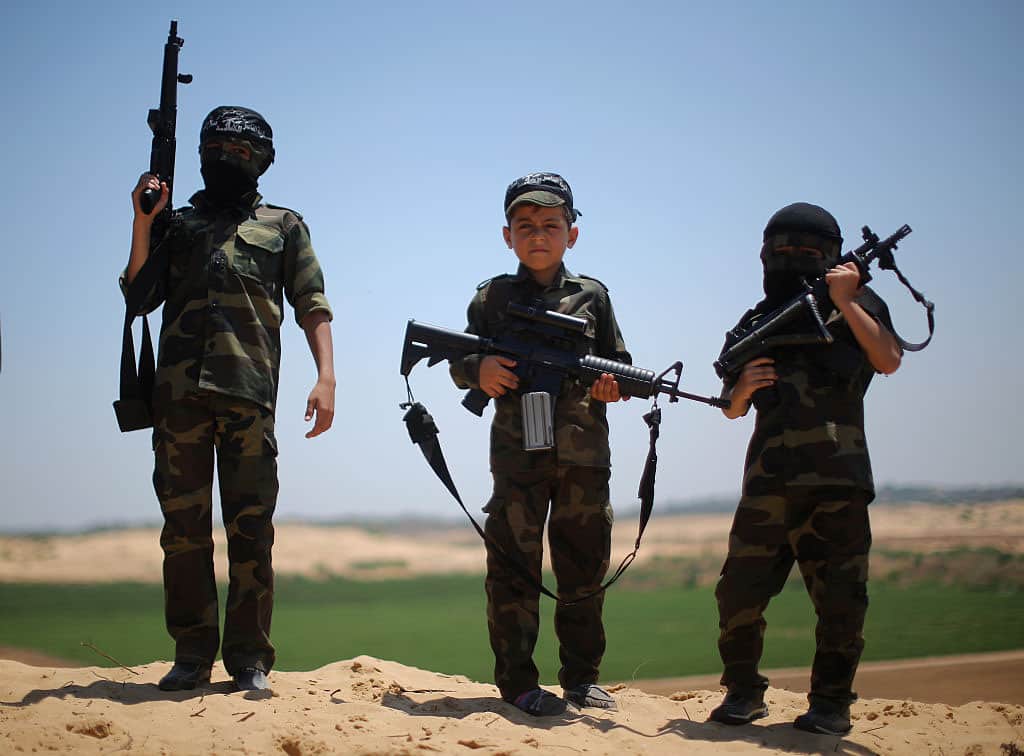
Palestinian Arab children as young as ten years old took an active part in the Hamas pogrom on October 7, according to shocking new testimony from eyewitnesses.

A survivor named Raziel Tamil, who was hiding in a citrus grove adjacent to the Israeli music festival that Hamas attacked, saw terrorists hand rifles to a group of children in Hamas garb—whom he estimated to be between six and ten years old—“and directed them to execute hostages, which they did,” the Washington Free Beacon reported.

Amotz Bazer and his family were barricaded in their safe room in Kibbutz Nir Oz when terrorists approached their home. Bazer “heard the gunmen push two young boys through the window. The boys then opened the front door for the armed terrorists.” He said that based on the sound of the boys’ voices, he believed they were probably about ten years old, since Bazer has children the same age.

Footage from security cameras has provided further confirmation of children’s involvement on October 7. The Beacon noted that “an online video of a 12-year-old Israeli boy’s abduction from Nir Oz [showed] a Gazan boy of about the same age accompanying the kidnappers.” Also, “boys were among the mob of Gazans recorded crossing into Israel after Hamas terrorists breached the border,” and a Hamas-linked Associated Press stringer “photographed a Gazan boy entering [Kibbutz] Kfar Aza.”

The Beacon added: “In addition to the children, hundreds of ordinary Gazans, including teenagers, joined in Hamas’s bloody rampage across southern Israeli communities.”

Such scenes are not unfamiliar to those who have studied previous Arab wars against Israel. A front page report in the Palestine [Jerusalem] Post on December 3, 1947 began: “A mob of 200 Arab hooligans between 10 and 20 years of age…smashed windows, looted shops and stabbed a number of people” in downtown Jerusalem.

Those teenage and pre-teen Palestinian Arabs were angry at the recent United Nations resolution recommending creation of a sovereign Palestinian state alongside a small Jewish state. They expressed their fury by smashing, looting, and stabbing Jews.

And burning them, too. The Post reported that the young terrorists “forced their way into textile and trade shops” where “the proprietors and workers had barricaded themselves” to escape the mob. The attackers “set goods on fire.” Not unlike those who burned Jews alive in southern Israel last month.

Some Israeli media outlets have been reporting for years that summer camps operated by Hamas in Gaza, and by the Palestinian Authority in the areas it occupies, train children to use weapons and glorify terrorists. Unfortunately, most mainstream American and European publications and media agencies have ignored such reports.

Dictators in previous generations likewise prioritized training children to hate and kill. Adolf Hitler, for example, viewed Germany’s schools as a breeding ground for raising an entire generation of Nazis.

Following Hitler’s rise to power in 1933, German school curricula and text books were revised to reflect Nazi ideas. The new biology texts advocated the theory of “Aryan” racial superiority. Atlases focused on the alleged danger to Germany posed by surrounding nations and claimed that various territories had been stolen from Germany. History books presented justifications for German militarism. The Nazis even created their own version of the Cinderella story, with the prince favoring a racially pure young heroine who rejects her racially alien stepmother.

Nazi-educated German children filled the ranks of the Hitler Youth movement. Teenage and pre-teen members took part in numerous atrocities, from forcing Jews to scrub the streets of Vienna with toothbrushes in 1938, to the mass shooting of Jews swimming from sinking boats in the German harbor of Lubeck in 1945.

In addition, many of those who graduated from Hitler Youth joined the Gestapo and participated in the mass murder of European Jewry. Most branches of the Nazi apparatus collapsed or surrendered in the waning days of World War II—but not Hitler Youth, whose members remained fanatically loyal to their Fuhrer to the very end of the war. That’s why they are often mentioned in accounts of atrocities that were perpetrated in the spring of 1945.

Menachem Weinryb, an Auschwitz survivor who was forced to take part in a death march from Poland to Germany, recalled how when the prisoners reached the Belsen area on April 13, 1945, the German guards went to a nearby town “and returned with a lot of young people from the Hitler Youth [and local policemen]…They chased us all into a large barn…we were five to six thousand people…[They] poured out petrol and set the barn on fire. Several thousand people were burned alive.”

Raising children to kill, whether in Nazi Germany in the 1930s or in Gaza today, always has deadly consequences.


Dr. Medoff is founding director of The David S. Wyman Institute for Holocaust Studies and author of more than 20 books about Jewish history and the Holocaust. His latest is America and the Holocaust: A Documentary History, published by the Jewish Publication Society & University of Nebraska Press.

Hitler Youth in Gaza Read More »