fbpx

October 29, 2023

Senior Advisor to LA City Councilmember Resigns After Making Holocaust Jokes on Twitter

Josh Androsky, a Senior Advisor to Los Angeles City Councilmember Hugo Soto-Martinez, resigned after getting caught making a series of Holocaust jokes on Friday on X, formerly-known as Twitter.

Soto-Martínez released a statement on his official account saying “the social media posts made by my staffer earlier today were disturbing and reprehensible. With antisemitism on the rise in recent years and especially in recent weeks, cracking jokes about the holocaust isn’t just disgusting, it’s dangerous. These antisemitic and misogynistic posts sickened me and I have accepted his resignation effective immediately.”

Androsky, in a dialogue with the X account of socialist-focused podcast True Anon Pod, made comments ridiculing Jewish comedian Amy Schumer with puns about Nazi concentration camps Auschwitz, Dachau, and Buchenwald. In the transgressions, they also ridiculed Schumer’s outspoken advocacy for body-image issue awareness.

Androsky’s last remark included a reference to the antisemitic Nazi propaganda newspaper Der Stürmer (“The Stormer”), which ran from the 1920s through the end of the Holocaust.

Although Androsky’s X account (@shutupandrosky) has the Tweets set to private, the Journal reviewed and confirmed Androsky’s comments from screenshots taken by multiple sources on Friday.

A transcript of the dialogue between True Anon and Androsky:

True Anon:  “Amy Schumer is particularly sensitive to Jewish deaths due to her experience in the holocaust. The nazis named a concentration camp after her. It was called Da Cow.”

Josh Androsky: “this is cute or whatever but it’s fucked up that you would say this about her when you know it was actually Cowschwitz.”

True Anon: “I also used to call that spot on the 5 Da Cow !!!!”

Josh Androsky: “i called it Cowschwitz!!! either way they all (and amy) smelled the same.

True Anon: “I also called it Moochenwald.”

Josh Androsky: “oh where’d you read that one, der steermer????”

Androsky is listed on Soto-Martinez’s official Government website as Senior Advisor. Soto-Martinez has represented Los Angeles’ 13th District since 2022, which includes Atwater Village, parts of East Hollywood, Echo Park, Elysian Valley, and Silverlake.

Soto-Martinez is a member of the Democratic Socialists of America, and the Los Angeles chapter endorsed his candidacy in 2022.

DSA has a history of endorsing the Boycott, Divestment, Sanctions movement against Israel. In the hours following the brutal October 7th terrorist attacks by Hamas on Israeli civilians, DSA’s Los Angeles chapter retweeted the national DSA account’s statement: “DSA is steadfast in expressing our solidarity with Palestine. Today’s events are a direct result of Israel’s apartheid regime—a regime that receives billions in funding from the United States. End the violence. End the Occupation. Free Palestine.”

The LA Times reported on October 12 that “the attack on Israel and how to respond to it is roiling L.A.’s election campaigns.”

Councilmember Nithya Raman, a DSA-LA member, said that the DSA “failed to reckon with the horrors committed by Hamas and was unacceptably devoid of empathy for communities in Israel and at home who are living in fear and mourning.” As of this writing, Raman is still endorsed by DSA-LA for re-election in 2024. During her first election in 2020, Androsky worked on her campaign.

Senior Advisor to LA City Councilmember Resigns After Making Holocaust Jokes on Twitter Read More »

Israel Must Avoid Hamlet’s Tragic Fate

Can a just and moral people defeat a ruthless enemy without moral compromise? Shakespeare’s “Hamlet” offers a valuable perspective on Israel’s agonizing moral conundrum. As Israel stands poised to eradicate Hamas from Gaza, the nation wrestles with the ethical issues “Hamlet” explores. A philosopher and a humanist, Hamlet cannot bring himself to act swiftly and decisively to punish Claudius, his father’s vicious murderer. Consequently, critics have accused the tormented prince of weakness, overthinking and indecision—qualities that ultimately lead to his tragic death, as well as the deaths of his mother, his beloved Ophelia, her brother Laertes, and a stage littered with corpses by the end of the play. Well-meaning humanitarians who are now asking Israel to “show restraint” have much to learn from Shakespeare’s greatest tragedy.

I thought of “Hamlet” as I watched on CNN the brother of a young pacifist killed by Hamas terrorists tearfully plead for an end to Israel’s plans to invade Gaza. With beloved members of his own family and community destroyed, this grieving young man agonizes over the fate of Palestinian families. Those who love life and value human beings do not share the terrorists’ “eye for an eye and tooth for a tooth” mentality. Israel is doing everything in its power to minimize the suffering it is now forced to inflict on Gaza’s civilian population. But how can it destroy the Hamas terrorists intent on destroying Israel without creating more innocent victims?

The possibility of having to punish an innocent individual unjustly drives Hamlet to despair. When his father’s ghost appears to him and demands revenge for his murder by treacherous Uncle Claudius, Hamlet feels stuck in a moral quagmire. The young prince’s keen sense of justice and morality is such that he cannot pronounce a man guilty of a crime without carefully examining the evidence. Forced to be both judge and executioner of the accused, Hamlet proceeds slowly, not out of cowardice, but out of a deep respect for the suspect’s humanity, which makes it impossible for the young prince to take life lightly. “What a piece of work is man, “Hamlet exclaims in a one of his famous soliloquies. “How noble in reason, how infinite in faculties, in form and moving how express and admirable, in action how like an angel, in apprehension how like a god: the beauty of the world, the paragon of animals!”

Hamlet values human life too much to kill a man without compunction. “A killer is a guy without imagination: He doesn’t give a damn for death because he has no idea of what life is,” says Hoerderer, a modern Hamlet, in Jean Paul Sartre’s “Dirty Hands,” a post-World War II reinterpretation of Shakespeare’s tragedy. Hoerderer is a young intellectual who, like Hamlet, is asked to execute a traitor but cannot bring himself to take another man’s life.

Hamlet’s moral compunctions prevent him from assassinating King Claudius before Claudius conceives an intricate plot to assassinate him. Finally convinced of his uncle’s guilt, Hamlet stumbles on the king from behind, as he kneels in prayer. The prince draws out his sword, about to strike the villain. But then, he stops, unable to kill a man in prayer. Claudius, by contrast, has no such compunctions. He convinces Hamlet’s former friend, Laertes, to “cut” Hamlet’s “throat I’th’ Church” because “revenge should have no bounds.” For ruthless power-hungry tyrants like King Claudius, ethical choices are easy: The ends justify the means. Objectives are clear: absolute power, annihilation of the opposition, domination of the weak by the strong, survival of the fittest.

On the other hand, Shakespeare demonstrates that for a moral individual forced to commit an act of cruelty, objectives are muddled and choices unclear. In their article, “Endgame in Gaza Is Far from Clear” (WSJ 16/23), Margherita Stancati and Dio Nissenbaum write that as it prepares to invade Gaza to “destroy the ability of Hamas to rule there,” Israel has “no good options.”  Neither does Hamlet. Tormented by paralyzing doubts and hesitations, Hamlet compares himself with Fortinbras, the young Prince of Norway. This “man of iron” has no qualms about sending “two thousand souls” to their deaths over a small, worthless piece of land that he is disputing with the king of Poland. Hamlet laments these rulers’ disregard for the sanctity of human life: “What is a man /If his chief good and market of his time/Be but to sleep and feed? A beast, no more/ Sure he that made us with such large discourse/Looking before and after, gave us not/ That capability and godlike reason/To fust in us unused.” Hamlet cannot understand how any leader can bring himself to “expose what is mortal and unsure/To all that fortune, death and danger dare/even for an eggshell.” Unlike such rulers, Hamlet recognizes the divine essence of human beings and would never send his soldiers to die out of lust for power and glory. However, Shakespeare shows us that this noble, high-minded prince is not cut out to lead armies. He is a poet, not a warrior. He cannot make the kind of fast and hard decisions a leader must make in order to survive in a treacherous world.

On the other hand, Shakespeare demonstrates that for a moral individual forced to commit an act of cruelty, objectives are muddled and choices unclear.

Though Hamlet is morally superior to Fortinbras, it is the prince of Norway who takes over the country after Hamlet falls victim to Claudius’ villainy. And it is the “man of iron” who ultimately has the last word in Shakespeare’s tragedy. The Bard tells us the truth. It is impossible for a leader to survive in a world of villains without moral compromise. Hamlet’s beautiful, poetic spirit makes us cry at his death, just as we cry for the all the beautiful, innocent, idealistic spirits that Hamas terrorists snuffed out or took hostage on October 7. But tears alone will not keep Israel safe. Tragically, in order to defeat its ruthless enemies, Israel, a humane nation, must steel its heart with some of Fortinbras’ iron.


Irina Bragin is a Los Angeles writer and head of the English Department at Touro College, Los Angeles. She is the author of “Subterranean Towers: A Father-Daughter Story.” You can follow her on X at@bragin_Irina


Israel Must Avoid Hamlet’s Tragic Fate Read More »

Shakespeare, Gaza, and How the World is Not Safe for Jews

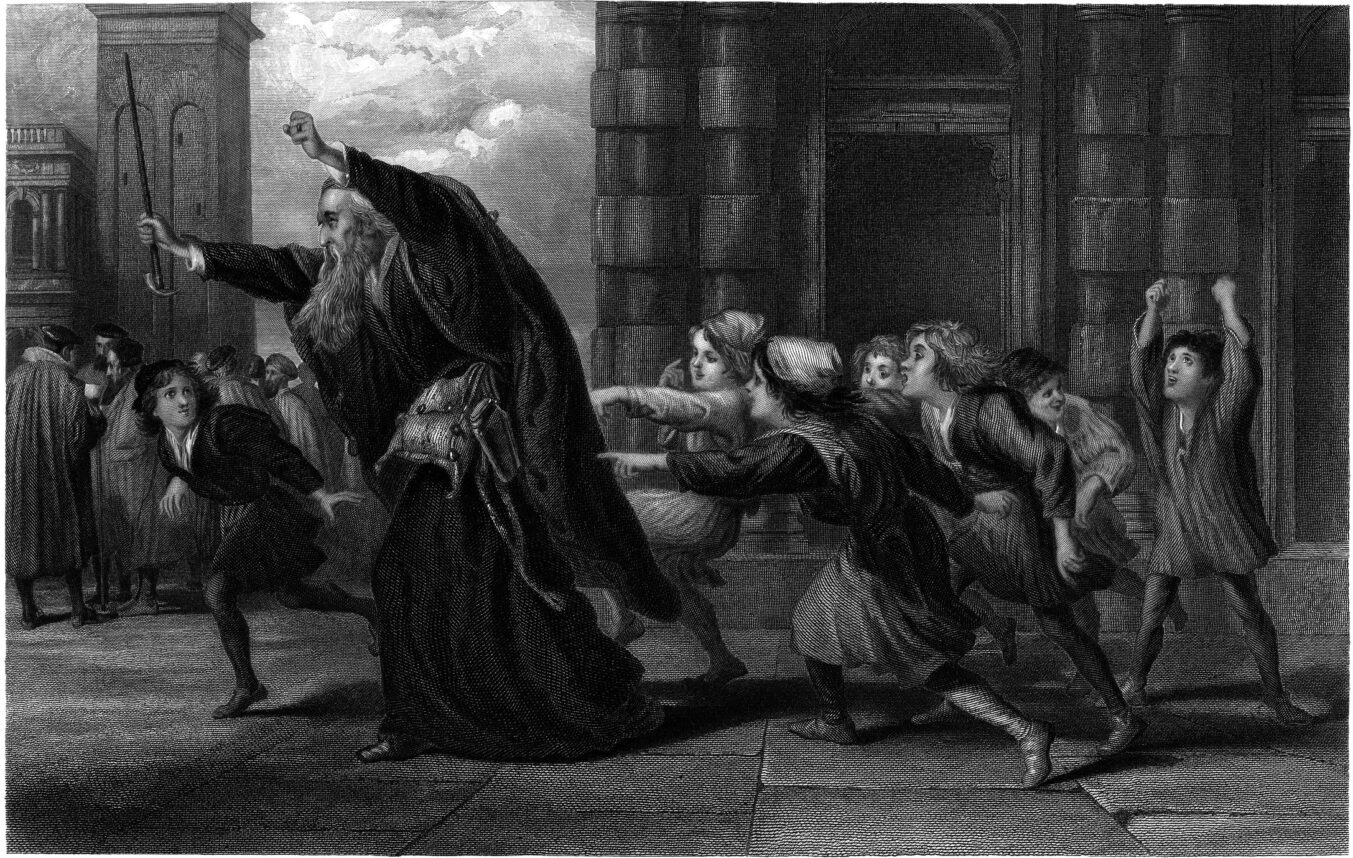
In Shakespeare’s “The Merchant of Venice,” Shylock discovers the sting of antisemitism only after his daughter has eloped with the Christian Lorenzo along with a fortune in ducats and jewels (including her mother’s turquoise ring, which she trades for a monkey). “The curse never fell upon our nation ‘til now,” Shylock moans to his friend, Tubal, “I never felt it ‘til now.”

It’s not that Shylock doesn’t know from antisemitism. Antonio, Shylock tells us at the play’s start, insults him “where merchants most do congregate,” spits on him, and kicks him as if he were a “stranger cur.” But the hostility doesn’t really bother or impede Shylock. He bears it “with a patient shrug.” Shylock clearly understands that antisemitism is out there. It’s occasionally directed at him, but antisemitism doesn’t stop Shylock from carrying on his life and his business. He’s able to separate himself from the hostility that surrounds him, and carry on.

That, I confess, is how I’ve felt about antisemitism. Obviously, there is plenty of Jew hatred in the world, and more than occasionally that hostility turns fatal. In between the neo-Nazi march in Charlottesville, the shootings at the Pittsburgh synagogue and the Chabad Center in Poway, the bomb scares at synagogues, and the many smaller incidents recorded by the ADL, it’s hard not to feel beleaguered and under attack. Yet I did, because it’s easy to distance oneself from the losers carrying tiki torches shouting “Jews Will Not Replace Us,” the thugs who destroyed a menorah outside the Chabad House near San Diego State University, and the fake bomb threats sent to Jewish Community Centers. Perhaps I was living in a dream.

But what made me feel the true weight and deep presence of antisemitism was the world’s response to the October 17 explosion in the parking lot outside a hospital in Gaza City. Hamas immediately blamed Israel (even though they knew perfectly well that the rocket came from Islamic Jihad), and the rest of the world jumped to believe Hamas.

News sources ran with headlines screaming that Israel had deliberately bombed a hospital and over 500 people were dead. When the New York Times first reported the story, the headline was “Israel Strike Kills Hundreds, Palestinians Say.” A BBC reporter said that “it was hard to see what else this could be” but Israel bombing innocent civilians. Over and over again, “Headlines suggested Israel had bombed a Christian hospital in Gaza’ and ‘murdered hundreds of civilians.’”

As one might expect, so-called progressive politicians jumped on the bandwagon. Rep. Cori Bush, in a now-deleted tweet, announced that “500 doctors, patients, and civilians killed after a hospital in Gaza was bombed”; Rep. Rashida Tlaib tweeted that Israel, on a whim, destroyed the hospital: “Israel just bombed the Baptist Hospital killing 500 Palestinians (doctors, children, patients) just like that.” And Rep. Ilhan Omar, quoting an AP report, tweeted, “Bombing a hospital is among the gravest of war crimes. The IDF reportedly blowing up one of the few places the injured and wounded can seek medical treatment and shelter during a war is horrific.” Riots erupted across the Middle East. A mob shouting “Murderous Israel” attacked a synagogue in Spain. In Tunisia, another synagogue was attacked and set on fire “a few hours after the news of the explosion at Al-Ahli hospital in Gaza, for which Hamas pointed the finger at an Israeli missile.”

Before this event, the world’s sympathy was focused on Israel. On October 7, Hamas forces invaded southern Israel and committed atrocity after atrocity. They murdered babies, burned families alive, and slaughtered innocent young people attending a rave. Hamas terrorists killed over 1400 people, and took over 200 hostages back to Gaza, all the while livestreaming their unspeakable deeds. Some blamed the invasion on Benjamin Netanyahu’s policies, others on Israel’s over-reliance on technology for security, and no doubt both are true. But whatever Israel’s faults (and let me be clear, they are legion), the world has not seen such barbarity as Hamas showed on that day for a very long time. So the world sympathized with Israel.

Not all, of course. In progressive circles, there was already widespread empathy for the Palestinians and antipathy for Israel. A rabbi in Los Angeles told her congregants that she got the sense from her leftwing friends that “these Israeli victims somehow deserved this terrible fate” because Israel is an “apartheid state.” Others, particularly on college campuses, were gleeful. A Cornell University history prof said he was “exhilarated” by the attack.

The anti-Israel contingent, however, did not enjoy wide support. The Cornell prof, for example, apologized for his statement in the face of public outcry and condemnation by Cornell’s administration. (He has since taken a leave of absence.)

But all it took, it seems, is one false statement from Hamas, and the world’s sympathy turned on a dime. Suddenly, Hamas’s responsibility for this war—they invaded Israel, not the other way around—was forgotten. Israel is now once more the bad guy, and the innocent Palestinians in the Gaza Strip the victims of wanton Israeli aggression.

Israel is now once more the bad guy, and the innocent Palestinians in the Gaza Strip the victims of wanton Israeli aggression.

On October 18, a full 24 hours after the hospital explosion, The New York Times ran a story, trying to explain, really, explain away, why their headlines shifted from blaming Israel and claiming that “At Least 500 Dead” in the attack to “Hundreds Reported Killed in Blast.”  The article blamed the changing headlines on the fog of war: “The shifting coverage about a deadly explosion at a hospital in Gaza highlighted the difficulties of reporting on a fast-moving war in which few journalists remain on the ground while claims fly freely on social media.” “It takes time to independently verify the claims from all sides,” and so, the article concludes, news organizations should be “exceptionally careful” how they report on the Israel-Hamas conflict, and be skeptical of the claims from both sides.

Except that’s not what happened. You would think that a terrorist organization that had just committed atrocity after atrocity would not have much credibility.  But rather than treating Hamas’s claims with skepticism, instead of being “exceptionally careful,” The New York Times and practically every other reputable news organization jumped to accept Hamas’s version of events. Only much later, did they walk back their claims. Some, such as al Jazeera, continue to assert Israel’s responsibility. Neither Cori Bush nor Rashida Tlaib retracted their claims or apologized for mistakenly blaming Israel for an explosion the IDF did not cause. In fact, Tlaib has “tripled down” on this false narrative.

And here is where, like Shylock, I finally realized the depth and virulence of antisemitism. The world does not want to see Israel as the victim of unprovoked aggression. The world does not like seeing Jews as victims, especially Jews victimized by Palestinians, and they certainly don’t love Jews who fight back. When Hamas first invaded, there was no alternative, especially as evidence for their murdering the elderly, torture, and rape began to pile up.

But the hospital bombing gave the world a perfect opportunity to flip the narrative: Now the Palestinians are the victims of a monstrous attack on innocent children. And in place of demonstrations against Hamas’s brutality, there are widespread protests against Israel that veer into outright antisemitism. The “Cease Fire Now Resolution” introduced in the House of Representatives by Ilhan Omar does not mention hostages or condemn Hamas for the invasion.

The fact that Islamic Jihad was responsible for the misfired rocket, and that the initial reports of casualties were highly inflated (100-300, not 500 plus), does not seem to matter. If the world has an opportunity to see Israel as the aggressor, even when evidence shows the opposite, that is what the world is going to do.

As for the canard that anti-Zionism is not antisemitism, the number of antisemitic incidents since the invasion has skyrocketed. In Paris, someone poured gasoline on the door of a Jewish couple in their 80s, and lit it on fire. In London, someone poured red paint on the gates of a Jewish school. In Warsaw, a grinning student held up a sign saying, “Keep the World Clean” with a picture of a star of David in a garbage can. The same sign has appeared at many other demonstrations, including one outside New York University in Manhattan.

I realize now, in a way I never did before, the world is not safe for Jews.


Peter C. Herman’s books include “Unspeakable: Literature and Terrorism from the Gunpowder Plot to 9/11,” and “Critical Contexts: Terrorism and Literature.” His opinion pieces have appeared in Newsweek, Salon, Areo, Inside Higher Ed, and Times of San Diego. 

Shakespeare, Gaza, and How the World is Not Safe for Jews Read More »