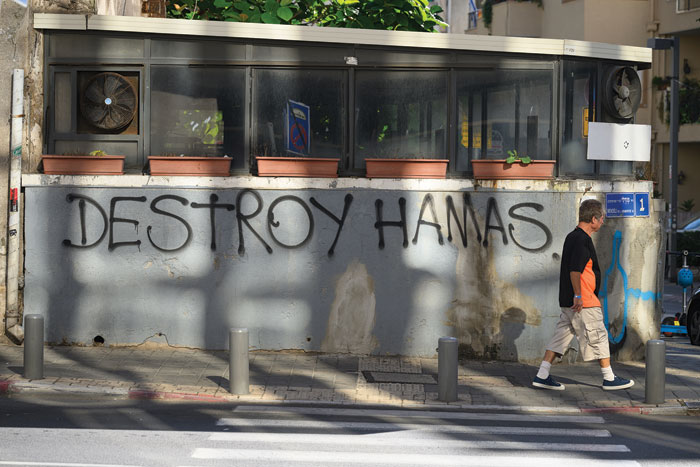
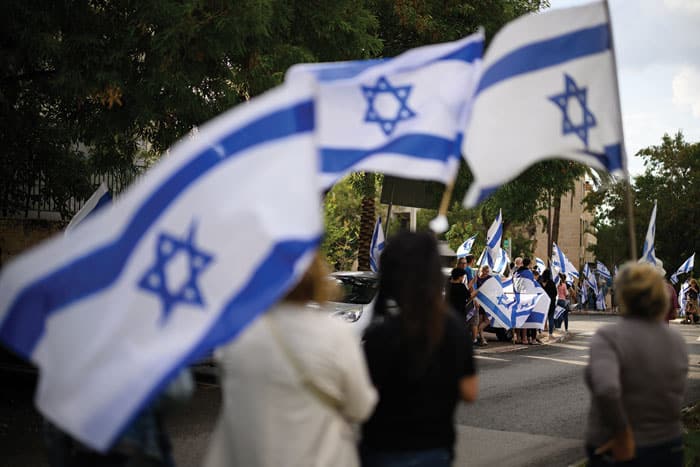
We are stunned, speechless, traumatized. As Simchat Torah ended and we learned the scope of the unprecedented terror attacks in Israel, it almost felt like we were turning back the calendar to Tisha b’Av, with us crying “Eicha” – how? How did this happen? We are further shaken by emboldened Jew-haters rallying around the world to defend the violence, university leadership that stays mute when student groups laud Hamas atrocities, and the realization that many people we thought of as “friends” remain silent, if not actually daring to apologize for the monstrous evil committed against us.
Despite this sudden and overwhelming war reality, we must live our lives. This means we need to learn to cope with our individual and communal trauma and fears. I offer the following ideas that resonate with me, and I hope will resonate with you, too. They have been gleaned from several sources, including Rebbetzin Shira Smiles, Rebbetzin Dina Schoonmaker, Rabbi David Lapin, mindfulness coach Rabbi Dov Ber Cohen, and my personal experiences and observations.
Checking the news frequently if not obsessively fosters a mistaken sense of control. Submerging ourselves in the news depresses and depletes us, misdirecting our emotional energy.
1. Checking the news frequently if not obsessively fosters a mistaken sense of control. Submerging ourselves in the news depresses and depletes us, misdirecting our emotional energy. It changes nothing on the battlefield but leaves us unavailable for our own needs and those of our loved ones. Limit news checks to two or three times a day, maximum.
2. Instead, we can channel our energy into building a strengthened spiritual reality. Prayer, acts of kindness, acts of forgiveness, Torah study, and similar things are powerful ways of bringing achdut (unity) and kedusha (holiness) into the world. Every act helps protect the IDF and the people of Israel. No act is too small for God to notice.
3. Terrorists engage in psychological warfare by luring us to look at images of their evil, and in the process, debilitating us. We must protect our souls and those of our children by refusing to look at such traumatizing images. We must do everything in our power to protect children from images that will haunt them for life.
Getting out of ourselves and uplifting others is a great way to resist falling into gloom or depression. Think: Who could use a phone call? A visit? A note of thanks or offer of practical help?
4. Getting out of ourselves and uplifting others is a great way to resist falling into gloom or depression. Think: Who could use a phone call? A visit? A note of thanks or offer of practical help? I know I felt much better after buying several yoga mats and dropping them off at a home jammed with volunteers packing hundreds of boxes of needed supplies to be sent to Israel: Children’s toys and diapers, men’s socks, snacks, first-aid kits, blankets, and much more. My contribution was paltry compared to the donor who had purchased 1,000 yoga mats, but this didn’t matter. I took a small, meaningful action. I was part of the team.
5. Mindfulness teaches us to allow ourselves to experience our feelings, including pain, anger, helplessness, fear, grief, and worry. We need to acknowledge and validate these feelings. We can say, “This is how I feel now,” and share them with close supportive people. But we can’t allow those feelings to dictate our lives. We need to live purposefully and as normally as possible. This includes self-care: Healthy food and sleep, creative self-expression, and as normal a schedule as possible.
6. We can learn to let go of small, petty concerns and irritations, giving us space to focus on the big picture. This helps us develop an expanded versus narrow consciousness. With this expanded consciousness, we will win the psychological battle that our enemies wage as they try to depress and humiliate us. It’s hard to resist giving in to moments of frustration or irritation, so it can help if we say, “God, in the merit of my self-control in this moment, please protect the Jewish people who are in danger now.”
7. God often expects us to hold conflicting emotions, such as joy and pain, simultaneously. No one has more experience with this than we do. And despite our darkest hours, we have always persevered and prevailed. Just as there were weddings in Jewish ghettos and Simchat Torah celebrations in the Nazi camps, today, IDF soldiers are dancing and singing with the Torah as they wait for orders to enter Gaza. We can and must build our emotional resilience to carry on for the long haul.
8. We are all on the front lines, only in different divisions. Some of us are in the Tefillah (prayer) division; others the Tzedakah brigade; others a kindness unit. We are not powerless. We have agency, physically and spiritually. God is watching and waiting for us to show the same kind of unity after this crisis passes that we are remarkably skilled at showing during a crisis. Many leaders have made the rather obvious connection between the vicious divisiveness in Israel in recent months and this catastrophe. We must learn to disagree without tearing one another apart. If we are too busy looking for the enemy within, we will miss the enemy without. Disunity and contempt weaken and endanger us.
9. We can feel uplifted and encouraged by the daily miracles that are unfolding in Israel and by the tidal wave of goodness, giving, unity, determination, and self-sacrifice demonstrated by Jews worldwide. A spiritual renaissance is taking place. Thousands of secular soldiers are requesting tzitzit. These spiritual garments are being sponsored and manufactured at breakneck pace. Mothers of soldiers on the front lines are volunteering in supermarkets. The minute a call goes out asking for sleeping space for displaced families, even numbering into the thousands, a deluge of offers fills the need. Every Jewish community of any size is gathering supplies in donated duffel bags and suitcases to be sent on cargo planes to Israel. The daily, even hourly outpourings of financial, material, emotional, psychological, spiritual, logistical, and physical assistance are overwhelming. Mi k’amcha Yisrael? Who is like you, Israel?With this sort of unbelievable, almost superhuman positive response to this new war, we all have reason to take heart, and go forward with renewed strength, courage, faith, and confidence.
Judy Gruen is the author of several books, including “The Skeptic and the Rabbi: Falling in Love With Faith.” Her next book, “Bylines and Blessings,” will be published in February 2024.
In his recent speech on the war in Israel, President Biden recounted meeting Golda Meir, who said to the then-senator that Israel’s secret weapon was that “we have nowhere else to go.”
I’ve been turning this story over in my mind over the past 24 hours as I grapple with the fact that unlike Golda, I do have somewhere else to go. My particular community — American rabbinical students living in Israel — is also having this discussion. So are many other olim, immigrants, to Israel — especially those from countries in Europe and America.
“Ein li eretz acheret,” “I have no other country,” is a popular saying in Israel, derived from the title of a 1982 song written by Ehud Manor and sung by Gali Atari. Increasingly, however, many Israelis do indeed have another country. Leaving aside immigrants, there is a growing population of native-born Israelis living abroad and a trend of Israelis applying for EU passports from the very countries their grandparents and great-grandparents once left — by choice or in flight from persecution.
In conversations I’ve had and will continue to have about the question of whether to stay or go, a number of factors are at play. There is concern for safety, fear of uncertainty, the strain this war has already put on our mental and physical health. In addition to this, there are parents at home whose worries we try in vain to quell. They want us home. They want us not to be proud, or foolhardy, or to wait too late to decide. Just to come home. Now.
Opposing all of this is the need to be close and the sense of anguish that arises with the thought of being anywhere else. I have been in the United States when Israel was facing a crisis, and the feeling of helplessness that one feels from afar was difficult for me to bear.
Israel is not where I grew up — I first came here when I was 20 — but it is where I became a grown-up. It is a place that has profound religious and political significance for me, but ultimately my connection to Israel is not rooted in any “ism,” whether it be Zionism or Judaism. Rather, this connection is rooted in something far more primal and far less rational than that. It is a matter of love.
Each time I have had to leave Israel — first to finish my undergraduate degree and then to start my rabbinical program — I was filled with dread. What if I don’t make it back?
Each time I have had to leave Israel — first to finish my undergraduate degree and then to start my rabbinical program — I was filled with dread. What if I don’t make it back? What if I meet someone, or get a job? What if life grabs me and drags me in another direction?
Each time when I return, I vow that this time, it’s for good. I always hoped I would find an Israeli partner who would help me solidify this commitment, and last year, I finally did. Alas, the matter is not yet settled, for he is Israeli-American, and his family lives in New Jersey. Like me, and unlike Ms. Meir, we have somewhere else to go.
For those who are not Jewish, the decision would appear to be a simple one. If it is not safe in Israel, come home. For Jews, however, this decision is complicated and deepened by centuries of history with the very matters — homeland, exile, vulnerability — that characterize this dilemma.
The first Jew to feel this dread at leaving the promised land was Jacob. When the land of Israel was in the grips of a wretched famine, Jacob and his family ventured south into Egypt to dwell in Goshen with Joseph. Wracked with anxiety at leaving, Jacob turned to God for guidance, Who told him not to fear. “I Myself will go down with you to Egypt, and I Myself will also bring you back” (Genesis 46:4).
Other images from Jewish text and history speak to this moment. There is the story of Rabbi Yochanan Ben Zakkai escaping a besieged Jerusalem in a coffin to go to Yavne. Judaism as we know it survived because of this choice. In fleeing, he chose life, and ensured his own future and the future of Judaism. Less compromising Jews, like the fighters at Masada, chose death. There is also the memory of the Jews of Germany who failed to intuit that Nazi persecution would get worse. By the time they understood, it was too late.
This last image steers us in two directions. No, we don’t want to “wait too long” like the Jews who perished at the hands of the Nazis, but neither do we want to be forced to live like we did in those days before the existence of Israel. Things are different now, are they not? We have a state. An army. None of that, apparently, spares us from the possibility of slaughter. But shouldn’t it mean — at the very least — that we don’t have to flee?
At this point, I can’t fathom leaving. Perhaps this will change. Indeed, if the state department’s travel advisory for Israel changes, my school may push me to choose between taking a leave of absence and coming home. But for now, I’m not ready to consider being anywhere else.
Freud described the psyche as a battlefield of dueling impulses — the life instinct, which is concerned with propagation, creativity, and survival, and the death instinct, obsessed with self-destruction and the pursuit of oblivion.
Perhaps my stubborn insistence on staying will be construed as an instance of the death instinct, but I see it differently. For me, this is the life instinct: A rejection of alienation and isolation, and an assertion of value rooted in the decision to stay close to the land and people I love.
Matthew Schultz is a Jewish Journal columnist and rabbinical student at Hebrew College. He is the author of the essay collection “What Came Before” (Tupelo, 2020) and lives in Boston and Jerusalem.
Wearing a shirt decorated with a hamsa and carrying a sign that depicted a weeping figure holding a baby, Maya Sherer said her dual identity, as both an American and an Israeli, compelled her to turn out to a recent Israeli solidarity rally.
“I’m Israeli, I’m American. My identity has been very tested, while overseas my family’s over there, and I need to walk for solidarity and to help my people,” she said.
At a moment widely considered to be among the most challenging in Israel’s 75-year history, Sherer was among an estimated 7,500 people who gathered to express love and support for Israel during a solidarity rally held in the Pico-Robertson and Century City areas and concluding at the Museum of Tolerance, on Oct. 15.
The Simon Wiesenthal Center, along with the help of sponsoring organizations, organized the rally.
Elected officials, religious leaders, community activists and celebrities, including world champion boxer Floyd Mayweather, Jr. and former NBA player Glen “Big Baby”Davis were among attendees of the rally, underscoring how Israel’s cause is drawing support from a wide swath of the local Jewish community, along with allies of other faiths and backgrounds.
“I’m behind you guys, 100%,” boxing champ Mayweather — who’s reportedly using his private plane to send essential supplies to Israeli soldiers—told the Journal at Sunday’s rally.
The rally was held in response to Hamas, the terrorist group controlling the Gaza Strip, infiltrating the Israeli-Gaza border on Oct. 7 before murdering more than 1,300 people and taking nearly 200 others as hostages.
At Sunday’s demonstration, there was a keen sense of frustration felt toward those who’ve attempted to justify Hamas’s attack.
“Any support of Hamas is antisemitism,” David Fox, who showed up to the rally carrying a large Israeli flag, told the Journal. “In their charter it says they want Israel’s destruction. So, to make justifications for their actions is antisemitic.”
Still, despite the community’s impassioned feelings about Hamas terrorists’ unprovoked actions, the event was calm, controlled and without incident, with one attendee noting the lack of hateful rhetoric toward the Palestinian community.
“It’s amazing how peaceful it is,” they told the Journal. “There’s no hate speech as opposed to what we see when they have pro-Palestinian rallies in Berlin, in France. There’s no nastiness here. It’s a peaceful demonstration unifying the Jewish people and there’s certainly no vitriol against the Palestinians. That’s the difference between this and other rallies we’ve seen.”
At 10:30 a.m., the demonstration kicked off with rally-goers marching from Young Israel of Century City before heading west. The sea of people waving blue-and-white flags moved at a steady pace on Pico Boulevard before reaching the museum, at 9786 W. Pico Boulevard.
So that rally-goers could walk on the street, Los Angeles Police Department (LAPD) officials closed off a section of Pico Boulevard for the duration of the program.
Around 11:30 a.m., city and community leaders — including Simon Wiesenthal Center (SWC) CEO Rabbi Marvin Hier; California Lt. Governor Eleni Kounalakis (D); U.S. Rep. Sydney Kamlager-Dove (D-Mid City), Omar Qudrat, a board member at the Muslim Coalition of America; Pastor Greg Laurie of Harvest Christian Fellowship; Consul General of Israel in Los Angeles Israel Bachar; and Jewish social media influencer and dancer Montana Tucker — delivered remarks from the Museum of Tolerance courtyard.
“Please, all of you here, use your social media platforms to stand for Israel – I beg you,” Tucker said. “It doesn’t matter if you have one follower or one million followers, you’ll impact at least one person, and that’s all that matters.”
Rachel Goldberg, whose son, Hersch, was injured and is believed kidnapped by Hamas, called into the event to speak.
Jewish Federation of Greater Los Angeles CEO and President Rabbi Noah Farkas also appeared. Addressing the crowd, Farkas highlighted the generosity of the Diaspora community in the days since the attack on Israel. As of Oct. 15, the L.A. Federation has raised more than $9 million, with funds benefiting soldiers as well as paying for electronics for Israeli schoolkids who are switching on a temporary basis to remote learning because of the war.
SWC Associate Dean Rabbi Abraham Cooper thanked the crowd for transforming what had been envisioned as a “local event, into a global statement on behalf of Klal Yisrael,” or Jewish peoplehood.
American Jewish Committee L.A. Regional Director Richard Hirschhaut said he was heartened by the strong turnout at the rally.
“Israel is about life, Israel is about the joy of life,” Hirschhaut told the Journal. “What we see here today is an expression of that spirit of Israel.”
Attendees carried signs saying, “Never Again” “Nothing Justifies Terrorism,” “I Stand with Israel,” and “Am Yisrael Chai.” They waved U.S. flags and Israeli flags, and they cheered as cars driving by honked in support. On the sidewalk at several corners on Pico Boulevard, Chabad members asked passerby if they’d wrapped tefillin that day, and the more entrepreneurial sold flags and pro-Israel T-shirts. Others taped handprinted signs, featuring the photographs of those kidnapped by Hamas, onto displays at bus stops. At times, attendees broke out into song, singing “Oseh Shalom” and “Am Yisrael Chai.”
Attending Sunday’s rally, Janice Weitz said she was tired of watching the news from home and feeling like she was sitting around helplessly.
Attending Sunday’s rally, Janice Weitz said she was tired of watching the news from home and feeling like she was sitting around helplessly.
“My father’s Israeli, I’m Jewish, and I feel like I have the right to stand up for Israelis,” Weitz said. “I was tired of sitting in my living room doing nothing.”
Kristin Walker noted the anti-Israel voices who’ve felt emboldened to speak up in the days following the attack. In an interview, she said she was “surprised” by “the amount of antisemitism that was hidden but closely underneath the surface.”
But she was feeling hopeful seeing the day’s turnout. It was, she said, a day of “community, Jewish people [standing] together and loud, not hiding.”
Thomas Jacobson, a retired attorney, was aboard the St. Louis as an infant when, in 1939, it was turned away by Cuba and the U.S. before being sent back to Europe. Walking down Pico at Sunday’s rally, the child Holocaust survivor spoke with the Journal about the importance of Jews having their own nation.
“This is why we say, ‘Never again,’” Jacobson said. “You have to have a homeland. You have to support Israel. That’s why I’m here.”
In the days after the white supremacist rally on Charlottesville, Virginia back in 2017, then-former Vice President Joe Biden wrote an essay for the Atlantic magazine in which he penned the following words:
“The giant forward steps we have taken in recent years on civil liberties and civil rights and human rights are being met by a ferocious pushback from the oldest and darkest forces in America,” Biden wrote. “Are we really surprised they rose up? Are we really surprised they lashed back? Did we really think they would be extinguished with a whimper rather than a fight?”
At the time, I was forced to admit to myself that in fact, I was surprised. I had somehow convinced myself over the years that the worst of these fights were in the past, and what Biden had called “the oldest and darkest forces in America” had been defeated, or at least diminished. Since then, I’ve learned – and been repeatedly reminded – how wrong I was.
I’ve been thinking about Biden’s article again in the days since Simchat Torah, not because of my opinions regarding his presidency, but because the questions he asked have forced me to once again confront my own overconfidence about the world in which we live.
Substitute his reference to “civil liberties and civil rights” with the phrase “toward the possibility of peace in the Middle East.” Replace his language about “the oldest and darkest forces in America” with a similar sentiment regarding even older and uglier sentiments from Israel’s enemies. Take Biden’s questions and transplant them halfway around the world and it’s clear that the same self-assurance that led me to believe that racism and bigotry in this country were shrinking forces had also convinced many of us that Israel’s strengths could now protect it from the ancient hatreds that Jews have faced since biblical times.
We were wrong.
This overconfidence was quickly exposed on several operational fronts, from the limitations of the Iron Dome defense system that was overpowered by unprecedented numbers of incoming missiles to the vulnerabilities of a high-tech border surveillance system that was easily disabled by rudimentary drone attacks. Terrorist activity in the West Bank and at the Lebanon border convinced Israeli military leaders to redeploy troops from the Gaza area to other parts of the country, leaving outnumbered and inexperienced conscripts to face the sophisticated Hamas onslaught.
But the most damaging error was a fundamental misunderstanding of Hamas’ priorities and goals. The widespread assumption was that a terrorist organization whose charter calls for the destruction of Israel had shifted its focus in recent years to the economic sustenance of the residences of Gaza and that its leaders were willing to forego their violent past in exchange for financial support. In fact, the lifelong terrorists were merely biding their time until the right opportunity presented itself to wreak maximum death and destruction.
Israel’s intelligence services have been deservedly criticized for their failure to anticipate such a massive terrorist action. But unjustified overconfidence was also an affliction shared throughout Israel and among its supporters in the U.S. and around the world.
We fell victim to recency bias, assuming that because there had been no overwhelmingly devastating attacks against Israel in recent years that meant that they couldn’t happen anymore.
We fell victim to recency bias, assuming that because there had been no overwhelmingly devastating attacks against Israel in recent years that meant that they couldn’t happen anymore. We were distracted by internal arguments, forgetting that the overriding purpose for a Jewish state was to protect Jewish people and that a tiny country in a turbulent region could not afford the luxury of unending internecine feuding. And we believed our own press clippings, believing that a defense system was invulnerable simply because we all knew it was. Until it wasn’t.
The phrase “never again” is justifiably associated with the lessons of the Holocaust and is rarely if ever used in other contexts. But after the single deadliest day for Jews since the days of Nazi Germany, perhaps those same words would also be a helpful reminder for those who care about Israel to carry with us so we can be better prepared to protect ourselves from another horrific massacre before it happens again.
Dan Schnur is the U.S. Politics Editor for the Jewish Journal. He teaches courses in politics, communications, and leadership at UC Berkeley, USC and Pepperdine. He hosts the monthly webinar “The Dan Schnur Political Report” for the Los Angeles World Affairs Council & Town Hall. Follow Dan’s work at www.danschnurpolitics.com
Ruth Swerdlow has done it. The Los Angeles native turned 100 on Saturday, and according to her daughter, Yael, one of the reasons she’s still here is because “she continually exhibits Jewish joy and resilience.” And, added Yael, “The past few weeks have broken her heart, but she still believes in peace and wants to live long enough to see it.”
I like to think that another reason why G-d has let Ruth live this long is to stick it to Hamas.
Jewish friends worldwide have told me that they’re filled with an urge to take revenge against Hamas for carrying out the biggest massacre of Jews since the Holocaust. To them and millions of other Jews who have (rightly) personalized the attacks in Israel as an assault against them as well, I offer one message: If you really want to stick it to Hamas and to everyone else who can’t tolerate the existence of Jews, double down on everything Jewish.
If my sheer existence is too much for Hamas and others, I’m going to be more of myself, not less.
It’s simple: If my sheer existence is too much for Hamas and others, I’m going to be more of myself, not less. If I was proudly Jewish before, I am now actively finding ways to be overwhelmingly Jewish. Dare I say, gratuitously Jewish?
Those four guests I was thinking of inviting over for Shabbat? Make ‘em 12. Some of them will have to sit on each other’s laps, but they won’t mind, because we’ll eat, sing and exude Judaism with every bite.
The $52 tzedakah donation I often send to a Jewish charity? Make it $152.
That photo of me from a Birthright trip to Israel in 2008, possibly hung over and still in disbelief that I hiked Masada at dawn? I unearthed it and it’ll be my new Facebook profile picture.
That huge jar of jellied gefilte fish at a supermarket in Culver City? I’m still not buying it, but if its powerful odor will send Hamas running for cover, I’ll happily ship a few hundred jars of it to the IDF to hurl over the border.
I understand that we, world Jewry, are currently not okay, whether we’re atheists or Orthodox. And that our smartphone apps, once guilty pleasures of social media escapism, are now the very devices of our torture and heartbreak.
I also understand that safety concerns are a vital factor, but for Jews who live outside of Israel, this is not the time to sigh, “I feel like staying under the covers this Shabbat,” “I don’t feel like going to a rally right now” or, in my case, “I don’t feel like learning how to do needlework and buying copious amounts of blue and white yarn to make solidarity trivets.”
Yes, solidarity trivets. They may not work under hot pans, due to their many holes, and I may end up knitting something that looks more like a Christmas stocking than a trivet, but the lopsided Star of David in their center will speak for themselves.
Now is the time to really double down. Take it from actress and Jewish activist Debra Messing: Last week, she posted a photo on Instagram in which she wore a Star of David necklace, above a Chai necklace, above a map of Israel necklace. Three necklaces, the last one the most courageous, especially for a celebrity. Her photo caption? Three simple words: “Loud and proud.”
As Jews, each of us is now serving in a defense unit. Some are fighting Hamas terrorists (as are non-Jewish Israeli soldiers), and to them, we owe everything. Others are fighting wars on social media, in the classroom, at corporations, at their local newspaper and elsewhere. Today, we each have a role in the war front.
But as we fight, we also need to carve out small spaces of joy. Jewish joy. Hamas doesn’t only love dead Jews: It would also love to know that Jews can’t bring themselves to smile or laugh anymore; that a Jew in Los Angeles, New York, Paris or Casablanca suffered a heart attack because he or she was under so much stress from the barbaric videos they’ve seen; or that, perish the thought, a Jew anywhere has lost his or her appetite for good.
On Instagram and X/Twitter, I’m not only sharing heartbreaking stories or exposing the seething racism of pro-Hamas activists in the West; I’m sharing content that runs the gamut of the Jewish experience, including humor. That includes hilarious photos that IDF soldiers have shared, including how some of them have received less than helpful supplies from some well-intentioned Jews abroad, such as soldiers who received adult diapers (and posed wearing them) and male soldiers who received packages of feminine care products (and also posed holding those boxes).
I’ve also shared an endearing video of an IDF reservist in northern Israel who, despite having lost five close friends (plus two who were kidnapped and are still missing), assured Jews worldwide that Israel would win this war, but also joked, “The reservists are an amazing thing. All ages report here. I swear, there’s someone in our company so old that I think his caretaker signed for his equipment.”
I know this doesn’t seem like a time to laugh. But Jews are a funny people, even on the frontlines. And the more we remember who we are, the more we’ll feel invested in fighting for our right to exist, and thrive.
Like you, I am heartbroken. But we can tend to our hearts, while also strengthening them.
The next time we feel the urge to get under the covers, doomscroll, then fall asleep depressed and anxious, let’s remember that Israelis would be energized to know that Jews worldwide are living with more passion for life, not less. Like you, I am heartbroken. But we can tend to our hearts, while also strengthening them.
So have Shabbat dinner this week, invite over a friend, commit to a new mitzvah; learn Hebrew, and if you already know some Hebrew, learn more; visit Israel this spring (that plane ticket will hopefully accrue some cash back on your credit card); next fall, hold off on the Halloween decorations and buy a sukkah; belt out “Shema Israel” before bed, even if the last time you recited it, you were 13. Ask a rabbi to give you a Jewish middle name (it’s never too late). And buy the gefilte fish. If it helps to connect you with your true self — a Jew — it’s a good thing.
And never forget the remainder of the message in the video from the soldier in the north, mentioned above:
“I think we’ve forgotten recently who and what Israel is. We were against each other for a long period, right versus left, left versus right, and we forgot who the real enemy is. We’ve also forgotten how many amazing people live in Israel … The desire to help, contribute, volunteer, assist, cuddle; anything that can be done, Israelis are doing. It boosts morale like crazy, even when it’s tough. We (soldiers) just start going for two minutes on the APC (armored personnel carrier) and get rained on with falafel and portable chargers (referring to the multitudes of supplies being sent to the IDF). Okay, I’ve churned out a speech worthy of the defense minister, at least. I need to go. In short, those at home: Stay strong. And those in the field: Stay even stronger. For my psychologist: Get ready for 453 sessions the week I return.”
Tabby Refael is an award-winning writer, speaker and civic action activist. Follow her on Instagram and X/Twitter @TabbyRefael
Reliable evidence shows that the tragic explosion at Al-Ahli Hospital in Gaza was likely caused by a misfired Palestinian rocket aimed at Israel.
Hamas insists that Israel bombed the hospital, aiming to kill refugees from its air campaign, which follows the brutal Hamas massacre of hundreds of Israelis. Hamas also claims that at least 500 people, maybe even 1,000, were killed in the explosion, and thousands more were injured.
Hamas has not produced evidence to back up its claims. Shortly after landing in Israel for a solidarity visit, US President Joe Biden declared, with notably insensitive language, that the blast was apparently caused by “the other team.”
Even so, the outcry against Israel could affect how it pursues its counterattack in Gaza.
In a world where anti-social media rules, the Hamas account of “Israel’s latest atrocity” took flight before the embers were cool. Jordan canceled a summit meeting that its king was supposed to host with Biden and the leader of Egypt. Jordan and Egypt issued condemnations against Israel. There were angry Palestinian demonstrations in the West Bank, and sympathizers rallied elsewhere, in the Mideast and beyond.
Al-Jazeera, the Qatar-based Arab TV news channel, not tainted with sympathy for Israel, happened to be broadcasting from Gaza when the blast occurred, and it aired live video of what appeared to be a rocket hitting the hospital area. Israel released what it said was a secretly monitored phone conversation between two Hamas operatives, implicating their “sister” terrorist group, Islamic Jihad.
It doesn’t matter—because we are in a “post-truth” era when facts don’t matter.
Biden’s vice president, Kamala Harris, inadvertently made that point clear a year ago when confronted by an Iranian student who charged Israel with “ethnic genocide,” among other crimes.
Harris could have responded by saying, “You have a lot of nerve as a guest from Iran, dressing down the vice president of the United States with such despicable lies. What you say is not only untrue, it’s libelous. And what do you suppose would happen to you if you spoke out against your own country’s homicidal regime while confronting Iran’s second in command?” But no.
What Harris actually said was, “I’m glad you (spoke out). And again, this is about the fact that your voice, your perspective, your experience, your truth, should not be suppressed. And it must be heard, right?”
Post-truth means your truth is as good as my truth. If I say the sun rises in the east, you can say, “That’s just your opinion,” and we’re both right.
The fact that Israel’s evidence is stronger than Hamas’ non-evidence pales into insignificance when applied to the real world. Outcries against past Israel atrocities, real and imagined, have influenced Israel’s actions, and they could color this one, too.
The clearest example came in 1996. Israel was engaged in a war in south Lebanon, aimed at stopping Hizbullah’s rocket fire at Israel. Hizbullah effectively sucker-punched the Israelis, launching rockets from next to a UN camp where about 800 Lebanese were seeking shelter. Israel’s return fire hit the camp, killing more than 100 civilians. Then world condemnation forced Israel to stop its operation. But at least that was based on truth.
A good example of how “non-truth” took hold is Israel’s operation in the Jenin refugee camp in 2002. It came during an offensive to root out terrorists and suicide bombers who had plagued Israel for more than a year, killing hundreds of Israelis on buses and in public places. Soon after Israeli military forces entered the refugee camp, the Palestinians declared that at least 500 people had been killed. That jumped to 1,000 later, alongside tales of Israel burying many bodies under destroyed buildings to cover up the death toll.
Weeks later, independent investigations put the Palestinian death toll at 52, along with 23 Israeli soldiers dead. But even today, there are tearful, angry commemorations of the “Jenin massacre of 2002.” The camp is etched in the memory of Israel’s enemies.
So, precedent indicates that Israel may buckle under world pressure after the “bombing” of the Gaza hospital, even if Israel wasn’t to blame. Much probably depends on what Biden told Israel’s leaders in their closed meeting, between his sympathetic public statements—couched though they were with calls to play by the rules and refrain from harming civilians.
It’s no secret that Israel has massed troops on the Gaza border, awaiting orders to move in and eliminate Hamas. That could mean destroying weapons, stockpiles, and arms factories. It could mean blowing up attack tunnels and the underground fortifications known as the “Metro.” It could also mean hunting down and eliminating Hamas fighters and leaders.
That’s what Israel’s discredited leaders have promised their disillusioned, angry, and frightened people. Many times in the past, after an operation in Gaza and the inevitable cease-fire, Israeli politicians have crowed about the “heavy blow” they inflicted on Hamas, only to face the terrorists again a few years or even months later.
Will world outcry over the hospital bombing force Israel to back out again, short of its stated goals?
It’s impossible to predict, but this time, the starting point is different. Before, Israel was responding to rocket attacks. This time it’s counterattacking after an invasion by bloodthirsty terrorists who massacred hundreds of civilians, hacked infants to death, murdered 90-year-olds, and abducted men, women, children, and even babies to Gaza.
Even though Hamas has its own “Israeli atrocity” to parade before the world in the form of the hospital bombing, Israel is unlikely to pay as much attention to the outcry as it did before—because of the enormity and horror of the Hamas crime that ignited this conflict.
Mark Lavie has been covering the Middle East for major news outlets since 1972. His second book, Why Are We Still Afraid?, which follows his five-decade career and comes to a surprising conclusion, is available on Amazon.
To read more articles from The Media Line, click here.
Shortly after the Hamas massacre,I was driving on the highway between Jerusalem and Tel Aviv. In place of civilian traffic, flatbed trucks transported tanks and carloads of reservists headed to their units. I spotted a banner hanging across an overpass, imprinted with a slogan denouncing Prime Minister Benjamin Netanyahu for his assault on the judicial system. It felt like the remains of a long-forgotten election campaign.
Only a week earlier I’d been out in the streets, along with hundreds of thousands of my fellow citizens, waving large Israeli flags, trying to save our country’s democracy. Now we are trying to save our country.
Yet only a week earlier I’d been out in the streets, along with hundreds of thousands of my fellow citizens, chanting “Shame!” and waving large Israeli flags, trying to save our country’s democracy.
Now we are trying to save our country.
Before the massacre, I’d feared that the Netanyahu government had done irreparable damage to our ability to function as a cohesive people. Now, the horror of our intimate encounter with evil has once again brought us together.
Despite Netanyahu’s initial resistance, public pressure gave him no choice but to form a unity coalition. The government has suspended all legislation not connected with the war effort. It is inconceivable that, once the fighting is over, the Israeli public will allow a fatally discredited Netanyahu to revive his judicial coup.
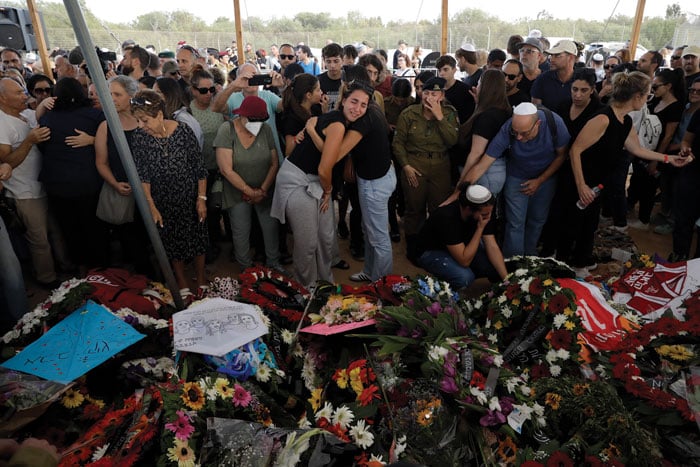
Mourners attend a a funeral held for the Kutz family, killed last Saturday at Kfar Aza kibbutz on October 16, 2023 in Gan Yavne, Israel Amir Levy/Getty Images
Meanwhile, the pilots who had announced they would not serve an anti-democratic government are now flying sorties over Gaza. The Brothers in Arms movement that had supported their refusal is helping shell-shocked residents along the Gaza border with food, clothing and psychological counselling – taking the place of government ministries that are barely functioning, a result of the coalition’s systematic replacement of professional civil servants with incompetent political hacks.Astonishingly but not surprisingly, the government that failed to protect the residents of the Gaza border communities while they were being massacred has effectively abandoned the survivors.
This is a joyless unity, imposed on a nation whose bitter divisions will take years to heal. Never has the country gone to war with so many Israelis faulting each other for catastrophe. Those of us who oppose the government blame it not only for the disaster of failing to secure the Gaza border, but for dividing the country over the past year, signalling a fatal weakness to our enemies. Netanyahu ignored the urgent warnings of the IDF about the impact of his judicial policies on the cohesiveness of Israeli society and of the army itself, even refusing to meet with the IDF Commander-in-Chief Herzi Halevi. Just days before the attack, Yesh Atid leader Yair Lapid went on television to warn that, based on briefings he’d received from the military as head of the opposition, Israel was facing a major and perhaps imminent security threat on its borders. Netanyahu ignored all those warnings, insisting on moving ahead with his divisive agenda, as though nothing was more fateful for Israel’s future than restraining judicial overreach. And now of course, the leader who is always claiming credit for national achievements, whether or not they are his, is acting as though someone else were prime minister on October 7.
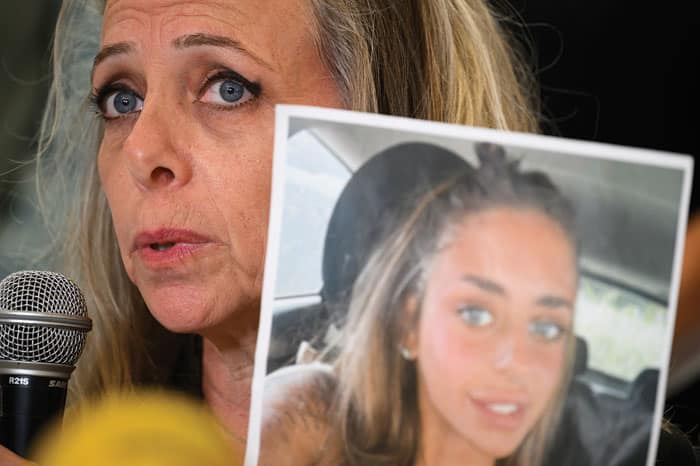
Keren Sherf Shem holds a photograph of her daughter Mia Shem, during a press conference October 17, 2023 in Tel Aviv, Israel. Leon Neal/Getty Images
For their part, the shrinking minority of government supporters blame the protest movement, and the thousands of reservists who’d declared their refusal to serve an authoritarian government, for emboldening Hamas. The commentators on the pro-Netanyahu television station, Channel 14, which for the last year has portrayed government opponents as traitors, have become increasingly desperate in trying to deflect blame for Israel’s worst-ever security disaster on to the protest movement. Listening to their vitriol, I could only imagine what they would be saying if the worst terrorist attack in Israel’s history had happened on the watch of Prime Minister Naftali Bennett.
What Netanyahu’s defenders miss is that, had the protesters not prevented the government from destroying Israeli democracy, we would never have been able to go to war again as a united people.
Most of us who opposed this government over the last year know this is not the time for score-settling. The reckoning will come the day after the war, and it will be furious.
Even so, outrage erupted at funerals for the massacre’s victims. “I didn’t want to speak about politics here today,” said Ofir Shai, a young man eulogizing his brother, and proceeded to demand that the entire cabinet resign, while many in the crowd vigorously nodded. When Environment Minister Idit Silman tried to visit the wounded in a hospital, she was taunted by outraged family members. A doctor joined in, shouting, “You’ve destroyed our country! Get out of here! Now it’s our turn to take control! Left-wing, right-wing, one united nation, without you! You’ve ruined everything!”Silman quickly left.
Graffiti on a wall on October 17, 2023 in Tel Aviv, Israel. Leon Neal/Getty Images
This is the moment of the maturation of the Israeli people. An effectively leaderless nation is mobilizing and inspiring itself.We share a rage against our enemies far greater than the rage we feel toward our leaders.
In the four decades since my Aliyah, I’ve experienced multiple versions of Israel. There was the Israel I moved to in 1982, when inflation was raging close to 500% and the economy seemed headed toward collapse; and then abruptly, a decade later, the “startup nation” emerged, and Israel became a world center of high-tech innovation. There was the Israel of the Second Intifada in the early 2000s, when suicide bombings on buses and in cafés scattered severed limbs on our streets and we hid in our homes, fearful of congregating in public spaces. And there was the Israel of the Abraham Accords of 2020, when parts of the Arab world suddenly opened up to us, and even Saudi Arabia, our most implacable Arab enemy, began signalling its acceptance of a Jewish state.
A new, as yet unimagined, Israel has just been born. The Second Intifada transformed Israeli politics for a generation, destroying the once-formidable left and ensuring the seemingly invincible rule of the Likud. More and more Israelis turned to religion for comfort, challenging the nation’s secular ethos. A thousand Israelis died during those four terrible years – and 1,400 died on October 7.
The impact of this massacre on Israel’s politics and psyche will likely be even more profound. That could mean a shift further rightward, or else, given the widespread revulsion toward this government, a shift to the moderate center, allowing Israeli society to begin to heal. What happens on the battlefield in the coming weeks and perhaps months will help determine the next iteration of Israel.
We know there are no good options for us in this war. Invade Gaza City and the crowded refugee camps and we risk the lives of hundreds of Israeli soldiers and those of our fellow citizens captured by Hamas, along with the lives of thousands of innocent Palestinian civilians who are in effect Hamas’s human shields.
We know there are no good options for us in this war. Invade Gaza City and the crowded refugee camps and we risk the lives of hundreds of Israeli soldiers and those of our fellow citizens captured by Hamas, along with the lives of thousands of innocent Palestinian civilians who are in effect Hamas’s human shields. A ground offensive risks becoming stuck in the Gaza quagmire. But to allow the Hamas regime to remain in power will further erode Israeli deterrence, emboldening our enemies, from Hezbollah to Iran.
Living with terrifying options, along with constant violence, is an essential part of the Israeli experience. Though outsiders often trivialize the agony of Israel’s Palestinian dilemma, most of us here know the truth: Anything we do could threaten Israel’s existence.
Opt for a Palestinian state on the West Bank, and a second Gaza may well emerge in the highlands overlooking the coastal plain around Tel Aviv, where most Israelis live. Opt for annexation, and the forcible absorption of three million Palestinians into Israeli society destroys its identity as a Jewish and democratic state. Most Israelis prefer a nebulous centrist position, maintaining a status quo that is neither annexation nor withdrawal. Yet that too is dangerous, allowing the settlement movement to expand and inch us closer to a bi-national state.
Was the massacre, as Hamas’ defenders insist, an “understandable” if perhaps exaggerated reaction to the occupation?
Hamas calls the area it attacked “occupied Palestine,” though it is within Israel’s internationally recognized borders. For Hamas and its Iranian and Hezbollah allies, Tel Aviv is no different from a West Bank settlement.
People line the route of a funeral procession for a fallen soldier, on October 15, 2023 in Modi’in, Israel. Leon Neal/Getty Images
Though much has been made by Hamas apologists regarding the 2017 amendment of its charter to include acceptance of a Palestinian state in the 1967 borders, that was merely a tactical shift, an interim stage on the way to Israel’s destruction: “Hamas believes that no part of the land of Palestine shall be compromised or conceded,” the same charter says. “Hamas rejects any alternative to the full and complete liberation of Palestine, from the river to the sea.”
Many Israelis who oppose the occupation recognize the moral clarity of this moment and are now in uniform. Whatever one’s politics, we know that it wasn’t Israel’s policies that provoked the massacre but its existence.
Many Israelis who oppose the occupation recognize the moral clarity of this moment and are now in uniform. Whatever one’s politics, we know that it wasn’t Israel’s policies that provoked the massacre but its existence.
The massacre was not an expression of desperation but of genocidal intent. The tactics exposed the goal. The point-blank mass murder of civilians wasn’t a political problem requiring a political solution, but an existential threat requiring a military response.
For the Jewish moral sensibility, Israel’s 100 year conflict with the Palestinians is deeply disorienting. During 2,000 years of exile and persecution, Jews confronted variations of enmity with no basis in reality. “The Jews” didn’t kill Jesus. We were not the subverters of the white race, as the Nazis believed, nor the manipulators of world capital, as the Soviet communists claimed.
But in the era of Jewish power, our enemies’ accusations aren’t entirely baseless. A large part of the Palestinian people are living under Israeli occupation. There are human-rights violations in the West Bank, and settler violence against innocent Palestinians. There are dead children in Gaza, killed by Israeli planes. We may argue, as we must, that these are consequences of a conflict Israel tried to avert and then tried to solve, that arguably no national movement has rejected offers of statehood more often than have Palestinian leaders, that Israel tries to prevent civilian casualties while its enemies try to maximize them.
Still, a nation seeking to thwart enemies attempting to destroy it, and who are prepared to use any means, will inevitably find itself in morally compromising situations. This tragedy will once again play out in the coming weeks. The price of power is the loss of innocence.
But Hamas has reminded us why the Jewish people opted for power in the first place. In a world in which pure evil exists, and where Jew-hatred may be an incurable illness, powerlessness is, for Jews, the greater sin.
Hamas has given us no choice. Victimhood is antithetical to the Israeli ethos. We would rather be condemned than pitied.
As the ferocity of Israel’s response unfolds, along with the terrible suffering of innocent Palestinians caught in the crossfire, we will lose much of the sympathy our dead have earned us. But Hamas has given us no choice. Victimhood is antithetical to the Israeli ethos. We would rather be condemned than pitied.
When this is over, we will return to the agonizing debate over the future of our relations with the Palestinians. Will a Saudi rapprochement with Israel make possible a joint Arab-Israeli approach to ending the occupation? Will the devastation of this war – which could expand to Lebanon and Syria and even Iran – lead to the creation of a new Middle East prefigured by the 2020 Abraham Accords? Will regional war lead to a regional approach to peace?
Meanwhile, we cope as Israelis always do during war – by endlessly arguing military strategy in our air raid shelters, by reminding each other we’ve been through worse (though that argument is more difficult to make today), by earnestly repeating all the clichés about Jewish perseverance that in normal times cause young Israelis to roll their eyes, by reverting to the ironic humor of our ancestors. One friend, a new immigrant, confided that she is panicking and thinking of going abroad. “This is my first war,” she said, “How do people here go through this every few years?” “By pretending you’re not panicking,” I said. And by hoping that, when this is over, we will return to the pretense of living normal lives in a normal country.
Editor’s note: An earlier version of this essay appeared in the Globe and Mail.
Yossi Klein Halevi is a senior fellow of the Shalom Hartman Institute in Jerusalem.His latest book, “Letters to My Palestinian Neighbor,” is a New York Times bestseller.
A prominent liberal journal that spoke out against the Nazi genocide has published an article accusing Israel of genocide, justifying the Hamas pogrom, and denying the Jewish state’s right to exist.
Irony? Tragedy? Perhaps both.
In its October 9 issue, The Nation featured an essay by Mohammed R. Mhawish, a writer in Gaza, claiming that “Israel has been slowly killing all 2.3 million people in Gaza for the past 16 years.”
Raphael Lemkin, the Polish Jewish scholar who coined the term “genocide” in 1944, would have been surprised by this novel concept of a genocide which kills people so slowly that they do not actually die. The population growth rate of Gaza is more than 2% annually; by comparison, the U.S. rate is half of one percent.
Mhawish also rationalized the Hamas massacres (or “resistance,” as he called them) on the grounds that “No people can be expected to endure the kind of oppression and discrimination that Palestinians face at the hands of the Israeli government forever without any kind of response.”
The decision to print Mhawish’s article is consistent with the views of The Nation’s publisher, Katrina vanden Heuvel. She responded to the Hamas massacres by retweeting commentary from Jeremy Corbyn and Ilhan Omar. On the fifth day of the war, Prof. Matt Schneirov of Duquesne University publicly asked vanden Heuvel on X (Twitter), “Any thoughts about the brutal murder of 1000 Jews in one day?” She replied by accusing Israel of “dispossession of Palestinians.”
Founded in 1865, The Nation is America’s longest continuously-published political affairs weekly. During the Holocaust years, it was respected and influential, and it used its prominence to speak out, early and vigorously, for U.S. action to rescue Europe’s Jews.
After the 1938 Kristallnacht pogrom in Germany, the journal called for admission to the U.S. of at least 15,000 German Jewish refugee children. The Roosevelt administration’s refugee policy “is one which must sicken any person of ordinarily humane instinct,” editor-in-chief Freda Kirchwey wrote in 1940. “It is as if we were to examine laboriously the curriculum vitae of flood victims clinging to a piece of floating wreckage and finally to decide that no matter what their virtues, all but a few had better be allowed to drown.”
In 1941, the Roosevelt administration devised a new immigration regulation that barred the admission of anyone with close relatives in Europe, on the grounds that the Nazis might compel them to spy for Hitler by threatening their relatives. The Nation‘s editors denounced that theory as “reckless and ridiculous.” Kirchwey blasted the espionage claim as “an excuse concocted by the [State Department]” to keep refugees out and “a good story with which to win popular support for a brutal and unjust restriction.”
In early 1943, at the height of the Holocaust, a Kirchwey editorial denounced President Franklin Roosevelt’s response to the mass murder in particularly strong terms.
“You and I and the President and the Congress and the State Department are accessories to the crime and share Hitler’s guilt,” she wrote. “If we had behaved like humane and generous people instead of complacent, cowardly ones, the two million Jews lying today in the earth of Poland and Hitler’s other crowded graveyards would be alive and safe. And other millions yet to die would have found sanctuary. We had it in our power to rescue this doomed people and we did not lift a hand to do it—or perhaps it would be fairer to say that we lifted just one cautious hand, encased in a tight-fitting glove of quotas and visas and affidavits, and a thick layer of prejudice.”
In 1944, Kirchwey authored a moving appeal for U.S. action against the deportation of Hungary’s Jews to Auschwitz. The millions of European Jews already killed were victims of both “Nazi ferocity and Allied indifference,” she wrote. “It is untrue to say that little could have been done, once the war was started, to save the Jews of Europe. Much could have been done. At most stages Hitler was willing to permit his Jewish victims to substitute migration for deportation and death. But the other countries refused to take in refugees in sufficient numbers to reduce by more than a fraction the roll of those destined to die.”
The Roosevelt administration’s claims that it was impossible to rescue the Jews was just a flimsy excuse, Kirchwey emphasized. “[U.S.] troopships which have delivered their loads at Mediterranean ports could be diverted for a single errand of mercy. Transport planes returning from India or the Eastern Mediterranean could carry out of Hungary the 10,000 children to whom Sweden has offered shelter….The last opportunity to save half a million more lives cannot be treated as a matter of minor concern…[W]e must hurry, hurry!”
The Nation has fallen from those days, not only in circulation (today it’s under 100,000 and dropping) but, especially, in moral stature. For a magazine that once forthrightly spoke out against actual genocide to feature an article falsely accusing the Jews of genocide represents a new low.
Dr. Medoff is founding director of The David S. Wyman Institute for Holocaust Studies and author of more than 20 books about Jewish history and the Holocaust. His latest is America and the Holocaust: A Documentary History, published by the Jewish Publication Society & University of Nebraska Press.
Cornell University’s leadership has condemned Professor Russell Rickford for calling the Hamas terror attack against Israel on October 7 “exhilarating” during a Sunday pro-Palestinian rally in downtown Ithaca.
The Cornell Daily Sun reported that Rickford, an associate professor of history, said that Hamas “punctured the illusion of invincibility. That’s what they have done. You don’t have to be a Hamas supporter to recognize that.” Rickford proceeded to say that “in those first few hours, even as horrific acts were being carried out, many of which we would not learn about until later, there are many Gazans of good will, many Palestinians of conscience, who abhor violence, as do you, as do I. Who abhor the targeting of civilians, as do you, as do I. Who were able to breathe, they were able to breathe for the first time in years. It was exhilarating. It was exhilarating, it was energizing. And if they weren’t exhilarated by this challenge to the monopoly of violence, the shifting of the violence of power, then they would not be human. I was exhilarated.”
At this point, video footage shows some in the crowd chanting, “From the river to the sea, Palestine will be free.”
For full context, here is the entire video of Cornell University Professor Russell Rickford speaking about Hamas terrorist attacks. Thanks to @nnn_Netanel_nnn for sharing. pic.twitter.com/6ApgIq38BR
Rickford told the Sun that he was referring to Hamas breaking “through the apartheid wall,” calling it “a symbol of resistance.” “It really signaled that the Palestinian will to resist had not been broken,” he said. “In subsequent days, we learned of some of the horrifying realities. I want to make it clear that Hamas is a fundamentalist organization. It’s important to note that in some ways, the fundamentalism of Hamas mirrors that of Israeli leadership.” Rickford added that he abhors “the killing of civilians.”
University President Martha Pollack and Board of Trustees Chair Kraig Keyser said in a statement to the Journal, “We learned yesterday of comments that Professor Russell Rickford made over the weekend at an off-campus rally where he described the Hamas terrorist attacks as ‘exhilarating.’ This is a reprehensible comment that demonstrates no regard whatsoever for humanity. As we said in yesterday’s statement, endorsed by senior leadership of the Board of Trustees, any members of our community who have made such statements do not speak for Cornell; in fact, they speak in direct opposition to all we stand for at Cornell. The university is taking this incident seriously and is currently reviewing it consistent with our procedures.”
Pollack’s initial statement from Monday said that that the Hamas terror attack “shattered countless innocent lives, caused unimaginable pain and challenged our very understanding of humanity. The intentional targeting and killing of innocent civilians is the very definition of terrorism. I am sickened by statements glorifying the evilness of Hamas terrorism. Any members of our community who have made such statements do not speak for Cornell; in fact, they speak in direct opposition to all we stand for at Cornell. There is no justification for or moral equivalent to these violent and abhorrent acts. I am outraged by them and, along with senior leadership of the Cornell Board of Trustees, I again condemn them in the strongest possible terms.”
She later added: “Our community must, as it always has, stand against hatred of all forms. I am inspired by our Jewish, Palestinian and Muslim students who were joined by others in holding peaceful vigils last week and who were generous in their expression of shared loss for all in the region. I hope that the Cornell community is able to find grace, care and empathy for one another, and to support one another in the very difficult days ahead.”
Rickford did not respond to the Journal’s requests for comment.
Rickford’s comments have received widespread condemnation on social media.
“We are appalled to see a @Cornell Professor not only condoning the brutal murder and kidnapping committed by Hamas against Israelis last week but openly celebrating it,” Anti-Defamation League (ADL) New York / New Jersey posted on X, formerly known as Twitter. “This type of language is reprehensible and makes Jewish students feel unsafe.” The Jewish group also lauded Pollack’s Monday statement. “Thank you, President Pollack, for calling out this grotesque language,” they wrote on X. “You reminded everyone that @Cornell is no place for hate and that Jewish students and students of all backgrounds must be made to feel safe on @Cornell’s campus.”
"We are appalled to see a @Cornell Professor not only condoning the brutal murder and kidnapping committed by Hamas against Israelis last week but openly celebrating it. This type of language is reprehensible and makes Jewish students feel unsafe. https://t.co/3cgVY49N1r.
"Thank you, President Pollack, for calling out this grotesque language. You reminded everyone that @Cornell is no place for hate and that Jewish students and students of all backgrounds must be made to feel safe on @Cornell's campus. https://t.co/3cgVY49N1r."
The Simon Wiesenthal Center also posted on X that Rickford’s remarks were evidence of “moral rot at universities.”
More moral rot at elite universities, this time @Cornell,who describes mass murder, rape and kidnapping as exhilarating!https://t.co/bu9VguAoRS via @nypost
Representative Ritchie Torres (D-NY) posted on X, “Most of us—who have common sense rather than Ivy League degrees—consider Hamas’ terrorism to be terrible and terrifying. A Cornell Professor found it ‘exhilarating’ and ‘energizing.’ Imagine being an Israeli or a Jew on a college campus and being taught by a scholarly sociopath shamelessly celebrating and cheering the cold-blooded murder of your people. Hate in higher ed has been exposed as a central cause of antisemitism in America. We ignore it at our own peril.”
Most of us—who have common sense rather than Ivy League degrees—consider Hamas’ terrorism to be terrible and terrifying.
A Cornell Professor found it “exhilarating” and “energizing.”
Imagine being an Israeli or a Jew on a college campus and being taught by a scholarly…
The American Jewish Committee (AJC) replied to Torres on X by saying: “The Hamas attacks on Israel were not ‘exciting’ or ‘energizing.’ They were inhumane. We welcome @Cornell Pres. Pollack’s latest statement making clear she is ‘sickened’ by Prof. Rickford’s comments, emphasizing that they are fundamentally contradictory to Cornell University’s values.”
The Hamas attacks on Israel were not "exciting" or "energizing." They were inhumane.
We welcome @Cornell Pres. Pollack's latest statement making clear she is "sickened" by Prof. Rickford's comments, emphasizing that they are fundamentally contradictory to Cornell University's… https://t.co/K19Y0UXUcS
A couple of petitions have been launched calling for Rickford to be fired, both of which have garnered more than 1,000 signatures.
UPDATE: Rickford apologized for his remarks, stating in a letter to the Sun published on Wednesday: “I apologize for the horrible choice of words that I used in a portion of a speech that was intended to stress grassroots African American, Jewish and Palestinian traditions of resistance to oppression. I recognize that some of the language I used was reprehensible and did not reflect my values. As I said in the speech, I abhor violence and the violent targeting of civilians. I am sorry for the pain that my reckless remarks have caused my family, my students, my colleagues and many others in this time of suffering.”
He added: “As a scholar, a teacher, an activist and a father, I strive to uphold the values of human dignity, peace and justice. I want to make it clear that I unequivocally oppose and denounce racism, anti-semitism, Islamophobia, militarism, fundamentalism and all systems that dehumanize, divide and oppress people.”
Hamas has built “a labyrinth of tunnels under Gaza, as wide as a city,” CNN reported on October 14. The tunnels were used to facilitate the Hamas pogrom, and the 150 Israelis whom Hamas kidnapped probably are being held there.
So how did Hamas acquire the cement, despite Israel’s blockade of such materials?
Apparently Hamas had some help from former U.S. Mideast envoy Dennis Ross — according to Ross himself.
Ross has been appearing as an expert commentator on major media outlets in recent days, including on NBC’s “Meet the Press” on October 8, CNN’s “Amanpour and Company” on October 13, and Fox News Channel on October 14, among others.
Yet Ross did not think it was relevant to mention in any of those interviews that he himself pressured Israel to let Hamas obtain the cement — a role he admitted in a Washington Post op-ed on August 8, 2014.
In the op-ed, Ross described how, as a U.S. envoy, he urged Israel to allow Hamas to import cement even though he knew, at the time, that Hamas had been using cement for military purposes.
“At times,” he wrote in the Post, “I argued with Israeli leaders and security officials, telling them they needed to allow more construction materials, including cement, into Gaza so that housing, schools and basic infrastructure could be built. They countered that Hamas would misuse it, and they were right.”
In the 1930s, Americans were divided about permitting U.S. exports to another terrorist regime, Adolf Hitler’s Nazi Germany.
President Franklin D. Roosevelt maintained trade with the Nazis, arguing that the persecution of the Jews in Germany was none of America’s business.
But Jewish organizations, and many other Americans, participated in a boycott of German goods. One noted supporter of the boycott was the mayor of New York City, Fiorello La Guardia.
In 1935, the city’s Triborough Bridge Authority purchased five hundreds tons of sheet steel from Nazi Germany, in order to build the Triborough Bridge.
La Guardia learned of the deal while bedridden at Mount Sinai Hospital after a painful attack of sciatica. But he did not let his illness deter from him intervening.
In a telegram to Bridge Authority chairman Nathan Burkan, the mayor announced that he did not want that “damned steel” in his city. “The only commodity we can import from Hitlerland now is hatred,” La Guardia declared, “and we don’t want any in our country.”
Technically, the Bridge Authority was an independent agency that did not require the mayor’s approval for its construction purchases, but the mayor found grounds to block the deal: He bore responsibility for New Yorkers’ safety, and he could not vouch for the reliability of Hitler’s steel. He wrote to Burkan: “I cannot be certain of its safety unless I first have every bit and piece of German-made material tested before used.” He added, in German: “Verstehen Sie [Do you understand] ?”
La Guardia took his share of heat for his one-man campaign against Hitler Germany. Six thousand German-Americans held a rally in New York City and pledged to vote him out of office. Nazi propaganda chief Joseph Goebbels threatened to bomb New York City. Secretary of State Cordell Hull complained that La Guardia’s actions were harming German-American relations.
The mayor was not fazed. “I run the subways and [Hull] runs the State Department — except when I abrogate a treaty or something,” he declared in classic La Guardia style.
One dissenter within the Roosevelt administration regarding Nazi Germany was Secretary of the Interior Harold Ickes.
In late 1937, President Roosevelt approved the sale of helium to power Germany’s Zeppelin airships, telling Congress it was “sound national policy” for the United States to be “a good neighbor” to Germany.
After initially supporting the sale, Secretary Ickes reversed himself in the wake of Hitler’s annexation of Austria in March 1938. That aggression proved it would be dangerous to provide the Nazis with a gas that was “of military importance,” Ickes declared. News of the dispute leaked to the press. A number of members of Congress then publicly opposed the sale, and mail to the White House ran heavily against it as well.
At a White House conference between Roosevelt, Ickes, and the administration’s legal experts in May, the solicitor general informed the president that the sale could not go forward without the interior secretary’s approval.
But FDR refused to give up. At a cabinet session two days later, the president again pressed Ickes to support the sale; Roosevelt was backed by all but two of the cabinet members. (Labor Secretary Frances Perkins and Treasury Secretary Henry Morgenthau, Jr. said nothing).
FDR suggested he could relieve Ickes of responsibility by giving him a letter stating it was Roosevelt’s “judgment, as Commander in Chief of the Army and Navy, that this helium was not of military importance.” Ickes still refused to budge.
It’s a pity that statesmen of the caliber of La Guardia or Ickes weren’t around when Dennis Ross was urging Israel to let Hamas import cement. One suspects they would have offered very different counsel.
Dr. Medoff is founding director of The David S. Wyman Institute for Holocaust Studies and author of more than 20 books about Jewish history and the Holocaust. His latest is America and the Holocaust: A Documentary History, published by the Jewish Publication Society & University of Nebraska Press.