fbpx

October 6, 2023

A Story of Arrival on Shmini Atzeret

Lots has happened since I last posted on this site. 

I am almost a Rabbi, and I was ordained by the ALEPH Ordination Program as a Mashpia, a Jewish Spiritual Director. 

People ask me how I knew I wanted to be a Rabbi. There are two memories that come to mind. Although, from this vantage point, it feels that my life is like a prism slanted to a particular angle saying, “all paths led here.”

One major experience that led me to make the choice to be a rabbi came through the Jewish Journal, so I want to share it on this site. I was being interviewed by one of your reporters about a play I was doing in California. Sitting across from her at a restaurant, I remember wanting to only talk about God and spirituality. I remember wanting to talk about Judaism, but she kept asking me questions about the play. I said to myself, “unless I become a Rabbi, no one will know what I want to talk about. No one will know who I really am inside!” And so, it was in that moment that I admitted to myself who I have always been, and who I really am: A spiritual woman. A woman who wants to serve through spirituality.

I also remember being a younger person and knowing I wanted to be a rabbi. But,  I was afraid people would make fun of me. How could a person born into my situation, with a famous father, be something so seemingly OTHER than that? There was cognitive dissonance between the world around me, and this passion I felt for the truth of my soul.

Having a soul is the biggest blessing in the world. There’s so much room to get lost in the world, but having a soul, having faith, having a sense of self beyond this world, something eternal inside, as the Torah blessings say— “Natan Bitochanu” Life eternal you have placed inside of us— what a blessing! So, I want to say thank You to God. 

Tonight begins the holiday Shmini Atzeret. Atzeret means STOP. So, on this day of halting, of highest reflection, let us together take a breath to assess. Where are you really?  Are you poised to serve your highest purpose? If the eternal place in you is not being represented in this world yet, please, for God’s sake, for your sake, for all our sakes, admit it.

May we all be able to look upon our lives and say, “Yes, Blessed are You, God, because my whole life has led me here.”

Blessed are You, Shechianu V’kiamanu— and enabled us to reach— Lazman Hazeh— this moment.

Chag Sameach.

A Story of Arrival on Shmini Atzeret Read More »

Taking the D Train

Now that I’m lucky enough to return to Paris each year, certain spots snap me right back into place. The bench in the Tuileries from which you can line up the Eiffel Tower, the Grand Palais and Place de la Concorde; a green lawn chair in the Luxembourg gardens overlooking children pushing model sailboats in the pond; an outdoor market full of people jostling for the best melon like their lives depend on it. Sights like these, plus a croissant, never fail to revive my faith in the city’s enduring beauty.

Once my transformation from addled Angeleno to world weary Parisian is complete, I take my yearly pilgrimage to Galeries Lafayette. To call the overstuffed dinosaur a department store does not do it justice. This is no grey, functional Macy’s.

It’s a place to live for the day—to soak in the ebullient art nouveau architecture, nibble on a pastry from one of Paris’s best bakeries, watch a fashion show, wander an entire city block of shoes and another half floor of baskets (French for sneakers), swan around the designer department, get spritzed with the best perfumes, ogle the status hand bags, check out adorable paper products and ribbons, try on a $440 headband, and then end the day with a glass of wine on the rooftop terrace. I’ve seen families shopping with their sloppy sheepdogs in tow, husbands diplomatically advising wives on dresses, and female friends making a day of it. Shopping aside, this is prime people-watching in a 100 year-old artifact.

The Galeries Lafayette store (Photo by Pascal Le Segretain/Getty Images)

As for the service, it is pure luxe. I felt so swaddled after a sales person spent about an hour helping me purchase a bra that I was teary-eyed when we said good-bye. Another time, when I described a shade of pink to a salesman in the lobby, he took a moment. Then he seized my  elbow and guided me upstairs to the primo scarf department that carries about 10 shades of pink in the softest cashmere. The professional scarf vendeuse then swaddled me with so many shades of pink I channeled Barbie for a minute.

It’s not fair to compare, but the last time I wandered into a high-end store here at home, I felt like the apocalypse had come and taken away all the inventory and happy salespeople. Forget about finding a sympathetic ear. Just try finding someone to ring you up.

It’s not fair to compare, but the last time I wandered into a high-end store here at home, I felt like the apocalypse had come and taken away all the inventory and happy salespeople.

We used to have our own great department stores. When I was I growing up in New York in the 1950s and ‘60s, several grand old department stores dotted Fifth Avenue from 34th to 59th street. Stores like Bonwit Teller, Best & Co., B. Altman, Lord & Taylor, and Henri Bendel’s were designed to service the carriage trade. Tailored men in starched uniforms (now called security guards) politely opened the doors and operated the elevators, welcoming society women and working girls into a dreamscape of soigné cocktail dresses and accoutrements for the ladies who lunch. Saks and Bergdorf Goodman’s on Fifth Avenue are the last ones standing.

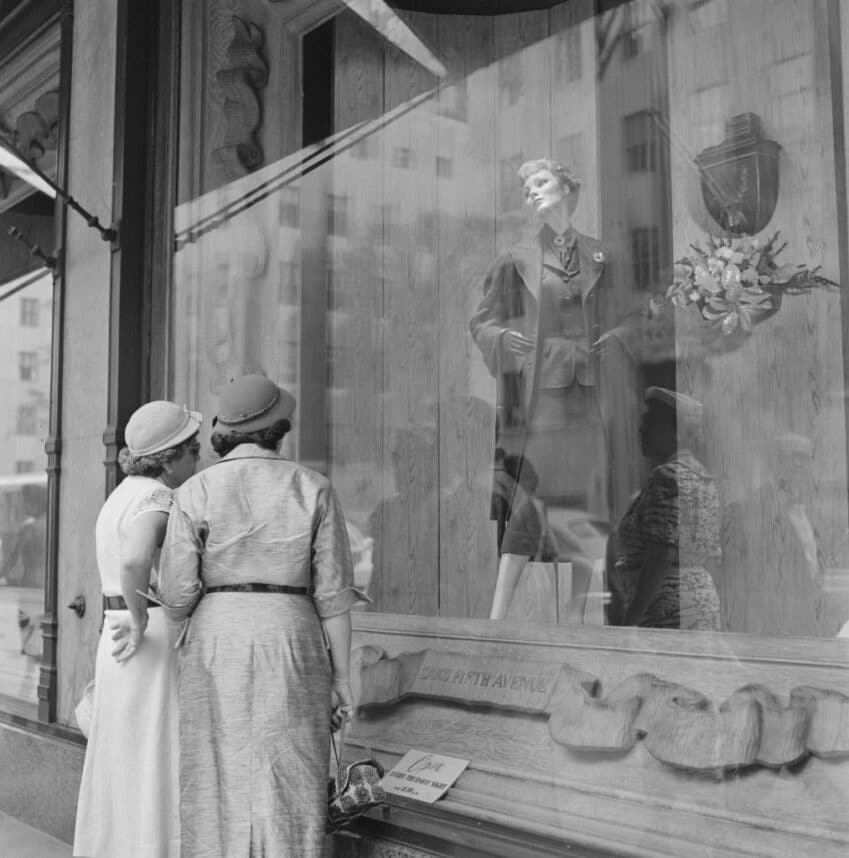
Two women window shopping outside Saks Fifth Avenue clothing store on Fifth Avenue, New York City, circa 1952. (Photo by Pix/Michael Ochs Archives/Getty Images)

As a high school kid in the Bronx, upscale stores were my day ticket to fantasyland. When the dreariness got me down and I needed an escape, my best friend and I skipped school and took the D train downtown. In 30 minutes we would get off at Rockefeller Center, cut to Fifth, and spend a few hours wandering up and down the avenue dashing through the best, most elegant stores. Now I think of it as “Ferris Bueller’s Day Off”—if Ferris was a girl from the Bronx yearning for more, better outfits to wear to school.

Did we try things on? Yes! Did we treat ourselves to a ladies lunch at the dainty tea room at Lord & Taylor? Yes! Did we ever buy anything? Rarely, but I do remember saving for ages to buy a pair of clunky shoes that made me stand out among the more plebeian high school girls whose mothers were still shopping with them. Did we ever get caught? If our parents suspected anything, they never said a word. Sales people mostly ignored us. Senior year we both got after school jobs in snooty department stores that demystified the glamour but did come with a 30% discount.

But by the time I moved to Los Angeles in the early ‘80s, Robinson’s Beverly Hills and Bullocks Wilshire were starting to smell of moth balls and stale perfume. Nonetheless, I made the scene at Bullocks Wilshire’s tea room just minutes before the doors closed in 1993.

It’s common knowledge that retail is in the midst of reinventing itself now that we are all Amazon shoppers. But e-commerce will always be a pale replacement for feeling fabric against your skin, seeing how color changes everything, or having a salesperson who cares about finding you another size. Other than that short ping of adrenaline that comes from completing an online purchase, modern shopping is a joyless, lonely experience. Please don’t tell me how easy online returns are; I didn’t retire to run a small mail room.

There’s no going back. But I can’t help feeling nostalgic for the quintessential urban experience that exists today only in a few old-world pedestrian cities. I suppose I’ll just have to return to Paris.


Los Angeles food writer Helene Siegel is the author of 40 cookbooks, including the “Totally Cookbook” series and “Pure Chocolate.” She runs the Pastry Session blog.

Taking the D Train Read More »

Israelis Need to Understand that Jewish American Support for Israel Is Changing

The various protests and marches in the past months across Israel have generated international attention, and with so much focus on overhauling the Supreme Court and the very structure of Israel’s democracy, Israelis can be forgiven for missing another existential threat that is coming from the United States. This danger, almost unthinkable just a decade ago, is the very real possibility that the Jewish American community is turning away from its unwavering support for the State of Israel.

While there are many Israelis who are not interested in American support and think that Israel can handle its affairs without any assistance from partners, the fact of the matter is that Israel has long benefitted from the political and economic support of both the United States and American Jewry. Today, however, the longstanding support of Israel among many Americans is weakening among both America’s political elite and the masses and notably also among America’s Jews. Israelis need to wake up to the reality that Jews are leading the charge to end financial, military and cultural support to Israel, which could be deeply dangerous to the Jewish state in the years to come.

Data from a recent national survey of American Jews sponsored by Keren Keshet in 2022-23 are sobering and cannot be overlooked. The survey reveals that the biggest threat to support for Israel among the Jewish community comes from the rising power and growing  population of Jewish progressives. As a group, these Jewish progressives tend to mirror other progressives in the United States and place undue emphasis upon the Tikkun Olam (social justice) dimension of Jewish life, while downplaying other valued aspects of Jewish tradition. They may also be seen as unduly critical of Israel to the point of undermining the political and moral legitimacy of the Jewish State.

Although their numbers are still small relative to the overall community—the Keren Keshet survey finds that about 8 percent of American Jews identify as progressive, while 47 percent of Jewish Americans are in the left camp (liberals and progressives), 34 percent are moderate, and 19 percent are conservative—left-wing progressive Jews are organized, vocal, engaged and disproportionately influential on the current national political scene. And before dismissing these ideologues as just a fringe element of the political world, consider that progressives have become a powerful national force in Congress and electoral politics and in the educational world with pushing anti-racist agendas and creating divisive diversity, equity, and inclusion offices across the nation’s higher education campuses.

What Israelis must understand now is that these progressive Jews are appreciably less engaged in Jewish life and with historic Jewish institutions than their more moderate, liberal and centrist counterparts. Critically, they lack the traditional pro-Israel sentiments that have been a hallmark of the Jewish American community for decades. The survey data powerfully demonstrate that when compared with liberals, progressives are notably less likely to have visited Israel (21 percent versus 34 percent). Moreover, progressive Jews are less likely to feel at least somewhat emotionally attached to Israel and by quite a large gap: 31 percent versus 50 percent. So, yes, some progressive Jews are both attached to Israel while also taking deeply critical positions toward current government policies, just like many Israelis. That said, a large number—perhaps a majority—are not merely critical of Israeli policies, but also distant if not hostile to the very idea of a (or the) Jewish State.

The largest difference on Jewish engagement items between progressives and all the others, however, emerges when respondents are asked directly about American support for Israel. When queried if the United States is too supportive of Israel, a huge 42 percent of progressive Jews agree with that statement compared to just 11 percent of other political groups.

Given the political sorting in the nation and the fact that progressive Jews have taken on the political and ideological position of progressives more generally at the expense of traditional values and practices, supporting Israel is almost impossible. For many of these very liberal Jews, Israel is believed to be on the wrong side of the narrative and one’s position on the Jewish State has become a key test of ideological purity and commitment. Thus, being highly critical if not overtly hostile toward Israel is not simply one stance among others for Jewish progressives: It is a defining feature of their political identity.

Thus, being highly critical if not overtly hostile toward Israel is not simply one stance among others for Jewish progressives: It is a defining feature of their political identity.

While the Jewish progressive movement and agenda has not completely taken over the agenda and ideology of the American Jewish community, numerous groups—from Repair the World, Truah, Jewish Voice for Peace, Bend the Arc, and If Not Now—have all benefitted, despite their many ideological and stylistic differences, from a surge in Jewish ideological engagement on the left. Progressive ideology is ascendant and, like what is being seen in American politics more generally, this growing bloc of progressive Jews may fundamentally alter the political priorities and preferences of the Jewish community going forward. Many progressive Jews have radically extreme views about social justice and Israel with notably anti-institutional and anti-religious inclinations; Israel will be seriously harmed if it becomes even more isolated and loses support of both Americans and the American Jewish community.


Samuel J. Abrams is a professor of politics at Sarah Lawrence College and a senior fellow at the American Enterprise Institute.

Israelis Need to Understand that Jewish American Support for Israel Is Changing Read More »

A Game Plan for the American Jewish Future

Several weeks ago, on these pages, I laid out the “unthinkable” challenges facing our society. In that piece, I described the mindset of American Jewry: “This contemporary state of anxiety is framed around an assault that Jews are experiencing in connection with their love affair with America, reminding one how deeply invested Jews have been in this society.”

In this piece I am seeking to build the internal Jewish response, to be followed by a second article addressing the broader and future role for the Jewish community within the American public square.

Just as American culture and politics are undergoing significant change, so too is American Judaism. If Jews are to play an effective role within the broader society, they must first deal with the extraordinary issues and divisions internal to our community.

Today, we are experiencing a new normal, driven by a structural “revolution” upending the existing communal order. The impact of changing generational expectations, the presence of economic pressures, the emergence of social media platforms and the realities of declining loyalties and trust are producing new policy and structural outcomes for 21st-century American Judaism.

Reflections on the Past

At the outset, it is essential to understand the 19th-century organizing ideas that framed the Jewish communal system. These principles gave shape and context to our current condition and served as the basis of our core beliefs.

Capitalism: This economic model defined 19th- and 20th-century American life and more directly, the American Jewish experience. The Jewish religious and social service networks adopted this competitive, corporate business framework.

Denominationalism: A series of religious “awakenings” contributed to the reshaping of American church/synagogue life. In the aftermath of the Civil War, “denominationalism” would be the formula around which Americans would create their religious identities.

Progressivism: In the late-19th century, progressive ideas about social service would inform how the nonprofit sector would be organized. These same ideas led to the formation of the Jewish communal order, involving the establishment of federations and their allied agencies. These overarching social ideas emphasized a “melting pot” formula for developing communities and organized them around a particular set of ideals and social welfare initiatives.

Universalism and Brotherhood: These ideological ideals, constructed in the early decades of the 20th century, fostered a perspective of how Jews, among others, might embrace the broader society. This focus de-emphasized particularism, sectarianism and separatism in favor of a global outlook on humanity, and in the process rejected elements of nationalism and communalism.

Manifest Destiny and American Exceptionalism: While seen as competing with the idea of universalism, this distinctive focus on America would also profoundly influence Americans’ belief about this society and our unique role in the world. Jews would interpret these concepts as representative of the “Golden Medina” (the perfect society).

Urbanization and Second Industrial Revolution: The growth of America’s cities and the evolution of this nation’s economy would take on special significance in the second half of the 19th century. A portion of that story is aligned with the arrival of the American railroad as linking the nation together and providing the means for creating the essential connections not only for business and trade but also for religious and cultural links to be fostered and maintained. As an urban peoples and culture, Jews would benefit and contribute to the development of America’s great cities.

Managing Forward

The great ideas of the 19th century that helped frame and shape our communal ideas and institutions have given way in this new century to an alternative set of forces, including the rise of technology, the focus on the sovereign self, and the presence of consumerism. If we saw during this earlier iteration the creation of financial and industrial growth and religious expansion, in this current time frame we are operating in a shifting environment of rapid social and structural change, cultural disruption and economic uncertainty. 

We need to understand how we as a community are changing, and in what ways the pandemic and other factors have transformed us. The economic realities, the emerging demographic characteristics, and the changing generational patterns represent ingredients to this unfolding picture of how we will operate in the decades moving forward.

Unpacking the Contemporary Jewish Community

As with the larger society, the Jewish condition is rapidly and radically changing. There will be increasing pressure on our community to reposition itself, to reclaim its political and social influence. No doubt, this will be more difficult considering the internal divisions that today define the American Jewish polity. Power can only accrue as a communal system demonstrates a heightened level of solidarity, focusing on a collective agenda, while effectively managing internal threats and challenges.

In this century, we are encountering a new organizing scheme that sees community through an inverse lens. We are reminded that the traditional communal system operated as a federalist structure, employing a top-down model of distributive power and a built-in competitive framework. Today, we are experiencing a bottom-up and an outside-in realignment of communal power and practice.

Historically, this system operated in institutional silos. This competitive framework served us well, but in this moment, collaborative partnerships will need to shape our operational practice. We no longer have the financial capacity, demographic base, or institutional resources to operate in structural isolation. There is a significant set of transformational changes taking place leading to this communal reformulation.

The Upending of Community: Realignment and Reimagination

The Great Paradigm Shift: Today, many of our traditional organizations are saddled with a 19th-century legacy structure, while managing a 20th-century agenda, as we engage a 21st-century community.

If the 19th century created the essential building blocks for the community, the 21st century will afford American Jewry a range of new ways to express and experience Judaism. If in the past, we saw American Judaism as denominationally based, in this century we can best describe religious behavior as personalized where multiple “Judaisms” are in play. With the availability of an array of choices, accessible through social media and other platforms, Judaism is not only taking on a new delivery mechanism but also is being presented through various portals in a variety of new ways. Collaboration and connection will serve as the operating modality, even as we experience new forms of Jewish religious and communal diversity.

The Great Power Shift: If the core needs of our community defined Jewish organizing of the 19th century, then innovation is driving 21st-century institutional behavior and practice. If federations managed the communal agenda of the last century, then today community and family foundations, as well as individual funders, are reshaping 21st-century Jewish life.

The New Political Reality: If American Jews believed that in the decades following the Shoah and the founding of the State of Israel, as a people we would experience greater security, in this century our community is confronted with the presence of new threats to global Jewish and Israeli security. Anti-Israel and antisemitic sentiment and actions may well define and reshape this century’s Jewish experience.

The Birth of Ideas: In the 19th and 20th centuries, New York was seen as the American “Jewish Capital” and center of Jewish life, where ideas and practice moved from east to west. Today innovation is unfolding everywhere on this continent, with many of the current demographic and organizational trends now moving in reverse, from west to east.

A New Economic Model: If American capitalist ideas described and framed the behaviors of the historic Jewish organizations over two earlier centuries, currently various alternative forms of economic practice, including collaborative engagement, entrepreneurial behavior, and community organizing models have come into play.

The Jewish Boutique Revolution: Beginning in the mid-1980s, a new American Jewish revolution was unleashed with the emergence of “boutique” organizations, which have become an integral part of the communal market space. This organizing model is centered on innovation, individualism and entrepreneurship, with the rise of single-issue constituencies and the presence of independent institutional builders. By contrast, “legacy” organizations of the previous two centuries were seen as formal, networked and corporate structures. In the wake of this “revolution” we are witnessing the undoing of the Jewish collective, where today a variety of institutional options are competing for brand recognition and funding.

Whereas in the past, American Judaism was constructed in order to help accommodate Jews to a new society, the Judaism of today is being reshaped by such broader social forces as diversity, inclusion and equity. Technology is revolutionizing how religious cultures are delivering their messages, services and programs. Demographic, economic and generational patterns are fundamentally transforming Jewish life. New forms of organizational practice, cultural behaviors and structural experimentation are each contributing to this communal revolution.

Power Shifts: If Jewish political influence and philanthropic giving were centralized during the second half of the last century, where ADL led the fight against antisemitism, AIPAC managed the Israel political case, the Reform Movement defined the liberal domestic agenda, AJC controlled inter-religious affairs, and Federations dominated the Israel giving field and Jewish social service marketplace, the 21st century has exploded with the presence of an array of Jewish advocacy initiatives, multiple boutique giving options, and the presence of distinctive, highly-segmented organizing models, all now competing for communal space and a share of the Jewish market economy.

We will require a new financial partnership that allows us to bring together our federations, community foundations, family funders, and major donors in collective action to aid those in need as well as to address the long-term needs and strategic directions for our institutions, synagogues and schools. We have the opportunity to launch new initiatives, possibly establish a Jewish Innovation Lab, designed to draw on our collective resources and to expand the multiplicity of ways to “be Jewish” in this century.

Collaborative Leadership: If lay leadership drove the communal agenda in the 19th and 20th centuries, Jewish professionals, outside experts and corporate contractors are managing/directing this century’s Jewish infrastructure. The imprint of technology and economic data points reflect the contemporary behavior of the Jewish marketplace. If the communal space was seen as a growth industry in the last century, it is likely to be understood as being in a state of recalibration and downsizing in this time frame. Historically, within the American Jewish economy, competition shaped communal outcomes; collaborative initiatives however will likely drive the Jewish communal future.

On Dialogue: As a community facing many internal divisions, we have a vital stake in nurturing essential conversations among Jews around Israel and intra-Jewish matters. Finding avenues of communication among peoples should represent a core priority, as we seek to make whole a divided constituency. The excitement here is that there are already venues committed to enhancing these essential conversations, including such initiatives as Resetting the Table.

As a community facing many internal divisions, we have a vital stake in nurturing essential conversations among Jews around Israel and intra-Jewish matters.

 The Tasks Before Us: Managing the great external threats to our democracy and our community must begin with a richer understanding of how as a communal system we are changing and how we can re-establish a viable and dynamic Jewish community. As with all Jewish history, if our internal mechanisms are not successful in reaching and serving our people, our capacity to wage an effective response to the events beyond us will be greatly imperiled.


Dr. Steven Windmueller is an Emeritus Professor of Jewish Communal Studies at the Jack H. Skirball Campus of HUC-JIR, Los Angeles. His writings can be found on his website, www.thewindreport.com.


 

A Game Plan for the American Jewish Future Read More »

43 Years of Baby Steps

On the Friday night of Shabbat Shuvah 43 years ago, I began my return to Judaism. I was living in Marina del Rey at the time, and I said to my roommate, “It’s Shabbat Shuvah and I am shuv-ing!” I’d been wrestling with whether to become more observant for over a year, and on that night, I committed to taking the first step. 

I strolled up the Venice Boardwalk to the Pacific Jewish Center, now known as Shul on the Beach, in Venice, California. I came to the door, where Michael Medved, co-founder of PJC, greeted me with a smile. When the services were over, I prepared to leave; I’d promised a friend I would meet her for coffee after shul. Michael approached me and asked if I would be available to go to someone’s home for Friday night dinner. I was amazed. The last person who had invited me to their home for dinner was my mother. I stammered that I had to cancel my plans with a friend, and Michael said it was no problem; my hosts would wait. I walked up the Boardwalk to a payphone and put in a dime (this was 1980, remember). I told my friend we’d have to reschedule and hung up. The dime came back. My first thought was, “God doesn’t want me to spend money on Shabbat!”

I enjoyed a lively Shabbat dinner and was soon a regular attendee at the Pacific Jewish Center. If you had told me in 1980 that in 2023, I would be a senior member of that shul, that I would have been married for 38 years, and have Torah-observant children and grandchildren, I would have been incredulous. Yet over the years of regularly attending Shabbat services, being hosted graciously in many homes, and absorbing the beauty of Torah life, I became an observant Jew. 

On Rosh Hashanah, I hosted a group of people who were at the beginning of their Jewish rediscovery. Seeing them struggle with the blessings after the meal, I remembered that at my first Shabbat meal, the blessings seemed both interminable and incomprehensible. Today, I know them by heart. When I began trying to daven the silent prayer, the Amidah, I was overwhelmed at the prospect of deciphering all that Hebrew. Rabbi Daniel Lapin suggested that I take it one paragraph at a time, moving at my own pace until I felt comfortable enough to move on. Today, the prayers flow smoothly. 

Personal transformation rarely happens in a moment. It’s about taking baby steps. Lighting Shabbat candles, even if you turn on the TV after you light. Forgoing the side order of bacon at brunch, not because you don’t like bacon but because it’s not kosher. Letting that Saturday phone call go to voicemail because it’s Shabbat and you are going to refrain from answering that one call. Every small thing we do because we believe that is what Jewish tradition demands from us is a step toward a more spiritual life. 

Looking back, I find it hard to wrap my head around the notion that I have been on this path for most of my life. At Shul on the Beach, I have seen many rabbis and key congregants come and go. But what remains the same? Shabbat. Yom Tovim. Community. Torah.

Simchat Torah is a reminder that an observant life is not meant to be one of grudging, drudging compliance with a set of musty laws. It is a path of pleasantness, meant to bring meaning and joy into every aspect of life.

Preparing to celebrate Simchat Torah, I focus on the holiday’s name: Joy of the Torah. Many years ago, I was struggling with a detail of Shabbat observance, and a trusted rebbetzin reminded me of what we sing every week as the Torah is returned to the ark: “It is a tree of life to those who hold fast to it … its paths are paths of pleasantness.” In other words, if I was not experiencing joy in my Jewish practice, I wasn’t doing it right. Bringing joy into the ritual transformed it. Simchat Torah is a reminder that an observant life is not meant to be one of grudging, drudging compliance with a set of musty laws. It is a path of pleasantness, meant to bring meaning and joy into every aspect of life.


Elizabeth Danziger is the author of four books, including Get to the Point, 2nd edition, which was originally published by Random House. She lives in Venice, California.

43 Years of Baby Steps Read More »

Chabad Rabbi Sells Etrogs from Italy, Israel Bonds Affair, JNF-USA Israel Mission

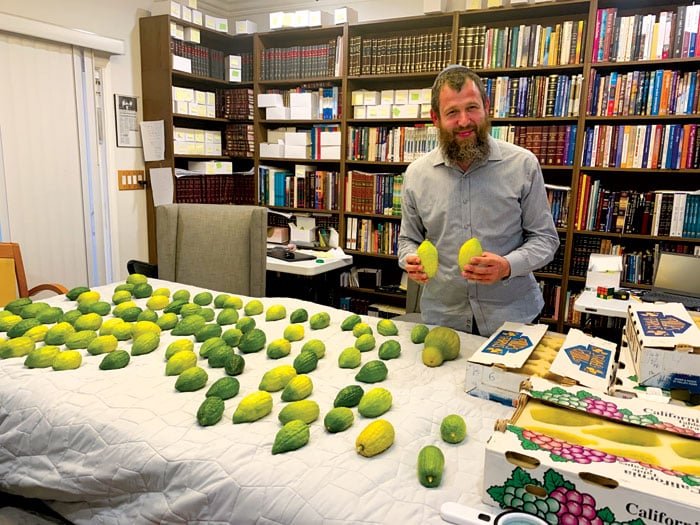
Ahead of Sukkot, Chabad of the Valley Rabbi Yanky Khan sells etrogim out of his Tarzana home. Khan harvests the ritual fruit in Calabria, a coastal region in southern Italy, before having them imported to the U.S. 

Calabria etrogim are popular among leaders in the Chabad movement for a variety of reasons, including the history of the region’s farmers adhering to kosher practices when growing the citron trees. Additionally, the first rebbe of Chabad taught that God instructed Moses to collect an etrog specifically from the Calabria region.

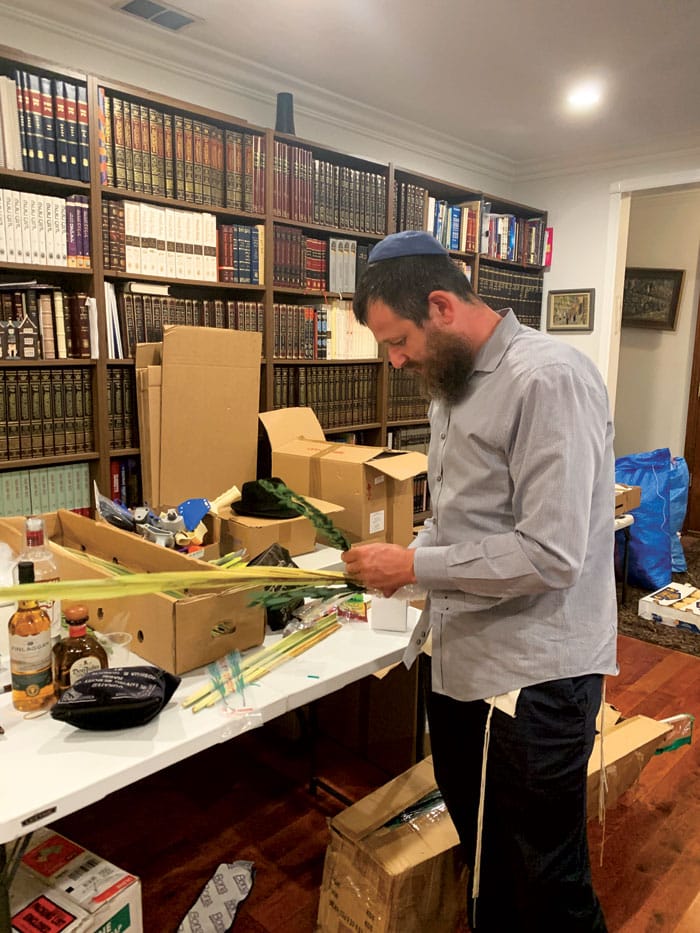
Rabbi Yanky prepares a lulav, which he’ll give to a member of the community. Photo by Ryan Torok

Khan inspects each of the fruits with a magnifying glass to see what imperfections there may be on their surfaces. The number of flaws determine the price of etrog — which can range from $40-$100 — but, ultimately, the buyer determines what’s aesthetically pleasing to them, he told the Journal.

“It’s a very unique question as to what’s beautiful,” Khan said. “Beauty is in the eye of the beholder.”

Khan has been in the etrog business for nearly 30 years. The father of four travels to Italy multiple times a year to check in on the progress of the etrogs, which are grown on leased land. 

Along with the etrogs, he offers lulavs and sukkah supplies to members of the community. To those who cannot afford the cost of the objects, he provides them at no cost.


Jewish Journal Publisher David Suissa (center) presents awards to Holocaust survivors Pnina Sharf (left) and Joseph Alexander (right) at an event hosted by the Israel Bonds Western Region.
Photo by Linda Kasian Photography

On Sept. 13, Israel Bonds Western Region paid tribute to bravery in its different forms by honoring the members of Unit 669, the Israel Defense Forces’ elite airborne evacuation and rescue unit, as well as two local Holocaust survivors.

During the Prime Minister’s Club event in Los Angeles, participants had the rare opportunity for an up-close and personal conversation with the special operatives of Unit 669, which was formed because of the need to rescue pilots who abandoned their aircraft over enemy lines. Since then, the unit’s areas of responsibility have expanded significantly. The elite unit specializes in aerial rescue missions for soldiers and civilians, regardless of location and conditions.

The event’s attendees included Laura Stein, who serves on the national board of directors and on the national campaign advisory committee of Israel Bonds, as well as Israel Bonds President and CEO Dani Naveh.

Along with recognizing the accomplishments of the IDF’s Unit 669, Israel Bonds also honored Holocaust survivors Joseph Alexander, 100, who lived through 12 Nazi concentration camps, and Pnina Sharf, 82, who was born in the Demblin ghetto and grew up in different labor and concentration camps. Jewish Journal Publisher and Editor-in-Chief David Suissa presented their awards.

“What better way to showcase a unit like 669 while as a backdrop to its story, we honor two Holocaust survivors?” Erez Goldman, executive director for the southwest region of Israel Bonds, said. “Ask yourselves, what is the meaning of one without the other? I truly hope that tonight’s event will keep all of us on the right track and reaffirm to us that we can never let politics of the moment overshadow the greatest moment in Jewish history we are all living through now.”

For more than seven decades, Israel Bonds has generated $49 billion worldwide, across all Bonds entities, in financial support for the building and development of every sector of Israel’s economy. The first Israel Bonds were issued in 1951 and have since played a decisive role in Israel’s evolution. 


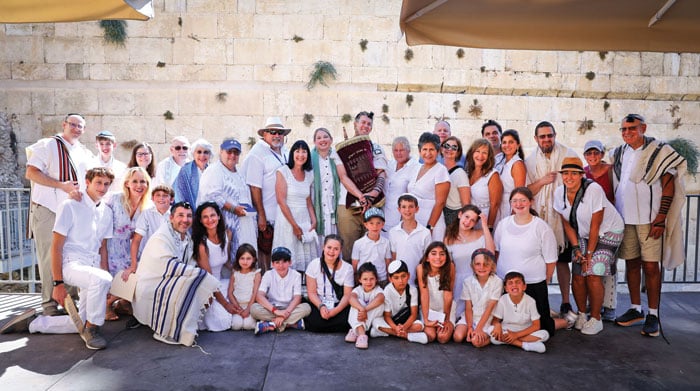
Sinai Temple and JNF-USA’s mission participants at the Western Wall in Jerusalem. Courtesy of JNF-USA

Recently, three generations of Los Angeles community members went on Sinai Temple’s mission to Israel, where the attendees reconnected with their roots and learned about their heritage while enjoying the classic tourist destinations the country offers.

The two-week tour took more than 40 Sinai Temple members, including several rabbis, on a “backstage pass” style trip throughout Israel. From praying at the Kotel to swimming in the Dead Sea, the trip balanced traditional experiences with visits to sites most tourists don’t even know exist.

“We are so excited to partner with Jewish National Fund-USA, showing our congregants both the historical and modern Zionist vision,” Sinai Temple Senior Rabbi Nicole Guzik said. “The organization really was the inspiration for this trip.”

Chabad Rabbi Sells Etrogs from Italy, Israel Bonds Affair, JNF-USA Israel Mission Read More »