
fbpx

September 1, 2023

Will Jews Continue To Flee Russia in Large Numbers?

To read more articles from The Media Line, click here.

After the Wagner Group led by the rumored-to-be-Jewish Yevgeny Prigozhin took over Russian military installations and threatened to drive 700 miles north and launch a coup in Moscow, many feared that Russia’s Jews would become scapegoats.

The incident infused a new sense of uncertainty into the country, already reeling from international sanctions linked to its war on Ukraine.

But will the aborted uprising spur a further exodus of Russia’s Jews?

Russia’s invasion of Ukraine in February 2022 triggered a wave of Jewish emigration from both countries, many of whom moved to Israel. Over 43,000 Jews from Russia and over 15,000 from Ukraine moved to Israel in 2022, accounting for almost 80% of Israel’s total immigration that year.

In the past 17 months, 64,633 Russians have moved to Israel, according to the quasi-governmental Jewish Agency.

If the trend continues, over half of Russia’s Jewish population will be gone in seven years, according to a report published by the London-based Institute for Jewish Policy Research last week. The institute estimates that some 145,000 Jews and an equal number of part-Jews who have at least one Jewish parent live in Russia.

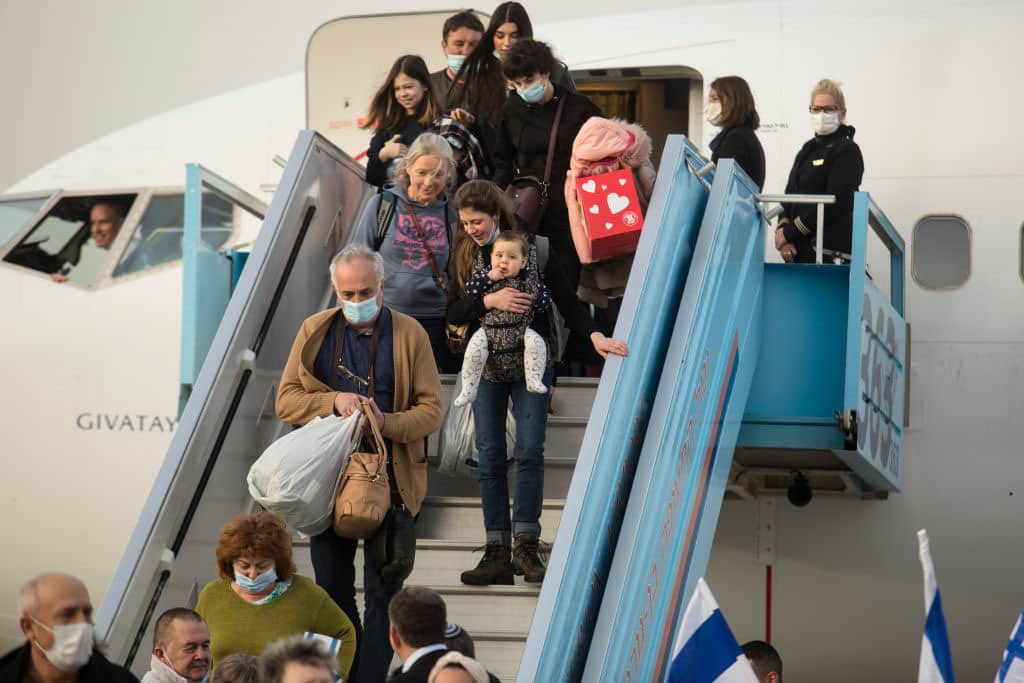
A Ukrainian family reunites In Tel Aviv’s airport after fleeing Russian invasion on March 6, 2022 (Photo by Amir Levy/Getty Images)

However, some Russians working with Jewish organizations say it is too early to tell whether the wave of Jewish emigration will continue.

Tanya Lvova, deputy director of the Eva Jewish Welfare and Community Center in St. Petersburg, said that most of her center’s 2,000 Jewish beneficiaries are elderly and uninterested in leaving.

She said that the war in Ukraine has not, to date, triggered threats against the Jewish community.

“We were worried a year ago that [threats against Russian Jews] might happen, but they didn’t,” Lvova told The Media Line. “I don’t see a rise in antisemitism in my surroundings. The [Russian] state does not support antisemitism, and we hope it stays that way.”

In fact, Lvova said, “Russia has been one of the least antisemitic countries in the last decade.” She said that although anti-Jewish sentiment has grown in the US and France, it is “not fashionable” in Russia.

Nevertheless, Lvova said that almost half of the participants in her organization’s family camps have recently migrated. These participants were particularly active in the Jewish community and had “always been interested” in moving to Israel, she said.

Howard Flower, director of Jewish immigration to Israel for the International Christian Embassy in Jerusalem, said the number of newcomers from all parts of the former Soviet Union might increase this year.

Jewish immigration to Israel from Russia and the former Soviet republics is “quite high now due to uncertainty,” Flower told The Media Line.

Flower recalled his first visit to St. Petersburg in 1992, when Russian Jewish emigration to Israel spiked following the Soviet collapse.

He said the numbers today are similar and “we will know better by the end of the year” whether that trend continues.

The author of the report for the Institute for Jewish Policy Research, demographer Daniel Staetsky, called 2022 “a watershed year” for Russian and Ukrainian Jews.

“If migration from these countries continues for seven years at the levels seen in 2022 and early 2023, 80% to 90% of the 2021 Jewish population of Ukraine and 50% to 60% of the 2021 Jewish population of Russia will have emigrated,” he said.

Staetsky warned that mass Jewish migration could signal “a wider storm.”

In the past, the widespread relocation of European Jews followed major political events, such as the rise of the Nazi regime in Germany in the 1930s or the collapse of the Soviet Union in the late 1980s-early 1990s.

In mid-2023, the scale of Jewish migration from Russia and Ukraine offers “ominous signs of a major, possibly catastrophic, political crisis in Europe,” Staetsky wrote.

Flower said that while the Wagner Group incident “captured the world’s attention,” it is unclear whether the brief uprising has rattled Russia’s Jews sufficiently to make them move.

In 1993, then-President Boris Yeltsin sought to suppress rebels in Moscow by calling out the tanks. Pro-coup fighters briefly seized the Russian parliament and TV station. It was “dramatic but ended quickly,” Flower said.

Will Jews Continue To Flee Russia in Large Numbers? Read More »

Steps Toward Rosh HaShanah – The Good, the Bad and the Ugly


Bitter Bros.  Hardware Store on Allenby in Tel Aviv

Steps Toward Rosh HaShanah

The Good, the Bad and the Ugly (coinciding with Parshat Ki Tavo 2023) (adapted from previous versions)


Back when I was in high school, I used to frequent one of those cavernous book stores, down in Long Beach, California. Piles of books, floor to ceiling, mostly paperbacks. I had developed a love for poetry and found treasures in this roughly organized warehouse. I bought anthologies for 15 cents. I discovered this poem, written by Stephen Crane. He was 24 when he published it in 1895. He died when he was 28. I remember reading it, shuddering. I quote it often, badly. So here it is, as written:


In the desert
I saw a creature, naked, bestial,
who, squatting upon the ground,
Held his heart in his hands,
And ate of it.
I said, “Is it good, friend?”
“It is bitter – bitter,” he answered;
“But I like it
Because it is bitter,
And because it is my heart.”


  • From “The Black Riders and other Lines” #3, 1895


Now that I know some Bible, I cannot help but think that Stephen Crane had Proverbs 14:10 in the back of his mind, “Lev yode’a marat nafsho”  “The heart knows the bitterness of its soul. . .”


I have spoken about two kinds of Teshuvah (return, penitence), one of our core drives during the Days of Awe. One kind of Teshuvah, the moral type, means working out harm done to other people by taking responsibility and apologizing. The other kind of Teshuvah is harder to describe. The second Teshuvah, the more spiritual version, means returning to a path of well-being, goodness and righteousness. Sometimes it means returning to that which we have not yet been.


Many of us, when we look over our lives, see mistakes, confusion, wrong paths taken, and even, now and then, real harm done to others. We feel guilt, remorse, regret and sometimes shame. Others of us focus on the harm that others have done to us. We feel anger, resentment, and see ourselves as a victim. The deeper we go into reflecting on living our complex lives, the more we see that we never had enough wisdom when we needed it the most. We lacked the wisdom needed not to cause avoidable harm. We lacked the wisdom work our way through confusion. We sometimes look back on life and don’t understand why we did what we did.


We lacked the wisdom to work through guilt and regret. We often lacked the wisdom needed to withstand the harm that others inflict upon us. We often lacked the wisdom of not allowing our resentment of others to ensnare us. In those moments of painful insight, we can feel that queasy sense of the soul that Proverbs teaches – “The heart knows the bitterness of its soul.”


I think for some of us, we cannot do full Teshuvah (return, repair, penitence) in either realm, the moral or the spiritual, without encountering the bitterness of our souls. We must feel the depths of our pain, our own brokenness, the tragedy of our story. I also think for real Teshuvah in either realm, we must be able, when appropriate, to have empathy for others. Anger, resentment and blaming can be as damaging for our inner growth as depression, guilt and shame.


Setting things as straight as possible in the moral, interpersonal realm is crucial. We must be accountable and, as much as possible, make amends. In the process of making amends, we must do the work of straightening out ourselves within. Know the truth of ourselves, hidden away in our depths.


We must admit the bad and the ugly – that we have done, that others have done to us. We are scarred, and we scar others. Sometimes through negligence and sometimes on purpose – we all sin. We must admit this and experience our own brokenness.


Psalm 51:19 tells us that the true sacrifice to God is a broken spirit, a broken and crushed heart. Truth can be bitter. We bring our bitter, broken hearts to the Divine altar.


We break apart the husks of guilt and regret, resentment and victimhood. Within the husk, we discover sadness, a holy sadness, an unbearable sadness – that can transform into light. The spark of a purified heart, a new and steadfast spirit, flows through us. We find the good – the light of love, gratitude, grace and kindness.


And then we make a prayer for ourselves: May that redemptive spark of light, redeemed through knowing our bitter and broken hearts, transform into a will, a diamond-like, will to be a channel of the light and the good.


That diamond-like will, crystal and clear, comes from encountering the bitterness of the soul that the heart knows. The good outshines the darkness of the bad and the ugly, the dreadful and the unbearable. The path is bitter, but it is good, because it is your heart, your soul, your life.


We have a choice to make every year. Shall we journey through these Days of Awe like sleepwalkers, oblivious to the pain in the soul and the truth about the disruptions between us and others?  Or do we use the teaching of these days to do Teshuvah – to return to an inner path of the good and the true that awakens us to life’s purpose?


Steps Toward Rosh HaShanah – The Good, the Bad and the Ugly Read More »

The Secret of Jewish Resilience

Totalitarians don’t like the truth. In the Soviet Union, reality was consistently denied, and bad news was ruthlessly censored. Josef Stalin’s declaration in 1935 that “Life is getting better, comrades! Life is getting merrier!” was turned into a full propaganda campaign, including a hit song. This joyous slogan was coined just a year after a four-year famine that claimed the lives of 8,000,000 people. A year later Stalin would launch the Great Purge, which would claim the lives of over 700,000 people. Life certainly wasn’t getting merrier.

Throughout history, authoritarian regimes from the Pharaohs down to Putin have hidden their failures. Ancient Egyptian records carry no mention of defeats; much the same is true in contemporary China and Russia, who have turned disinformation into an art form. Bad news is a challenge to the authority of dictators.

The Tanakh is very different. Joshua Berman writes that “the Bible displays a penchant for judging its heroes harshly, and for recording Israel’s failings even more than its successes. No other ancient Near Eastern culture produced a literature so revealing of fault….”

The Tanakh’s willingness to grapple with bad news launches a culture of authenticity and responsibility. Even more astounding is the obligation, found in Deuteronomy (26:5-9), to revisit the worst moments in our history at the most joyous of times. “Parshat HaBikkurim,” or the “The Declaration of the First Fruits,” was a short proclamation read by farmers when bringing their offering of first fruits to the Temple. In it, a short precis of Jewish history is offered:

“My father was a wandering Aramean, and he went down to Egypt and dwelt there, few in number; and there he became a nation, great, mighty, and populous. But the Egyptians mistreated us, afflicted us, and laid hard bondage on us. Then we cried out to the Lord God of our fathers, and the Lord heard our voice and looked on our affliction and our labor and our oppression. So the Lord brought us out of Egypt with a mighty hand and with an outstretched arm, with great terror and with signs and wonders. And He has brought us to this place and has given us this land, a land flowing with milk and honey..”

While thanking God for the new harvest, a farmer recites a proclamation that tells the Jewish story, starting from the patriarchs. It is a narrative of wandering and slavery, with equal space allotted to the misery of exile and the blessings of redemption.

Parshat HaBikkurim also becomes the central text of the Passover Haggadah, where it is punctuated with additional commentary.  The Mishnah states that the Haggadah follows a format that “begins with disgrace and concludes with their glory.” There are two theories in the Talmud about what this phrase means; but Rabbi David Tzvi Hoffman offers convincing arguments that the Mishnah is actually referring to the reading of Parshat HaBikkurim at the Seder, which emphasizes the humiliation of slavery before turning to the story of redemption.

The Seder starts with an extended retelling of the years of slavery. This is particularly notable because being a slave was considered a stigma in the ancient world. Yet for Jews, this section was of such importance that the Talmud says that one should recite the story of disgrace and slavery “in a loud voice.” (Sotah 32b).

But why? What exactly is the point of revisiting slavery?

“Begining with disgrace and concluding with glory” is certainly an effective narrative tool; one truly appreciates freedom after enduring slavery. The Zohar remarks that “one doesn’t understand a sweet taste until they have tasted bitterness.” Starting the narrative in the midst of the agony of slavery is a far more meaningful and dramatic way to tell the story of redemption.

Bondage in Egypt (Exodus 1), wood engraving, published in 1877 (ZU_09/Getty Images)

Remembering the disgrace of slavery also keeps one grounded. Maimonides explains that the shared lesson of the holidays of Pesach and Sukkot is that “man ought to remember his worst days in his days of prosperity. He will then offer a great deal of appreciation for God’s gifts, and learn the importance of a modest and humble life.” Success can corrode the soul, and allow people to imagine that they are invulnerable. The memories of slavery are meant to be humbling, a way to present the comfortable and prosperous with a more authentic picture of life.

A third possibility is that recalling the years of slavery can, paradoxically,  make us more resilient. Nicolas Taleb in his book Antifragile: Things That Gain from Disorder, notes that the opposite of being fragile is not being strong; it is being able to adapt to threats and overcome them. He uses the example of Hormesis, which is the ability of organisms to become stronger when exposed to low-dose stress. In humans, exposure to small doses of poison increases the body’s ability to cope with larger doses of that poison in the future; similarly, vaccines expose people to a weakened or dead form of a virus that triggers the immune system and readies it to fight off future threats.

On a psychological level, the same thing occurs when retelling family stories. Marshall Duke, a psychologist at Emory University, and his colleague Robyn Fivush, director of Emory’s Family Narratives Lab, have found that the most resilient children are those who are deeply familiar with their family’s history and are taught an “oscillating narrative”: that the family has had challenges in the past, but then were able to overcome them. Knowing their family history of adversity made the children psychologically stronger.

Resilience is psychological hormesis, where one learns how to transcend their personal challenges by remembering past challenges endured by their parents and grandparents.

Resilience is why we begin the Exodus story with an extended discussion of slavery. The traumas of exile over us an important lesson: We have transcended slavery in the past, and we can do so in the future. As Michael Walzer puts it: “Wherever people know the Bible and experience oppression, the Exodus has sustained their spirits and inspired their resistance.” We retell the story of slavery because it strengthens us, and helps us transcend future challenges.

Parshat HaBikurrim’s narrative about the Exodus from Egypt stands in marked contrast to the ways of ancient Egypt, which exaggerated its victories and hid its defeats. But that is precisely the secret of Jewish resilience to this day; and these former slaves are still going strong, while their masters have long disappeared from the world stage.

Jews continue to draw incredible strength from the Passover Seder. Natan Sharansky, who was imprisoned by the Soviet Union for nine years after he applied for a visa to emigrate to Israel, has spoken often about the meaning the Seder held for him in his years of imprisonment. During endless KGB interrogations, Sharansky would tell himself: “Your history did not begin with your birth or with the birth of the Soviet regime. You are continuing an exodus that began in Egypt. History is with you.”

Natan Sharansky (Photo by Ram Mendel under the Creative Commons Attribution-Share Alike 4.0 International license)

Sharansky would explain that he first learned about the Seder when he joined the Zionist movement at 24: “As part of my Zionist activities, I began to learn Hebrew in secret, in an underground ulpan. I celebrated the first Passover Seder of my life with my fiancé at the time, Avital (then Natasha), in Moscow. …As we didn’t know Hebrew well enough to read from the Haggadah, our teachers gave each of us a short part to memorize.”

A few years later when Sharansky was in solitary confinement, he continued to celebrate the Seder. As he put it, “Recalling the lines I had learned for my first Seder, I felt that our struggle continued…. I repeated the words of the Haggadah: ‘This year we are slaves, next year free men; this year we are here, and next year in Jerusalem.’…And I found out that this is the great place to …enjoy thinking that….next year we could be free people in Jerusalem.”

Here is the secret of Jewish resilience on full display. Sharansky draws strength from the Seder, which tells a story that “begins with disgrace and concludes with glory.”

The same holds true for all of us. No matter how awful the situation, we must remember that Jews have overcome worse in the past. And at the most difficult of times, we must never forget that tomorrow we could be free again.


Rabbi Chaim Steinmetz is the Senior Rabbi of Congregation Kehilath Jeshurun in New York.

The Secret of Jewish Resilience Read More »

CUNY Graduate Center President Stepping Down Shortly After Marc Lamont Hill’s Hire

The City University of New York (CUNY) Graduate Center president will be stepping down from her position by the end of September, leading to a dispute on social media on whether it was due to the controversial hiring of Marc Lamont Hill as a professor at the Graduate Center.

The New York Post reported that CUNY Chancellor Felix Matos Rodriguez said in a statement on Monday that they will be appointing an interim president to replace outgoing CUNY Graduate Center President Robin L. Garrell and will eventually name a permanent successor. “We congratulate President Garrell on her accomplishments, thank her for her service to the Graduate Center and CUNY, and wish her well in her future endeavors,” Matos Rodriguez said. No reason was given for Garrell’s departure.

New York City Councilwoman Inna Vernikov (R) celebrated Garrell’s resignation as a victory. “That @marclamonthill was even considered as a professor at CUNY is reprehensible,” she posted on X, formerly known as Twitter. “Together with [Former Assemblyman] @HikindDov we fought for swift action to be taken. While I am grateful the CUNY Chancellor @ChancellorCUNY acted and made sure the President who made this awful decision RESIGNS, it’s not enough and we aren’t satisfied. Every day that Marc Lamont Hill keeps his job at CUNY is a stain on this institution. He must be next. Hill must be relieved from his post immediately. I will work tirelessly to make sure it happens.” She subsequently added in a follow up post on X, “[CUNY Gradudate Center President] Robin Garrell, who allegedly made the final hire decision of @marclamonthill, sat through hours of our City Council hearing last summer, & listened to testimony after testimony about pervasive antisemitic & anti-Israel environment that students & professors face at @CUNY.”

However, Students and Faculty for Equality (SAFE) CUNY claimed in a post on X that “Garrell resigned because of a 700 campus member no confidence vote against her. It had NOTHING to do with Lamont Hill. It had nothing to do with Vernikov. Garrell’s resignation was in the works well before Hill was even hired.” Back in January, more than 700 faculty, staff and graduate workers signed a letter of no confidence in Garrell, Provost Steve Everett and Senior Vice President for Finance and Administration Brian Peterson.

Hill was fired from CNN in 2018 after he said in a speech to the United Nations, “We have an opportunity to not just offer solidarity in words but to commit to political action, grass-roots action, local action and international action that will give us what justice requires and that is a free Palestine from the river to the sea.” Hill responded to the controversy at the time by posting on X, formerly known as Twitter: “My reference to ‘river to the sea’ was not a call to destroy anything or anyone. It was a call for justice, both in Israel and in the West Bank/Gaza. The speech very clearly and specifically said those things. No amount of debate will change what I actually said or what I meant.”

He later apologized in an open letter to the Temple University community, where Hill had been working as a media and communications professor, that stated in part: “At the conclusion of my speech, I used a phrase (‘Free Palestine, from the River to the Sea’) that some have interpreted as anti-Semitic. Specifically, they believe that the phrase signified a call to physically destroy the state of Israel, or otherwise do harm to Jewish people. To be clear, this was not my intention at all. Indeed, I was genuinely saddened that my comments produced such an interpretation.” Hill also wrote, “While I stand behind my political beliefs, I have learned that my use of language produced interpretations, feelings, and responses that I did not intend. For that, I am deeply sorry.  Everyone deserves to live with peace, safety, and security. My vision of justice for Palestinians absolutely does not come at the expense of justice for Jews anywhere in the world. To anyone who felt that my comments suggested otherwise, I apologize.” In a 2019 interview with AJ+, Hill said regarding his “from the river to the sea” remarks: “When people were saying I was calling for the destruction of Israel in a speech where I was very explicitly and directly calling for Israel to be reformed, for me it was frustrating.”

Hill’s “from the river to the sea” remarks were condemned by Temple’s Board of Trustees at the time, which expressed “their disappointment, displeasure, and disagreement with Professor Hill’s comments, and reaffirm in the strongest possible terms the [university] President’s condemnation of all anti-Semitic, racist or incendiary language, hate speech, calls to violence, or the disparagement of any person or persons based on religion, nationality, race, gender, sexual orientation or identity.”

Hill told The Philadelphia Inquirer on August 22 that “Temple has been fairly hands off when it comes to intellectual freedom. There was one moment when the board voiced its displeasure, but if I look at the full 11 years … I would say I’ve had the space to be a very public intellectual and I’ve managed to be promoted to full professor and get tenure and get an endowed chair.”

Hill also told the Inquirer on August 22 that he has “always dreamed of” the opportunity that CUNY is providing, saying that his decision is “was much more a pull from CUNY than a push from Temple.”

Klein College of Media and Communication Dean David Boardman told the Inquirer, “I was proud to have Marc as a colleague and am excited for this new opportunity for him.”

CUNY’s hiring of Hill resulted in criticism on social media.

“.@MarcLamontHill was fired from @CNN for his unabashed anti-Israel rhetoric that often borders on antisemitism,” the American Jewish Committee posted on X. “Why, then, has he been hired by @CUNY? CUNY’s lack of intellectually diverse faculty at several of its schools is a detriment to every student, particularly for Jews.”

“This is the result of @CUNY having faced zero accountability for sponsoring hate speech at @CUNYLaw graduation & for numerous antisemitic incidents on campuses,” New York City Councilmember Ari Kagan (R) posted on X. “Now they hire a high profile professor who was fired by CNN for his horrible anti-Israel antisemitic speech calling for BDS [Boycott, Divestment and Sanctions] & for the end of Zionism & Israel. I am calling on the @CUNY board of trustees to not allow this dangerous hire to move forward that will leave CUNY’s Jewish students and staff feeling even less safe than they do now.”

New York City Councilmember Kalman Yeger similarly posted on X that CUNY’s hiring of Hill “is so on brand for @CUNY, that bastion of antisemitism: When your antisemitism is so vivid that even CNN feels compelled to fire you, of course it makes sense that [CUNY’s Graduate Center] recruits you.”

SAFE CUNY posted a lengthy statement on X that read in part: “We learned today that CUNY has hired renowned antisemite, Marc Lamont Hill. This is what systemic antisemitism means. This is what it looks like when a university fully commits to expunging its Jews –students, staff, and faculty alike. CUNY itself has already proudly described Hill, now at its Graduate Center Antisemitism Incubator as a ‘radical’ whose research addresses –surprise!—‘Settler-Colonialism–Palestine.’”

Bryan E. Leib, who heads CASEPAC, said in a statement: “The time is now for Members of Congress to find common ground on this issue and to call on CUNY Chancellor to rescind the hiring of Marc Lamont Hill. If CUNY doesn’t then Congress should be prepared to act in stripping all federal funding that CUNY receives.”

A CUNY Graduate spokesperson told The New York Post on August 23, “Professor Hill, a widely respected expert in his field, was unanimously selected by the Urban Education hiring committee for a position that focuses on advancing conversation and research about the role of education in American society. The committee reviewed the entirety of his scholarship and public comments, which include a public letter of apology for remarks made half a decade ago and his strong, unequivocal condemnations of antisemitism and antisemitic violence.”

Hill and CUNY did not respond to the Journal’s requests for comment.

This article has been updated.

CUNY Graduate Center President Stepping Down Shortly After Marc Lamont Hill’s Hire Read More »

We Must Celebrate Labor Organizing and Its Long History in Jewish Tradition

In the late-19th century, labor rights activists across the United States, entrenched in the depths of the Industrial Revolution, began to advocate for a national holiday that recognized the sacrifices and contributions of American workers. Following a robust advocacy campaign led by a coalition of preeminent labor unions, President Grover Cleveland officially declared Labor Day a national holiday on June 28, 1894.

But over a century later, many people who reap the benefits of Labor Day by taking the day off from work or school are unaware of its significance. With Labor Day approaching, it’s even more important that we, as Jewish people living in Los Angeles, understand the impact that labor organizing has played in our history, city and traditions.

Jews have been entrenched in labor organizing since the early years of the U.S. labor movement. In the late 1880s, many Jews, largely immigrants from Eastern Europe, joined labor unions. Jews played a central role in an 1886 strike for the eight-hour work day and founded the United Hebrew Trades in 1888. In 1909, the mostly Jewish women-led Uprising of 20,000 by the International Ladies Garment Workers Union (ILGWU) sought higher wages and better working conditions.

Female garment workers in Cincinnati sell newspapers to support their fellow workers in the International Ladies’ Garment Workers’ Union, who are striking in New York, circa 1910. (Photo by Paul Thompson/FPG/Hulton Archive/Getty Images)

While the dramatic strikes and drawn-out labor disputes of the Gilded Age may appear distant, many similar struggles exist today, several of which impact Angelenos. The ongoing strikes by the Writers Guild of America (WGA) and the Screen Actors Guild (SAG-AFTRA) are omnipresent in our city as writers and actors seek, among other things, better residual pay from streaming services.

The Torah states that “workers are entitled to eat as much as they like, provided that the food comes from the field in which they are actually working.”

Jewish texts actually set a standard for such an issue. The Torah states that “workers are entitled to eat as much as they like, provided that the food comes from the field in which they are actually working.” In other words, an employee has the right to receive a share of the money that the company earns. Beyond residual pay for actors and writers, this standard applies equally to more modern forms of compensation such as employee stock ownership options and tip sharing.

Members of Writers of America East and SAG-AFTRA hold signs while walking a picket line on August 29, 2023 in New York City. (Photo by Michael M. Santiago/Getty Images)

While the plight of those who supply our never-ending flow of streaming content is currently top of mind, many recent labor fights in Los Angeles have been overlooked. One such effort has been driven by UNITE HERE Local 11, a union of hotel, food service, laundry, warehouse and casino workers. Formerly led by renowned Jewish labor leader Myra Wolfgang, this major union has been striking for higher wages and better working conditions since their contracts with area hotels expired in early July.

Another labor struggle that can be tied to Jewish values comes out of Amazon. On strike to protest unfair and unsafe labor practices, Amazon delivery drivers and dispatchers are asking the company to install AC units in their trucks and to nix regulations on the amount of water allowed on a route. Further, those responsible for getting our coveted online orders from the warehouse to our front door want policies that prevent them from being overworked.

The Torah and Talmud both famously outline an ancient form of a “Fair Labor Standards Act,” which dictates that workers not continue labor at night. It goes on to indicate a limit on the amount of work an employee can do by designating a day of rest each week. This, of course, is known as the Sabbath, a weekly day of rest built into the Jewish calendar.

While major labor disputes continue to rage across the country, some unions have seen recent success. The Teamsters UPS Package Division, which was set to go on strike at the end of July, recently signed a new contract that affords drivers higher wages and better working conditions. This momentous achievement is a quintessential example of the power of organizing and collective bargaining, actions strongly supported by Judaism.

From our ancient texts to the Jewish-led strikes of the 20th century, labor organizing is deeply intertwined with Judaism. This Labor Day, I encourage my fellow Jewish citizens, particularly those in my teenage cohort who will have the day off while likely not understanding why, to explore this history and tradition. For in order to respect labor organizing, we need to first understand who and what came before us.


Simon Bank is a senior at Geffen Academy at UCLA and legislative fellow at the Jewish Center for Justice. He is a labor rights activist and is currently working with UCLA’s Professor Tobias Higbie on labor history research.

We Must Celebrate Labor Organizing and Its Long History in Jewish Tradition Read More »
