The agenda for the winter session of Israel’s Knesset can be described in all kinds of ways, all connected to the ultra-Orthodox.
One way: Passing a law that would exempt the ultra-Orthodox from army conscription for good. Another: Passing a law that will allow for more integration of ultra-Orthodox Israelis in the labor market. Another: A move that would finally end a crisis that has no solution. And finally: A move that will mark the beginning of the end of Israel’s “People’s Army.”
The last option — the fourth — is the most dramatic. And it is also the least talked about. Many Israelis believe that all Israelis must share the burden of military service. Many of them are angry at any plan that would exempt the ultra-Orthodox forever. Many are also worried because half of all ultra-Orthodox men don’t work. Some of them believe that it is more important for Israel that the ultra-Orthodox work than that they enlist. And we are all tired of the never-ending debate about drafting the ultra-Orthodox. They tell us in surveys that “they won’t enlist anyway,” so maybe it’s time to end this charade once and for all — let’s pass a new law and move on.
Few Israelis — too few — take the fourth option into account. But it’s a possibility that some experts believe is a certainty. The law that the government is slated to pass in October would be a watershed, beyond which the IDF will no longer be what it was. It will no longer be a “People’s Army.” Not in principle (because there is a law that exempts Israelis from conscription), and not in fact (because other Israelis will decide that if there is an exemption, they too deserve it).
The “People’s Army” brand has a practical function: it allows the IDF to recruit everyone, including the best and the brightest, to fill the ranks of the regulars and the reserves, to give Israelis a feeling of binding partnership. But the “People’s Army” brand also has a symbolic role: It is an essential part of Israel’s identity, a core feature of its character.
If Israel loses the IDF as a People’s Army, this will have practical and symbolic consequences. Security experts will have to deal with the practical consequences. What new model to adopt, how to maintain Israel’s security in a new era. Some of them say that there is no such possibility. This is a scary statement, but it is not necessarily relevant: if the IDF must change, they’d still have to sit down and devise a way to keep us all secure. They will have to square the circle, or whatever cliché you choose, and make Israel strong enough with an IDF that is no longer the “People’s Army.”
It is very difficult to imagine the State of Israel without the IDF as a central, dominant, unifying symbol.
Alongside this practical challenge, there is also a symbolic challenge. It is very difficult to imagine the State of Israel without the IDF as a central, dominant, unifying symbol. It is very difficult to imagine Israel without the ethos of the People’s Army. But you can try to do it, by looking at the many countries where there is no “People’s Army.” These are countries where the army is sometimes revered and sometimes less so, these are countries where a large part of the population are alienated from the military, do not know much about it, do not understand it. In those countries, the military is still and institution with an important role, like the Ministry of the Interior, or the Parks Authority, or the police.
In fact, the police is a good example with which to imagine Israel of the future. If the IDF is no longer the people’s army, it will be more like the police. That is, an institution that we all understand is important, and that we are all grateful to those who work in it, but it is not a unique Israeli symbol. No one says about the policemen that they are “our children.” We only say such thing about the soldiers. In polls that test approval and trust, the IDF is always at the top. The police is not.
So ahead of the winter session of the Knesset, one should take into account the possibility that this is exactly the move the government is leading to. And of course, its ministers will say no, that’s not true, what you say is unthinkable. And yet, there’s no other way to interpret a blanket exemption for a rapidly growing population. It might possible to have a military based on 80% of the population and still call it a “People’s Army,” and maybe 70%, or even 60%. But at a certain point – 50%? 40%? – the house of cards will collapse. There is no “People’s Army” when so many Israelis are exempt from it both practically and in principle.
An IDF that is not the “People’s Army” will be a completely different institution.
An Israel whose military is not a people’s army will be a completely different Israel.
Something I wrote in Hebrew
Connect the dots and discover a pattern. The government has a pattern. It has a unique character. Our current government is the We-Know-Better government. By accepting this theme as the defining theme of the government, suddenly everything seems clear. Finance Minnister Bezalel Smotrich thinks he knows better than the Shin Bet what will or will not cause the radicalization of Arab students. Justice Minister Yariv Levin thinks that politicians know better than judges how to handle citizens rights. MK Simcha Rothman believes that he is the outmost expert on constitutional law. MK Moshe Gafni knows better than the Bank of Israel how to manage the interest rate. Minister Itamar Ben-Gvir knows better than the police how to tame crime violence … This is a fascinating phenomenon, which mixes arrogance (we won the elections, a sign that we are smarter), with feelings of inferiority (so we don’t know math or English, so what?).
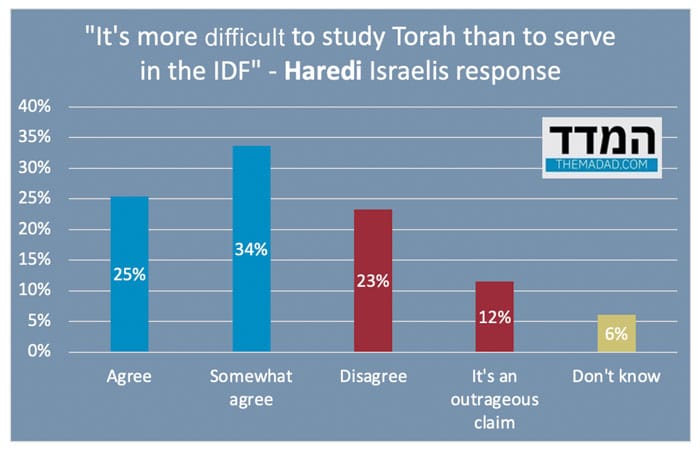
A week’s numbers
This is one reason why Haredi Israelis can’t quite communicate with their secular fellow citizens.
A reader’s response:
Rafi Schweig asks: “Would most Israelis still prefer Trump over Biden in the next election?” My response: The understanding between the U.S. and Iran from last week makes this quite likely.
Shmuel Rosner is senior political editor. For more analysis of Israeli and international politics, visit Rosner’s Domain at jewishjournal.com/rosnersdomain.
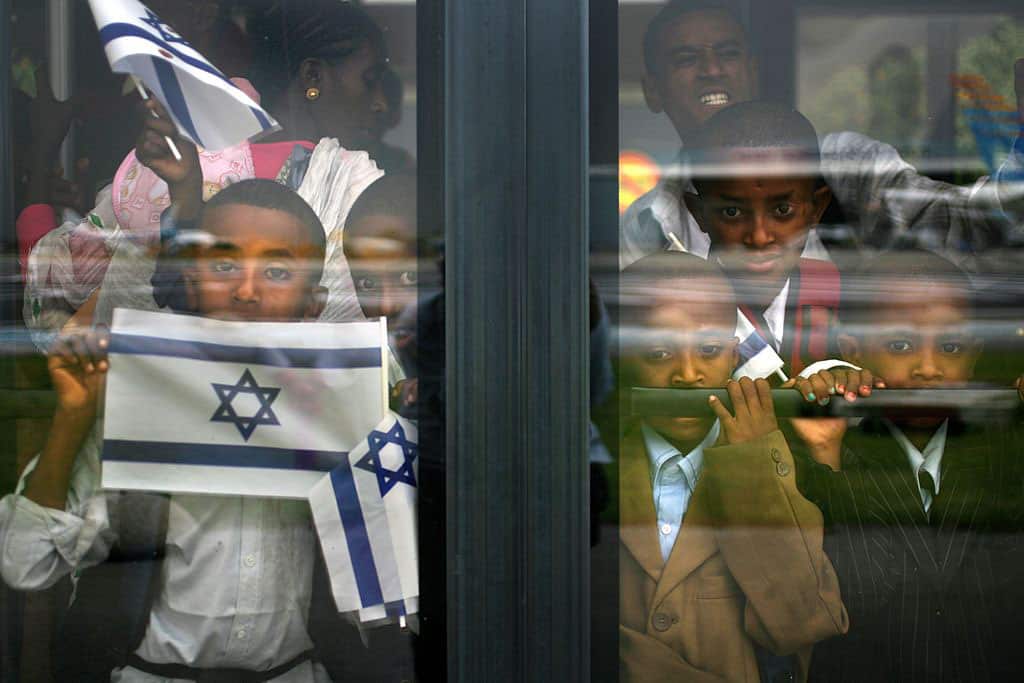
After so many months of demonstrations across Israel, efforts solely revolved around judicial reform, PM Netanyahu and his cabinet, and the so-called delicacy of Israeli democracy, this week Israel is facing protests of a much, much greater meaning than the months preceding. After years of increasing military and militant clashes and horrific violence in Ethiopia, today we face a profound urgency to rescue the Ethiopians of Jewish descent and to bring them safely home to Israel.
But so far only 200 of the nearly 4500 Ethiopian applicants for aliyah have been rescued, and approximately 100 of those rescued were Israeli citizens. Last week, a joint operation of the Prime Minister and the Jewish agency succeeded with one rescue mission, but it remains unclear what steps are underway to save those left behind. Protesters in Israel, many of Ethiopian descent, are comparing the swiftness of rescue afforded Ukranian Jews during the recent Russian invasion, and decrying the difference in Israel’s response to Jews of Ethiopia.
The comparable rate of rescue is troubling, but what is most concerning is every moment that hangs in the air as thousands of lives hang in the balance of our inaction. The Right of Return is inclusive across the varied halachic status of those waiting for rescue in Ethiopia, and the obligation to save a life is above and beyond the scale and scope of any disagreement on labels and status. Any question as to the specific heritage of newcomers to Israel can be addressed after everyone has safely arrived.
From the Talmud (Sanhedrin 37), we know that “whoever saves a life, saves the entire world”. As the people of the nation of Israel, we have an unparalleled obligation and opportunity to singularly and swiftly rescue every single applicant and to save the entire world, many times over.
And once we have completed the entirety of this critical rescue, the nation of Israel will have facilitated the return of thousands of Jews and Jewish descendants to their homeland, an enormous undertaking and achievement, both for the sake of the nation and for the future of the Jewish people. The comprehensive rescue of Ethiopian Jews will also increase trust, compassion and hope amongst the millions of disheartened Israelis looking for examples and actions of hopefulness and progress in Israel.
There are only gains in fully engaging and succeeding in this rescue, for every individual that needs rescuing, And without acting, with any continued hesitation or indifference, the losses will be incalculable.
In Jewish playwright Arthur Miller’s world, if you ratted someone out to the authorities, your reputation would sink. On “The Sopranos,” if you were a mafia man talking to the feds, your body could end up in the river.
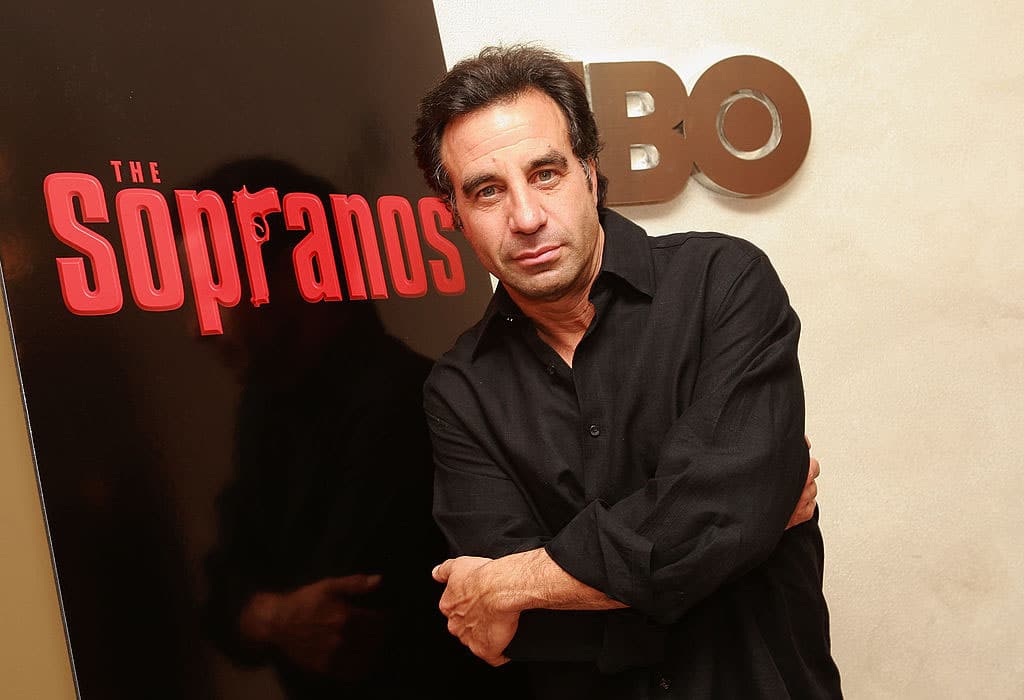
Ray Abruzzo, who appeared in 16 episodes of “The Sopranos” as Little Carmine Lupertazzi, said there is one similarity and several differences between his mobster character and Eddie Carbone, the character he plays in Miller’s “A View From The Bridge” opening August 18, presented by The Ruskin Group.
“The idea of betrayal and rats are certainly dominating in both societies,” Abruzzo said. “But Eddie works in an animalistic nature, whereas Little Carmine tries to intellectualize. Even if he uses the wrong words, his views of the situation are always correct, like his idea that Johnny Sack (New York underboss of the Lupertazzi crime family) is too greedy and he is sensitive to personal issues, or when A.J. (Tony’s son) tries to commit suicide. Eddie is more transactional and has visceral reactions.”
“A View From The Bridge” tells the story of Eddie, a 1950’s Brooklyn man who has lost desire for his wife, Beatrice, (Kim Chase) and has a troubling attraction to his niece, Catherine, played by Aurora Leonard. At the behest of his wife, Eddie allows Marco and Rodolpho (Jesse Janzen and Brandon Lill) to stay in his home despite the fact they have illegally come from Italy. Angered by the fact that Catherine and Rodolpho begin to date, Eddie consults his lawyer, Alfieri, (Sal Viscuso) who advises him not to take drastic measures. Eddie doesn’t heed the advice. He implies Rodolpho is gay, saying he “ain’t right” and when that doesn’t work, he does something that causes big ramifications.
In a key scene, Eddie is play-boxing with Rodolpho and, according to stage directions, “mildly staggers” him,. (In previews of the 2010 Broadway production with Liev Schreiber as Eddie and Santino Fontana as Rodolpho, Schreiber accidentally gave Fontana what was called “a minor concussion.”)
“I’m very conscious of that,” Abruzzo said of avoiding injury. “On stage, as an actor, I’ve always been intrigued at how if we’re angry, we’re not playing angry. The veins pop out of our necks, our faces get red and we’re crying tears that flow. So, the emotions are real, but there’s a part of your brain saying you can’t really hit him and safety is really important. When punches are thrown, we’re careful. Hopefully that (an injury) won’t happen. I’d rather the audience see that I miss him, then actually hit him.”
What was Abruzzo’s biggest challenge in preparing for the role?
“Miller’s language is very specific,” Abruzzo said. “He mixes tenses in the same sentence and has these little asides, so the challenge is just memorizing his words. But once you get them to come out of your mouth, you realize the poetry and the music of them.”
Like the protagonists of Miller’s best known plays —“Death of A Salesman” and “The Crucible,” — Eddie is an everyman with a tragic flaw. He pretends he is a father figure to Catherine and betrays her trust and belief in him.
The play also raises the notion that people cast aspersions on immigrants.
Abruzzo said that those trying to come to America have faced different specific circumstances that can be evaluated separately, there is a common theme of suspicion “from Jews trying to come by boat in 1939 to escape the Nazis, Italians after World War II here these people are, trying to escape the poverty that as brought on by the war, and of course, now, people trying to get into this country and escape horrific conditions. It’s a never-ending thing.”
The climax of “A View From The Bridge” features a showdown between Eddie and Marco.
In his essay, “Tragedy and The Common Man” Miller wrote: “As a general rule, to which there may be exceptions unknown to me, I think the tragic feeling is evoked in us when we are in the presence of a character who is ready to lay down his own life, if need be, to secure one thing-his sense of personal dignity…”
“A View From The Bridge,” which Miller revised and fleshed out after early productions were not well received, has gone on to win numerous awards, including the Tony Award for Best Revival of a Play in 2015 with Ivo van Hove winning the Tony for Best Director.. The Ruskin Group’s production is directed by Mike Reily.
Abruzzo said he is honored to be performing one of Miller’s plays and said in addition to entertaining an audience, theater has the power to make people introspective and reflective, which can lead to personal growth.
“We always hope that as artists we can touch one person with our performance and get them to go home and think a little differently,” he said.
“A View From The Bridge” is in previews August 16 and 17 and opens on August 18, running until October 8.
Recently the UN Secretary General’s annual report on “Children and Armed Conflict” (CAAC) was released, covering January to December 2022. The report’s noble goal of “engagement with parties responsible for violations that might lead to behavioral change, including promotion of accountability and compliance with child protection provisions in peace processes” is one the Simon Wiesenthal Center (SWC) would fully embrace had the UN’s Special Representative for Children and Armed Conflict, Virginia Gamba, ensured that the “verified grave violations” she included in the section titled “Israel and the State of Palestine” reflected the full, factual facts on the ground.
The key phrase throughout the report is “parties responsible.” Acknowledging who are the actual responsible parties for grave violations against Palestinian and Israeli children is essential in order for all concerned to grow up in a region that respects their rights as children. Prime among these is a child’s right to be protected from violence.
While the CAAC refers to the “State of Palestine,” Special Representative Gamba does not name the Palestinian Authority, instead calling out only Palestinian Islamic Jihad and unnamed “Palestinian armed groups”:
“I am deeply concerned by the increase in the killing and maiming of children by Palestinian Islamic Jihad’s Al-Quds Brigades.
“I call upon all Palestinian armed groups to cease indiscriminate launching of rockets and mortars from densely populated areas in Gaza towards Israeli civilian population centers.
“I urge all Palestinian armed groups to protect children, including by preventing them from being exposed to the risk of violence and by abstaining from instrumentalizing them for political purposes.
“I reiterate my call upon armed groups to end and prevent the recruitment and use of children and to abide by their domestic and international legal obligations.”
Welcome words. But then she adds this Orwellian plea :“I exhort Palestinian armed groups to better protect schools.”
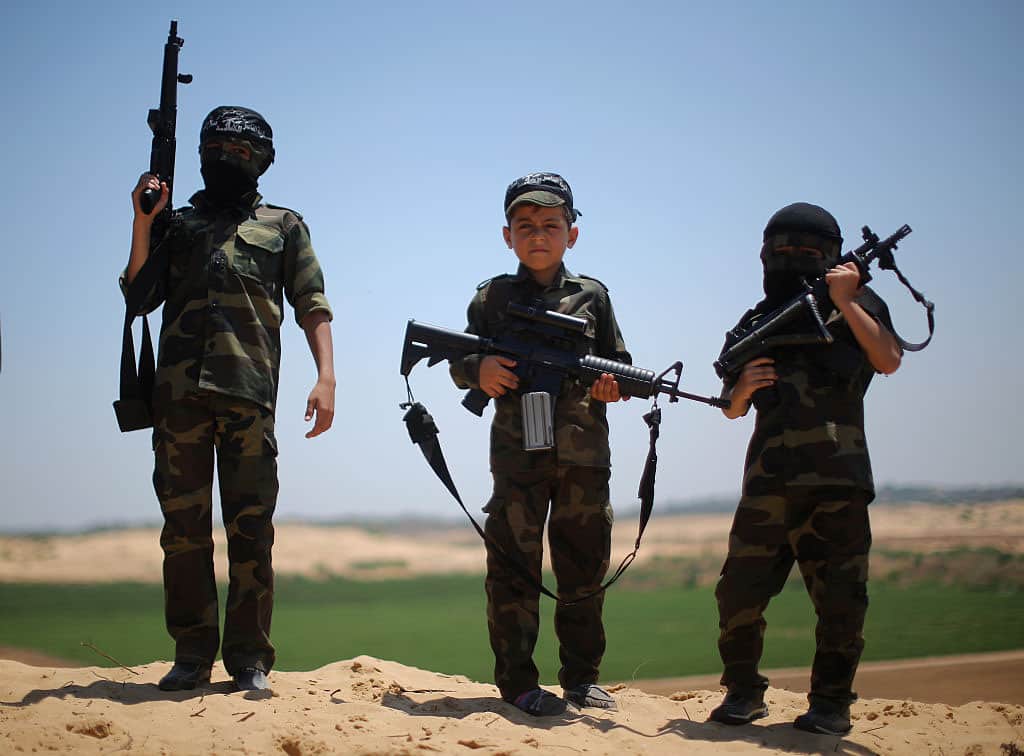
Whereas statistics on the recruitment of children used in combat and other roles is diligently included in other regions of conflict in this report, conspicuously absent is any accounting of Palestinian children recruited by Hamas, Palestinian Islamic Jihad and the PA for combat. Moreover, nowhere is the Iranian regime–the chief destabilizing power in the region–called out for funding those entities and inciting and recruiting children to partake in the “armed struggle” against the state of Israel. While the use of children as human shields is condemned—it is Israel, not Hamas, that CAAC charges with deploying this inhumane tactic, perpetuating the UN’s long history of discrimination against the Jewish state.
The CAAC report, in effect, provides a moral free pass for Palestinian teenage terrorists while disingenuously insisting that Israel must take steps not to harm these “children.” When asked at the press conference for the report’s release whether the figures for Palestinian children who were killed, wounded, or detained by Israel should exclude heavily armed teen militants, Special Representative Gamba declared that it was “regrettable” but immaterial to the report.
As for Israel, the UN Special Representative charged:
“I am deeply concerned by the continuing increase in the number of children detained by Israel and by the reports by children of physical violence directed against them during detention. I reiterate my call upon Israel to uphold international juvenile justice standards… to end the administrative detention of children, and to prevent any violence and ill-treatment in detention.”
Given the Special Representative’s declaration that “a child is a child is a child,” is it not “societal child abuse” that Palestinian children are being put in harm’s way? Who is to blame when an armed Palestinian teen indoctrinated and recruited to murder Jews and become a martyr, is neutralized by Israel’s security forces? Does the world expect that IDF soldiers must first check an ID to see if a terrorist firing his weapon has reached his 18th birthday?
To change the deadly status quo, the world should look at how Palestinian children are spending their summer vacations. The Simon Wiesenthal Center urges UN Secretary General Guterres to send a personal envoy back to Gaza, West Bank and East Jerusalem to investigate an authoritative report—just released by the respected MEMRI institute. It addresses the indoctrination of Palestinian children in 630 summer camps this year. The MEMRI report homes in on the one issue Special Representative Gamba does not: Why are Palestinian youth turning to terrorism and genocidal hate? Who are the perpetrators? Who are the funders?
Two excerpts from MEMRI provide some disturbing answers:
“Operated by the PLO’s Higher Council for Youth and Sports, which is headed by Fatah Central Committee member Jibril Rajoub, the camps were attended by some 65,000 boys and girls. The camps are platforms for political indoctrination and incitement against Israel. This year, as in the past, the content they imparted included glorification of terrorists (see Part I of this report), non-recognition of Israel and calls for the return of the Palestinian refugees to their original homes, including inside Israel. As part of inculcating the narrative of the right of return, activities often included the motif of the key as a symbol of this right.”
And the report identifies key funders of these camps:
“It should be noted that the PLO’s Higher Council for Youth and Sports, which operates the camps, has received funding in the past from the EU and from UN organizations, including the United Nations Children’s Fund (UNICEF) and the United Nations Development Program (UNDP). Today it continues to be the official Palestinian organ that collaborates with international bodies on youth empowerment projects, including with the UN and EU, which provide it with mentoring and counseling services.”
We all associate summer camp with fun, socialization and personal growth. But in Palestinian society, that is not the reality on the ground. Secretary General Gutteres: There is so much more that UN agencies can do to protect Palestinian and Israeli children, but step #1 is to finally hold accountable the Palestinian Authority, Hamas, Palestinian Islamic Jihad, and all other entities brainwashing children into a culture of genocidal hate and training the next generation of terrorists.
Failure to dismantle the deadly status quo will only ensure another lost generation, with peace and reconciliation in the Holy Land, a distant unattainable dream.
Dr. Deborah Soffen is a pediatrician and longtime community activist. She has recently been appointed the Simon Wiesenthal Center’s first Children’s Advocate.
How did I end up visiting a Jewish summer camp in the war-torn country of Ukraine?
Last October, I saw a video of a Camp Ramah in Ukraine, called Camp Ramah Yachad, and was transfixed. Campers who looked like they were from Camp Ramah in Ojai having the time of their lives, but living through a horrific war where civilians are being targeted and their homes are being destroyed. I wanted to go there to see it for myself and to show the campers that they are part of something larger, a worldwide Jewish community that doesn’t leave anyone behind.
My family and friends thought I was crazy. “It’s a war zone! You’re a father!” But I was undeterred.
Fortunately, I was not alone. Two friends from L.A. and others from Philadelphia and Israel wanted to join me, including Rabbi Leonid Feldman, the longtime rabbi of Palm Beach’s Temple Beth El (and fluent Russian speaker – he was born in Moldova during the Soviet era), and Rabbi David Golinkin, president of The Schechter Institutes of Jerusalem, which runs the camp. Our goal: To spend a Shabbat at the camp.
Shortly after the collapse of the Soviet Union, Golinkin’s Schechter Institutes established the camp, as well as a series of community centers and schools, in four cities across Ukraine. With an unknown number of Jews (estimated at between 100,000 – 200,000 people), Schechter thought it could have a deep impact. And it has, as I was soon to witness firsthand.
After days of travel to cross the Ukrainian border by bus, we arrived at the small Ukrainian resort near Chernivtsi (in southwestern Ukraine) where the camp was being held this summer around midday on Friday, August 4th.
Waiting to welcome us were Rabbi Irina Gritsevskaya, the director of the camp, and Igor Babkin, the camp manager.
“Rabbi Irina,” as she is called, oversees Schechter’s operations in Ukraine (in addition to Neve Schechter in Tel Aviv). She is tireless and committed, brimming with joy and enthusiasm, a smile on her face.
Igor is a native of Ukraine who now lives in Israel.With a twinkle in his eye and a booming voice (perfect for addressing a camp full of kids!), he never speaks sharply, only with love. He brings a combination of humor, passion, and a nurturing soul to camp. When he is not at camp, he spends his days helping at-risk teens.
We walked outside to tour the camp. Our first stop was at a meeting with the madrichim (counselors). One by one, we introduced ourselves. Most Ukrainians speak Russian and Ukrainian fluently, and the madrichim were no exception (also speaking surprisingly fluent Hebrew from Schechter Institute schools the attended). But as we learned, this was a country experiencing a national awakening. They would rather speak broken English than fluent Russian.
After making introductions, we toured the chugim (activities) in progress. First stop: A first aid class. One of the two doctors on staff this summer was showing kids what to do when someone loses an arm or a leg, starting with the best bandage to use to staunch the flow of blood. As a madrich accompanying us explained: “You have to stop the blood loss, which is huge if it’s a leg. So the most important thing that volunteers are buying or asking for is this kind of bandage.” The doctor then showed the campers how to apply a tourniquet.
Next, we moved on to a baking class taking place inside the main building. There, a young boy around 11 years old and transfixed by his phone said (without once looking away from the screen): “Hi, my name is Danny. Would you like to see these videos I shot?” Our hearts broke as he showed us videos he took showing apartment buildings less than a kilometer from his home, all heavily damaged by missiles, and the hood of a car that had been shredded by shrapnel.
Danny told us he’s from Kharkiv, which we knew had seen some of the most intense fighting of the war since the invasion began, with Russia targeting population centers with cluster munitions, missiles and artillery. Later, I saw Danny was glued to his phone again. When I mentioned it to Rabbi Irina, she assured me that people like Danny receive the support they need from a staff psychologist.
Many campers are refugees, like Danny, and many of them live in Poland, Germany and other European countries and in Israel.Two campers living with families in Spain traveled for five days by train to join their friends at camp.
Next, we watched an art and dance class.In the latter, about 20 people were doing a synchronized dance to a popular Israeli song.To our surprise, the irrepressible Irina jumped right in and knew all the moves!
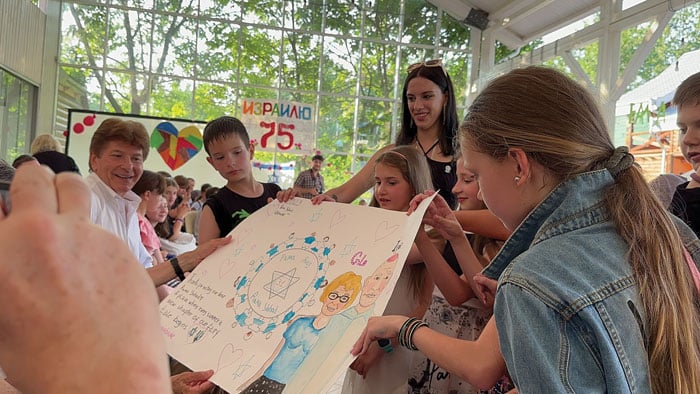
At Kabbalat Shabbat services, the campers sang and performed dances and skits (with typical nervous giggling from younger campers) with the enthusiasm and ruach (spirit) one would expect to see from any happy camper. Waves of campers presented us with gifts, including a poster with the message: “Thanks for visiting our dear Ramah Yachad, a place where every summer a new chapter of our fairy tale begins” and hamsas made by the campers.
Before lighting Shabbat candles together, we took a moment to introduce ourselves through Leonid. In his impish fashion, Leonid introduced fellow traveler from L.A. Jonathan Anschell, General Counsel of Mattel, as “’Barbie’ producer”!
Ryan Gosling and Margot Robbie would not have elicited more excitement than did this announcement.As soon as the service ended, dozens of campers swarmed Jonathan to take selfies with him. “Have you met Margot Robbie?? Have you met Ryan Gosling??” Jonathan, as always, was a terrific sport and posed for selfies and accepted hugs from the kids.
Jonathan wasn’t the only “celebrity.”Really, we all were.The campers posed for selfies with all of us and dispensed hundreds of hugs. They were just excited that a bunch of Americans flew halfway around the world to be with them.
But Jonathan wasn’t the only “celebrity.”Really, we all were.The campers posed for selfies with all of us and dispensed hundreds of hugs. They were just excited that a bunch of Americans flew halfway around the world to be with them.
One camper who was about 10 years old repeatedly emerged from the crowd throughout our stay to give us hugs. He never said anything, really, though I kept thanking him and telling him how nice it was to see him again. I’m not sure how much he understood and he didn’t say much back. I think the hugs conveyed everything he needed to know and wanted to tell me.
After lighting candles and enjoying a sumptuous Shabbat dinner, the entire chadar ochel (dining hall) was filled with singing and slapping of tables as everyone recited the Birkat Hamazon (Grace After Meals).Afterward, the campers, counselors, and even some staff joined hands and danced with pure joy around the entire chadar ochel.
The following morning, a 12-year-old girl was reading from the Torah for the first time. Afterward, she was so overcome with emotion that she broke down and cried. Luckily, her mother was present (she lives in nearby Chernivtsi) and they hugged for a long time, rocking back and forth and sobbing in joy.
After Shabbat lunch, the camp assembled in rows of chairs and we answered questions from the campers. One asked why we came to Camp Ramah Yachad. I told them that we wanted to show our support and that the Jewish people are connected to each other wherever they live. Later, we spoke to the kids in breakout sessions where we could connect to the campers in smaller groups. I found myself learning their names and learning about their lives.
The campers were eager to learn about America. “We hear there is a lot of crime in America.Have you ever been robbed?” “What is the average salary in America?” “What does private school tuition cost in America? Do you have to wear uniforms in school?” “Who’s the biggest pop star in America?”
A little boy sitting immediately to my left asked, “Were you ever bullied?” Another asked: “Does America have the strongest army in the world?” This I answered in the affirmative, in part to reassure the campers who of course know that America is standing behind Ukraine. “In a world of Hitlers and Vladimir Putins, America has the job of maintaining the strongest army. It’s like the Wild West and America is the sheriff,” I explained. “I hope someday this won’t be necessary.”
The 90 minutes allotted to the breakout sessions went very quickly and before I knew it, we were summoned to a Havdalah ceremony starting under some trees nearby. The campers formed two or three concentric circles and held hands. As we approached, the campers spontaneously opened the outer circle and invited us to join them, alternately holding hands or standing with arms over each other’s shoulders. As in any Camp Ramah, Havdalah was a special time and the ruach again manifested itself in the joyful singing of all the campers.
After the candle flame was extinguished, my fellow travelers and I were swamped by kids requesting selfies and hugs (we each must have received 100 hugs a day!) and also something new – requests to sign the shirts on their backs or their baseball caps or even the backs of their hands. They even had permanent ink markers at the ready!Unable to come up with anything more clever, I wrote “Ψ from America” on every shirt, hat, and hand that was offered.
As if instinctively, the campers suddenly turned away and migrated through a path in the nearby forest down to a small lake.As we walked after them, I tried to engage Igor a bit, to learn more about him. I noticed that throughout our visit, he kept opening doors for us and saying in his booming voice: “Welcome to the HOTEL California!” so I asked him what his favorite band is. “The BEATLES!” he replied.
“Which song is your favorite?” I asked.
“’Yesterday’!” Then he proceeded to sing the lyrics: “Yesterday, all our troubles seemed so far away!” I was impressed. He knew the words instantly in English and he had a nice voice. Good choice, I thought.
Photo courtesy of David Kekst
But then it hit me: These weren’t just the words to his favorite song. They were words that likely reflected the sentiments of all the campers, counselors, and staff in an unbelievably scary and difficult time for them, their families, friends, and neighbors.
As we entered the forest, I noticed that the path was lined with rainbow colored LED lights pulsating to soft electronic dance music. Through the trees, I could see an enormous bonfire by a small lake.
The campers were sitting on the ground around the fire, furiously writing notes to each other. This was an end-of-camp activity called “The Postman,” where the campers write secret, usually anonymous notes and have friends deliver them to other campers (and occasionally counselors). Some were love notes to fellow campers.Others were notes of gratitude. At one point, Rabbi Irina’s son Adam walked over and handed me a note that read: “David thank you for talking to me it was interesting.”
At another point, a former camper, who is now an officer in the Ukrainian Army, came over to me with a sealed, teal-colored bag. “I have gift for you from Ukrainian Army!” I thanked him and opened it and found three sealed bags of army rations inside! We opened one of them and found individually sealed packages of crackers, cookies, meat, and other food items for a meal. It even contained a tea bag and a small container of Ukrainian honey! I was very touched by the gesture.
After receiving more hugs, we said our goodbyes to the campers and left them by the lake. We had to leave very early the next morning to get back over the border in time for a flight back to Bucharest, where we would return to our homes and families.
I was told this evening marked the beginning of the difficult period in which all of the campers would be saying tearful goodbyes to each other, since camp would be ending on Monday. I felt a sadness of my own as we left them by the lake. It was like a wonderful dream that was ending.
Back at the hotel, my fellow travelers and I gathered to reflect on the day and on the trip.And we received a surprise guest – the Ukrainian Army officer! I had invited him to join our group back at the hotel later that evening, but wasn’t sure he would come.
Through Leonid’s translation, we asked the officer about the war. He declined to give details on anything. For example, we had heard that he had received a very special medal from one of Ukraine’s top generals, but he would not tell us why.
He did tell us that he had been given leave to return to camp for the weekend. He also told us that he had gone to university to study military tactics and history – following in the footsteps of his parents, both career military. He said he went in an act of rebellion because they had urged him not to go. After graduating, he became a bartender. When the Russians invaded last year, he was already a lieutenant and was put in charge of a company of soldiers. Rabbi Irina had told us that he had been in Israel a week ago and could have remained there.“Why did you come back?” we asked.
To him, the answer was obvious: He has to fight for his country.
“What will you do after the war?”
“That is too far in the future. When we get there, I will figure it out.”
We asked if there is antisemitism in the Army. “No,” he said.
Photo courtesy of David Kekst
He showed us a picture of himself in his uniform and pointed to a Star of David he had on a ribbon under his name. He told us that he made the ribbon and put it on the uniform. “No one has ever said anything about it.” He said he wore the Star of David so that Russian soldiers would see who they are fighting, “that we are not Nazis.”
After we returned to our rooms, I called my wife and told her about my day. I was surprised to find myself getting choked up repeatedly, unable to get some of the words out as tears welled up in my eyes.We agreed to speak later, as it had been a long, intense day.
And that was just after one day. The campers, counselors and staff live it every day, and have been since the Russians invaded in February 2022 (though to Ukrainians, the war began when Russia seized Crimea in 2014).
Back in L.A., as I read the latest news of the fighting in Ukraine, I pray that these wonderful children, campers, counselors, staff members, and the soldier who visited with us, are staying safe.
Back in L.A., as I read the latest news of the fighting in Ukraine, I pray that these wonderful children, campers, counselors, staff members, and the soldier who visited with us, are staying safe. Despite or because of all the horrors and challenges, these young campers come from all over Ukraine and from outside Ukraine simply because they love it. Like them, a part of me wishes I could go back to see them again and show my family what a special place it is. Camp Ramah … in Ukraine.
David Kekst is an independent producer in Los Angeles.He currently serves as the Vice-Chair of The Schechter Institutes Board of Directors.