fbpx

August 4, 2023

Rabbi Mati Kirschenbaum: Using Taylor Swift To Teach Torah

Rabbi Mati Kirschenbaum, who has gone from Poland to London, is now happy to be a part of a warm community in at Fullerton’s Congregation Beth Tikvah in North Orange County. And he doesn’t just mean the weather. Congregants threw him a surprise birthday party in mid-July as he turned 36.

The congregations threw the rabbi a surprise birthday party as he turned 36. Photo Courtesy of Rabbi Kirschenbaum.

Kirschenbaum said he also enjoyed the July 4th experience of fireworks festivities and running a barbecue.

And he’s keen on fusing the contemporary with the old.

“I am a huge fan of bringing our tradition closer to my congregants by finding parallels between Jewish wisdom and contemporary culture,” he said. “I believe that one can use Taylor Swift’s songs to teach people Torah.”

He said it is important for people of all ages to be introspective and reflective as they examine their lives and their spiritual growth.

Born in Wroclaw, Poland, he studied at the rabbinical seminary Abraham Geiger College in Potsdam, Germany, as well as Leo Baeck College in London, where he got his rabbinical training.

“I’ve been involved in Jewish life in Poland and other places and it’s a goal to spread my knowledge in this wonderful community at TBT,” he said, adding that he speaks English, Hebrew, German, Russian, Polish, German and is learning Spanish.

He had the honor to perform what is believed to be the first bar mitzvah at a Reform synagogue in Poland since the end of World War II.

“It meant a lot to do that,” he said.

He said the history of Jews in Poland is, of course, complex.

“We know the history, that awful things have happened to Jews there as well as other parts of the world,” he said. “My view is that there is tikkun, repair, that can be done in the world. We can obviously not undo the past. We can work now to try to rebuild what has been destroyed, and to show what the Jewish people are strong, and willing to speak with other communities for the sake of humanity and to inspire unity.”

“We can work now to try to rebuild what has been destroyed, and to show what the Jewish people are strong, and willing to speak with other communities for the sake of humanity and to inspire unity.”

Kirschenbaum said he’s thankfully not experienced antisemitism but is aware if is a growing problem in America. He said his time in London was insightful because he was able to hear about a range of diverse views.

An avid hiker, Kirschenbaum said the weather is wonderful and much better than Poland or London. He said that the congregation is friendly, caring and the people are enthusiastic and excited to learn.

“My number one priority as a rabbi is to build on amazing lay engagement of TBT leaders,” he said. “I believe that we have the potential to be the leading center of Jewish life in northern Orange County.”

He said when explaining the parsha of the week, he enjoys bringing in rabbinical commentaries that people might not be so familiar with. On occasion, he will link lyrics of Swift or other artists, to use in a sermon or a lesson, if the lyrics are relevant and connected to messages of Torah.

He feels empowered by the many traditions he’s learned as well as Jewish history. Committed to helping congregants grow in their Jewish journeys, from his first interview, he could tell the synagogue’s leaders areequally committed to giving congregants the best experience possible. He said he will brush up on his baseball.

“The plan is to go to a Dodgers game at some point soon,” he said. “The congregants are so kind, and some have already offered to take me to a game.”

Rabbi Mati Kirschenbaum: Using Taylor Swift To Teach Torah Read More »

Revering, Walking, Loving, Serving – Thoughts on Torah Portion Ekev


Revering, Walking, Loving, Serving
Reflections of Torah portion Ekev 2023 (from previous versions)


This week’s Torah potion, Ekev, has a section that I encourage you to memorize, as we ascend on our path toward the Days of Awe. This passage expresses succinctly the worldview of the book of Deuteronomy and much of the Bible.


And now, O Israel, what does the Lord your God demand of you? Only this: to revere Adonai your God, to walk only in God’s paths, to love God, and to serve the Adonai your God with all your heart and soul . . . for your good. (Deuteronomy 10:12 and following)


Memorize these verbs: revere, walk, love and serve.


The Hebrew word for reverence is Yirah – “awe.” The term is sometimes translated as “fear,” but not in the English sense of being frightened. Yirah can refer to an experience of overwhelming wonderment. I recall truly being awestruck when I saw the Grand Canyon for the first time, for its majesty and grandeur. I also recall feeling awestruck when I saw the Kotel in Jerusalem for the first time (and every time since), for a different kind of majesty and grandeur.


The awe produced in nature and monuments seems to take us over. This capacity for awe can arise in smaller moments, especially in the experience of the beautiful. We can closely examine a flower, listen to music, see the stars, or witness the sublime arc of a cinematic scene and feel awestruck.


There is a version of awe called reverence. For example, as an American, I revere the Constitution and the constitutional process, in our nation’s stumbling ever forward toward a vision of a just society. I revere the Bible, and all our holy texts. I revere the souls of other human beings. The words of sacred texts bring me to a state of reverence.


I revere God and have moments of awe in God’s presence. I venerate certain people.


Every experience of awe, reverence and veneration ends in an experience of deep gratitude.


I have spoken often that one of the curses of modernity, among its many benefits, is the lack of the common cultural experience of awe, of reverence, of veneration, of deep respect, and honor. We often know better what we hate than what we revere. Even if one has those experiences of awe, reverence, veneration and honor privately, there is much to be gained by sharing these experiences as a community of meaning.


Think about it. If you were to regularly experience reverence, respect, awe, veneration, and gratitude in a purposeful community, the teachings presented there would lodge deeply within. A natural desire to “walk the path” is created. I have seen this power at 12 Step groups, in military training, and of course in study, worship, and celebration in the religious life.


If you ask yourself insistently what you revere (we don’t ask ourselves this very often, but we should), you will find a way to live differently. Let me give a personal example. For the past few years, I have been listening to Audible books on the history of science, the origins of the universe, the appearance of life, the evolution of human beings, but especially the nature of the brain, the mind, the appearance of consciousness, and the miracle of my being conscious. To paraphrase Bill Bryson in his Short History of Everything,


Trillions and trillions of atoms, tiny pieces of matter, that are not alive, have been drawn together and formed me, as a live being. These pieces of matter comprise my brain, from which consciousness proceeds. Matter is producing consciousness. This unique and, for me, serendipitous conglomerate of atoms will fall apart in due time. I hope they enjoy being me as much as I am grateful that I am alive.


In short, life is a miracle.


The more I study both scientific achievements in understanding the physical world, and the nature of life and consciousness, the more awestruck and amazed I become, and grateful to the scientific world that has brought this knowledge to me. With that awe and gratitude comes a desire to make all the energy that is swirling around and making me me be worth the effort. My studies have helped me revere existence, nature, and life, and as a result my spiritual path is different. I feel deeply how much I am ensconced in a mystery, an extraordinary wonder.


I think reverence for God is fundamentally rooted in the same experience, except that the Power that brought the atoms together is conceived of as conscious – a Power that is conscious of you, and loves you in some extraordinary, unimaginable way, and has set out straight paths before you lest you stumble and waste your life away, but forgives you when you do.  As these verses say, God gives us these paths “for our good.” There are, according to our nature as human beings, better and worse ways to live. Torah sets out the good path.


One of the aspects of walking in the paths of God is the daily practice of cultivating love for God. Cynics like to deride this – why does God command us to love God?


I often issue the advice of love to families in trouble. I catch a teenager with a particularly venomous sarcasm, designed very well to drive the parents up the wall.  The kid is ordered into counseling. I listen to the litany of complaints, and I say, “Okay here is my advice:  Act as if you love them.” At this point, the teen protests, “But I don’t love them.” I say, “If you want the next five or 10 years to go well for you, you will at least pretend to like them. For your own good.”  The acting-as-if, of course, helps remove the barrier from around the heart. Love, at least partly, is a choice, a practice, a discipline, a method.


All these words, “revere, walk in the paths, and love,” lead to the final term: to serve God. Those who experience these words find themselves with a profound desire to respond. In other words, those who meditate on these words, day and night, have discovered “responsibility” – the virtuous, life-long moral response to having been touched, benefited, and transformed.


How do we serve God? The ritual dimension is designed to bring us into states of holiness, consciousness, mindfulness, and communion. Admittedly, for some people, the ritual dimension gets in the way of those experiences. However it happens, when we have a moment of awe, reverence, veneration, honor, we should act on it, if possible.


The moral/virtue dimension of serving God directs us to be of service to each other, to love each other, and to do good for each other.


These terms, “Revering, Walking, Loving, and Serving,” can awaken the soul in many ways. The main thing is: memorize these words, allow them to help forge our path to the Days of Awe.


Revering, Walking, Loving, Serving – Thoughts on Torah Portion Ekev Read More »

The King of Bahrain’s Blessed Vision

On August 1, I attended the Gala Dinner at the Beverly Hilton Hotel for the inaugural King Hamad Award for Peaceful Coexistence under the patronage of His Majesty King Hamad Bin Isa Al Khalifa of Bahrain, sponsored by The King Hamad Global Center for Peaceful Coexistence and This is Bahrain.

It was an uplifting and inspiring evening, especially at this moment of struggle and strife, including our beloved Israel. If this interfaith movement could take off — after centuries of battles between religions — and fulfill his Majesty’s declaration on religious freedom that “every person has the right to pray as he or she sees fit,” then anything is possible for our people. It’s an optimistic vision in this moment of despair and hostility, where brother is rising against brother, and where many concerned that the dispute over the role of Israel’s Supreme Court has irremediably damaged Israel’s unity. The King is determined to create the most comprehensive interfaith movement ever undertaken, to bring peace and harmony among people through religious freedom.

The evening began with a video showing meetings between Jewish, Christian, Muslims, Hindus, Buddhists, Bahai and other faith leaders coming together on the initiative of the King of Bahrain.

The chairman of the King Hamad Global Center for Peaceful Existence, Dr. Sheikh Abdullah bin Ahmed Al Khalifa talked about the search for peace and harmony through religious freedom, a recurrent theme in Bahrain’s history and culture. Peaceful coexistence is possible and is reachable, he said, and King Hamad’s vision is to fulfill this promise.

The Simon Wiesenthal Center’s Rabbi Marvin Hier’s speech blended a keen sense of humor (his first connection with the King was their mutual admiration of Frank Sinatra), spirituality (his Jewish blessing for the King), and pointed biblical references. Rabbi Hier spoke of the rewarding experience of working with the King, of how the King had denounced the Arab boycott of Israel and of the Wiesenthal Center’s work to make “The Abraham Accords a historic reality.”

He introduced Secretary of State Mike Pompeo, one of the principal architects of the Accords, as the keynote speaker. Secretary Pompeo believed that “there was a place for every nation to prosper through their friendship and shared cooperation.” He said that the idea of “peace through strength” made the Abraham Accords possible. He explained thart “we know strength deters wars, and weakness invites them” and that Israel “is not the problem in the Middle East,” and received the loudest applause of the evening.

“We know strength deters wars, and weakness invites them … Israel is not the problem in the Middle East.”- Mike Pompeo

Betsy Mathieson, Deputy Chairperson of “This is Bahrain,” said the evening conveyed the King’s spirit and vision of harmony brought about by freedom of religion.

I left the event inspired, hopeful and believing that anything is possible. It just requires people like the leaders present at this evening to work with courage, heart, and vision.


Gina Ross, MFCT, is the Founder/President of the International Trauma-Healing Institute USA (ITI-Israel). 

The King of Bahrain’s Blessed Vision Read More »

Nerdy Jews and Glamorous Gentiles: A Review of Curtis Sittenfeld’s “Romantic Comedy”

Curtis Sittenfeld’s new fun novel “Romantic Comedy” is not, ostensibly, about Jews. To use a great Britishism, it does exactly what it says on the tin. It tells a story of two people who meet, like each other, face various obstacles (mostly of their own creation), get over their obstacles, have a lot of sex, and live happily ever after in a grand castle (mansion in Topanga, same same)—with a bundle of laughs along the way.

But there is a jangle (Jewish angle) here.

Sally Milz, the heroine of this romantic comedy, is not Jewish. Neither is her love interest, Noah Brewster. Although Sally gives off major New York/neurotic/Jewish humor vibes and declines her stepdad’s pork steaks in favor of veggie burgers, Sally and Noah are both self-identified WASPs, a point repeated throughout the novel. Still, their romance turns on the “Danny Horst” rule, and Danny—and all the others who exist for the purpose of creating this rule—most certainly is Jewish.

Sally and Danny Horst work at “The Night Owls,” or “TNO,” a very thinly fictionalized version of “Saturday Night Live.” In the prologue of the novel, Sally discovers, to her distress, that Danny and recent “TNO” guest Annabel Lily are dating. What annoys Sally is this: “Annabel Lily was a gorgeous, talented, world-famous movie star, and Danny was a shlub.” The Yiddishism is surely not incidental; Danny, we are told, comes from an Orthodox Jewish community in Brooklyn. Danny is “pasty-skinned” and talks about his social anxiety and porn consumption. He worries publicly about his hair loss and burps at work meetings. Annabel, in contrast, has a “slender yet curvy body” and long red hair that gets styled in “old Hollywood waves.” According to Sally, this uneven pairing could only happen in one direction: with the nerdy guy and glamorous woman. Sittenfeld doesn’t name them, but they come to mind anyway: Woody Allen and Diane Keaton in “Annie Hall.” Larry David and Cheryl Hines on “Curb Your Enthusiasm.” All the Phillip Roth protagonists and all their shiksa goddesses.

Reviewing the evidence borne out of her workplace, Sally gives three examples of the Danny Horst rule, which all involve, she says, a “bona fide female celebrity” and a male staff member. In addition to Danny Horst and Annabel Lily, there is couple number two: “icy blonde Oscar-winning British actress … Imogen Wagner” and staffer “Josh Beekman, best known for his recurring character [on “TNO”], Backne Guy.” And number three: “Elliot Markovitz (five-foot-eight, forty, and [her] Topsider-wearing boss)” who “married a multi-platinum-album-selling pop singer named Nicola Dornan (five-foot-ten, thirty, and a special envoy for the UN).” Sally emphatically believes that “Such couples would never exist with a gender switch.” Of course, it’s not only gender that divides the Elliots from the Nicolas. What she doesn’t say is that all these relationships comprise a Jewish staff member and a very not Jewish celebrity.

Nonetheless, beginning with the supposition that the gender switch is impossible, Sittenfeld, unsurprisingly, comes to show that the impossible is possible, and that the only thing holding (Jew-ish WASP) Sally back from true love with surfer-dude pop star (WASPy WASP) Noah Brewster is her own lack of confidence.

In the first section, which makes good use of Sittenfeld’s research into “Saturday Night Live,” we witness Sally’s (Sittenfeld’s) cleverness. The sketches that Sally devises for “TNO” are funny and smart. Noah arrives as a guest on the show, and the sparks between Sally and Noah fly.

Then COVID hits, and in the second section, the characters are back home, isolated, living in/on/through their computers. Moving from first-person narration, full of reflective analyses, and action that takes place in a bustling office building, the novel thrusts readers into the circumscribed experience of 2020, and the story proceeds to unfold in epistolary fashion, limiting our perspective to the ways that the characters attempt to represent themselves to each other. Sally and Noah’s relationship-as-email-exchange feels true to pandemic living (I want to add “unfortunately,” as in, this all feels too soon to me!). It also feels true to its generic tradition. Think 1998 classic rom-com “You’ve Got Mail,” with Meg Ryan and Tom Hanks tapping away in their AOL accounts or their analog pen-pal predecessors in the 1940 film “The Shop Around the Corner”!

Finally, the reunion. I know this is kind of a spoiler but the thing about working within the confines of a formula is that the outcome is set from page one. So, I won’t ruin the ending, but, you know what happens. That said, not all Danny Horsts end up with their Annabel Lilys. The original Danny Horst, in fact, ends up with a down-to-earth (but gorgeous) Jewish graduate of Brown, who is also the daughter of the Nigel Peterson, Sittenfeld’s Lorne Michaels (born Lorne David Lipowitz) stand-in.

“Romantic Comedy” is not a deep novel, and, despite its feminist-rage premise, it’s unlikely to change the state of gender roles and expectations going forward. And with Sally not being Jewish (but only Jew-ish), the novel is also unlikely to cause film and television writers to radically rethink their Harry Goldblatt/Charlotte York pairings, though I admit I haven’t even finished the first season of “And Just Like That,” so what do I know?

In any case, for lovers of the romance genre, it’s a delightful read.


Karen E. H. Skinazi, Ph.D, is Associate Professor of Literature and Culture and the director of Liberal Arts at the University of Bristol (UK) and the author of Women of Valor: Orthodox Jewish Troll Fighters, Crime Writers, and Rock Stars in Contemporary Literature and Culture.

Nerdy Jews and Glamorous Gentiles: A Review of Curtis Sittenfeld’s “Romantic Comedy” Read More »

Jewish Federation Hires Security Leader, Tisha b’Av Protest Supports Hotel Workers

The Jewish Federation of Greater Los Angeles has hired Sergeant Larry Mead as the new vice president of its Community Security Initiative (CSI). 

“I am very pleased and excited to be part of The Jewish Federation of Greater Los Angeles, and I am looking forward to being an approachable and inclusive team member,” Mead said.

According to the L.A. Federation, Mead is a 36-year veteran of the Los Angeles County Sheriff’s Department, with in-depth knowledge of terrorism, street gangs, organized crime, security threat groups, cartels and human trafficking. Prior to his law enforcement career, Mead served for four years in the U.S. Army and graduated from Northrop University.   

“We are thrilled and honored to have Sergeant Mead now lead our Community Security Initiative,” L.A. Federation CEO and President Rabbi Noah Farkas said in a statement. “Our CSI program serves a vital role in keeping our entire Los Angeles Jewish community safe. CSI is needed now more than ever as we see antisemitism and threats against our Jewish community here and abroad rising in alarming numbers. We could not have found a more qualified and experienced person than Sergeant Mead. He will lead our security team into the future. Our community should feel confident and safer knowing that he is at the helm.”

Launched in 2012, CSI aims to combat the rising threat of terrorism while protecting Jewish schools, synagogues, summer camps and other organizations in Los Angeles. It plays a unique role by serving as a single point of contact for critical incident coordination, information sharing, safety and security training and resources for Jewish institutions across the city.


Jewish community members join striking hotel workers outside downtown L.A. hotels. Courtesy of Clergy and Laity United for Economic Justice

In commemoration of Tisha b’Av, Jewish and interfaith leaders joined striking hotel workers on picket lines calling for improved wages for the city’s hospitality employees.

On July 27, more than 50 people turned out at Pico Union Project for a program that included remarks from Craig Taubman and “Barrio Boychik” Shmuel Gonzales. Attendees then joined hotel workers on picket lines outside downtown L.A. hotels JW Marriott and The Ritz-Carlton to show solidarity with hotel workers who’ve been on strike since the beginning of July.

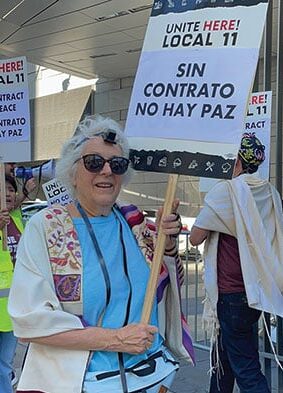
Tisha b’Av rituals, including the reading of the Mourner’s Kaddish, blowing of the shofar and chanting for a better world, blended with the day’s activities. Meanwhile, demonstrators, some of whom wore tallit and tefillin, carried signs saying, “Sin contrato no hay paz,” Spanish for “No contract, no peace.” 

Rachel Rubin-Green, a writer and retired teacher, joined a Tisha b’Av protest calling for improved hotel workers’ wages. Courtesy of Clergy and Laity United for Economic Justice

On June 30, contracts expired for approximately 15,000 hotel workers across Los Angeles and Orange Counties. One day later, on July 1, labor union Unite Here Local 11, which represents thousands of workers at approximately 60 hotels, declared a strike at hotels across the region. The day’s Tisha b’Av protest was one many actions that have been organized in collaboration with hospitality labor union Unite Here Local 11.

Matthew David Hom, an organizer at Clergy and Laity United for Economic Justice, described the day as an “incredible and beautiful moment.” The joining of Jewish leaders with a labor union fighting for better economic conditions for hotel workers aligned with the history of the progressive and liberal Jewish community’s commitment to social justice, he said, one tracing back to Abraham Joshua Heschel marching with Martin Luther King Jr. during the civil rights movement.

Co-organizers of the day’s action included the Southern California chapter of Bend the Arc: Jewish Action as well as IfNotNow and spiritual communities IKAR and Nefesh.


Jewish Federation Hires Security Leader, Tisha b’Av Protest Supports Hotel Workers Read More »