fbpx

July 27, 2023

Rabbis of LA | Rabbi David Mendelson’s Journey to HaMakom

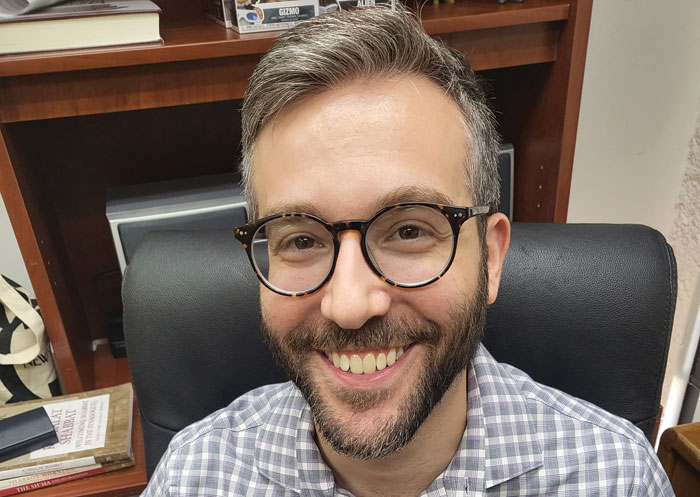
In the nearly 10 years since David Mendelson — now Assistant Rabbi at HaMakom, the new congregation formed when Temple Aliyah and Shomrei Torah Synagogue merged earlier this month —  graduated from Georgia’s Kennesaw State University, there have been, he says, three main influences on his life: His father, his mother and God.

Like many other young Jews, a Birthright Israel trip he took before his senior year was not only a life-changing experience, but one that had a major impact on his career.  When the Israeli official greeting Mendelson and his traveling mates said “Welcome home!” it struck the intended chord in the young man’s heart and mind. “That simple phrase brought a lot of emotion,” he said. “I did not realize Israel would mean so much to me. As a child in religious school, Israel was a far-off land. I never thought I would get to go there. My family never talked about it, and we never planned a trip.” Strolling through the Old City on Friday afternoon in Israel, seeing the Kotel a couple hours before Shabbat, Mendelson was “blown away.” While in Israel, Mendelson made up his mind to spend his life teaching Jewish children. 

His mother helped him along that path. When he came home determined to teach, his mother — a lifelong educator — told him about a classroom opening at a nearby temple. A month after his return from Israel, he got a job teaching fourth graders.  “I wanted to share my experience with the next generation,” he said of his passion for education. But Israel made him think about joining the rabbinate. At the synagogue where Mendelson had grown up, he was told  — flatly and without apology — that he did not nearly know enough about Judaism and given his complete lack of knowledge of Hebrew, he might want to find a different career. 

Mendelson was shocked. But he was also stubborn. He persisted, confident in his career choice. “Most of the time. I was thinking about Jewish education,” he said. “I love teaching, I love seeing the looks on students’ faces when they understand something they did not realize was a part of Judaism. Teaching b’nai mitzvah students was amazing. I got to have a really in-depth conversation about what it means to be in this transitional period from childhood to being a teenager.”

It was Mendelson’s father who helped him this time. “It was my Dad who made the decisive difference,” he told the Journal. Two years after David’s Birthright trip, he began thinking more seriously about a life in the rabbinate. While he loved the classroom, he needed to figure out what was next. He scouted out teaching positions and Master’s programs both abroad and across America. “For years, even before I went to Israel, [my father] would joke around — based on my conversations with him. He would say ‘Maybe you would make a good rabbi.’” The remark spurred the young Mendelson to ask himself what being a good rabbi meant.

Unbeknownst to his son, in 2015, the elder Mendelson reached out to the Jewish Theological Seminary (JTS) in New York.  So David was surprised when, out of nowhere, he received an email from Rabbi Joel Alter, Director of Admissions at JTS. “The rabbi said he was very excited that I was interested in pursuing the rabbinate at JTS. I was shocked, and a little mad at my father. We exchanged some words.” Looking back, he calls it “the best thing he has done for me, honestly.” When he attended a JTS open house, Mendelson “absolutely loved it. I got to meet Rabbi Alter and JTS students and the faculty. An amazing time. Now I knew, this was what I wanted to do.” 

But there was a roadblock. When he returned home to Atlanta, Rabbi Alter sent a message that Mendelson’s Hebrew and knowledge of the Talmud fell short. He should take a year off and study. To help, Alter connected him with a rabbi teacher, and they met regularly. Alter also found a job for the young man.

Then the hand of God seemed to enter.  “The rabbi of my (childhood) shul was thinking of stepping down. They brought in a young rabbi to fill in. He had recently graduated from the Ziegler School of Rabbinic Studies (at American Jewish University).  He raved about the school.” Intrigued, contacted the school. He spoke with Rabbi Bradley Shavit Artson, dean of the Ziegler school. “I met with him on a monthly basis until I applied and was accepted.”

He has been busy ever since. He taught at IKAR for three years, studied in Israel for a year, and taught at Congregation Tikvat Jacob in Manhattan Beach, where the education director had once been his boss in Atlanta. Rabbi Mendelson then served as a rabbinic intern for a year at Temple Aliyah. Upon ordination in May, he was happily promoted to assistant rabbi.

Fast Takes with Rabbi Mendelson

Jewish Journal: What is the best (secular) book you ever have read?

Rabbi Mendelson: Lord of the Rings.

J.J. Your favorite Jewish food?

Rabbi Mendelson: Shakshuka.

J.J.: What do you do on your day off?

Rabbi Mendelson: I enjoy watching films. And I have a huge collection of vinyl records.

Rabbis of LA | Rabbi David Mendelson’s Journey to HaMakom Read More »

Filmmaker Shows Power of Gratitude

With so much turmoil around the world, filmmaker Louie Schwartzberg believes that gratitude can help balance the scales. In his new film “Gratitude Revealed,” he takes his audience on a journey where they can explore how to live a more meaningful life. 
“We may not be able to change the world, but we want to try to shine light where we can,“ Schwartzberg told the Journal. 

As the son of Holocaust survivors, Schwartzberg understands the power of gratitude firsthand. “You grow up really learning to appreciate all the little things in life: the roof over your head, food on the table, a steady job, the miracle of having children,” Schwartzberg said. 

He believes survival is part of his DNA. For Schwartzberg, “Gratitude is the overarching umbrella of all positive values and virtues … That’s why, in the movie, we don’t really talk about gratitude as much as we talk about courage, forgiveness, connection, generosity, creativity [and] wonder.”

Schwartzberg calls his film a mosaic or tapestry. Gratitude is found – and expressed – through community, curiosity, creativity and courage. 

Schwartzberg calls his film a mosaic or tapestry. Woven throughout are intimate conversations with everyday people from dairy farmers and salsa dancers to low riders and people recently released from prison, as well as thought leaders and personalities, including Deepak Chopra, producer Brian Grazer and sitcom legend Norman Lear. Gratitude is found – and expressed – through community, curiosity, creativity and courage. 

“The film itself is an exploration,” Schwartzberg said. “The audience needs to lean in and create the context and meaning.”

For instance, someone in the film may remind you of a relative or a location he visits might spark a memory. Schwartzberg hopes these little things trigger insight and emotion; he wants his film to touch people’s souls. 

“You are your own best friend, you are your own guide, you are your own everything,” he said. “A lot of times we’ve become disconnected with our inner self, and when you recognize it, then you [can] reconnect to it.” 

When faced with challenges, you have two choices: you can be a victim or change your way of thinking. 

“What you learn about gratitude is, it builds resilience,” Schwartzberg said. “You bounce back a lot faster.”

Another thing he discovered: Gratitude stops you from going on a negative spiral. Simply thinking about what you are grateful for stops that rumination.  

“You can’t be thinking a negative thought and a positive thought at the same time,” he said. Gratitude forces us to go in a different direction … It’s amazing how well it does work.”

Schwartzberg used the quiet time during COVID to put “Gratitude Revealed” together. 

“It was a great opportunity to dive into my library and try to put this giant megillah together,” he said. “I’ve been accumulating all these stories of people who overcame adversity, like my parents, but still had a lot of love and joy. They were not damaged people.”

These themes of resilience are also reflected in his nature work, which includes his award-winning documentary “Fantastic Fungi.” 

In “Fantastic Fungi” for instance, Schwartzberg explores the magic of the natural world. 

“What we really explored with “Fantastic Fungi” is this thing called the mycelium network, [which is] the root structure of mushrooms,” he said. “Mushrooms sprout up as a fruit, but their root system is all underground …”

He continued, “The mother tree [is] this underground network of trees that share information and nutrients with one another to create ecosystems that flourish without greed. It’s a really beautiful blueprint for how we could live our lives.”

With “Gratitude Revealed,” Schwartzberg takes nature’s wisdom above ground, asking his audience how they can apply it to their life, relationships, community and to the world. 

“Overcoming adversity by being tough, by being a survivor, that’s a nature-story, too,” he said. 

“We all want a kinder world. We all want to be more compassionate toward each other. If we do that, then [we’re] making the world a better place.”


To watch “Gratitude Revealed,” go to LouieChannel.tv. You can also explore GratitudeRevealed.com, where you can discover resources to deepen your connection with gratitude.

Filmmaker Shows Power of Gratitude Read More »

Why I Don’t Post Vacation Photos on Social Media

Before my husband Daniel and I had children, we’d travel the world, visiting places like Israel, Morocco, Scotland, Spain and Italy. On our honeymoon, we went to 10 places, including seven different countries, and we thoroughly documented the entire trip on social media.

Nowadays, nobody knows when Daniel, our two daughters and I are on vacation except for family members and close friends. I never post about my travels on social media anymore. 

I stopped posting vacation photos for a number of reasons. First of all, safety. You never know who is looking at your photos, even if you have a “private” profile (we all know social media is never truly private). If someone discovers you aren’t home, they could break in. I know that sounds paranoid, but I like to be extra careful. For that same reason, I also don’t take Ubers to and from the airport anymore; I hire a private company within the Jewish community, since I trust the person who runs it as well as his fleet of professional drivers.

Not posting our family vacation photos makes the trip even more special, because we can keep it just between us. These are our memories we have together and will never forget. 

The second reason I stopped posting vacation photos on social media was privacy. I write very personal essays about my life and share my thoughts on social media every single day. I post pictures all the time when I’m home in Los Angeles. However, not posting our family vacation photos makes the trip even more special, because we can keep it just between us. These are our memories we have together and will never forget. When we want to look back at our vacation, we can just flip through our physical photo album or see the photos on our digital frame. We don’t have to log onto Facebook or Instagram to remember the fun we had. 

Years ago, when I’d post travel photos, people would come up to me and say, “Wow, you travel a lot” or “You’re going on vacation again?” I could hear in their tone that they were judging me. I knew it because I was guilty of it too. The first thought that usually comes to my mind when I see someone else’s vacation photos is, “How can they afford that? That’s so expensive.” Admittedly, I also become envious, which is something I have to work on. But it’s hard not to feel this way, especially if I’m working and haven’t had a vacation all year. 

The truth is that I don’t want people seeing me in that light. They only see the good parts of the vacation on social media and have no idea what’s going on in real life. Do they see me schlepping my bags through the airport while I break into a cold sweat, or do they know I’m sitting through a four-hour long timeshare presentation just to get a free hotel room? Do they know I stay up late working on vacation, even when I’m incredibly jet-lagged, because I can’t afford to take so much time off? 

Nope. They think everything is peachy keen, and that I’m some well-to-do traveler with not a care in the world. I don’t want anyone seeing me that way, judging me or being envious of my life.

When I go on a vacation with my family now, I don’t really care if my makeup looks perfect or if I’m wearing a perfectly coordinated outfit for a photo. I don’t have to think about the cute caption I’m going to put underneath a picture or how many likes my photo is going to get.

Instead, I can just take some much-needed time off building precious memories with my husband and daughters. I can focus on relaxing, making the trip exciting for my daughters and exploring somewhere fascinating and new. I enjoy not being on social media the whole time, which distracts me from fulfilling my real goal of bonding with my husband and kids. 

I know that when I get back, social media will be there waiting for me. But I won’t be tempted to post those photos of my family and I. No, those will stay just between us.

Have a good vacation memory to share? Email me: Kylieol@JewishJournal.com


Kylie Ora Lobell is the Community Editor of the Jewish Journal.

Why I Don’t Post Vacation Photos on Social Media Read More »

Serious Semite: Get Schooled

There’s a joke sometimes heard in the Los Angeles Jewish community; “What’s the best contraceptive? The price of Jewish education.” 

It’s also true across most of the world, although we can add a follow-up line: “What’s the best fertility drug for Jewish conception? Move to Great Britain.”

Parents in the United States regularly pay up to $40,000 per child to send their kids to Jewish day school, although many only manage through scholarships, grandparents’ contributions, and price reductions. 

Parents in the United States regularly pay up to $40,000 per child to send their kids to Jewish day school, although many only manage through scholarships, grandparents’ contributions, and price reductions. Due to prohibitive costs, whilst some schools are accessible to all through means-tested financial aid, many families reluctantly send their children to public schools, and various synagogues offer after-school programs for supplementary Jewish education.

Britain is the opposite. Religious schools are free and paid for by the British Government. Of course they aren’t really free, since the money comes from a substantially higher tax rate than in the U.S., but it feels free. In this respect, the majority of U.K. Jewish day schools are the equivalent of U.S. public schools. Parents are encouraged to make an annual “voluntary contribution” for each child, which can be as low as £1620 ($2059). Despite some American friends’ idea of Britain as a hotbed of Islamic anti-Jewish extremism, some aspects of Anglo-Jewish life are pretty impressive.

The late Chief Rabbi Lord Jonathan Sacks once told me how happy he was with the results of an initiative they began at the start of his term of office. When he became Chief Rabbi in 1991, 25% of Jewish children were in Jewish day schools, and that rose to 70% by 2013 at the end of his tenure. Combined with the emergence and growth of non-Orthodox schools, Anglo-Jewry’s Jewish education explosion was supported by four Prime Ministers he was in regular contact with: John Major, Tony Blair, Gordon Brown and David Cameron. 

Despite this opportunity, many British Jews still don’t send their children to Jewish schools. It is their own choice as to how to educate their children, but there are interesting counterarguments.
One favorite is “parents who aren’t religious shouldn’t send their children to a Jewish school, because then there will be one set of teachings at school, and contradictions at home.” This may relate to families who perhaps don’t keep kosher or are cynical about their Judaism. A counterargument may be that whilst it is not our place to judge, why punish the children? Even if there are contradictory messages between home and school, at least the child will grow up with some Jewish literacy, an ability to read Hebrew, and a deeper connection to his or her heritage.

Another is “I know people who went to Jewish schools and still married non-Jews.” While this happens, it is less likely. Intermarriage rates range from 14% in Belgium, to 43% in the USA, and 63% in Russia. But isn’t this a stronger reason for Jewish schooling, so as to stack the odds in favor of intra-marriage within the community?

“If they go to a Jewish school then they will find it hard to integrate into the general non-Jewish community when they are older” is another counter-argument. This is the idea that someone will have trouble relating to non-Jewish people and understanding the world after they leave the community bubble of their youth. It is unlikely. Every community is its own bubble, and unless someone grows up in a Yiddish-speaking Hassidic enclave with no secular education, or has interpersonal social communication issues, this shouldn’t be a problem. 

Community schooling has also been blamed for a drop in synagogue attendance, since some parents feel their children’s Jewish involvement is being fulfilled at school, so they stop going to shul. But why blame parents’ individual choices on a successful educational system? As a side note, many synagogues would benefit from offering more vibrant, engaging programs and opportunities for deeper spiritual engagement. Synagogues that partner with schools formally or informally, capitalizing on access and relationships, are often those who can thrive alongside them. 

Finally, one area that has taken a big knock in Britain is the world of informal youth movements. There was a golden heyday in recent decades when Sunday nights were full of activities with groups like B’nai Brith Youth Organization (BBYO), the Federation of Zionist Youth (FZY) (sister to the America’s Young Judea movement), and Habonim-Dror. In some communities movements have taken a big hit, since they used to be a place where Jewish kids could develop a Jewish social life, but they were all primarily at non-Jewish schools. This social need has been fulfilled now that the students have an active Jewish social life at school, so giving up a Sunday evening has far less appeal. The movements also taught a lot of Zionist history, informal leadership training and Israel advocacy, but this is now part of a lot of school syllabuses.

Some adults see the decline of the youth movements with regret, since they look back on their time with happy, sentimental memories. However, times have changed, and we now have new solutions to fit new challenges.

Melbourne, Australia offers a good example. With over 60% of children in Jewish schools, the openness of the schools to these organizations ensures that the bulk of youth movement attendance is from children in Jewish schools. Youth movement representatives attend schools at lunchtimes, on Jewish festivals and even on school camps.

So, if U.S. Jewish day school fees get too burdensome and you get fed up with California’s sunshine, you can always grab an umbrella, move to England, and at least one of your problems will be solved.

We live in a time of tremendous opportunity. So, if U.S. Jewish day school fees get too burdensome and you get fed up with California’s sunshine, you can always grab an umbrella, move to England, and at least one of your problems will be solved.


www.marcusjfreed.com and on social @marcusjfreed.  

Serious Semite: Get Schooled Read More »

Table for Five: Vaetchanan

One verse, five voices. Edited by Salvador Litvak, the Accidental Talmudist

For the Lord your God is a consuming fire, a zealous God.

– Deut. 4:24


Rabbi Lori Shapiro
Open Temple/Founder

Writing from the Crow Reservation north of Wyoming and bordering Montana, the land is on fire. Thick with ash from Canada’s fires, the burnt orange sunrises cast a specter across the land, a seeming shadow from battles on these native soils almost 150 years ago and reading like Biblical accounts of war. 

Moses’ poetic implorations in Vaetchanan seem to echo upon this land of Crow and Arapaho. Expansive and vast, with rising mountains in the west, it feels as if this land is connected to Mt. Nebo, and Moses’ pleas whisper to us in the wind. Indeed, Moses stands less like Custer before his final battle and more like Tatanka Iyotake, aka Sitting Bull, a spiritual leader himself whose words “Truth, Justice and Wisdom” could have been written by  a rabbi. As Moses watches from a perch atop a hillside and implores the Israelites to remember the mystical transmission at Horeb, today, at Bull Run, we witness modern-day consuming fires on the land as God’s zealous fires burn smoke from the north. 

The Land is ours to conquer or cultivate, to create civilization or destroy it. The Land invites us to hear the wisdom of our ancestors, now rendered as ferrous and calcium buried below our feet and alchemized into the rocks upon which we stand. The Land “devours like fires which do not leave root or branch” (Ibn Ezra) and burn with total consumption, a warning from Moses in his final plea to the Israelites, or like a prophecy from Sitting Bull … and we must listen or face our last stand. 


Rabbi Ari Schwarzberg
Shalhevet High School

I imagine that we all read this parsha as cautionary: if you mess with idolatry you will face the consequences of a fiery and zealous God. Idol worship, an act of betrayal, is met with an intense and harsh response. The same phrase, E-l Kanna, also appears in the Ten Commandments following the commandment not to fashion nor worship idols. In the Torah Hashem is sometimes merciful while at other times vindictive and the two are not contradictory. 

But Rabbi Yaakov Tzvi Mecklenburg, a 19th century German rabbi, offers an alternative read of this verse. Rather than interpreting the word kanah as kinah  — zealousness or envy — he suggests to think about kanah through a different verse in the Torah, one that refers to Hashem as the Koneh shamayim va’aretz – the Builder/Creator of the world. In that sense, R’ Mecklenberg suggests that the parsha here is telling us that Hashem is an E-l Kanna, a God that builds us up so we can receive the abundance of His blessings.  

This etymological shift changes the whole meaning of the parsha. It’s no longer a scary refrain about God’s potential wrath. In fact, the parsha is now incredibly supportive, offering a reason not to turn towards idolatry. Idolatry is empty and useless, it may not hurt you, but it won’t get you anywhere either. But a life that’s committed to the ways of Hashem will be a life that is perpetually one of ascent for such is the way of Hashem, an E-l Kanna.


Rabbi Jonathan Leener
Rabbi, Prospect Heights Shul, N.Y.

The sages (Sotah 14a) pondered the question of how one can be commanded to cleave to Hashem (Deuteronomy 13:5) while acknowledging Hashem as a “devouring flame.” 

One possible concern they had was the inherent impossibility of fire and humans coexisting intimately. Alternatively, they might have been troubled by the idea of the Torah commanding us to be annihilated in the very presence of Hashem. 

Animals are offered as korbanot, sacrifices, whereas human beings are not. However, what if we were to embrace this paradox in a metaphorical sense, envisioning our pursuit of Hashem as so intense and immersive that our sense of self is completely obliterated? 

While seeking balance in spiritual practice is essential, moments of transcendence are deeply rooted in our tradition as well. Dullness stands in stark contrast to the path of a seeker of Hashem. Fire is transformational; it is never content and always reaches higher, spreading out. We should strive to embody these properties. 

Perhaps we have become overly accustomed to maintaining a safe distance from the flames of religious passion. As the echo of the shofar reverberates in the near future, maybe this year’s call is to take a step closer and embrace the intensity. Perhaps this is the exact spark we need to reignite our own fires.


Rabbi Mendel Schwartz
The Chai Center

The Hassidic master, the Bal Shem Tov (Besht), taught his students, “everything in this world has a reason.” My father Rabbi Shlomo “Schwartzie” Schwartz called this “Bashertness.” Once, the students of the Besht were walking home from the study hall and noticed a group of Christians carrying a five-foot-tall sculptured cross carved from a brick of ice. The students went back to their master and asked him to explain why they needed to see this brick of ice. What was the reason it crossed their path and what was the lesson? The Besht responded that ice is hard and cold, uncomfortable to the touch. It is a reminder not to be hard or cold to another person. An “icy” person is one who displays carelessness and apathy. Fire and heat, on the other hand, represent passion and energy.

Not only is it OK to be an enthusiastic Jew, but it’s a mitzvah. There’s a reason Marvel and Disney depict G-d and the prophets as a ball of fire or the like. Being cold like ice is not a Jewish theme. It belongs in my glass of Diet Coke.


Nicholas Losorelli
4th year Student, Ziegler School of Rabbinic Studies

God is described as “a consuming fire” immediately after a warning not to make idols, idols that are later described as being “gods of wood and stone,” materials which stand no chance against fire. One can marvel at the intricacies of woodcarvings, and the marble masterpieces that still “survive” from the Roman Empire, but despite their beauty, none of them will last forever. These things we make may feel tangible, and holding a small sculpture in your hand, feeling its weight could give you the illusion of its permanence, but one way or another it will be reduced to dust. Fire, on the other hand, has an intangibility to it. It is constantly changing its shape, its appearance varies depending on its heat, going so far as to become invisible at its hottest. Fire, like God, can’t be held in one’s hand, can’t be forced to hold a shape for too long, and when it’s working its hardest is often difficult to see. It is also destructive and constructive, both of which can be dangerous and awe-inspiring. 

With Elul approaching, I wonder what we are holding on to that feels permanent, and what potential letting those things go contains? I wonder what we could do, or who we could be, if like fire — and like God — we aspire to see ourselves as full of potential. Yes, if you play with fire, you may get burned, but what is comfortable and what is necessary for positive change are rarely the same. 

Table for Five: Vaetchanan Read More »

After the Destruction: When Justice was Impossible to Achieve, Some Sought Vengeance

“Nakam: The Holocaust Survivors Who Sought Full Scale Revenge” (Stanford: Stanford UP, 2023) 

Last week, Jews observed Tisha b’Av, the traditional day of mourning for the destruction of the first and second Temples, the expulsion from Spain and most recently, for the first deportation of Jews from Warsaw to Treblinka. Given centuries of experience with tragedy, we know what to do on the 9th of Av: mourn, lament, cry and confront the magnitude of loss while imagining what could have been had we not been defeated again and again.

But what about the 10th of Av, the day after destruction?

Israeli historian Dina Porat has written a fascinating book about a small band of Holocaust survivors who were intent on full-scale revenge. Led by the charismatic poet/fighter Abba Kovner who, together with a close-knit group of young people, left the Vilna Ghetto to fight in the forests of Lithuania against the Germans. They were determined to avenge the spilled blood of the Jews after they were liberated from the Germans. 

Their reasoning: There must be a price, a high price, for the murder of six million Jews. An eye for an eye, six million Germans for six million Jews. The world will learn that Jewish blood cannot flow freely. Unwilling to wait for Divine Vengeance, traditional synagogues still recite a prayer to God to “avenge the spilled blood of your servants.” On Wednesday mornings we conclude the daily service with the Song the Levites sang in the Temple: 

God of retribution
Lord, God of retribution appear
Judge the earth,
Give the arrogant their deserts.
How long, Lord, how long
Shall the wicked exult?
They pour out arrogance, swaggering, boasting.
They crush Your people, Lord
They oppress Your very own.
(Psalm 94: 1-3).

Biblical Jews were more comfortable with vengeance than we moderns and even than the rabbinic Jews who, because they taught in exile and powerlessness, may have dreamed of vengeance but could not effectively achieve it.

The avengers were also untrusting of the Allies’ symbolic efforts at justice. The judicial processes of Nuremberg did not impress them — so many had committed crimes, so few were brought to justice. And with justice unavailable, vengeance is ever more appealing, at least to these men and women who had lived in the woods for years, bound by their own rules of conducts, their own set of values. They knew that they could not defeat the German enemy, only armies could do that, but they could exact a price in blood. As early as January 1, 1942, Kovner had proclaimed: “We will not be led like sheep to the slaughter. True, we are weak and helpless, but the only response to the murderer is revolt! Brothers! It is better to die fighting like free men than to live at the mercy of the murderers. Arise! Arise with your last breath!” 

Two plans were advanced, one to poison the water supply of a German city — six million for six million, men, women and children, the innocent and the guilty, and the other to poison the bread supply of a Prisoner of War camp incarcerating the SS, to punish those with blood on their hands.

For this group of fighters, the flames of vengeance were all consuming; their desire for it took over their lives.

For this group of fighters, the flames of vengeance were all consuming; their desire for it took over their lives. As Porat describes it, after interviewing them over many years — first for 2009’s “The Fall of a Sparrow,” her major biography of Abba Kovner and, again, for this book. A disciplined historian, she also examined archives and gave shape to discordant historical fragments. Some were willing to speak; others stayed silent. Some told only part of their story. Sworn to secrecy then, they continued to honor that vow a generation later.

Vengeance was their plan for the 10th of Av, and even from the perspective of decades, many still believe that they were right, morally, spiritually, Jewishly. But on the 10th of Av, their agenda was not uncontested. Some felt that the primary task in the aftermath of the war was to help the survivors. 

Survivors were hungry and desolate, their past had been shattered, their future uncertain. “Where do we go? What do we do?” were the questions they had to face. They had no homes to return to, former neighbors were living in their homes, operating their businesses and farms, if they returned, they faced danger, even pogroms. Their communities were desolate, without Jews and without a Jewish community.  

And liberation was bittersweet. “Liberation took time – much time – and for some it never came,” wrote one survivor. “For six years we feared death and then, upon ‘liberation’ we came to understand that we also feared life,” another survivor said in her testimony. Some U.S. Army chaplains did heroic work to help the survivors heal; they were aided by ordinary GIs, Jews and non-Jews alike. The Jewish Brigade, comprised of Palestinian Jews (before May 1948, Jews living in the land of Israel were called Palestinians) who were fighting for the British were also fully committed to helping the survivors.

Others felt that in the aftermath of the Churban (the destruction) — it was not yet called the Holocaust or the Shoah — there was only one task for the Jewish people to perform, the establishment of a Jewish State that could be the home and place of rehabilitation for the survivors as well as a source of protection for Jews in need. Many in the Jewish Brigade regarded this as their guiding value, all the more urgent given what they had seen. They and their superiors in Palestine, from Ben-Gurion and Haganah commanders on down, actively opposed the mission. They feared that however just or whatever satisfaction it would give to the fighters and the survivors, must be outweighed by the damage it would surely do to the efforts at Jewish statehood.

Others objected morally: One may not punish the innocent along with the guilty, SS personnel yes, but not women and children. Jews need not imitate their enemies.

Still others — Simon Wiesenthal, from the day of his liberation to his day of his death — believed that the criminals must be brought to justice: Inadequate justice, a fragmentary justice, a surely imperfect justice.

Some American Jewish GI and some members of the Jewish Brigade were willing to assist in the assassination of specific people whom they knew to be guilty. They felt no guilt. It was a responsibility they willingly accepted.

Porat shatters the myth that there was no revenge or even that Jews did not seek revenge. Elie Wiesel wrote in the French edition and the English translation of “Night”: “Our first act as free men was to throw ourselves onto the provisions. That’s all we thought about. No thought of revenge, or of our parents. Only of bread. And even when we were no longer hungry, not one of us thought of revenge.”

Wiesel’s accounts in the original Yiddish and in the newly discovered Hebrew edition of this majestic work are far more vengeful and far less forgiving of the Gentiles, but writing for his own people in their own languages he was willing to say things that he did not necessarily want the Gentiles to hear.

In the end, both plans failed. Kovner, who had gone to Palestine to secure the poison given to him by a young Jewish chemist who later became the fourth president of Israel, was on a ship returning to Europe. The British came aboard to arrest him and the poison was dropped into the Mediterranean. Porat could not discover who betrayed Kovner, but there were more than a few candidates. Bread was coated with arsenic and delivered to the SS POW camp. To this day, one cannot be sure how many were killed, how many SS prisoners became ill. The Americans wanted to downplay its impact as they feared being blamed by the German population.

For those uncomfortable with the notion of vengeance, this is a deeply discomforting book, but the task of a good historian — and Dina Porat is surely one — is not to offer comfort but to tell the truth. 

One can only imagine how other Jews felt in Jerusalem, Babylon, Rome or Spain on the 10th of Av, but thanks to Porat’s diligent work, we now know more far more how the Jews of the last generation felt on the 10th: The conflicting emotions, the diverse and divergent agendas. Their hopes, their despair — and their anger.


Michael Berenbaum is director of the Sigi Ziering Institute and a professor of Jewish Studies at American Jewish University.

After the Destruction: When Justice was Impossible to Achieve, Some Sought Vengeance Read More »

When Laws and Justice Clash

An unexpected benefit of the fact that few of us are proficient in ancient languages is that we have no idea what our college mottos mean.  If you investigate them, you will discover that they typically range from the banal to the pretentious.  “Veritas,” anyone?

But the motto of my graduate school alma mater — the University of Pennsylvania — has always struck me as an outlier: “Leges Sine Moribus Vanae,” which is derived from a quote by Horace, translates from Latin as “Laws without morals are useless.”

That phrase hit home as my wife and I finished watching a remarkable miniseries, ”A Small Light.” It tells the story of Miep Gies, who along with her husband Jan and three of her colleagues, hid and sustained Anne Frank, her family, and four other Dutch Jews for more than two years, under penalty of death. Talk about righteous Gentiles!  Why, she was asked, did she risk her life to save Jews?  “I am not a hero. I am not a special person. I don’t want attention. I did what any decent person would have done.”  Yet, there were millions of supposed “decent” people who turned a blind eye to extraordinary injustice, mindlessly accepting orders or obeying laws that undermined any sense of humanity.

The Shoah was an extreme case where civil disobedience to a rogue state was obviously justified. But what standard should be applied in other instances?  From protests concerning climate change or systemic racism in this country, to demonstrations regarding judicial “reform” in Israel, where do you draw the line between anarchy and exercising your moral obligation to stand up in the face of injustice?

A memorable tale involves Henry David Thoreau, who in 1846 refused to pay taxes to a government that supported slavery. When his friend, Ralph Waldo Emerson, visited him in jail, Emerson reportedly asked “What are you doing in jail?” to which Thoreau replied, “What are you doing out of jail?” As Thoreau argued in his classic essay “Civil Disobedience,” it is our duty to withhold support for unjust policies.  His willingness to be jailed wasn’t all that he and his family did to work against slavery: They sheltered fugitive slaves and aided their escape.  

My favorite treatise on the subject comes from Martin Luther King, Jr. After being arrested during a peaceful protest against the reprehensible laws of segregation, he composed his monumental “Letter from Birmingham Jail.” Written 60 years ago, his words resonate today: “How can you advocate breaking some laws and obeying others?  The answer is found in the fact that there are two types of laws: There are just laws, and there are unjust laws. I would agree with St. Augustine that ‘An unjust law is no law at all.’” 

That raises a fundamental question in King’s mind: “How does one determine when a law is just or unjust? A just law is a man-made code that squares with the moral law, or the law of God. An unjust law is a code that is out of harmony with the moral law.”

Jews look not just at our sacred texts, but at a code of conduct that has evolved over several millennia. Judaism provides a sense of right and wrong at its very core. When we live in a time and place when the secular powers violate that morality, we know what we must do.

If you have ever questioned the greatness of Martin Luther King, Jr., I return to his “Letter from Birmingham Jail.” He pointed out that what the Germans did during the Shoah was technically “legal.”  But, he wrote, “I am sure that if I had lived in Germany during that time I would have aided and comforted my Jewish brothers even though it was illegal.” There is little doubt that he would have.

I am an economist, not a philosopher. But as an American and as a Jew, I believe that wrestling with the distinction between law and justice, and having the courage to defy the authorities when need be, is essential to living a life of righteousness.


Morton Schapiro is the former president of Williams College and Northwestern University. His most recent book (with Gary Saul Morson)
is “Minds Wide Shut: How the New Fundamentalisms Divide Us.”

When Laws and Justice Clash Read More »

Savoring Seville: A Special Spinach Recipe

Ever since I was a little girl, my mother Rica would tell me about the beauty of Seville. When we were little, she had a funny rhyme “Quien va a Sevilla, pierde su silla!” It was an old Spanish proverb that literally means he who goes to Seville loses his seat. We always had a good laugh saying it to whoever left their chair and came back to find someone else occupying it. So in April, when Neil and I went to visit our daughter Rebekah while she was in Madrid for a semester abroad, we had to visit Seville, the capital of Andalusia. 

On our train ride, we passed through the medieval towns of Andalusia, towns such as Toledo and Cordoba that once boasted thriving Jewish communities. Towns that bore witness to a Golden Age, the flowering of Jewish and Islamic literature, philosophy, culture and science in Al-Andalus. Towns that were once the home of both our ancestors for seven centuries before the Expulsion Order of 1492. 

Seville sits on the banks of the River Guadalquivir and it is indeed as breathtaking as my mother described. The Royal Alcazar is a spectacular Palace that showcases the perfect fusion of Moorish and Christian architecture, with it’s many towers, tiled chambers and gardens. The Catedral de Sevilla is one of the largest Gothic cathedrals in Europe. And the Plaza de Espana is a landmark square that features an ornate pavilion. 

Our small, charming hotel was in the old city and the narrow cobble-stoned streets (so reminiscent of the Old City of Jerusalem) made it impossible for our taxi to bring us all the way to our hotel. We started walking and were immediately entranced by the majestic orange trees that line the streets. There were still delicate white blossoms on the trees and they scented the air with their intoxicating perfume. 

After dropping our (carry-on) luggage at the hotel, we ventured out in search of a cool drink. We found an establishment with a quaint courtyard, lots of tables and shady trees. We ordered two ice cold beers and perused the menu. We were excited to see foods so similar to our Sephardic recipes. Potato salad with tuna. Eggplant with honey. Our eyes lit up when we saw listed espinaca con garbanzos, spinach and garbanzo beans.

This is a famous Rhodesli dish that Neil’s mother used to cook for us. Recently, Neil had been reminiscing about his mother’s spinach and garbanzos, so I added it to my cooking repertoire. Becky, my mother-in-law, always made it with tomato sauce and lots of fresh citrusy lemon juice, but I added fresh garlic, paprika and a bit of ground coriander.

We had no idea it was a traditional Sevillan dish, one of the essential tapas. Along with the headline ingredients, this dish contains olive oil and many spices, usually garlic, cumin, ground coriander and paprika. The young server told us “this is a favorite of our abuelas (grandmothers). Everyone’s grandma makes it.” The Seville recipe calls for more spices and vinegar instead of the lemon juice my mother in law used. And their recipe also includes ground almonds and bread crumbs. Over time it has become a symbolic dish of Sevillian cuisine. It is the pride of the locals and visitors are sure to taste it when they pass through Seville. It was delicious.

There was little reminder of the Jewish community that had once walked on these same cobblestones and prayed in one of the 23 synagogues of Seville. 

We had arranged a Jewish walking tour of the old city. Our excellent guide, Gershon Ovadia, a native of the Spanish Moroccan enclave of Ceuta, described how the Jewish community had once thrived in the shadow of the Alcazar Palace. He showed us a sign still identifying the Juderia, where the Jews had once lived. He showed us some of the old synagogues, now converted to churches and we could only imagine what once was. There was little reminder of the Jewish community that had once walked on these same cobblestones and prayed in one of the 23 synagogues of Seville. 

When the ancient Jewish cemetery was discovered on the outskirts of the walled city it was converted into a lovely park. Sadly, there was no Jewish organization to insist on a proper memorial to mark the sacred remnants of the Jewish community. Instead, Gershon took us to an underground parking garage. There in space number 63 in the far corner, behind a parked car, the city erected a small plaque and a window showing an ancient tombstone. It was hard to hold back the tears, imagining our ancestors that had lived here and were forced to convert or leave. 

Our arrival in Seville coincided with record breaking heat and with the famous La Feria de Abril de Sevilla. The city was packed with Spaniards from all over the country attending the weeklong Seville April Fair, which began in 1846, and is the most colorful festival in all of Spain.

At midday, the fiesta begins with a parade of horse riders and carriages filled with members of the most affluent and important families in Seville. The carriages take their occupants to the bullring to watch the daily bull fights. 

There are endless rows of casetas, tents owned by prominent families, businesses, political parties and clubs. Each one hosts an invitation-only party with live music, dinner and drinks. (There are also public casetas, with parties hosted by the city for those who do not get a private invitation.) There are over 1,000 tents in total, as well as many food and drink stands and fairground rides.

Seville is the birthplace of flamenco and the majority of the women (and many men) wear their finest traditional costumes, called traje de gitana. The women are completely decked out in long ruffled dresses with fluttering sleeves and they all look beautiful with their hairstyles adorned with flowers and jeweled barrettes. All the men, young and old, wear suits and ties and some wear stylish hats. 

It was all magnificent and Seville was truly magical. 

—Rachel 

Espinaca Con Garbanzos (Spinach and garbazo beans)

3 Tbsp extra virgin olive oil
3 cloves garlic, finely chopped
3 Tbsp tomato paste
1 tsp kosher salt
½ tsp pepper
2 tsp paprika
1 tsp ground coriander or cumin,
optional
1 15 oz can garbanzo beans, with liquid
2 lb fresh spinach
1/3 cup water
1 lemon, juiced

In a large deep pot, warm olive oil over medium heat. Add garlic, tomato paste, salt and pepper, and spices.

Sauté for 1 minute to cook the garlic and spices.

Add the garbanzo beans with their liquid and add water.

Cover and simmer for about 10 minutes, until the garbanzos have softened.

Add the spinach in batches. As the spinach cooks down, use tongs to add more and pull the cooked spinach from the bottom to cover the fresh spinach.

Repeat until all the spinach is in the pot.

Cover and simmer for 10 minutes.

Remove from heat and take off the lid. It is important to keep the spinach uncovered to prevent it from turning brown.

Pour in the lemon juice, stir gently and serve.

Note: If preparing this dish ahead of time, do not add the lemon juice until the spinach is reheated and ready to serve.


Sharon Gomperts and Rachel Emquies Sheff have been friends since high school. The Sephardic Spice Girls project has grown from their collaboration on events for the Sephardic Educational Center in Jerusalem. Follow them
on Instagram @sephardicspicegirls and on Facebook at Sephardic Spice SEC Food. Website sephardicspicegirls.com/full-recipes.

Savoring Seville: A Special Spinach Recipe Read More »

A Masa Israel Love Story

From the moment they met at the Masa Israel Teaching Fellows program in Tel Aviv, Rachel Sasiene and Harris Blum became inseparable. Together, they explored Tel Aviv and other parts of Israel, and took trips to Greece and Italy during their breaks. On Friday nights, they’d go to Harris’ cousin’s home for Shabbat dinner and enjoy the time with family and friends. 

“I remember being charmed by [Blum’s] intelligence, and we had great conversations,” said Sasiene. “But I also remember thinking that getting involved with someone else on the program was not the best idea, in case things went south. He’ll tell you I friended him on Facebook at 2 a.m. that next morning, but I have no recollection of that!”

As their Masa program came to a close, Sasiene and Blum, who started dating in October of 2018, knew that they were each other’s besherts. They moved to Miami together, where he enrolled in law school and she led the Israel engagement program at the University of Miami Hillel. 

Now, they are living in Sasiene’s hometown of Houston, Texas with their dog Pita, named in celebration of how they met, and this past January, they got engaged. 

The timing came as a surprise. They’d spent Hanukkah and the New Year in Philadelphia with Blum’s grandmother, who, as a baby, escaped Germany on the last ship out before Kristallnacht. They found out she’d been diagnosed with cancer, and they wanted to be with her and the rest of his family.

“I was absolutely shocked when a family trip to Florida for his grandmother’s birthday was our surprise engagement.“

“Harris and I had gone to pick out rings, but he had told me we wouldn’t get engaged until after he got a job and we moved,” Sasiene said. “I was absolutely shocked when a family trip to Florida for his grandmother’s birthday was our surprise engagement. In three weeks’ time, he organized the entire thing, with both of our families in attendance. He really thought I knew, but when I insisted on working out that morning and not washing my hair, he knew I was in the dark.”

Now, the couple is planning their wedding and putting down roots in Houston, where they are going to stay for the long term.

“Harris and I are excited to build a life in Houston together,” Sasiene said. “The Jewish community is something we have both benefited from in a myriad of ways throughout our lives.”

The two plan to travel to Israel soon; Blum is going back for the first time since MITF ended, while Sasiene travels there twice a year for her job as Hillel International’s Senior Manager, Israel Action & Addressing Antisemitism. 

For the couple, Judaism and Israel are at the core of their being.

“Israel is currently a daily topic of conversation for us, and I imagine it will continue this way,” Sasiene said. “If we start a family of our own Jewish practice, the importance of Jewish peoplehood and Zionism will be among the many values of our home.”

Looking forward, Sasiene and Blum hope to do big things, making the world a better place through their respective careers and spreading their love of Israel. 

“We both have big career goals in the legal and Jewish communities respectively,” Sasiene said. “We support each other’s dreams and hope to each make an impact in our community and fields of work. We envision a thriving Jewish and Zionist future, and know there’s a lot of work to be done to secure that for the next generation.”

A Masa Israel Love Story Read More »