fbpx

July 14, 2023

Jenin Counter-Terrorism Effort

Since the beginning of 2023, twenty eight Israeli citizens were brutally murdered in Palestinian terrorist attacks. More than two hundred and seventy Israeli citizens were injured. The various methods used for attacking Israeli civilians included car rammings, drive by shootings, the launching of rockets, to stabbings. The common aspect is that they target uninvolved Israeli civilians, using innocent Palestinians as human shields, constituting a double war crime.

In this context, there was a sharp increase in the attacks emerging from Judea and Samaria and from Jenin in particular. The district of Jenin was responsible for more terror attacks than any other district in the West Bank.

Further manifestations of the Jenin terror machine, were additional incidents.

On May 26th two rockets were launched from the city of Jenin. The rockets fell short and exploded within the territory of the Palestinian Authority (PA). The rockets launched reflected an ongoing effort by terrorist organizations, operating in northern Samaria and Jenin, to upgrade airborne projectiles for attacking Israelis.

On June 19th, an IDF and Border Patrol’s operation to arrest terrorists in Jenin was met with heavy fire, including a large number of explosive devices, fired at the forces and placed underground ahead of time. This was further proof that the district known as the Jenin refugee camp – housing thousands of residents in a very densely populated area – had become an epi-center for terror activity.

For these reasons, the Israeli government launched a counter-terrorism effort in Jenin.

During this brief operation, twelve Palestinian terrorists were killed, and a large part of the terror infrastructure in Jenin was diminished. There were zero civilian casualties. Despite it being a densely civilian populated area, chosen by the Palestinians terrorists as their home base, Israeli forces made a conscious effort to avoid harm to innocent Palestinians, bringing civilian casualties down to zero.

A few points are worthy of stressing. Firstly, the Israeli forces have no interest in entering the Palestinian Authority areas. They do this out of necessity, to prevent the murder of Israeli citizens. It is incumbent upon every country to act in self-defense to prevent the murder of citizens. If there was no terrorism emanating from the PA, then there would be no Israeli incursions.

Israel makes a clear distinction between militants and innocent Palestinian civilians. Even while the operation was taking place, the entry of Palestinian laborers into Israel continued and the routine of civil activity throughout Judea and Samaria was maintained.

The current wave of terrorism reflects the weakness of the Palestinian Authority. The terrorist organizations, PIJ and Hamas, are taking advantage of the unstable governance of the PA and its refusal to act against the terrorist entities. These proxy forces are supported by Iran, which does not have the good interests of the Palestinian people or the PA at heart.

An additional point relates to the role of the media and some in the International community. While many recognize Israel’s right of self-defense, others do a disservice to regional peace, to Israelis and even to the interests of the Palestinian people. There is no moral equation between the Palestinian terrorist attacks and Israel’s actions of self-defense. Israel’s actions are not random raids. The blind support extended to the PA, and knee jerk opposition to Israeli actions, does not serve truth, justice or even the Palestinian interests. Rabbi Lee, who lost his wife and two daughters in a terrorist attack, wrote an article about the “silent Palestinians” who despise the terrorists and wish for their removal, just as much as the Israelis.

The citizens of Israel do query why the basic right of self-defense, extended to every country in the world, is questioned or denied in relation to Israel.

Those who truly aspire to co-existence in the Middle East, should draw conclusions from the Abraham Accords, signed between Israel and four additional Arab states. This normalization proved once again that the obstacle to peace in the Middle East has always been the rejection of Israel and the lack of willingness to come to terms with Israel’s existence as a state, in any borders. Once they were willing, we had normalization. That is also the key issue with the Palestinians. The problem is not Israel’s recognition of them, but their willingness to come to terms with Israel’s existence. The cry “from the river to the sea” is not a call for the two state solution, but for the annihilation of Israel.

Under the Oslo accords, the idea promoted was “territories for peace”. It failed, because Israel, time and time again, relinquished territories, yet received no peace. Due to endless blind support, pampering and indulgence offered to the Palestinians, they understood that there was no demand of accountability for their actions.

Those aspiring for peace and co-existence between Israel and the Palestinians, should encourage Palestinian acceptance of Israel as an entity in the region. They should join Israel in condemning Palestinian incitement, terrorism and PA direct and indirect support of violence.

It is time for the Palestinians to take responsibility, and for the International Community to demand such accountability.


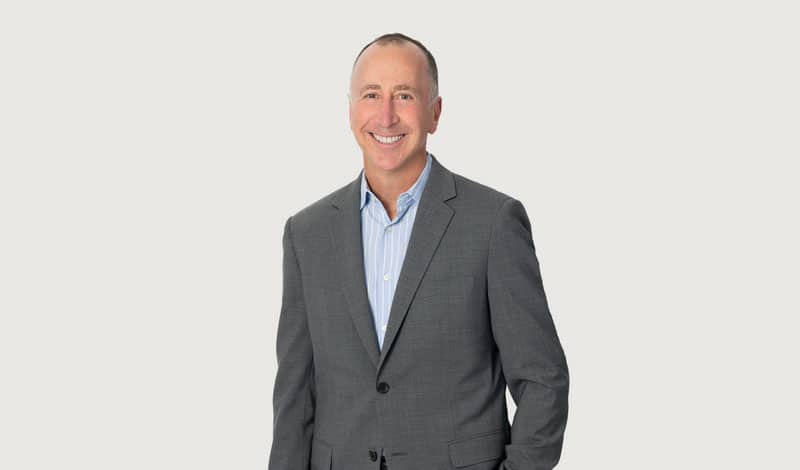
Hillel Newman is the Consul General of The Consulate General of Israel in Los Angeles.

Jenin Counter-Terrorism Effort Read More »

States Should Deliver the Final Blow to BDS at Morningstar

The Jewish News Syndicate (JNS) last week reported that Morningstar Sustainalytics – the environmental, social, governance (ESG) ratings arm of Morningstar, Inc. – had removed negative “controversy” ratings from 19 Israel-based companies. Sounds positive at first until you hear the “but.” Morningstar, sadly, also reaffirmed negative ratings for seven Israeli firms due to their operations in Jerusalem, Judea and Samaria, or their support for Israeli counterterrorism operations. Now it’s up to governors, attorneys general, and treasurers to rid this company of Israel boycotts once and for all.

According to Morningstar, B Communications, Bezeq, Construcciones y Auxiliar de Ferrocarriles, Elbit Systems, Elco, Electra, and Shapir Engineering and Industry remain flagged with ESG controversies in connection with the Israeli-Palestinian conflict. These controversy ratings often serve as the guidepost for ESG investor decision-making – avoiding investments in or even divesting from companies carrying such negative labels.

Bezeq and its largest shareholder, B Communications, are reportedly subject to human rights controversies for providing telecommunications infrastructure to Jews living in Judea and Samaria, also known as the West Bank – land that is also claimed by the Palestinians.

“Many international organizations have reported that the development of infrastructure and the provision of services that contribute to the maintenance and expansion of settlements might reduce the land available to Palestinians, negatively affecting their livelihoods and restricting their right to equality and non-discrimination and freedom of movement,” a Morningstar spokesperson told JNS. “Our rating reflects the fact that these allegations create risk for the company.”

Rather than remain neutral in what is arguably the most complicated geopolitical dispute in history, Morningstar’s ratings align with the boycott, divestment, sanctions (BDS) campaign that punishes companies for supporting any Jewish presence in these territories. Morningstar is using tools of economic warfare to pressure Israel to make unilateral concessions to the Palestinians outside the framework of a negotiated settlement.

Spain-based Construcciónes y Auxiliar de Ferrocarriles (CAF) is also subject to a human rights controversy rating because it builds and operates trams in Jerusalem, the capital of Israel. While Palestinians claim eastern Jerusalem as disputed territory, the United States recognizes Israel’s sovereignty over all of Jerusalem and moved the U.S. embassy there in 2018. Morningstar said CAF, like Bezeq and B Communications, was contributing to the maintenance and expansion of settlements – suggesting it is company policy to consider eastern Jerusalem, including the Western Wall, to be an Israeli settlement rather than Israel’s capital. Morningstar’s spokesperson also compared CAF helping Israel to expand light rail access for Israeli-Arabs in Jerusalem to involvement in “rail projects that support Myanmar’s junta as it uses trains to move its troops, arms and other supplies.”

Morningstar applies negative controversy ratings to three other Israeli companies for similar work. Shapir Engineering reportedly gets a controversy rating for operating and expanding the Jerusalem Light Rail system, which would connect it to Jewish communities in eastern Jerusalem. Electra and its major shareholder, Elco, are reportedly flagged for human rights risks for building tunnels in Jerusalem to help alleviate traffic – one of which would allow better road access for Jewish communities in Judea and Samaria.

In all these cases, Morningstar makes no allegation that these companies are involved in any violation of human rights. Instead, the alleged violation is merely providing non-controversial services or infrastructure in specific territory controlled by Israel – Jerusalem, Judea, and Samaria. This could trigger divestment and contracting bans in certain U.S. states, whose laws consider differential treatment of companies operating in Israeli-controlled territory to be a form of boycott.

The seventh Israeli company blacklisted by Morningstar’s ESG ratings is reportedly defense contractor Elbit Systems, which also remains on Morningstar’s Global Standards Screening (GSS) watchlist – a de facto “do-not-invest” list. Morningstar assigns Elbit a controversy rating due “to some minor reputational risks following allegations of delivering weapons that are used by the Israeli military and have caused civilian casualties.” Morningstar apparently ignores the fact that Israel, like the United States, is a democracy with a military that adheres to laws of war and goes to greater lengths than any country to minimize civilian casualties. Indeed, in other controversy reports, Morningstar lumps Israel in with Saudi Arabia, Egypt, Iraq, Lebanon, Oman, and Qatar as “countries which have been recognized as a high risk of violence against civilians.”

The United States military, of course, has faced similar allegations due to civilian casualties sustained during strikes on Al Qaeda and other terrorist targets around the globe. But there is no evidence either the United States or Israel targets civilians in counterterrorism operations. Punishing Elbit for unintended civilian casualties in such legitimate and defensive strikes is an assault on Israel’s inherent right to self-defense.

More than 35 U.S. states have adopted laws or executive orders intended to deter companies from engaging in boycott, divestment, sanctions (BDS) activities targeting the Jewish state. Some states prohibit contracting with companies that boycott Israel, while others mandate divestment of state funds, including pension fund investments, from such companies. Several states enforced these laws after Unilever subsidiary Ben & Jerry’s announced a boycott of its Israeli licensee.

Last month, JNS reported that the State of Florida opened a formal investigation into whether Morningstar may be violating its state’s updated anti-BDS statute, that specifically calls out ESG ratings. That follows an investigation opened by Arizona’s state treasurer last year. JNS also revealed new investigations launched by attorneys general in Montana and Kentucky.

State officials investigating Morningstar should request copies of all controversy reports or GSS watchlist reports related to the seven companies profiled in this analysis to determine whether Morningstar is violating state anti-BDS laws. In the case of Elbit, officials should also request controversy and watchlist reports for American defense contractors whose weapons systems may have resulted in unintentional civilian casualties during counterterrorism operations launched by the United States to compare Elbit’s treatment.

It’s certainly welcome news that Morningstar was able to remove controversy ratings for 19 Israel-based companies in the last few weeks without first hiring any independent “experts,” as the company had previously suggested might be necessary. That list included all of Israel’s banks and cell phone companies targeted for providing services to Jews living in disputed territories, which prompts an obvious question: Why is Morningstar applying a different standard to the seven Israeli companies still blacklisted?

For a firm whose brand depends on investors believing its financial research and ratings are objective and consistent, Morningstar’s ESG ratings related to Israel have proven to be anything but. To rescue its reputation, now is the time for the company to fully uproot the BDS infrastructure within its ESG subsidiary and remove the remaining seven companies from its blacklist. If C-suite leaders delay any further, state officials should hold them accountable.


Richard Goldberg, a senior adviser at the Foundation for Defense of Democracies, is a former National Security Council official, US Senate aide, governor’s chief of staff and Navy Reserve Intelligence Officer.


States Should Deliver the Final Blow to BDS at Morningstar Read More »

Teaching in Exile – Reflections on Torah Portion Mattot-Massei


Teaching in Exile
Reflections on Torah Portion Mattot-Masei (reworked from previous versions)

One of the core teachings in Torah portion Massei (the second of our double-portion) is the concept of the “cities of refuge” that will be established in the land (Numbers 35:9-34). The Cities of Refuge were set up to handle cases of homicide, especially cases of negligent homicide.

Here’s the background: In ancient times, when a person killed someone accidentally but negligently, that person was still subject to the vengeance of the family of the deceased. In most pre-modern cultures, any member of the opposing group in a blood feud would suffice for vengeance, not just the offender. It didn’t matter if the killing was done by negligence. Blood had to be avenged. Blood for blood. If a Hatfield killed a McCoy, then a McCoy killed a Hatfield. The offended clan would send out a Blood Avenger to seek retributive justice.

The details on the law of the Blood Avenger in this week’s portion were a step forward in the development of law, in two ways. Instead of all the members of a group being held responsible for a killing, only the actual perpetrator was held responsible. In addition, the accused could flee from the Blood Avenger to a city of refuge and get a fair trial.

If the killing were deemed completely accidental, the person was free to go. On the other hand, if it turned out that the person committed willful murder, the court would hand the perpetrator over to the Blood Avenger, who would slay the murderer.

If the killing were deemed only negligent, however, the person could stay safely in the city of refuge until the current High Priest died. At that time, the Blood Avenger was relieved of his duty to avenge the blood of his kinfolk, and the perpetrator could leave the city safely.

This law clearly seems to be intended to prevent something rampant in pre-modern times, and still in force in many places today: the vendetta. If a person from one tribe, group, gang, mob, race, religion, nation, etc., kills a person from another group, the offended group feels it has the right and duty to kill any member of the group of the perpetrator, regardless of culpability. Destructive feuds follow.

The law in this Torah portion takes us a step out of the primitive world of blood vengeance and limits the avenger to killing only the perpetrator. The law of the city of refuge affords the accused a fair trial. The law of negligent homicide is established.

The Talmud, in a surprise moved, takes this wise and fairly straightforward law into unforeseen territory. The Bible in Deuteronomy 4:42, where this matter from our Torah portion is reviewed, says that the person guilty of negligent homicide can flee to a city of refuge and adds the words “and live.” The Talmudic rabbis ask what it means “to live.”  Obviously, he goes there to live and not to die; that is the purpose of the law. “To live” must mean something else.

The rabbis decide (as recorded in Tractate Makkot 10a) that a person cannot live without the study of Torah, so if a person is exiled to the city of refuge, his teacher must go with him so that “he can live.” And where the teacher goes, the whole yeshivah goes.

This fantastical reading of the text is, of course, contested, and there is no recorded case of a rabbi and the yeshivah following a negligent killer into the exile of a city of refuge (at least partly because rabbis and yeshivahs did not exist in the time of the Bible).

The Talmud is probably referring to something deeper, something that every real parent, teacher, healer, therapist, life coach, mentor, true friend, etc. knows:  you can only guide another person if you are willing to go into the exile experienced by the person for whom you are caring for.

The empathy and insight required for true guidance requires that the person who assumes the role of guide can somehow empathetically peer into the soul of the suffering one and not be defended from what one sees there. The true witness to the suffering of another will not be untouched. Perhaps this willingness to suffer some of the exile of the one in pain is the mark of a healing presence.

The rabbi of the man who kills negligently must go into exile with him, we are taught, as well as the entire yeshivah. I try to imagine how the curriculum of this mythological yeshivah is affected. All the inhabitants of the city of refuge sign up for classes. All the students have killed someone. All feel guilty. All feel pursued.

From the perspective of archetypal psychology, we are all students in the yeshivah of negligent killers in the city of refuge. Relationships are often killed, negligently, by a thousand cuts. We kill the spirits of others with our harsh words and uncaring deeds. We often kill ourselves spiritually with addictions, including relentless negative inner voices, cutting away at our sense of self.

We all need to flee to the city of refuge, a state of mind in which we admit that we are sometimes slowly and negligently killing the spirits of others, killing relationships, killing our own well-being. In that exile in the city of refuge, we can confront that destructive negligence and seek the teaching that will release us. We get a fair trial.

Off the top of my head, here are two little teachings. We all live with resentment and regret. You are not human if you have not been hurt or regret some of your deeds, hurting yourself or others. But we ought not be weighted down into the past. Each day is a day that opens on to a new horizon, a new canvas for self-creation, repentance, and renewal. Voices of resentment and regret must be addressed (they never go away), but they ought not dominate our inner dialogue. We ought not let inner forces kill us. Our inner life should be guided toward openness, hope, and joy.

A second teaching: understanding poetry, depth, and irony. While studying this Torah portion, I did not expect to come across this profound teaching in the Talmud. Clearly, the author of this teaching had experienced something very deep, very troubling, and chose to present it as a comment on the law of the city of refuge. Oftentimes, the greatest teachings are taught through metaphor and misdirection, bypassing the defended and skeptical ego self, directly reaching the heart.

The signpost to the city of refuge emerges suddenly out of the dark. It’s talking to you.


Teaching in Exile – Reflections on Torah Portion Mattot-Massei Read More »

Beit T’Shuvah Names Board Chair; AFHU and MASA’s Hires

The board of directors at Jewish rehabilitation organization and synagogue Beit T’Shuvah (BTS) has appointed Keith Elkins as its next chair.

Elkins has been a dedicated advocate of Beit T’Shuvah for many years and brings a wealth of experience and deep commitment to the position, according to BTS Executive Director Sergio Rizzo-Fontanesi.

Elkins succeeds Paul Bergman, who served as chair since 2021 and who will continue to serve on the board. 

In a statement, Bergman emphasized his experienced leading the BTS board through challenging times, including rabbinical transitions, a temporarily unhoused thrift shop and COVID-19-prompted lockdowns, saying all the while the organization stayed on course.

“We remain committed to our mission of saving and transforming lives,” he said.

Elkins, a founding member of law firm Elkins Kalt, has served on the BTS board since 2018. His wife, Jackie, started the BTS challah-baking program and joined the board this year. 

“We are immensely grateful to Paul for his tireless work as chair and for his stable and calm leadership,” BTS’s leadership said in a statement. “Please join all of Beit T’Shuvah in congratulating Keith and expressing our heartfelt gratitude to Paul.” 

Elkins’ appointment as board chair became effective July 1. 


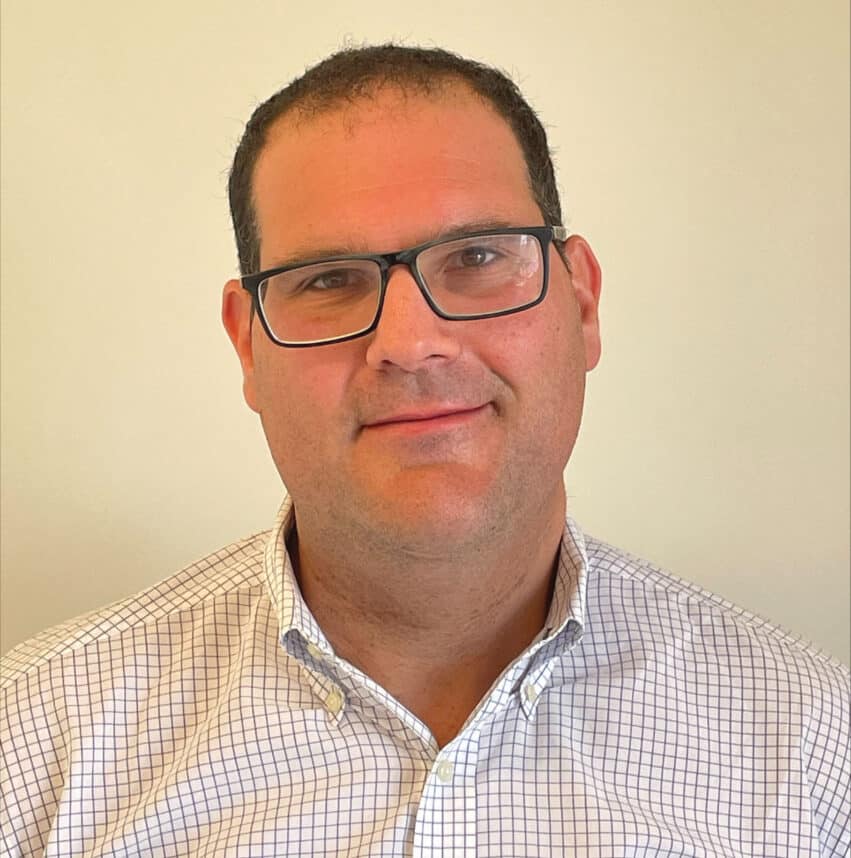
AFHU Western Region Philanthropy Officer Bradley Eisen. Courtesy of American Friends of the Hebrew University

American Friends of the Hebrew University (AFHU) has named fundraising veteran Bradley Eisen its western region philanthropy officer.

“I am excited to be joining the AFHU team,” Eisen said. “I look forward to playing an integral role in supporting the growth and innovation taking place at the Hebrew University of Jerusalem.”

Eisen previously worked at the Jewish Federation of Greater Los Angeles, where he served as a major gifts manager since 2016. His areas of expertise include major and planned giving, capital campaigns, donor engagement and stewardship. He has also worked in sports marketing and sales.

“Brad’s skills as a frontline, major gifts fundraiser, coupled with his background in the Los Angeles philanthropic community, make him a perfect fit for our philanthropy officer role,” AFHU CEO Joshua Rednik said. “We look forward to his contributions and building upon the momentum in our western region.”

The New York-headquartered AFHU is a national nonprofit that raises funds and awareness for Hebrew University of Jerusalem. AFHU fundraising activities support Hebrew University’s scholarly and scientific achievements, create scholarships, construct new facilities and assist efforts to attract and retain exceptional faculty. 

The university serves more than 23,000 students from 80 countries.


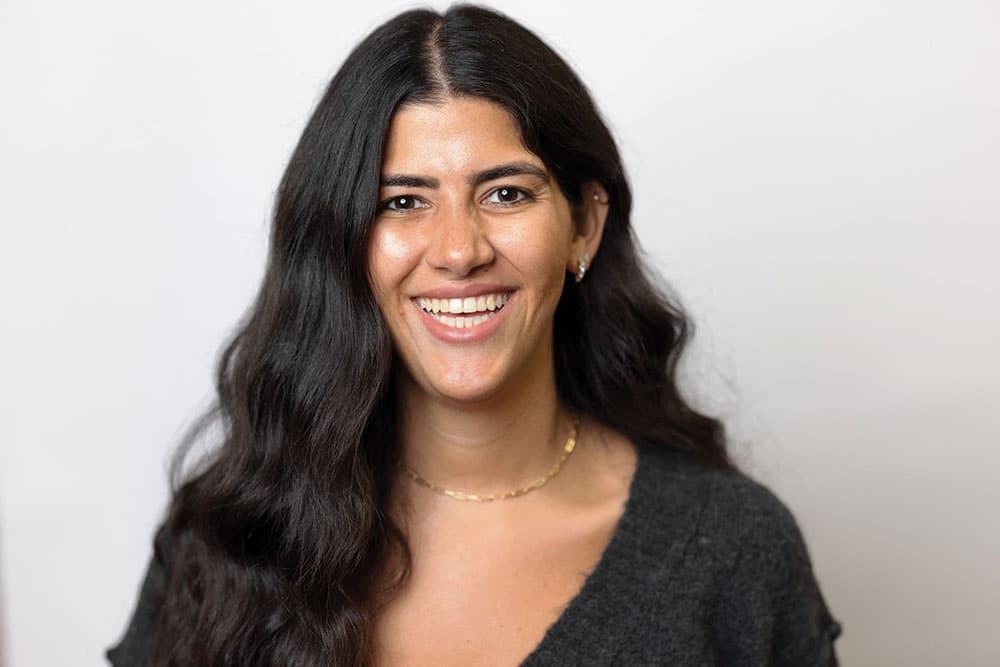
Rozeeta Mavashev. Courtesy of Miller Ink

Masa Israel Journey has appointed Rozeeta Mavashev as its director of office and operations for North America, citing her experience working at Hillel and in diverse Jewish spaces as well as her personal mission to connect Jews around the world to each other and a shared Jewish future.

“Rozeeta is a trailblazer and a role model,” Masa Israel Journey CEO Ofer Gutman said. “She represents many ‘firsts’ — first to join in the initiative of DEI groups at Hillel, first to help in spearheading Employee Resource Groups at Hillel, first Bukharian, Mizrahi woman to receive the Wexner Davidson Fellowship. She understands that our choices and our connections as Jewish people are the energy forces that will power us forward.”

Her path to Masa was not so straightforward. While enrolled at City University of New York, Mavashev, in fact, felt disconnected from her Judaism. But after college and at the urging of her sister, she accepted an internship at Hillel. She then became a Masa Israel teaching fellow — experiences, she said, that altered the trajectory of her life.

“What Masa did was expose me to a range of ways to be Jewish – and they helped me integrate that with my relationships, professional goals and sense of self,” Mavashev said. “Long before the word ‘intersectionality’ became common lingo, that’s what Masa was doing.”

Masa Israel Journey describes itself as the largest immersive, long-term educational experience for young adults ages 16-35. Its programs include Masa Career, Masa Gap, Masa Israel Teaching Fellows and Masa Academic Fellows. Since its 2004 founding by The Jewish Agency and government of Israel, the organization has served nearly 200,000 young people from more than 60 countries.

Beit T’Shuvah Names Board Chair; AFHU and MASA’s Hires Read More »

Mark Rayant and Tikkun Olam Makers (TOM) USC Create Detachable Wheelchair Motor Pack

Tikkun Olam Makers (TOM) is all about creating innovative solutions for the betterment of society. 

Founded in 2014, TOM is an Israeli-Jewish-turned-global-humanitarian-movement that connects makers, students and engineers with people living with disabilities, the elderly and the poor. The goal: to create need-based solutions that will benefit everyone. “Through one-on-one personal interactions, our clients (called ‘need-knowers’) help inform TOM design teams to generate custom open-source prosthetics and assistive technologies,” Mark Rayant, a Master’s student at USC’s Viterbi School of Engineering, told the Journal. “Once developed, [they] are made public and can be manufactured and distributed to any in need of them.”

Rayant, who started the TOM chapter at USC last fall, recently developed an affordable, detachable motor pack for wheelchairs, called Project Wilson. It’s named after the need-knower who requested it. Wilson was having difficulty with their commute to class. The long distance caused a lot of arm strain and calluses on their hands, especially on the often uneven pavement outside of campus.

The team met with Wilson to measure the wheelchair specifications and ensure the device was tailored to their needs, and decided to base the design around a relatively inexpensive electric scooter.

Wilson sets up the final prototype for the ride home.

From there, Rayant explained, it took several trips to hardware stores and some careful planning with sketches and 3D modeling software, along with many hours in the machine shop, refining parts, to perfectly match the prefabricated scooter components. 

“Using pre-existing holes in the chassis of the wheelchair, our team was able to design a bracket that securely and non-invasively attaches with steel safety pins while being simple for the user to remove and suitable for any similar chair design,” he said. “Into that bracket the motor and handlebars easily lock into place, and after welding the prototype together and painting it hot rod red (Wilson’s favorite), we were ready for the races.”

Rayant said nothing was more satisfying than seeing the smile on Wilson’s face while it accelerated up to speed. “The prototype, with some refining into a final product, will cheaply and safely motorize any manual wheelchair,” Rayant said. “The easily detachable design takes the strain off a user during long distance travel, without any permanent modifications to the wheelchair and while still allowing for manual use, as needed. 

Rayant added, “After purchasing the parts and following the easily repeatable process, the design is around one-third the cost of the cheapest alternative.”

“Mark’s work embodies the tremendous potential that lies within university communities,” TOM founder Gidi Grinstein told the Journal. “In the U.S. alone, students of engineering and design are estimated to do 50,000 projects per year. TOM aims to allow these students and their faculty and universities to deploy their talents and resources toward serving their communities, society and the world.”

“Mark’s work embodies the tremendous potential that lies within university communities.”
– Gidi Grinstein

Last fall, Rayant was recruited to begin a chapter of the organization at USC. “Though having chapters at universities around the world, TOM is fairly unrepresented in California and was looking for ways to increase their presence in the region,” Rayant said. “After joining, my goal was to go beyond the basic community requirements and create a permanent student organization at my university that could have a lasting impact on campus.”

Mission accomplished. Rayant recruited a team of motivated peers, found a committed academic advisor, drafted a constitution with the newly-formed executive board, became a registered student organization, gained access to machine shops and found and recruited need-knowers for projects.

They also designed and delivered prototypes in time for TOM’s Global Innovation Challenge, where they finished in the top 20 out of 235 submitted projects from teams around the world. This included a prize of funding for future development.

Rayant was familiar with the concept of Tikkun Olam before he was ever contacted by the organization. “Growing up Conservative in the U.S. and having a grandfather who escaped the Holocaust have made my Jewish heritage an integral part of my life and identity,” he said. “I see healing the world not only as a calling, but as an obligation, given how many blessings I have received in my life.” 

He sees his role in TOM: USC as “an incredible opportunity that could not be denied,” he said. “I think it will be among the most important things I will do while finishing my degree.”

“Since its inception, Tikkun Olam Makers has been driven by a singular vision: to make a significant and distinctly Jewish and Israeli contribution to humanity by deploying technology and design toward improving the lives of millions of people,” Grinstein said. “TOM was also created to bridge across religious, political and national divides. We are the only Israeli-American organization to operate, including with local partners, in Bahrain, UAE, Morocco and Jordan, as well as in the Palestinian Authority as a grantee of USAID within the Nita Lowey Middle East Peace and Prosperity Act (MEPPA).”

In addition to designing and distributing new projects next semester, Rayant plans to offer lessons to interested students of all backgrounds in the machine shop and host guest lecturers from USC’s rich supply of esteemed faculty. 

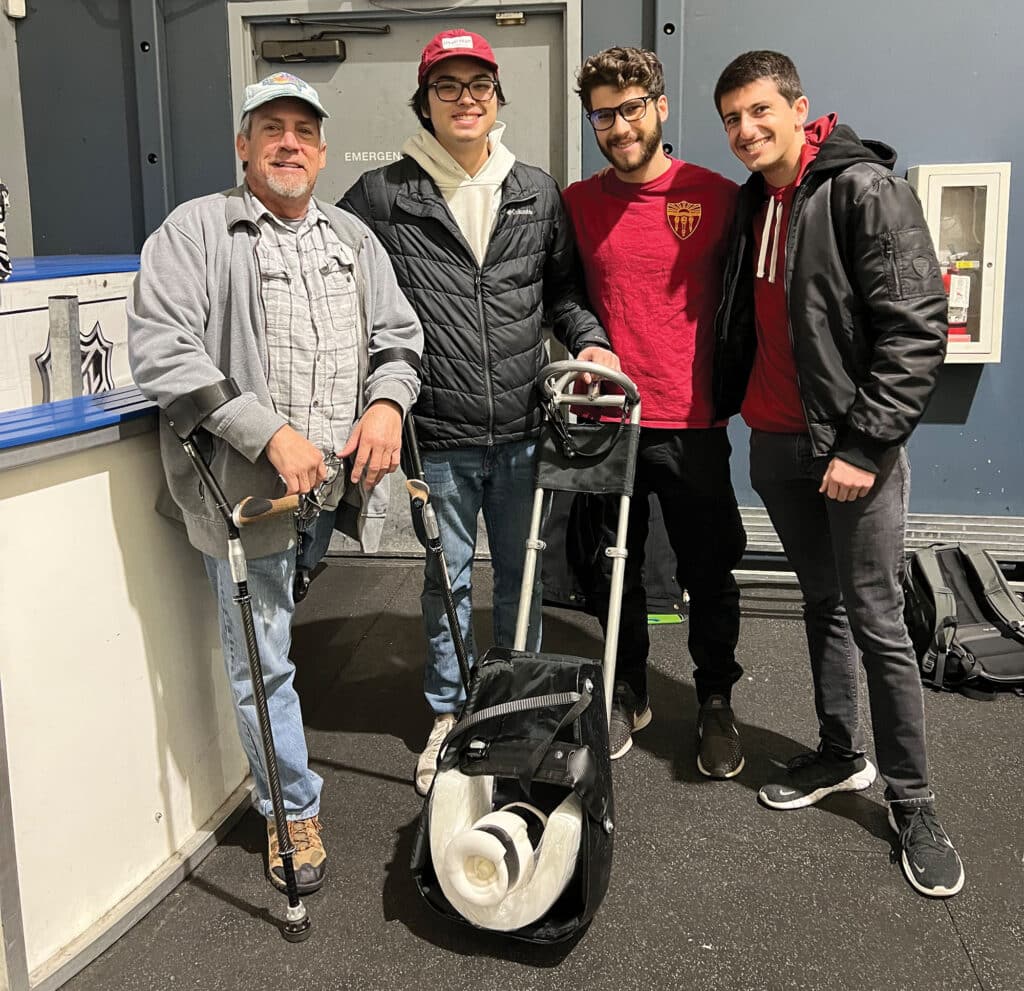
The next project for development is a stabilizing device to allow Dick, a Need-Knower, and other amputees, to more easily and comfortably play sled hockey. Work on this project will resume in late August at the beginning of the Fall 2023 semester.

“I want to thank my executive board Justin Lockwood, Netanel Sadeghi, Oliver Laryea, and Victoria Onajobi for making TOM: USC possible,” Rayant said. “I especially want to thank Wilson Johnson for being so wonderful to work with, and now part of our team.”

To obtain and customize the motor, or any TOM Product, simply download a Product File from the page on TOMGlobal.org and assemble it at home. You may also be able to choose a manufacturer from the list of relevant maker-spaces on the site.

If you or someone you know has an unfulfilled need and is interested in consulting with the team, please reach out to tomrecruitmentusc@gmail.com.

Mark Rayant and Tikkun Olam Makers (TOM) USC Create Detachable Wheelchair Motor Pack Read More »

A Moment in Time: “Are You Here with Your Wife?” (Shopkeeper to me)

Dear all,

I share the following interaction from my recent trip to Israel:

“Are you here with your wife?”

Yes, that’s what the orthodox shopkeeper asked as I perused her store in the Jewish Quarter of the Old City of Jerusalem.

Even now, 27 years post my official “coming out,” I still pause before responding.

Should my answer be any different whether I am in West Hollywood, Dallas, Kuala Lumpur, or Jerusalem?

Should my answer be any different whether I am speaking to a religious or a secular person?

Should my answer be any different if I am alone or with a group?

Yes – these thoughts continue to stir.

But in this particular moment in time, I took a deep breath and shared:

“I’m here with my husband.”

“Oh,” she continued, “Please invite him in, as it’s always better to shop as a couple!”

I left her shop with a smile rather than a sense of conflict. It’s amazing how truth opens doors of possibilities.

With love and shalom,

Rabbi Zach Shapiro

A Moment in Time: “Are You Here with Your Wife?” (Shopkeeper to me) Read More »