fbpx

June 30, 2023

Letter to the Editor: On American Jewish Legacy Organization

Letter to the Editor:

Thane Rosenbaum’s polemic (June 28) casts a wide and indiscriminate net in unleashing myriad false accusations upon American Jewish legacy organizations.

I will not speak for fellow organizations but can proudly assert that AJC is staffed with proud Zionists across our national and international platforms, colleagues who at any given moment are engaged in the good fight against antisemitism across the political spectrum.

We regularly interact with elected officials, locally and internationally, bringing a nonpartisan perspective that enlists members of both parties, including our Project Interchange delegations that shine a light of understanding about the Mideast conflict while sharing our love and pride for Israel. AJC also actively supports Jewish students on campus, including recently calling out administrators at City University of New York.

AJC was an early leader in fighting the insidious tactics underpinning creation of the California Ethnic Studies Model Curriculum and its so-called liberatory mutations. We routinely combat BDS, educating our intergroup allies to the true nature of a movement whose singular purpose is to delegitimize Israel. At AJC, we roll up our sleeves to get good work done daily, steadily pushing back against the world’s most enduring hatred. We stand by our efforts to combat antisemitism and advocate for Israel and will never shrink from this sacred obligation.

Richard S. Hirschhaut
Los Angeles Director,
American Jewish Committee (AJC)

Letter to the Editor: On American Jewish Legacy Organization Read More »

Disturbed Lead Singer During Tel Aviv Concert: “F— Roger Waters”

Disturbed lead singer David Draiman declared “F— Roger Waters” during the heavy metal band’s June 28 Tel Aviv concert, which was met with loud applause.

“F— Roger Waters and all the rest of his f—ing BDS [Boycott, Divestment and Sanction] Nazi a–holes,” Draiman said onstage at the Tel Aviv Expo. “Every last f—ing one of them. We don’t need that s—. We’ve survived worse than them and we’ll continue surviving worse than them. They can make up any lie they want, they can create any bulls— story they want, we know the truth, history knows the truth, we are not going any f—ing where.” At that point, the audience started chanting, “David! David!”

“Besides, even though we’ve gone through some dark periods in our history … sometimes darkness can show you the light,” Draiman added, referencing the Disturbed song “The Light.”

Waters, the former Pink Floyd bassist and frontman, has come under fire after donning a Nazi-style uniform and comparing Palestinian journalist Shireen Abu Akleh to Anne Frank during a couple of his concerts in May; Waters has argued that the uniform is a satirical way of speaking out against fascism and that Abu Akleh and Frank were listed among those who were “killed either by militarized police or by tyrannical racist regimes.”

Draiman has long been a staunch critic of Waters. In a 2019 video interview with the Bring Disturbed to Israel Facebook page, Draiman said regarding Waters and BDS: “The very notion that Waters and the rest of his Nazi comrades decide that this is the way to go ahead and foster change is absolute lunacy and idiocy. It makes no sense whatsoever. It’s only based on hatred of a culture and of a people in a society that has been demonized unjustifiably since the beginning of time.” Draiman also chastised Waters’ use of a Star of David on a flying pig during a 2013 show as being “abhorrent and blatantly antisemitic.”

Also during Disturbed’s June 28 Tel Aviv concert, Draiman gave a stirring rendition of the Israeli national anthem “Hatikvah” while donning an Israel Defense Force (IDF) tank-top. At one point Draiman said, per the Jerusalem Post: “As you can see by my attire, I couldn’t be more proud to be Jewish, Israeli.”

Disturbed Lead Singer During Tel Aviv Concert: “F— Roger Waters” Read More »

Brave-ish Summer News Spectacular

June News 2023 with Lisa Niver & We Said Go Travel:

Thank you to Woman’s Day Magazine for highlighting my friendship with Carl Law for Best Friend’s Day!

https://youtube.com/shorts/gD2q_ud_kT0

🥁📚 Exciting news! 📰 Join me in a virtual drum roll as I unveil the cover for my upcoming book! 🎉🎉 It’s been an incredible journey ✈️, and I’m beyond grateful for your unwavering support. 💕💕 I am the author of “Brave-ish, One Break-up, Six Continents and Feeling Fearless After Fifty! PREORDER: https://lisaniver.com/braveish/  🎉🎉

Thank you to the Los Angeles Press Club! I was nominated for TWO Southern California Journalism Awards! Thanks to BJ Korros, The Hollywood Moment, for all his support for my book!

65th Annual Southern California Journalism Awards LOS ANGELES, CALIFORNIA – JUNE 25: Journalist Lisa Niver (L) and entertainment reporter BJ Korros attend the 65th Annual Southern California Journalism Awards at the Biltmore Los Angeles on June 25, 2023 in Los Angeles, California. (Photo by Amanda Edwards/Getty Images)

FIND and FOLLOW We Said Go Travel on GOOGLE NEWS!

THANK YOU to the PENN GAZETTE for sharing about 1989 travel panel & my adventures with Carl

Lisa Niver C’89, founder of WeSaidGoTravel.com, participated in a virtual alumni travel panel last fall, hosted by the Class of 1989, and organized by Julia Stone C’89 with the Penn Alumni 1989 team. Other panelists included Brad Handler C’89 W’89, executive chairman of Inspirato, and Cara Schneider Bongiorno C’89, founder of Philly History Pop Ups; and the panel was moderated by Romy Buchman Coquillette C’89. Among the attendees were Mike Karz C’89 W’89 and Kenneth Pickar Gr’66. Lisa writes, “I also had a 38-year friendship anniversary with Carl Law C’87. We met on my first day as a student at Penn. In other news, my book will be out in September, I’ve spoken at four Travel and Adventure Shows this year (Chicago, Los Angeles, Dallas, and New York), and I have started a new podcast called Make Your Own Map. You can find it on my website, at lisaniver.com/makeyourownmap.”

https://thepenngazette.com/alumni-notes-162/

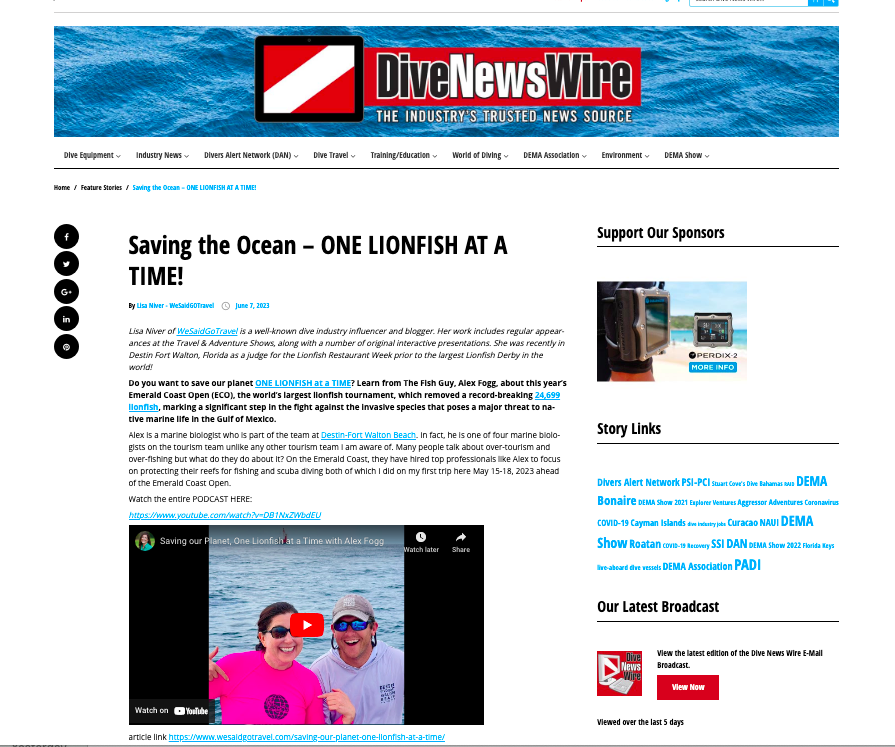
Thank you to Scott Jones from DiveNewsWire for sharing my podcast with Alex Fogg from Destin-Fort Walton Beach about the Lionfish Derby! I am honored to be part of this incredible publication that focuses on my passion of scuba diving!

THANK YOU for watching my podcast! It has now been seen and heard in 32 countries on 6 continents!

USA 🇺🇸 Canada 🇨🇦 Ireland 🇮🇪 UK 🇬🇧 Italy 🇮🇹 India 🇮🇳 Singapore 🇸🇬 Australia 🇦🇺 New Zealand 🇳🇿Switzerland 🇨🇭 Hong Kong 🇭🇰 France 🇫🇷 Latvia 🇱🇻 Philippines 🇵🇭 Netherlands 🇳🇱 Japan 🇯🇵 Fiji 🇫🇯 Portugal 🇵🇹 Kenya 🇰🇪 Mexico 🇲🇽 Guatemala 🇬🇹 Germany 🇩🇪 Uruguay 🇺🇾 Bangladesh 🇧🇩 Spain 🇪🇸 Panama 🇵🇦 Thailand 🇹🇭 Uganda 🇺🇬 UAE 🇦🇪 Greece 🇬🇷 South Africa 🇿🇦 Puerto Rico 🇵🇷

New PODCAST episodes: Jeff Jenkins, host of Never Say Never, Dr. Richard Murphy on World Environment Day at Dorado Beach, A Ritz-Carlton Reserve, Pauline Frommer of Frommer’s Travel Guides and Nina Ruggiero, digital editorial director of Travel and Leisure and co-founder of “Be A Travel Writer” course.

WATCH my podcast, “MAKE YOUR OWN MAP: Are YOU ready to be BRAVE?” on Spotify, Apple Music, Amazon Music, YouTube PodcastGoogle Podcasts, Audible, Anchor, PandoraiHeart Radio

WHERE CAN YOU FIND MY TRAVEL VIDEOS?

Here is the link to my video channel on YouTube where I have NEARLY TWO MILLION views on YouTube! (now at: 1,890,000 views)

Thank you for your support! Are you one of my 3,960 subscribers? I hope you will join me and subscribe! For more We Said Go Travel articles, TV segments, videos and social media: CLICK HERE

Find me on social media with over 150,000 followers. Please follow  on TikTok: @LisaNiver, Twitter at @LisaNiver, Instagram @LisaNiver and on FacebookPinterestYouTube, and at LisaNiver.com.

My Podcast: “Make Your Own Map!”

Fortune Cookie SAID:

“Open the pages of a book, and behold a universe unfurled. Adventure, knowledge, and inspiration await your curious mind. Let the words transport you to realms unknown, where dreams come alive and stories unfold. Lose yourself in the magic of reading, for within these words, a world of wonders resides.”

BRAVE-ish, One Break-up, Six Continents and Feeling Fearless After Fifty

More about my stay at Dorado Beach, A Ritz-Carlton Reserve coming soon—-

Brave-ish Summer News Spectacular Read More »

The Snake Within – Comment on Torah Portion Chukkat

“Nechushtan” John Romano D’Orazio – Wiki Commons


The Snake Within

Torah Portion Chukkat 2023 (based on prior versions)


How do people heal? I don’t mean in general. If I am injured or sick, I believe in western medicine when it is properly practiced. Physicians, nurses, hospitals, pharmaceuticals – the whole shebang. I also make use of Eastern, Northern and Southern medicine. Anything that works.


My question, ‘how do people heal?’ refers to that delicate moment in which you’ve already taken the full treatment from whichever geographic part of the globe to which you go, and something lies in the balance. A person is 50/50. Something else happens.


Prayers from others? Divine intervention? One’s own will? Some mysterious mixture of them all? I say “yes.” People ask me if I pray for healing. I say, yes, along with any other treatment that works. There are some moments, perhaps rare, in which the presence of healing energy, from others, from God, from within, is all you have left, and it just barely tips the scale. Don’t rely on miracles, but don’t shun them, either.


Let’s pick some not so random example from our Torah portion, for instance, a snake bite. From what I know, if a person is bitten by a poisonous snake, don’t use a tourniquet, bite, cut or suck the wound, rely on snake stones, give the person alcohol, or do anything except keep the person calm, keep the wounded area below the heart, and get them anti-venom treatment ASAP. Nothing else works, on any continent. That’s what I read.


One of the last things that would come to mind for a poisonous snake bite is looking at a copper snake on a staff, unless you were familiar the bizarre little anecdote told in this week’s Torah portion, Chukat, specifically, Numbers 21:5-9. Here is the story: The new generation of Israelites rediscovered the old-time religion of their parents – being disgruntled, either about something real or sometimes about things completely made up. The new generation, like their doomed parents, took to complaining about the so-called rotten bread, otherwise referred to as manna from heaven.


As is often pointed out, the God-Of-The-Hebrew-Bible (not the God I believe in, but the God they believed in) had a very low threshold for tolerating complaints. This time the biblical God sics fiery snakes on the people. Their complaining minds were distracted from their made-up complaints and quickly forgot about the quality of the recent batch of manna . People were actually dying of snake venom.


The Israelites adroitly repented and asked Moses to pray for them. Moses prayed for them, and in response the biblical God tells Moses to craft an image of a “s’raf” (a fiery serpent), proclaiming that when any bitten person looks at it, they will live. Moses takes to making a “n’chash nechoshet,” a sculpture of a copper snake.


A few things here. First, I can imagine Moses whipping out his coppersmith manual and getting to work. I can see anxious snake-bite victims gathering around, maybe throwing out some advice here and there on how to speed things up with making a copper snake, and Moses saying, “Watching me work won’t make it go any faster.”


Second, something else is going on. “Nachash” means “snake,” and “nechoshet” means “copper.” The two words share the sound of nachash. The snake takes us back to Eden. There was a play on words lurking about in the mind of the biblical author, just waiting to be played.


Third, the “snake on a staff” theme is ancient, very ancient. Ancient Sumeria had a god depicted as a snake (representing healing) entwining around an axial rod, symbolizing a tree of life. Wow – a snake and tree of life in ancient Sumerian mythology! What’s with the snake? Apparently, the capacity of a snake to shed its skin and appear young again mystified the ancients. It was as if the snake could heal itself of aging, and all other ailments, as well. The snake, as it were, knew the secret to eternal life. (Our Garden of Eden story with the snake, the tree of knowledge of good and evil, and the tree of life gets a bit more mysterious.)


One finds this tradition of the snake entwined on the staff representing healing in our present biblical text, and also in more well-known Greek mythology. The ancient Greek image of the Rod of Asclepius (the Greek god of healing) is used all over the world to represent the field of medicine. (The association of healing with the caduceus – two snakes on a rod with wings – is a mistake.)


Our biblical text that tells of the healing snake, then, is rooted in an ancient Near Eastern tradition connecting snakes with healing, a tradition that arrived in Greece, and it reappears today. (It seems very odd to me that the field of Western medicine, perhaps the apex of practical science, has chosen to symbolize itself with an ancient god of healing, Asclepius, who is symbolized by the even more ancient snake and staff imagery.)


After this snake infestation wanes, what happened to the snake on the staff? Apparently, it was kept around until King Hezekiah had the snake and staff of Moses destroyed – see II Kings 18:4.


How did the ancient rabbis understand all of this? The rabbis of the Talmud were incredulous that the staff worked as described. They said, in tractate Rosh HaShanah 29a, that when people looked up at the snake on the staff, it reminded them to pray to their Father in heaven, and that’s why they were healed. Yeah, right. I don’t think the ancient rabbis even believed that themselves. No, the people probably did really believe that looking at the staff might heal them. Believing in a placebo can have miraculous effects. Or maybe it wasn’t a placebo. “There are more things in heaven and earth . . . than are dreamt of in your philosophy.” (Shakespeare, Hamlet, Act 1, Scene 5)


For me, the question, “how do people heal when the matter hangs on a thread?” is the physical version of the question of how people transform at all. How does a false person become a true person? How does an addict become sober? How does a depressed person return to life? How does anger turn to forgiveness? Resentment to understanding? Willful ignorance to troubled wisdom? In what unconscious realm is the will to truth activated, surging its way into consciousness and life?


Let’s ask it this way. How does that inner, misfiring force arise, that would rather have us complain than solve, that would rather us blame than face ourselves? That snake within does not want us to know that there is a snake within. The snake within envenoms secretly. The venom of the snake within can attack us and everyone around us but relies on our not knowing that we have been poisoned.


The beginning of the anti-venom to the bite of the snake within is to see the snake.

The Snake Within – Comment on Torah Portion Chukkat Read More »

Hidden Gem of Tel Aviv – Alma – Center for Hebrew Culture


Friday June 30, 2023

Update from Tel Aviv

We hope you all have some time for fun and relaxation this summer. Our time is mostly devoted to family and enjoying Tel Aviv. It is truly a fabulous city, and I (the foreigner) still find hidden gems.

One place I sought out is called Beit Matanel – Alma – Bayit L’tarbut Ivrit  (Center for Hebrew Culture).

https://alma.org.il/

I’ve come across this term “Hebrew Culture” several times last year and this. The term roughly means the Hebrew language side of Jewish culture and texts, but without a religious context. For example, Alma (just a few minutes’ walk from us), offers study of Hebrew/Jewish texts for those who would be called “secular” – “non-religious.”  A secular Israeli with a good high school education has had a much richer exposure to Jewish texts than average non-Orthodox American rabbi. That Israeli being “secular,” though, means that they have had no place to engage with the that they studied back in high school or in college.  At Alma, there is no doctrine, no religious world view. No rabbis in charge. No politics. As the person who gave us a tour termed it, “we are walking barefoot in the orchard of Jewish texts.”  Alma, you might say, is a yeshiva for secular Jews.

Meirav and I signed up for summer course on reading passages from the Zohar (the class is in Hebrew). The teacher, Neta Sobol, has her Ph.D. in Kabbala from Tel Aviv university. She has a deep and poetic soul and is clearly adept at studying with the unique nature of the Israeli student. The 25 or so disparate students range in age from 20’s to 60’s, women and men. None wears a kippah (except your truly). The text of the Zohar is translated into Hebrew. As class discussion moves along, the students’ knowledge of Jewish texts (Bible, Midrash, etc.) is apparent. It is also apparent that many have studied other spiritual paths, including Eastern and New Age. I see that Neta’s role is not to teach “the meaning of the text” (a questionable literary endeavor to begin with). From my point of view, she teaches in the spirit of “the hammer on the rock” (see Talmud Sanhedrin 34). The word of a holy text is like a rock. As the mind of the reader of the text strikes the word, sparks of meaning fly. The room at Alma, full of disparate souls, is united by one thing: those present wanting to find meaning, as community, in a text that is their legacy, too. Meirav and I so deeply enjoy the sparks of interpretation, of meaning and engagement, flying in the room.


One of the main genres of the Zohar is the community of students (the “chevraya”) gathering together to strike the rock and let sparks fly. In this class, we are studying one of those passages (Sitrei Torah on Lekh Lekha – Zohar volume I:89b-90a). It is a deep experience, seeing us in the library at Alma, mirroring the text, the text mirroring us.

Hidden Gem of Tel Aviv – Alma – Center for Hebrew Culture Read More »

Defying Horrors of Teenage Years in Auschwitz, Joshua Kaufman, 95, Embraced Life

Holocaust survivor Joshua Kaufman, a beloved fixture of the Los Angeles Jewish community who was recognized at the 2019 State of the Union address in Washington, D.C., has died at the age of 95.

Joshua’s reunion with the American soldier who liberated him at Dachau Concentration Camp was captured in the 2015 History Channel documentary The Liberators: Why They Fought. In 2016, Joshua traveled to Germany to testify at the trial of Auschwitz guard Reinhold Hanning.

For many years, Joshua declined to speak about his wartime experience – even to his four daughters – but in 2017 he gave a 5-hour interview with the USC Shoah Foundation just as the Institute was ramping up its Last Chance Testimony Collection, an effort to capture the stories of Holocaust survivors while time and memory permit.

Joshua Kaufman, with three of his daughters, Malkie, Rachel, and Alexandra, who sat with him during his 2017 interview.

Joshua was invited to attend then President Trump’s 2019 State of the Union address, along with a Jewish American soldier who helped liberate Dachau. “Your presence this evening honors and uplifts our entire Nation,” President Trump said.

Joshua’s warmth and his no-nonsense lust for life were captured by artist David Kassan in a life-sized portrait of Joshua included in Facing Survival, a 2019 art exhibition of the USC Shoah Foundation and USC Fisher Museum of Art.

___

Joshua was born on February 20, 1928, in Debrecen, Hungary, the third of four children of Berta and Alexander Kaufman, a lumber industry businessman.  At the age of 11 or 12, Joshua was sent to the Satmar Yeshiva in Satu Mare, Romania, where he studied Talmud.

In 1938 and 1939, Hungary’s Nazi-influenced regime passed anti-Jewish race laws and in November 1940 Hungary joined Germany’s Axis alliance. Joshua’s father, a high ranking reservist, was expelled from the Hungarian army in 1942, and soon after he was deported to a labor prison in Russia.

In 1943, the Nazi-allied Hungarian police took Joshua and his brothers as slave laborers and in March 1944 the German army entered Debrecen. Jews were forced into a ghetto and in the early summer of 1944, Joshua and his mother and siblings were sent to the Auschwitz-Birkenau Concentration Camp.

Joshua, then 16 and athletically built, was sent to serve as a laborer. His mother and siblings were sent the other way, toward the gas chambers.

Food – the lack of it and the constant quest for more – took over Joshua’s every action. He endured beatings when he was caught stealing potatoes from the kitchen. When prisoners threw themselves at the high voltage fence that surrounded the camp, he volunteered to clean up the bodies, so he could retrieve any scraps they might have hidden in their clothing.

His main task in Auschwitz-Birkenau, where he was interned for about three months, was removing bodies from the gas chambers.

“I did my job because I got food and I want to see what is going on. Unbelievable for a Jewish religious child from a good home, good education, beautiful parents, beautiful grandparents, good people, that I have to become a butcher [at] 15 years,” he said.

As Russian troops advanced westward toward Auschwitz in early 1945, Joshua was sent on a death march to Dachau. At the Muhldorf subcamp of Dachau, Joshua worked carrying cement for the construction of an underground runway for a German aircraft factory.

On April 30, 1945, American soldiers liberated Dachau. They took the survivors to a field hospital.

“They took care of us like babies. I can never forget it,” he said of his American liberators.

Over the following year, Joshua regained his strength at the Feldafing Displaced Persons Camp in Germany and eventually made his way back to Drebecen. Joshua’s mother and his siblings, Malka, Tzvika, and Meir, and around 100 extended family members, had all been murdered.

But his father had survived, and he soon remarried. In 1949, facing postwar antisemitism in Communist Hungary, Joshua moved to the newly established State of Israel. He joined the Israeli military, where he worked as a tractor/heavy equipment operator and fought in Israel’s wars of 1956, 1967 and 1973.

As a tourist in Los Angeles in 1975, Joshua met Margaret Rosenblum, a Hungarian Holocaust survivor. They married and had four daughters and Joshua worked as a licensed plumber.

Joshua didn’t tell his daughters he was a Holocaust survivor until they were in high school, and even then, he shared very little, in part to protect them.

“It’s a very big thing,” he said of his decision to record his testimony in 2017. “Because I hear the voice of the people,what they said– Joshua, don’t let us forget.”

Margaret died in 2021 after a long illness. Joshua is survived by his daughters, Judy (Yehuda) Ledgley, Malkie (Jason) Rodin, Rachel, and Alexandra (Henry) Stern, and six grandchildren.

Watch Joshua Kaufman’s full testimony.


Julie Gruenbaum Fax is a content strategist at USC Shoah Foundation. A longer version of this article was published on the USC Shoah Foundation website.

Defying Horrors of Teenage Years in Auschwitz, Joshua Kaufman, 95, Embraced Life Read More »