fbpx

June 29, 2023

Jewish Future Pledge, LA Press Club Gala, Harkham GAON Names New Principal, Hebrew University Honorary Fellowship

Sinai Temple Emeritus Senior Rabbi David Wolpe has become the Jewish Future Pledge’s 18,000th “Chai Pledge Ambassador,” thereby committing to donate at least half of his charitable giving to support the Jewish people or the State of Israel.

“In signing the Jewish Future Pledge, I am making a profound and heartfelt commitment to my beloved community,” Wolpe said. “It is a pledge that reflects my strong conviction to uphold the cherished values and customs that have not only shaped my own identity but also impacted the lives of numerous individuals. This pledge represents a resolute determination to safeguard and preserve our rich heritage for future generations.”

Business executive and philanthropist Mike Leven, co-founder of the Jewish Future Pledge, said Wolpe’s “pledge exemplifies the impact one person can make in preserving our rich culture for generations. As we cross this milestone, we urge Jewish communities globally to join and make a difference. Committing to the Jewish Future Pledge creates a lasting legacy of hope, unity, and compassion.”

The Jewish Future Pledge aims to safeguard the future of the Jewish community by encouraging planned estate allocations and promoting the sharing of generational narratives and values. To date, more than 21,000 people have signed the pledge.


David Suissa at the LA Press Club ‘s annual Southern California Journalism Awards gala.

The Jewish Journal was recognized with several awards during the Los Angeles Press Club’s annual Southern California Journalism Awards Gala, held June 25 at the Millennium Biltmore hotel.

Journal Editor-in-Chief and Publisher David Suissa’s article, “The Fabelmans’: Steven Spielberg’s Antidote to Jewish Victimhood,” was recognized in the entertainment news or feature category. Additionally, Suissa was named best columnist for his article, “Can we fight antisemitism without losing our sense of humor?” He was competing among those who write for newspapers with a circulation under 50,000.

Journal columnist Tabby Refael’s article, “Want to be Pro-Israel? Support Iranians” was awarded second place in the columnist category.

The glitzy gathering drew hundreds of people. Speakers included Judea Pearl, father of slain Wall Street Journal reporter Daniel Pearl, who presented French-Jewish philosopher and activist Bernard-Henri Levy with the Daniel Pearl Award for courage and integrity in journalism. In his remarks, Pearl called on liberal media outlets to cover events in Israel more objectively.
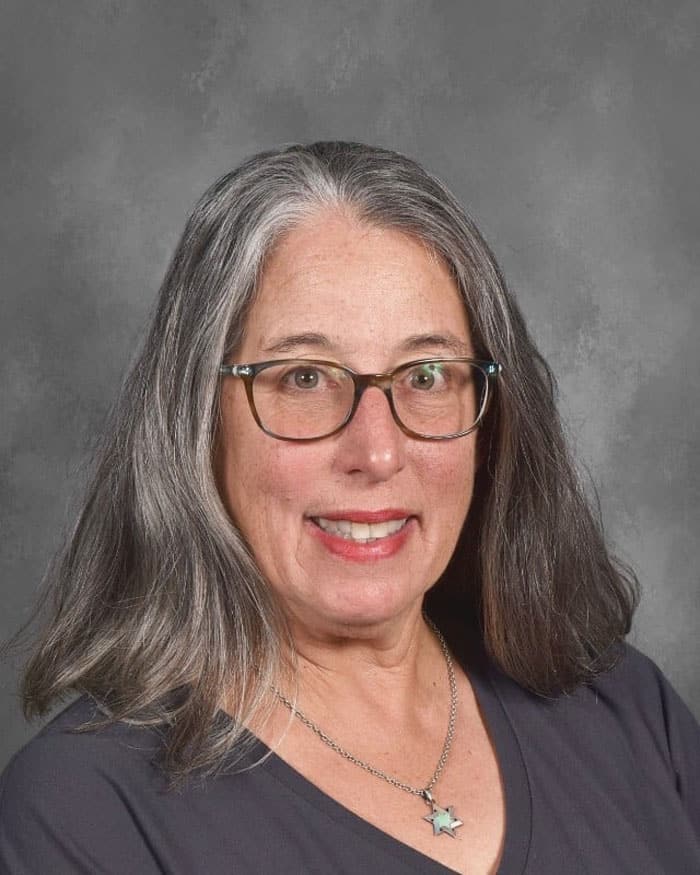

Ruth Morris

Harkham GAON Academy has named educator Ruth Morris its new principal, effective July 1.

Morris has spent the 20 years of her career in education working in the Culver City Unified School District. Most recently, she served as the general studies assistant principal at the Hebrew Academy Community Day School of Orange County. 

A native Angeleno and Culver City resident, she was seeking a position closer to home and views serving the Jewish community through education as her life’s calling. 

“Morris is well-equipped to lead our school into its next phase,” Harkham GAON Academy Founder and Rabbi Moises Benzaquen said. “She’s creative, has broad experience in both educational and business leadership, and her enthusiasm is infectious.”

Harkham-GAON Academy is a college preparatory day school located on the campus of Beth Jacob Congregation in Beverly Hills, serving students in grades 6 to 12. 
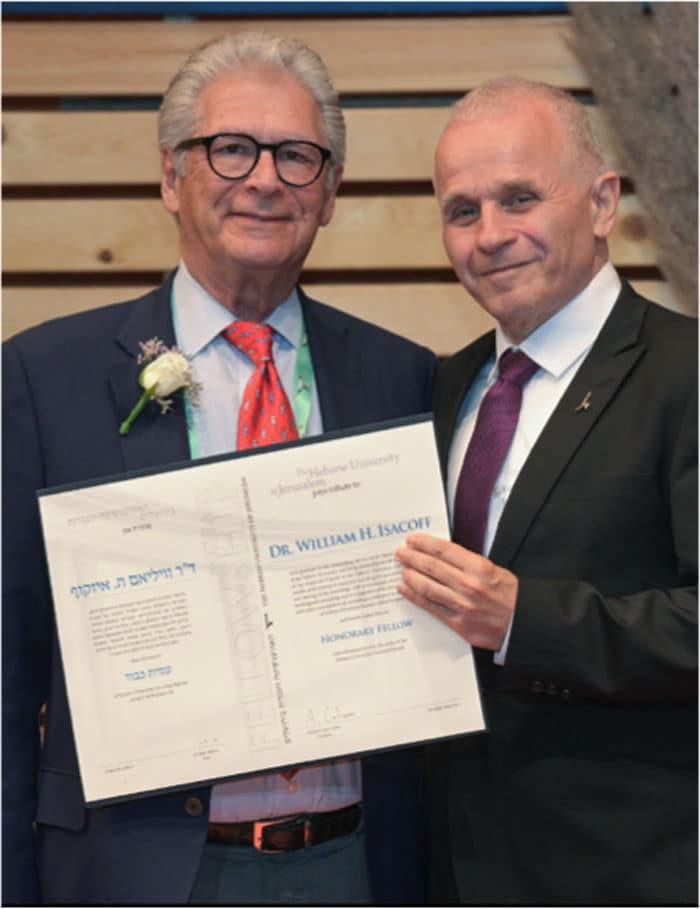

Hebrew University of Jerusalem President Professor Asher Cohen (right) presents an honorary fellowship to Dr. William Isacoff on June 12 at the 86th Board of Governors Meeting in Jerusalem. Photo by Bruno Charbit

Hebrew University of Jerusalem (HU) presented an honorary fellowship to prominent pancreatic cancer researcher and Jewish leader Dr. William Isacoff. 

Isacoff, one of the foremost gastrointestinal oncologists in the United States, has developed innovative treatments that have significantly extended the lives of pancreatic cancer patients nationwide. He currently holds an academic appointment within the department of medicine at the David Geffen School of Medicine at UCLA and serves on the UCLA Jonsson Comprehensive Cancer Foundation board.

He also sits on the American Friends of Hebrew University board as well as HU’s international board of governors. 

“We welcome Dr. William Isacoff into the ranks of the Hebrew University Honorary Fellows with gratitude for his outstanding service on the Board of Governors of the Hebrew University and for his leadership on the national AFHU Board,” HU President Professor Asher Cohen said. 

Jewish Future Pledge, LA Press Club Gala, Harkham GAON Names New Principal, Hebrew University Honorary Fellowship Read More »

Campus Watch June 29, 2023

Anti-Israel CUNY Law Commencement Speaker Says She Wouldn’t Change Anything About Her Speech: “I Would Say It Louder”

Students for Justice in Palestine (SJP) activist Fatima Mousa Mohammed doubled down on the anti-Israel commencement speech she gave at the City University of New York (CUNY) School of Law in May, telling Jewish Currents: “I would not change a single word of my speech — and I would say it louder.”

Mohammed’s interview, published on June 23, is the first interview she’s given since the speech. “For as long as Zionism has existed, it has wreaked violence and pain on the Palestinian people,” she said. “Our tax dollars are being used to fund this violence. I wanted to name that reality to remind myself and my colleagues of our responsibilities as future lawyers in the service of human needs.” Mohammed described the subsequent harassment she faced as being “overwhelming for me and my family” but that “the support” she has received over the speech “has kept me on my feet … There’s a student in California, Jana Abulaban, who is also right now being subjected to a smear campaign [for speaking about Palestine] … She told the New York Post she was inspired by my speech. It makes this whole thing worth it to know that censorship is not working anymore.” 

CUNY Faculty Union Endorses NYC Councilmember With History of Controversial Statements on Jews, Israel

The Professional Staff Congress (PSC-CUNY), the faculty union at CUNY, announced in a June 16 tweet that they are endorsing New York City Councilmember Charles Barron (D), who has a history of controversial statements about Israel and the Jews.

According to the Anti-Defamation League (ADL), Barron’s prior statements include saying that “the Semites are black,” calling the Gaza Strip “a virtual death camp, the same kind of conditions the Nazis imposed on the Jews,” and expressing support for Nation of Islam leader Louis Farrakhan. In April, Barron said he voted against a resolution establishing “End Jew Hatred Day” because “leaders in the Jewish community even supported apartheid in racist South Africa and said nothing about African people dying,” the New York Post reported.

A spokesperson from PSC-CUNY declined to comment to the Forward on the matter, telling the outlet: “All these articles are the same.”

Education Dept. to Investigate Allegations of Anti-Palestinian Discrimination at FSU

The Department of Education’s Office of Civil Rights (OCR) will be investigating Florida State University (FSU) over allegations that the university failed to address anti-Palestinian discrimination against a student who was under fire for social media posts criticized as being antisemitic.

The Algemeiner reported that Palestine Legal, which filed a complaint in 2021 on behalf of Palestinian student Ahmad Daraldik, announced on June 22 that OCR will be investigating the matter. When Daraldik became president of the FSU Student Senate in 2020, old posts of his surfaced of him saying “F— Israel” and “stupid Jew” as well as comparing Israel to the Nazis; at the time, the university issued a statement denouncing these past comments as being antisemitic. Daraldik later apologized for his past comments. In the complaint, Daraldik alleges that he received derogatory messages such “deport him to Gaza” and “dumb a—monkey a—piece of s—” and that the university didn’t do anything to ameliorate the hostile campus environment against him. Daraldik said in a statement that he was smeared “for speaking about my life as a Palestinian growing up under Israel’s violent system of apartheid.”

Swastikas Found at Fla. School’s Summer Camp

An number of swastikas were drawn inside a Broward County, Florida school’s summer camp bathroom on June 21.

The South Florida Sun Sentinel reported that the camp was Western High School in Davie’s program for gifted students in 3rd-6th grade. The graffiti has since been removed.

“Anyone determined to be involved in these hateful acts may face disciplinary measures, which include being withdrawn from the summer camp,” Broward County Public Schools spokesperson Keyla Concepción told the Sun Sentinel. “It is crucial that we condemn and actively discourage any form of hate speech or offensive imagery in our schools, fostering an environment of inclusivity, respect, and empathy for all.”

CAMERA Education Institute Aims to Fight Antisemitism, Anti-Israel Content on Campus

The Committee for Accuracy in Middle East Reporting (CAMERA) announced on June 14 that they are launching a new website, CAMERA-Edu.org, to counter antisemitic and anti-Israel narratives in schools.

The CAMERA Education Institute’s website features a curriculum about the history of Israel and Zionism, explainers on issues like ethnic studies in K-12 schools and their latest news and commentary on what’s happening on college campuses.

“CAMERA has decades of experience in countering bias and falsehoods in educational materials, curricula, and syllabi and providing accurate alternatives,” CAMERA Executive Director Andrea Levin said. “This is an exciting expansion of that work and we’re finding enthusiastic interest across the country in what we offer.”

Campus Watch June 29, 2023 Read More »

Make a 3D Painting with Real Flowers

Have you ever seen a painting of a flower that was so realistic you felt like you could just reach out and touch it? Well, with this 3D painting, you can.

Using a glass of water to prop up a stretched canvas while holding a flower stem, you can create a work of art in which the flower pops out of the painting. Now, that’s what I call pop art.

What you’ll need:

Stretched canvas
Acrylic paint
Paint brush
Hobby knife
Glass or bottle
Flower with stem

1. Start with a blank stretched canvas. I bought mine at the 99 Cents Only store. Using acrylic paint, draw a vase of any shape, some leaves and a short stem. The vase and leaves should take up a little more than half the canvas.

2. At the top of the painted stem, cut twoshort  crisscrossed slits with a hobby knife to create an opening for the real flower’s stem. 


3. Insert a floral stem through the hole you’ve cut. 
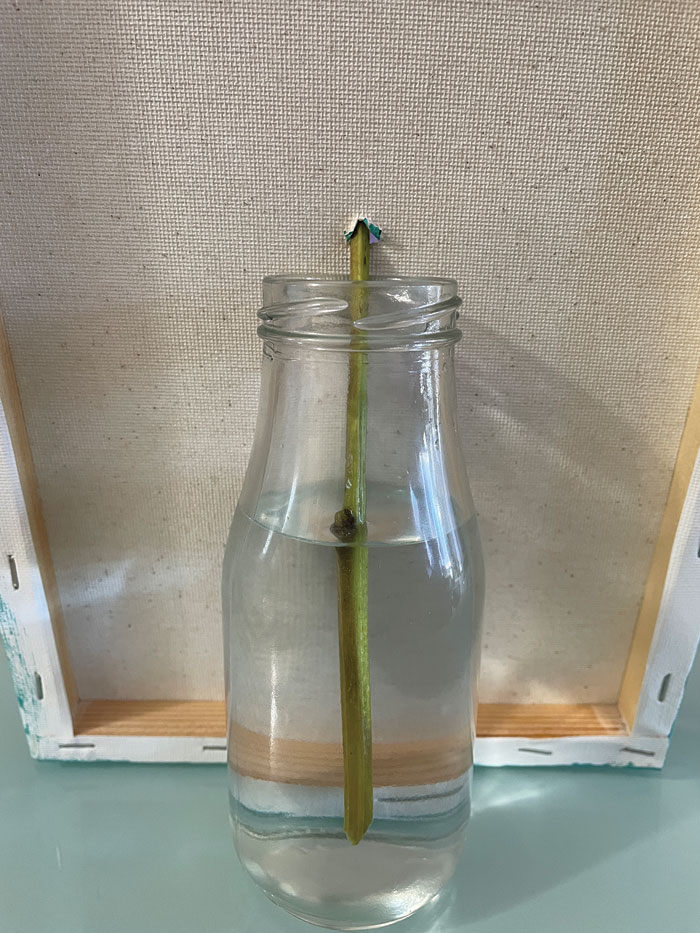

4. Behind the canvas, place a drinking glass or a glass bottle filled with water Insert the floral stem into the water. Lean the canvas against the glass, which acts as an easel.


Jonathan Fong is the author of “Flowers That Wow” and “Parties That Wow,” and host of “Style With a Smile” on YouTube. You can see more of his do-it-yourself projects at jonathanfongstyle.com.

Make a 3D Painting with Real Flowers Read More »

What the Donkey Saw – A poem for Parsha Chukat-Balak

The word God puts into my mouth-that I will speak.
Numbers 22:38

Words.
They come out of our mouths
and, lately, out of our fingers.
They float through the air
and travel electronically to
all the places.
They barge into the eyes and ears
of other mammals, intended or
otherwise.
Say what you’re going to say
as if the entire world is listening.
As if every sentence you utter
could eventually be your epitaph.
Say what you’re going to say
as if your words were arms
intended to wrap around
everyone you’ve ever loved.
Are their tents lovely?
They sure are, but how will they
ever know unless you tell them?
Tell them.
Let your words be your money
your business card, your
life-sustaining breath.
Let them keep you warm or cold
depending on the weather.
Build your home with your words.
Keep the big picture in view.
You never know what’s there
that only the donkey can see.


God Wrestler: a poem for every Torah Portion by Rick LupertLos Angeles poet Rick Lupert created the Poetry Super Highway (an online publication and resource for poets), and hosted the Cobalt Cafe weekly poetry reading for almost 21 years. He’s authored 27 collections of poetry, including “God Wrestler: A Poem for Every Torah Portion“, “I’m a Jew, Are You” (Jewish themed poems) and “Feeding Holy Cats” (Poetry written while a staff member on the first Birthright Israel trip), and most recently “The Low Country Shvitz” (Poems written in Georgia and the Carolinas – Ain’t Got No Press, May 2023) and edited the anthologies “Ekphrastia Gone Wild”, “A Poet’s Haggadah”, and “The Night Goes on All Night.” He writes the daily web comic “Cat and Banana” with fellow Los Angeles poet Brendan Constantine. He’s widely published and reads his poetry wherever they let him.
What the Donkey Saw – A poem for Parsha Chukat-Balak Read More »

Meditations on Love and Loss Growing Up in the San Fernando Valley

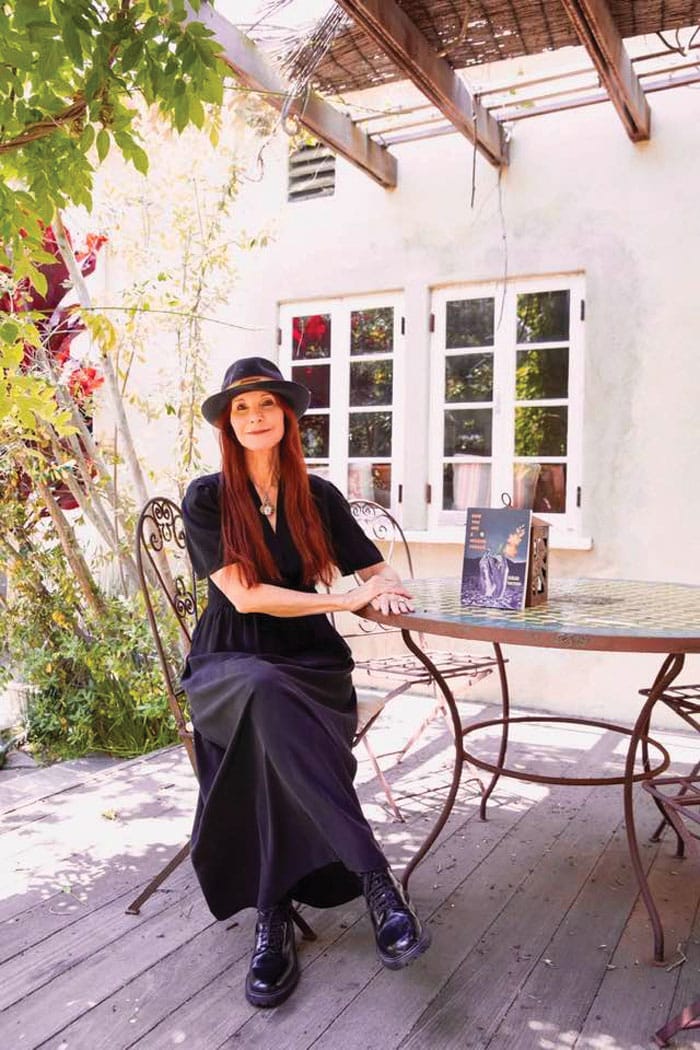
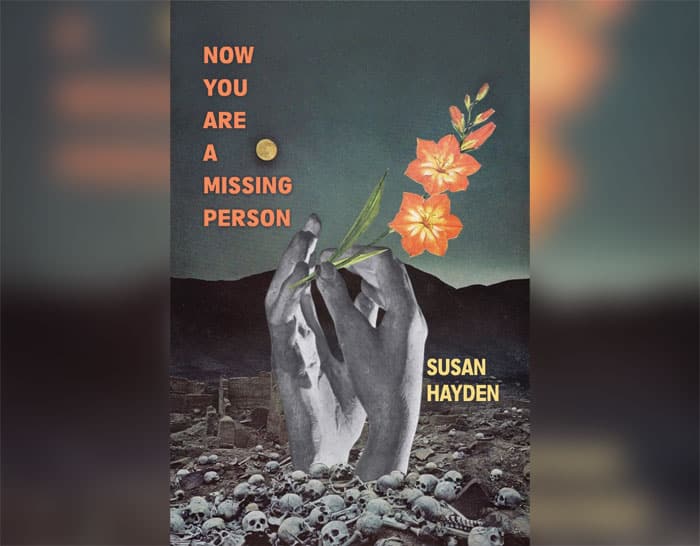
“I’m an unreliable narrator,” is how Susan Hayden introduces herself in her new book, “Now You Are a Missing Person.” That may (or may not be) the case, but after reading the book, there’s no doubt she’s a writer with a sharp, unsparing eye and a gift for precise, tactile prose, such as this description of her soon-to-be husband: “each curve of his face a secret prayer, each crack and line a scripture to live by.”

“Missing Person” a collection of stories, poems, and essays that Hayden describes as a “lyrical memoir,” is a meditation on love and loss. Reading it feels like looking at a mosaic or collage, each page a verbal snapshot. The short, two or three page chapters come together in a way that, by the end, you have a portrait of a place and time. “It’s a puzzle,” she told the Journal. It’s also a wonderful evocation of what it was like to grow up in the San Fernando Valley in the 1970s, as precise and resonant as the Valley of filmmaker Paul Thomas Anderson (“Boogie Nights,” “Magnolia”).

We met to discuss the book at Uncle Bernie’s, a deli on Ventura Boulevard. As we walked in, she pulled me aside and whispered conspiratorially, “That’s the table where Arnie Fromin died!” Before it was Uncle Bernie’s, the building was home to a Fromin’s Deli. (There’s a longer story, as precise and complex as the genealogies in Genesis 5; Hayden could probably write a book about every tract in Encino.) As we’re led to our table, she points out the table where he family used to have Sunday brunches and the booths where she would hang out with her friends.  

Susan Hayden Photo by Christopher Mortenson

Writing about the Valley was her favorite part of the book. “It’s my milieu. It’s what I do. I always go back and find more. It’s an endless well,  there’s always more to discover.” There are dinners with the family Ah Fongs, Love’s Barbeque, shopping at Nieman-Marcus, Wherehouse Records and Postermat,  a wedding at the Ventura Club, summers at Camp JCA, swimming in Liberace’s piano-shaped pool, taking exercise classes with the pre-fame Richard Simmons. These pages throb with the high-keyed emotions of adolescence,  when each disappointment or heartbreak feels especially painful because you haven’t experienced it before, and the more sober memories of adulthood. “As I get older,” she said, “my perspective changes and I see more.” But it can be painful, she said, to drive down Ventura Boulevard.  “It’s a different landscape,” she said, “a completely different place.” The buildings in Encino “were short, and overnight, they became tall. It was just so sad.” She once tried calling the Encino chamber of commerce to find out the history of the neighborhood. “Honey,” she was told, “this place doesn’t have any history. It’s a business district.” One of the few relics, she says, is Uncle Bernie’s. 

A self-described “boy crazy” teen, she yearns for the boy working the slicer at the Encino Deli (as we were leaving, she pointed out the counter where the slicing machine once stood); a musician whose hair “looked like SpaghettiOs”; a boy who woos her in the soul section of a record store and ends up being Billy Eckstine’s son, and a relationship with a “once-famous matinee idol” 25 years her senior. But when Hayden saw her first husband, actor Christopher Allport, she was so sure he was her soulmate, she told her friend “That’s the man I’m going to spend the rest of my life with.”

Allport, along with her father, are the figures make the most distinct impressions. Her father, Sherwin Goldstein, was an entertainment lawyer; a larger than life figure who, while observant enough to keep a kosher home (the family were members of Valley Beth Shalom; she describes services as same length as a Grateful Dead concert, but remembers  Rabbi Harold Schulweis as “warm, accessible … a legend”), was more drawn to the music of the Doors than the liturgical music in shul. There’s a wonderful anecdote where Hayden and her father see Edward G. Robinson at the Du-Par’s restaurant in the Farmer’s Market and he sends her to ask him for an autograph. She remains a fan of Robinson to this day.  

Allport was a magnetic figure, a rock climber with the soul of a daredevil. He calls Hayden “a butterfly,” who made him feel alive. She thought of herself as “base camp. I keep the cabin warm.” It’s a whirlwind romance, and her father, who told her as a teen she could only marry a Jewish boy, calls the Episcopalian Allport her “bashert.”  Writing about him, Hayden’s prose becomes more urgent and sensual. Their bed “ignites as if it has been heated by a warming pan: hyperkinetic, oppositional.” 

Allport’s death in a skiing accident and her father’s death (caused, she claimed, by a hospital’s gross negligence) cast a shadow on the book’s latter half. (The wait for Allport’s body to be found and his death confirmed gives the book its title.) She compares the shock of her loss to having the furniture rearranged. “Everything got reconfigured and I didn’t have a say in it.” Her heart “was a haunted house.” A widow with a young son (Mason Summit, now a Nashville-based singer/songwriter who, with Irene Greene, performs as The Prickly Pair), it felt, she writes, “like we were on a construction site and a crane fell from the sky and clobbered us on our heads.” She worries about raising a fatherless son, visits psychics, feels unsure she is able to move forward. The book has a happy ending, though. She’s “an optimistic widow,” remarried and in the garden that Allport used to keep, finds solace.

Hayden was surprised to find the book was more Jewish than she expected. “I wasn’t planning on writing about it,” she said, “but I started to really see how much it was a part of my fabric … The fabric of who I am.”

Once “Missing Person” was finished, Hayden was surprised to find the book was more Jewish than she expected. “I wasn’t planning on writing about it,” she said, “but I started to really see how much it was a part of my fabric … The fabric of who I am.”  One reason, she said, was her father. “He showed up and led the way.” Hayden attended Hebrew and Sunday school (although, she admitted, she used to cut Hebrew school and go to church — “I even did confession a couple times”) but she rejected Judaism around the time of her bat mitzvah. “I quit. I told my father that I didn’t want to. And he was heartbroken. I just, I’d always felt like it was forced upon me. And that I was pushing it away for a long time because it was forced on me. But now that it’s not forced on me, I appreciate it.”

Hayden, the creator/producer of Library Girl, said the hardest part of writing “Missing Person” was being the presented, as opposed to the presenter. Calling herself “a mother hen,” she loves the community that Library Girl has become. As a secular Jew, she explained,  “I have the community building gene. I feel like I got that from shared events in the temple I grew up with. So I think that, that, that helped inspire the show Library Girl. A sense of belonging that I’ve always craved and created came from those days.” Hayden might call herself an unreliable narrator, but reading “Now You Are a Missing Person,” you’re definitely drawn into her circle.


This summer, Hayden will be reading from “Missing Person.” For dates, visit https://www.susanhayden.com/events.

Meditations on Love and Loss Growing Up in the San Fernando Valley Read More »

John Williams, Harrison Ford and Readers of the Ark’s Contents

John Williams said that he could write a score for “Indiana Jones”

a fifth time because Harrison Ford was able for a fifth time to recapitulate his raiding role.

The Ark may never be revived as would the Jews’ bone-dry but undead bones,

revived by annual  recapitulation of the words inscribed inside the Ark, on parchment parshiot on each Torah scroll,

so though the Ark may never, despite raiders such as Harrison Ford, be rediscovered and revive,

revivals with tropical cantation of the scrolls’ contents have enabled them and many of their readers to survive.


The word “tropical” in this poem’s last line alludes to the melody with which the text of the Torah is chanted whenever it is read liturgically. The Talmud (Megillah 32a) states that a bad fate will befall “anyone who reads from the Torah without a pleasant melody.”

Parshiot is the popular word denoting a biblical chapter that is liturgically read on Sabbath or a festival.

In “John Williams on ‘Indiana Jones’ and His Favorite Scores,” NYT, 6/24/23, Darryn King writes:

When the New York Philharmonic honored the work of the film composer John Williams this past spring, the director Steven Spielberg introduced a clip of the opening scenes of “Raiders of the Lost Ark” — without the music. The effect, he noted apologetically, was like something out of the French new wave.

The clip was played again, this time with the orchestra joining in. Like magic, the adventuresome spirit of the movie was restored.

On June 30, the rugged archaeologist at the heart of that film (played by Harrison Ford) will return for the fifth entry in the franchise, “Indiana Jones and the Dial of Destiny.” He’ll be accompanied, as ever, by Williams’s indispensable music.

The composer, who turned 91 this year, had said it would be his final film score. Speaking during a video call more recently, he walked back his retirement plans. “If they do an ‘Indiana Jones 6,’ I’m on board.”…..

The “Indiana Jones” movies feature a number of Williams’s most recognizable character themes. They also feature swaths of swashbuckling music precisely calibrated to the action onscreen.

“I don’t see John as simply a genius of themes and tunes, which he is of course,” the director James Mangold said. “Rather, it’s John’s moment-to-moment scene work that astounds me. Film scoring is really a kind of duet between the director and the composer. It’s John’s sensitivity to this partnership that most defines his work for me.”

On the appeal of scoring a fifth “Indiana Jones” movie, Williams said, “I just thought, if Harrison Ford can do it, I can do it.” The movie features a new theme for the character of Helena, played by Phoebe Waller-Bridge. “I had a wonderful time writing a theme for her,” Williams said.

“When John first played that theme for me, with the orchestra, I was wowed, of course,” Mangold said, “completely knocked over by the music. But I was also a bit nervous that it was just too much — too damned lush. Too romantic. John just smiled, gently, and let me babble, because I think he knew it was going to work beautifully.”


Gershon Hepner is a poet who has written over 25,000 poems on subjects ranging from music to literature, politics to Torah. He grew up in England and moved to Los Angeles in 1976. Using his varied interests and experiences, he has authored dozens of papers in medical and academic journals, and authored “Legal Friction: Law, Narrative, and Identity Politics in Biblical Israel.” He can be reached at gershonhepner@gmail.com.

John Williams, Harrison Ford and Readers of the Ark’s Contents Read More »

A Bisl Torah – The Rabbi, The Dreamer

Dreams only come true if you’re willing to dream. And you’re only willing to dream if you have someone that teaches you to do so.

I have a mentor that teaches me to dream. To dream past expectation and through obstacles. To dream in a way that betters myself and influences the world.

My rabbinate, my life is forever changed by my mentor, Rabbi David Wolpe.

This Shabbat, Rabbi Sherman and I take on the position of Senior Rabbis of Sinai Temple. Herzl was known for saying, “If you will it, it is no dream.” Rabbi Wolpe, thank you for encouraging us to believe in ourselves. Years ago, we wondered about this possibility. And you nourished our souls and raised us into rabbis who transformed possibility into reality.

I am proud to be the first female Senior Rabbi at Sinai Temple. We are the first married couple to serve in this capacity. And together, under the tutelage of Rabbi David Wolpe, we have learned how to reach for the stars.

Sinai Temple and the greater Jewish community, the sky is just the limit.

Shabbat Shalom


Rabbi Nicole Guzik is a rabbi at Sinai Temple. She can be reached at her Facebook page at Rabbi Nicole Guzik or on Instagram @rabbiguzik. For more writings, visit Rabbi Guzik’s blog section from Sinai Temple’s website.

A Bisl Torah – The Rabbi, The Dreamer Read More »

Print Issue: Jews and Hollywood: It’s Complicated | June 30, 2023

CLICK HERE FOR FULLSCREEN VERSION

Print Issue: Jews and Hollywood: It’s Complicated | June 30, 2023 Read More »

Table for Five: Chukat-Balak

One verse, five voices. Edited by Salvador Litvak, the Accidental Talmudist

But God said to Balaam, “Do not go with them. You must not curse the people, for they are blessed.”
Num. 22:12


Rabbanit Alissa Thomas-Newborn
BCC/Clergy and Chaplain/Congregation Netivot Shalom, Teaneck, NJ

Ibn Ezra explains: Balaam will not be able to curse B’nai Yisrael because God has already blessed them. Which leads to the question, once we are blessed, is that blessing eternal? Stated differently, if God has blessed us, are we impervious to all curses and suffering? 

This does not seem to fit with our history or reality. From Abraham onward, we receive blessings, but they are not to the exclusion of loss, suffering, and even curses. So how do we make sense of the Divine protection depicted in our verse? Perhaps the curses God protects us from are existential — a sort of spiritual dooming as Balak intended — not regular human suffering. 

Alternatively, it could be that being a blessed people is not about protection from physical suffering but about perspective and resilience. In this way, Ibn Ezra’s interpretation could mean Balaam will not be able to curse B’nai Yisrael because God has blessed them to be people who are resilient. When they suffer, they do not define themselves by their suffering. They have hope. They choose to not allow the pain and woes of this world to shape their present and future. 

We know our verse is not the Messianic end of the Torah. And because of its placement in this context of facing external threats, it serves as an expression of love and protection from God from our parsha to today. 

Let’s ask ourselves how we are feeling blessed today and how we want to extend that blessing to others. 


Rabbi Elchanan Shoff
Rabbi, Beis Knesses of Los Angeles

Balaam opened his mouth to curse, but God placed different words in his mouth; a blessing escaped his lips! Unsuccessful, he sought a new place from which to curse. Our sages teach “He who establishes a set place for his prayers will be assisted by the God of Abraham.” When Abraham prayed for Sodom, and it was nevertheless destroyed, “Abraham awoke the next morning and stood [in prayer] where he’d previously stood.”

There was a fundamental difference between Abraham’s approach to rejection and the approach of Balaam. When Balaam was unsuccessful cursing Jews, it never occurred to him that he was the problem. His diagnosis was simple – the place was bad! So he changed places. Abraham always took responsibility; fighting lonely battles against vicious dictators and polytheistic cults; he understood the proper way to address fruitless endeavor: Looking inward. Returning to the same place – and altering his methods. We can always spend our time wishing that things were different, magically wishing things away, like Balaam. That’s a cursed life. The blessed life sees challenge after challenge, “Abraham was tested 10 times … demonstrating how much Hashem loved him.” Seeing things along your path as challenges built just for you is the path that Abraham forged for us. 

Responding to challenges like Abraham is to avoid blaming situations, offices, schools or spouses. Forget changing places; change yourself. The sorcerer who blames others for the failure of his spells will in the grand scheme of things fool no one more than himself.


Rabbi Yoni Dahlen
Congregation Shaarey Zedek, Southfield Michigan 

In the age of social media and trending hashtags, there seems to be a consensus that to be #blessed, is to be grateful for different elements of our lives. And just to be fair here, I don’t mean solely in a materialistic or superficial way. Often, to be #blessed is to be surrounded by family and friends, to take the time for sunsets, hikes, and a glass of wine; it’s to recognize the gifts of every day, every moment. 

But the Torah has a different idea of what it means to be blessed — one that I think we should consider adopting. Not because our modern understanding of being blessed is so bad, but because it just doesn’t have the same spark, the same fire that that biblical blessing contains. Because in the Torah, to be blessed is to have a purpose, to be gifted with a mission of the utmost importance, to fulfill a promise or an expectation of the Divine. 

That theological shift from gratitude to destiny might seem subtle, but it’s very relevant to who we are as individuals and who we are as a society. At its very core, it is egalitarian, unifying, healing. We all have purpose. We all have the ability to bring holiness into this world. Each and every one of us is blessed. 

But we have to see it. We have to acknowledge it. Otherwise we waste this incredible potential given to us. And to throw away that gift is, well …  a curse.


Yehudit Garmaise
Reporter, Parsha Teacher

When Hashem tells Balaam matter-of-factly, “Don’t even bless them because they are already blessed,” what is the source of this blessing?

“We have natural strengths that we inherit as the fortunate children and grandchildren of the avos [patriarchs] and imahos [matriarchs],” said Rabbi Avraham Zajac, the rabbi of Chabad SOLA. “We are maaminim [believers] because we are b’nei maaminim [children of believers.]” 

When the Talmud tells us that three qualities characterize a Jew: merciful, kind, and humble/modest, the Maharsha tells us that while Jews inherited their mercy and chesed from the avos and imahos, the blessings of humility and modesty only came to us after we received the Torah, says Rabbi Mendel Zajac. 

Balaam, who hated the Jews even more than Balak did, noted Jews’ strength, power, and longevity, but the blessing that we include in our morning alludes to our family lives, which Rabbanit Yemima Mizrachi interprets as an expression of the love, warmth, affirmation, acceptance, and hospitality that should characterize Jewish homes. 

Rashi says that Balaam remarked on the goodness of Jews’ tents after noticing that their doorways did not face one another because Jews respect each other’s privacy. 

The opening of the Jews’ tents also symbolize how we strive to use our mouths, the Maggid of Mezeritch tells us. 

While tents that face each other directly could represent conflict and aggression, Jews’ staggered tents reveal how Torah scholars gather, not G-d forbid, to argue with each other or to outdo each other, but to humbly increase their understanding.


Rabbi Chaim Singer-Frankes
Multi-faith Chaplain, Spiritual Care Guide, Kaiser Panorama City

Our sages ponder why Balaam’s actions are carefully circumscribed by God. “Why need God say, ‘do not go’ in addition to ‘do not curse?’ And “why does God emphasize that the people are blessed?” Torah wastes not a word. It surely embodies masterful efficiency of language, saying so much when it appears to say so little. 

Midrash Tanhuma (500-800 C.E.) suggests “dear reader there’s more to this conversation than meets the eye” by hypothesizing our verse as a schmooze between Balaam and The Divine. To God’s exhortation “do not go,” Tanhuma imagines Balaam responding, “then I’ll curse the people from where I sit.” To God’s appeal, “don’t curse the people,” Tanhuma reckons Balaam’s response, “if so, then let me bless them.” This in turn addresses why God says, “for they are blessed,” which is to say, “eh, don’t bother, because I’ve already blessed this people.” 

Why does Balak hire an augur to curse this nation? Because he and the rest of the Near East fear the Israelis’ durable, historical bond with God. Though Israel’s dubious behaviors in the wilderness fleeing Egyptian tyranny may not always merit this protection, it is nonetheless assured by the ancient covenant with Abraham; God says, “And I will bless them that bless thee, and him that curseth thee will I curse; and through thee all the families of the earth shall be blessed.’ And so dear reader, imagine that Balaam perceives Israel as the vessel through which he too might receive blessing.

Table for Five: Chukat-Balak Read More »

Rabbis of LA | Rabbi Brian Schuldenfrei : Rabbi with a Puppet and a Talmud

It’s been 20 years since Adat Ari El’s Senior Rabbi Brian Schuldenfrei was ordained. Asked what he’s learned over the last two decades, he told the Journal,  “When I look around the room, I think of myself as a young rabbi. Then I look in the mirror. It doesn’t lie.” Actually, Schuldenfrei looks like he has scarcely aged since his Jewish Theological Seminary ordination. He wears glasses, and is happily married to Rabbi Deborah Schuldenfrei, Head of School at Valley Beth Shalom Day School and they have three young sons. 

“I am exactly where I want to be,” the native New Yorker said.  He started his career as an associate rabbi at Sinai Temple,  then served for a brief period as senior rabbi in Miami, Florida, but the lure of the west coast was too strong. He returned to southern California, spending eight years as senior rabbi at Congregation Ner Tamid, in Palos Verdes. It was quite a change. “There was no Jewish community,” Schuldenfrei said. “We were the only game in town.”

Valley Village is a happy contrast — at Adat Ari El, he leads a congregation of  600 families, twice the size of Ner Tamid’s.  Schuldenfrei says he still is learning to adjust to the Valley’s larger community.  It’s about mingling, he said. “We just got back a couple weeks ago from the March of the Living in Poland. We were part of a delegation with Shomrei Torah and Rabbi Richard Camras, about the loveliest man you’re ever going to meet. It’s very special when we have an opportunity to do that.”

Schuldenfrei looks forward to working with other congregations. “We encourage collaboration,” he said. It’s “something I have been learning to do that wasn’t part of my orientation at Ner Tamid. It was just very different.” How has he adapted to the change? “Our faith asks us,” he said. “’Why do you make a blessing before you eat?’ Our tradition is telling us we should certainly move ahead, but with thought, with intention,” Schuldenfrei said. “Maybe that is the lesson of being in a community. Your actions have implications for others.”

What he cherishes about the Adat Ari El community is that it is “rooted in tradition. The David Familian Chapel is the oldest synagogue structure in the San Fernando Valley. At the same time, we have a thriving pre-school, and we have Shabbat programs that cater to the smallest of children. We do Super Bowl Shabbat, Family Fridays, Jammies & Jeans. We are telling stories. We are on the floor. We are also davening. We have a twice-a-day daily minyan.” He is very clear that “serious learning goes on here. That diversity of Jewish life is compelling.”

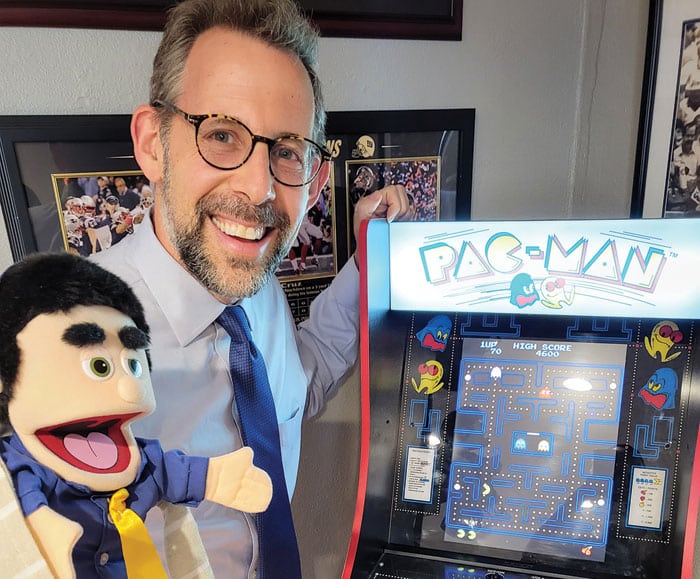
He is a rabbi who proudly displays an open Talmud and a Pac Man video game in his office. Not only that, but when he leaves home for the synagogue, a certain puppet is his constant companion. “The smartest thing I ever did in my rabbinic career – and it was not even my idea – happened when I was a year or two out of JTS and working at Sinai Temple,” the rabbi recalled. “The director of education there was Danielle Kassin, a bright ray of sunshine. 

“She and I were at a conference. I was thinking about what books I was going to purchase, what curriculum I was going to investigate. I was taking myself very seriously … Danielle saw a vendor who was hawking Jewish puppets. She said ‘you should get one of those as a way of connecting with kids.’ I scoffed. I said ‘it’s a waste of money.’ “She forced me to buy it. Or bought it for me. I don’t remember. Smartest thing I ever did.”

”What I look for as a model for synagogues is that people aren’t going to study Talmud or talk theology or explore the efficacy of prayer unless you establish a personal connection.”

After he finished the story, Schuldenfrei reached toward the bookcases  that line his office and introduced that puppet — Rabbi Schuldenfrei Jr. “Now kids who are in college come up to me and ask me about the puppet,” he said. What he “loves” about his work is that Rabbi Jr. is available all day. The puppet aside, “we do serious Judaism here, too. What I look for as a model for synagogues is that people aren’t going to study Talmud or talk theology or explore the efficacy of prayer unless you establish a personal connection.”

Schuldenfrei is about connections. Once he gets people to feel comfortable, he knows it opens many doors. When you start with a child with a puppet, he believes, where does the discourse end — when the child is a teenager? Start with a puppet, make the connection, and then you are building. He is convinced that too many synagogues skip over the connection piece. A rabbi with a puppet in one hand and a book of Talmud in the other will connect.

Having children around is the greatest blessing, said the rabbi. “Several weeks ago, pre-school kids were making noise, running up on the bimah. ”Great,” Schuldenfrei grinned. “They are welcome here.”

Fast Takes with Rabbi Schuldenfrei

Jewish Journal: What is your favorite activity in Israel?

Rabbi Schuldenfrei: My wife’s favorites are shopping and eating and mine are learning and eating.

J.J. Your favorite Jewish food?

Rabbi Schuldenfrei: True to my roots as a New Yorker, you simply can’t get a good bagel in Los Angeles.

J.J. Best book you ever read?

Rabbi Schuldenfrei: I am reading a fascinating book by Rabbi Edward Feld, “The Book of Revolutions,” essentially on the editing process behind the different codes of law embedded in the Torah.

Rabbis of LA | Rabbi Brian Schuldenfrei : Rabbi with a Puppet and a Talmud Read More »