fbpx

May 30, 2023

Man Charges Stage With Israeli Flag During Roger Waters Concert

A man charged the stage with an Israeli flag during Roger Waters’ May 28 concert in Frankfurt.

Video footage circulating on social media also showed protesters in the audience unfurling an Israeli flag and chanting, “Am Yisrael Chai!” in response to the former Pink Floyd frontman and bassist’s antisemitic controversy. Waters later told the audience in between songs that the man who charged the stage was “putting me off” and was “unnerving.”


The Times of Israel reported that the man who charged the stage, identified only as “Marcel L.,” is the head of the German-Israeli Society’s Frankfurt youth affiliate. Marcel told Channel 12 that Waters’ “security arrived quickly and violently took me down to the basement. They threatened to break my neck if I didn’t give them my mobile phone. I also didn’t want to let go of the Israeli flag, so the guard told me he would break my arm if I didn’t give him the flag.”

Other footage on social media appeared to show fans attacking the protesters holding Israeli flags in the audience during the show.

Waters’ latest tour has come under public scrutiny after he donned a Nazi-like uniform during his recent shows in Berlin––resulting in a criminal investigation against him––and drawing a comparison between Anne Frank and Palestinian journalist Shireen Abu Akleh, who was killed during an Israeli Defense Force raid in Jenin in 2022. German law bars the display of Nazi symbols but provides an exception for artistic or educational purposes. Waters responded to the controversy with a May 26 statement saying in part: “The elements of my performance that have been questioned are quite clearly a statement in opposition to fascism, injustice, and bigotry in all its forms. Attempts to portray those elements as something else are disingenuous and politically motivated. The depiction of an unhinged fascist demagogue has been a feature of my shows since Pink Floyd’s ‘The Wall’ in 1980.” The 1982 movie of the same name features a scene in which the main character, played by Bob Geldof, enters a drug-induced hallucination of himself leading a fictional neo-Nazi organization. The main character, named Pink Floyd, is a rock star who falls into insanity as the movie progresses.

Waters did not wear the Nazi-style uniform during the May 28 show, telling the audience that he wasn’t wearing it “out of respect for the history of the concert hall,” as “the Frankfurt Festhalle played a central role in the deportation of the city’s Jews as part of the Holocaust,” the German state-funded publication Deutsche Welle (DW) reported. Waters also declared during the concert that he is not antisemitic and “briefly burst into tears” as the audience cheered him, per DW.

Critics of the former Pink Floyd frontman think otherwise. “Always ‘bad faith’, never criticism or a different view,” David Hirsh, a lecturer at Goldsmiths University and founder of the London Centre for the Study of Contemporary Antisemitism, tweeted in response to Waters’ May 26 statement. “You accuse us of lying, not getting it wrong. Your Nazi cosplay might have featured in your show in the 80s, when people assumed you were anti-Nazi. [Its] meaning is different when you push antisemitic conspiracy fantasy.”

Jerusalem Post Senior Contributing Editor Lahav Harkov tweeted in response to Waters’ May 26 statement: “The antisemitism is bad enough, but [Waters] is also so deluded that he thinks he has ‘spent [his] entire life speaking out against authoritarianism and oppression’ when he’s an apologist for Russia and Syria.”

Waters’ next concert is on May 31 at the Utilita Arena Stadium in the British city of Birmingham.

Man Charges Stage With Israeli Flag During Roger Waters Concert Read More »
Got Jews?

The Jewish people are no strangers to exclusion. A long history of what historian Salo Baron calls a “lachrymose” Jewish narrative reinforces a pattern of entry-denial into the top echelons of societies. Among many things, the Jewish diaspora experience included limiting the mobility of Jews as in the case of ghettos in Renaissance Italy, shtetls in the Russian Pale of Settlement, and later mandating quotas on Jewish entry into the best universities and extolled professions.

America, on the other hand, the land of opportunity and uncharted dreams, provided Jews the unprecedented historic opportunity of integration and assimilation. It is not for nothing that upon visiting America for the first time, famed Yiddish author Sholem Aleichem wrote that “no people are as honored and glorified [in America] as the Jew. There a Jew is a big shot. It’s a mark of distinction to be a Jew. On Sukkos you can meet a Jew carrying an esrog and lulav on Fifth Avenue.” Aleichem’s accolades did not always reflect reality, as American Jews, too, were barred from entry into top universities during the era of segregation in America. And yet, despite the institutional racism and antisemitism, American Jews did indeed “make it in America,” as evidenced by high representation across many highly regarded professions and industries.

Today, however, the success of America’s Jews seems to be catching up with them. Professional and economic achievements are now used to penalize them for the stigma of “privilege,” predicated upon the phenomenon of “white passing.” Nowhere is this as striking as in what Armin Rosen calls “the Ivy League Exodus,” including a remarkable drop in the number of Jewish students attending Ivy League universities.

It is easy to blame the decline on institutional antisemitism. But in truth it may have much more to do with a shift in what top university administrators look for in stellar applicants. If a decade ago, high SAT scores and a strong GPA could all but guarantee a spot at an elite university, today admissions officers are looking less at academic merit and more at a student’s record of social action, as well as loosely expressed definitions of diversity and equity. The numbers speak for themselves: According to data from Hillel International, measured by Jewish attendance, the top ten list of private universities do not include a single Ivy League school.

To help explain the decline in numbers, it may be helpful to look at the role college counselors play in advising students on how best to position their applications for acceptance. “When applying to UCs,” a Jewish student who requested anonymity said to me, “my college counselor highly recommended that I not state that I am Jewish or involved in any pro-Israel organizations.” When I asked the student why, the student remarked, “because she said that Jews are seen as white and privileged, and that it wouldn’t help me.”

Another student shared with me his personal statement on the hardships of being an immigrant, but on the advice of a college counselor, he did not specify that his family had come from the former Soviet Union, instead writing how he would fix this broken world by using his (unspecified) immigrant experience to “fight oppression.”

I spoke with college counselors, as well. They did not specifically tell me they would advise a student not to state his or her religious, ethnic, sexual or racial identity. But they stressed that one of the most important things Ivy Leagues are looking for is leadership in “social action.” This, they explained, means showcasing activism that stresses “critical self-awareness as a budding citizen who will continue to fight for social change.” Some advise Jewish students to be strategic and “play the game.” “If you are a Jew from North Africa or the Middle East,” a college counselor, herself Jewish, confided in me, “I would say to write about being a ‘Jew of color.’”

The prioritization of social justice over academic excellence reflects our modern zeitgeist. In May 2021, calls to remove a statue of British imperialist Cecil Rhodes from a building at Oxford were so strong that a special committee was formed to access the figure’s “future” at the university. At Tufts University, a mural depicting the founding of America was taken down; and at theUniversity of Pennsylvania, the statue of founder and minister George Whitefield was taken down. These historic icons have often been replaced with representations of underprivileged minorities, as in the case of “Mama” by Kelly Latimore at Catholic University of America, a reimagined icon of Mary as black and cradling a Jesus represented with the face of George Floyd.

We cannot blame students for getting the message. Take, for example, the “10 Successful Harvard Application Essays” from 2021, published by the Crimson. In one essay, Ella, a minority student herself, writes that she must “step outside of my Korean American Southern Baptist paradigm because my experiences do not constitute everyone else’s.” Ella has incorporated the “rules of engagement” belief as espoused by Robin DiAngelo in her book, “White Fragility” (2018), which argues that people from a specific racial group can relate only to those within the same racial group. Or take Sophia’s essay from 2022, in which the author simultaneously confesses to the sin of listening to “white people music” and repents by tracing the “origins back to jazz musicians of the Harlem Renaissance.”

Thus the challenge presented by the Ivies’ professed commitment to “diversity” is not limited to Jewish students. It really isn’t about antisemitism per se. American Jewish students are not barred from entry into the Ivies because of their religious and ethnic identity—but because they are seen as “white,” privileged, and thus born with unfair advantages that need to be remedied.

American Jewish students are not barred from entry into the Ivies because of their religious and ethnic identity—but because they are seen as “white,” privileged, and thus born with unfair advantages that need to be remedied.

It is often said that the Jew is the “canary in the coal mine”—that what affects the Jew ends up affecting everyone. The decline of the Jewish role in elite America should be a red flag, suggesting our country has regressed as a result of such “progressive” activism. If “equity” comes at the expense of achievement, America will, in time, lose its leadership in the world in knowledge, science, technology, and a host of other fields. It will wither.

What, then, should American Jewish parents determined to get their kids into the best possible college do? Jewish parents have always seen education as the key to success—and in America, that means getting into a top school. As historian Peter Kenez once told me, “Jewish literacy in the Pale of Settlements surpassed the gentiles. The Jews, with their focus on education, for better or for worse, ensured their perennial success.”

Today it is not hard to find wonderful schools where Jewish students thrive.

American Jewish parents should never stop wanting the best education for their children. But in light of everything happening, we need to ask: What is the “best education”? Are students really getting it from schools that put “diversity, inclusion and equity” above everything else—or rather at other colleges, perhaps less prestigious than the Ivies, that still celebrate free thinking and achievement? Today it is not hard to find wonderful schools where Jewish students thrive. Perhaps the one exception to the Ivy League pattern is Brown Universityn acceptance rate of 5.5%, Brown is a place where “visible Jews” stand tall and proud.

American Jewish parents should never stop wanting the best education for their children. But in light of everything happening, we need to ask: What is the “best education”?

In the South, Tulane University ranks third among the top sixty private universities by Jewish population; it is also one of the only universities formally to reprimand a student for writing antisemitic content. Another often overlooked school is Indiana University, which hosted the largest Jewish gathering in IU Bloomington’s history, with over 500 students in attendance. IU is also home to the highly esteemed Institute for the Study of Contemporary Antisemitism.

There are many other such colleges, and high school counselors across the country are well aware of them. Jewish parents assisting their kids in the high-anxiety process of college applications would be wise to seek them out.

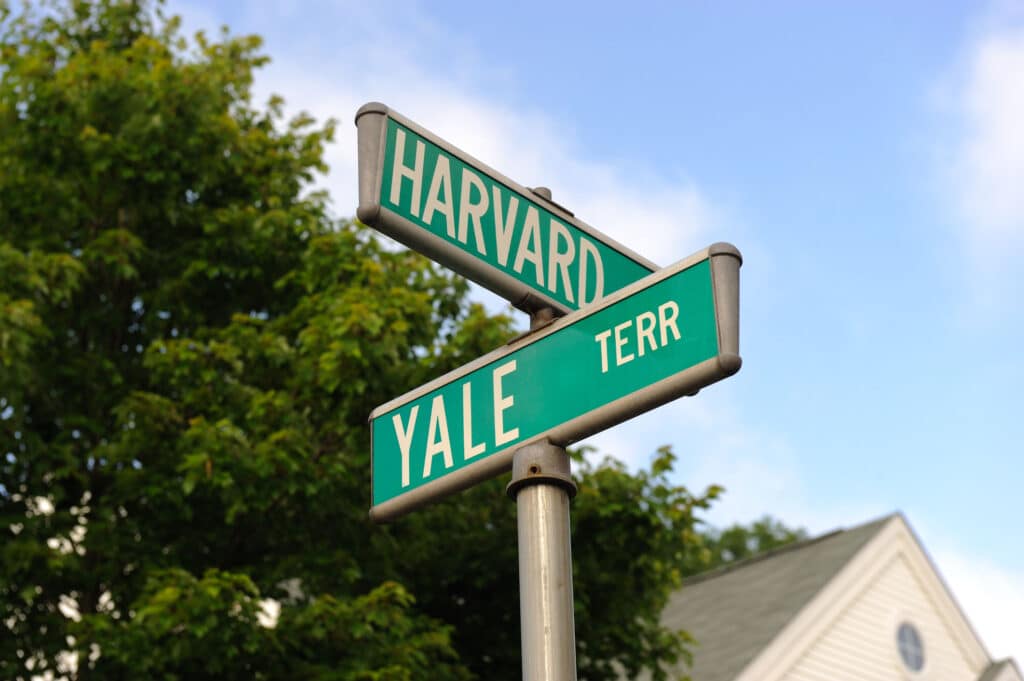
This, it seems, is where the future of Jewish higher education lies—just as when, a century ago, places like City College of New York benefited from a huge influx of top-notch Jewish minds who were barred from entry at Harvard and Yale. Once again, our students will find welcoming places to study—which in turn will gain in prestige as a result.

Jewish parents will continue to do whatever it takes to ensure that our children will always be able to make it in America. And America will be better for it.

Whatever happens, Jewish parents will continue to do whatever it takes to ensure that our children will always be able to make it in America. And America will be better for it.

Got Jews? Read More »

White House Antisemitism Plan Makes Jews Look Weak

Has anyone noticed how Jews look in that much-discussed White House “strategy” to counter antisemitism? Forgive a little bluntness, but I found that Jews came across as lame victims, unable to take care of themselves.

The report is infused with this idea that the nation at large must come to the rescue of Jews.

“Combating antisemitism is a truly whole-of-society challenge that demands a whole-of-society response,” the report asserts with a tone of august authority. “We hope all will join our call to action.”

The report means well, of course. It represents an official effort to combat the ancient curse of antisemitism that seems to follow Jews everywhere they live, even in a country as welcoming as the United States. This administration wants us to know they have our backs, and yes, we ought to be grateful for that.

The problem, however, is that the report is focused more on fighting haters than on strengthening Jews. In doing so, it underplays the indispensable role that we ourselves must play in determining our fate.

In a sense, the White House is simply following the playbook of our activist community, which has always assumed that the best way to combat Jew hatred is to go after the haters. If only we would ring the alarm bells louder and earlier, we tell ourselves, and expose the haters everywhere they lurch, maybe we’d make progress. And if only we could get the rest of the nation to join us in the fight, then we’d really make progress.

The elephant in the room no one wants to bring up is the notion that any “strategy” can ever eradicate a sentiment as immutable as hate. Would Jew haters hate Jews any less if they learned more about the history of antisemitism, or if they learned more about the Holocaust? If antisemites resent Jews because they see us as hard-working and successful, how do we make them stop resenting us? By arguing that we’re not that successful?

Instead of trying to change Jew haters, we’re better off trying to strengthen Jews.

First, let’s stop contorting ourselves trying to look like victims. No one’s buying it. It’s time we start owning our success and stop apologizing for it. Just because victims are the new heroes of a woke-influenced America, and the grievance industry is booming, doesn’t mean we should follow the herd.

Second, the smartest way to combat Jew hatred is to inoculate Jews through the timeless power of our tradition. What brings out our best is not when we’re against something but when we’re for something, like our rich and meaningful Jewish identity.

The smartest way to combat Jew hatred is to inoculate Jews through the timeless power of our tradition.

It’s worth noting that arguably the most successful organization in Jewish history has never once called for fighting Jew hatred or demonstrating against antisemitism. That is Chabad. Every day in over 100 countries around the globe, they make Jews proud to be Jews by reminding them of what they stand for, not what they’re against. Instead of fighting antisemitism, they promulgate prosemitism. 

The White House report is a welcome show of support for Jews, but it’s not a substitute for the hard work that must be done in our communities to strengthen Jewish pride. Complaining projects weakness; pride projects confidence. If the Jewish brand in America comes to be defined by obsessive complaining against anyone who hates us, we’ll end up looking weak, insecure and humorless. Who’d want to join that tribe?

By all means, let’s not stop the fight. Let’s use the official IHRA definition of antisemitism to expose and punish haters; let’s correct the lies against Israel; let’s take full advantage of the law to target incitement; and let’s add security to protect Jewish spaces. To the extent that this fighting gives us a sense of purpose, it is worthy in its own right. But let’s not fool ourselves into thinking it will end Jew hatred.

Jew hatred, whether it comes from the left or the right, is a resilient disease without any known cure. Thankfully, we know that there’s a powerful, long-term vaccine against the hate: a strong Jewish identity.

It’s ironic that the one empowering line in the White House report has received little attention: “We must tell the positive story of Jewish contributions to the United States and the world.” When I read that, I thought: Bingo. That kind of positive education is precisely the kind that would reinforce Jewish and Zionist pride, reminding Jews and others that this tiny tribe, against all odds, has indeed done great things for America and the world.

Instead of trying to get haters to hate Jews less, we must get Jews to love themselves more.

Instead of trying to get haters to hate Jews less, we must get Jews to love themselves more. Instead of showing fear and looking like whiners, we must instill pride and fight like winners. And instead of having only coalitions against antisemitism, let’s also have a few coalitions in favor of prosemitism.

For that mission, we’ll need the Jewish House, not the White House.

White House Antisemitism Plan Makes Jews Look Weak Read More »

Zionist Congress Shows Strong Push for a Liberal, Democratic and Pluralistic Israel, But the Fight is Not Over

After 13 years as the head of the Masorti/Conservative Movement in Israel, and now two-and-a-half years as Vice Chairman of the World Zionist Organization, I’m no stranger to political fights when it comes to preserving Israel’s liberal, democratic and pluralistic character. The recent World Zionist Congress was no different, except that for the first time in years, it feels like those of us who believe in Herzl’s vision of a liberal, Jewish and democratic state—a welcoming home to Jews of all streams—are winning.

Since its founding by Herzl in 1897, the World Zionist Congress has been the democratic parliament of Jewish people, with Jews from every background, political persuasion, and corner of the world represented. Prior to this year’s Congress in Jerusalem, allies of Israel’s current government read the tea leaves: They knew that world Jewry would strongly rebuke the most extreme government in the country’s history. After trying but failing to prevent holding votes altogether on resolutions that would send a clear message against the current government’s illiberal agenda on issues such as the so-called “judicial overhaul” and the Law of Return, the Likud and its right-wing allies resorted to a desperate, last minute filibuster and even litigation.

But facing a liberal Jewish world inspired and reenergized by the hundreds of thousands of Israelis who have taken to the streets week after week in defense of Israel’s democracy, the right-wing bloc was ultimately defeated. In the end, the Zionist Congress exercised its democratic prerogative and passed by large majorities a series of resolutions promoting women’s rights and LGBTQ rights in Israel, calling for equal recognition of Conservative and Reform conversions, and opposing changes to the Law of Return and the so-called “judicial overhaul” that threatens Israel’s democratic future. This is a victory for the MERCAZ party of the Masorti/Conservative Movement that I represent personally, as well as for our Reform partners at Arzenu and all our allies in the center-left-liberal bloc who put on display a new model for cooperation between like-minded forces in Israel and the Diaspora to protect Israel’s liberal and democratic character.

Through this Zionist Congress, the voice of world Jewry was heard loud and clear: first through our spirited protest against Simcha Rothman, architect of the anti-democratic so-called “judicial overhaul,” and then through the passage of these resolutions that, together, represent a victory for democracy. These resolutions are a victory not only because they represent the clear, democratic voice of world Jewry, despite the best efforts of the Likud and the ultra-Orthodox to silence them, but also because they show the Jewish world’s firm support for Herzl’s Zionist vision of a Jewish state that is liberal, democratic, pluralistic and a home for each and every Jew.

But this outcome was only possible because of the relative representation MERCAZ and its partners and allies have in the World Zionist Congress. That’s why at this crucial moment in the history of Israel, it’s imperative that Conservative and Reform Jews work to strengthen our representation in the Congress via the next elections in 2025. If we don’t, the extremist and illiberal forces whose dirty tricks failed this time, may succeed next time. As Jews who care about Israel’s future as a vibrant and secure Jewish and democratic state, that would ultimately put our values and interests at risk.


Dr. Yizhar Hess is Vice Chairman of the World Zionist Organization and the senior representative of MERCAZ, the Zionist slate of the Conservative Movement, at the national institutions in Jerusalem.

Zionist Congress Shows Strong Push for a Liberal, Democratic and Pluralistic Israel, But the Fight is Not Over Read More »