fbpx

April 13, 2023

The Swell App Curates Community Through Conversation

With all the turmoil in the world, we need community now more than ever. The Swell app enables people of all backgrounds, areas and influences to have conversations and make new connections.

Swell is a micro-podcasting app with social features. Users put up five-minute audio posts; they can add photos, hashtags and links. These are conversation-starters, so anyone can reply with their own up to five-minute audio clip.

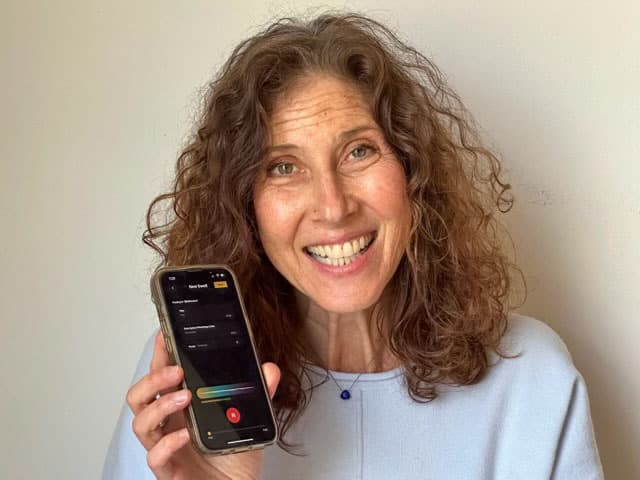
“Every day I want to grow, and part of that growth is to be in conversation,” Deborah Pardes, vice president of stories andvoices at Swell, told the Journal.

People use Swell to tell stories and voice their opinion, as well as to ask questions and give answers. Pardes grew up in a Modern Orthodox home, where she was taught about the Talmudic tendencies of questioning.

“I was brought into that world of dialogue, where you can look at the same text for 17 years, and have different takes every year,” she said. “When you’re in a circle of really curious people, who are in deep inquiry about a specific thing, the voices rise.” 

In fact, Swell reminds Pardes of the Friday night dinner conversations she had with her family growing up.

“I feel like Swell brings you to that warm table,” she said. “You can listen, if you are not in the mood to talk. And then, if you feel interested in something, you can add your voice without having to scream … to find a way in.”

While you can listen to anyone’s Swellcast via web browser, you need to be logged into the app to post and reply. To reply, you simply click reply on someone else’s Swell or comment, record your audio and post.

You can interview others, capture a moment in time or use it as an audio diary of what’s going on in your world.

Pardes likes to use Swell at weddings. She captures the audio well-wishes for the bride and groom and snaps a photo of whoever is talking. 

“What really got me was creating stories that were going to be accessible in perpetuity,” Pardes said. “It’s why I love the Shoah Project. You memorialize people.”

The fact that it is not video is also a plus.

“At the end of the day, we waste too much time coiffing,” she said. “If I’m saying something, I want someone to hear me and not look at what my eyebrows are doing.”

Pardes, who lives in Los Angeles, joined the Swell team in November 2019, one month after the founding of the company. Swell’s original purpose was to be a clearinghouse for audio stories about health. Pardes came on board because of her background in health and podcasting.

At the beginning, Swell collected conversations with people about their ailments; the intention was to discover how they solved their problems. Then COVID, and the George Floyd protests, happened.

“We realized this needed to be a product that enables all conversations, not just ones about health,” she said. “It was a pivotal moment.”

Pardes’ role at Swell is to curate and host conversations. As with other social apps, there’s no barrier to entry for Swell.

“However, there’s a discovery that happens with deep listening,” she said. “And you can’t do deep listening on Reddit or Twitter.”

Pardes is constantly speaking with the people she might never have met.

“The ones who create the true sense of community on Swell are the ones who are coming in with their story [and] an intention to have a really great conversation,” she said. “There’s nothing better.” 

Pardes thinks Swell will be a beacon of hope for authentic voices.

“There are so many beautiful people in the world telling beautiful stories,” Pardes said. “I guess I’m kind of mushy about it, because it’s making me feel a little hopeful.”

 
Photo by Deborah Pardes

Deconstructed Salad Recipe

Just like Swell is the canvas for great audio interactions – blending unique voices together – Pardes’ deconstructed salad is a perfect conversation-starter for your next in-person gathering or company lunch.

Empty plates serve as the canvas. Fill the center of the table with bowls, brimming with delicious, fresh ingredients. Salad dressings serve as the final creative splash across the finished creation.

Each guest makes their own plate. It’s a fun way to hang out before the meal, and help make the “salad.”

Here are some important ingredients

nuts
seeds
bits of cheese
cherry tomatoes
cut cucumbers
multi-colored radishes
bright green peas
microgreens
kumquats
berries
spring onions
fresh herbs

Use your “what’s in season” imagination!

Follow Deborah Pardes on Swell at swellcast.com/dbpardes. Follow Debra Eckerling at swellcast.com/thedebmethod.

The Swell App Curates Community Through Conversation Read More »

Rules and When Not to Follow Them – A poem for Parsha Shemini

…And Aaron spoke to Moses…Moses heard [this], and it pleased him
-Leviticus 10:19 and 10:20

Once upon a time in a school
where a poet’s fourteen year old
commingled with similarly aged
patrons of the earth

a self proclaimed Rabbi of
American History took five
hard earned points away
from the boy

for no good reason.

The boy spoke up.
He gave his reasons, and
the self-appointed Rashi of
Civil War knowledge, acknowledged
and the points were restored.

This made all the difference.

It was like when the sons of Aaron
ate their meat in the wrong place
at the wrong time, catching Moses’ eye –
Moses, who knew all the rules about
where you could do such things.

Aaron spoke up for his boys.

Aaron did most of the talking
back then, and all the words he said
landed in Moses’ ears like honey.
And he said honey (maybe that’s
what they called each other back then)

I see there are other ways.

And it was all good.
Never follow the rules blindly
and if you know something is right
speak up about it. We are all
accountable for each other.

These words, just an outline.


God Wrestler: a poem for every Torah Portion by Rick LupertLos Angeles poet Rick Lupert created the Poetry Super Highway (an online publication and resource for poets), and hosted the Cobalt Cafe weekly poetry reading for almost 21 years. He’s authored 26 collections of poetry, including “God Wrestler: A Poem for Every Torah Portion“, “I’m a Jew, Are You” (Jewish themed poems) and “Feeding Holy Cats” (Poetry written while a staff member on the first Birthright Israel trip), and most recently “I Am Not Writing a Book of Poems in Hawaii” (Poems written in Hawaii – Ain’t Got No Press, August 2022) and edited the anthologies “Ekphrastia Gone Wild”, “A Poet’s Haggadah”, and “The Night Goes on All Night.” He writes the daily web comic “Cat and Banana” with fellow Los Angeles poet Brendan Constantine. He’s widely published and reads his poetry wherever they let him.
Rules and When Not to Follow Them – A poem for Parsha Shemini Read More »

Shedding Light on Shephardic, Mizrahi and North African Jewish Food and Culture

When Regine and Nathalie Basha, creators of the “Kitchen Radio” podcast, started talking about doing a show together, they wanted to find a way to share their heritage and history. The duo, who happen to be aunt and niece, respectively, decided to do that through food.

“We’ve been finding that so many people out there … besides our own interest, have been creating food blogs and reviving their Arab Jewish history through food,” Regine  told the Journal. “We thought the best thing to do is just start interviewing people who are doing this as well.”

“Kitchen Radio” was released by Reboot Studios on April 3. In each episode, hosts Regine (Founder of “Tuning Baghdad”) and Nathalie Basha (The Travel Muse) feature a dish and a conversation to introduce the still little-known Jewish culture of the Middle East and North Africa (MENA) region. 

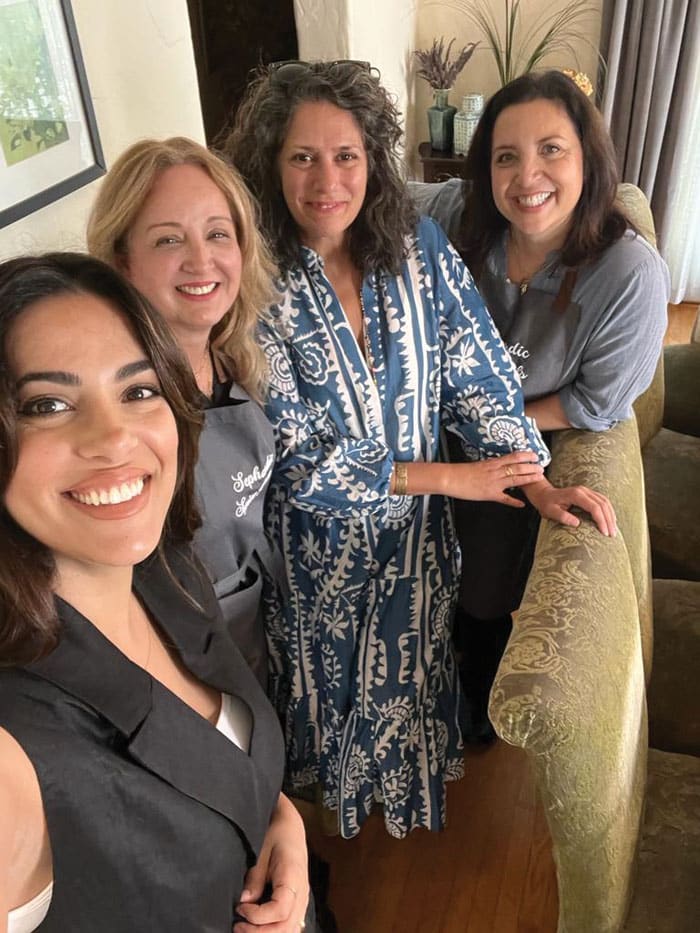
Tannaz Sassooni making the Persian rice and poultry dish Gondi Kashi kicked off the season. Jewish Journal columnists The Sephardic Spice Girls, as well as cookbook author Claudia Roden and artist Rafram Chaddad also appear  on Kitchen Radio’s first season. New episodes will be released every Tuesday in April.

When we would tell people that we are Iraqi Jewish, most people would say, ‘What does that even mean? How can you be both?’”– Nathalie Basha

“When we speak about Jewishness and Jewish food, at least here in the U.S., we automatically go to Ashkenazi Jewish,” Nathalie  told the Journal. “When we would tell people that we are Iraqi Jewish, most people would say, ‘What does that even mean? How can you be both?’ So we thought that would be a really interesting way to start this conversation.”

Food has been an integral part of the hosts’ upbringing. Regine and Nathalie remember the open houses  “Aunt Daisy,” a family friend from the Iraqi Jewish community, would host every Saturday.  

“Basically, it would just be a smorgasbord of food,” Nathalie said. “Anybody who wanted to come from  10 a.m. until whenever would just come.” 

There would be tea flowing, cheese, fruits and platters of Iraqi delicacies, along with the sharing of stories and history.  

“It was such a positive, happy moment in both of our childhoods and even going into early adulthood,” she said. “When it stopped, we were like, ‘Who’s going to do this? Who’s going to keep this tradition?’” 

Regine and Nathalie are thrilled to share the little known foods they grew up with and the history behind them. 

“Getting this information out there is like inviting everybody else into this really colorful, beautiful world of Arabic Jewish food,” Nathalie said. 

Nathalie’s favorite dish is a dessert called Konafa, which is featured in episode four with Claudia Roden, an Egyptian-born British cookbook writer and cultural anthropologist of Sephardi/Mizrahi descent.

“It’s a kind of ubiquitous Middle Eastern dessert,” Nathalie said. “Everyone, meaning every country, tries to claim that they were the originators of Konafa.” 

Made with white cheeses — depending on your family’s region or country, the cheese mix changes —- sandwiched between pressed down vermicelli-like noodles, drenched in butter and cooked until it’s “really crispy, and the cheese inside gets very, very melty,” Nathalie said. 

When the dish comes out of the oven, you spoon a simple syrup, usually enhanced with rose water or orange blossom, all over it.

“I can’t even describe how good it smells,” Nathalie said. “But it hits all the notes that you want in a dessert: it’s crunchy, it’s salty, it’s sweet, it’s chewy.” 

Just like that dessert, Regine and Nathalie hope their podcast enhances all of the senses, while giving listeners a delicious taste of history.

“What we tried to do is really focus on one dish [per episode],” Regine said. “In most cases we were in the kitchen with our guests, and they were making and talking through that dish.”

“At the end of every podcast, you’re going to want to eat everything we talked about,” Nathalie said. 

Go to Rebooting.com/kitchen-radio to learn more and get the Companion Cookbook. Subscribe to Kitchen Radio on your favorite podcast platform.

Konafa (Tamer Soliman/Getty Images)

Konafa A La Creme with Claudia Roden

“This crispy vermicelli-like pastry with a cream filling, which is eaten hot with fragrant syrup poured over, was an important party dish in our community in Egypt, as it was in Syria. Muslims made it with a bland white cheese, Jews favored a cream filling with ground rice.” — Claudia Roden, “The Book of Jewish Food”

1/2 cups sugar
1 1/4 cups water
2 Tbsp lemon juice
2 Tbsp orange-blossom water

For the Dough
3/4 cup plus 1 tablespoon rice flour
5 1/2 cups cold milk
4 tablespoons sugar
2/3 cup heavy cream (optional)

For the Pastry
1 lb konafa (kadaif)*
8 oz unsalted butter, melted
2/3 cup pistachios,
coarsely chopped, to garnish

*Konafa/kadaif pastry may be difficult to find. Check a local middle eastern market or Mediterranean bakery.

1. Preheat the oven to 350°F.
2. Make the syrup first. Boil the sugar, water, and lemon juice for 10-15 minutes, then add the orange-blossom water. Let it cool, then chill in the refrigerator.
3. For the filling, mix the rice flour with enough of the cold milk to make a smooth paste. Heat the rest of the milk to a boil. Add the rice flour paste, stirring vigorously with a wooden spoon. Leave on very low heat and simmer for about 15 minutes, stirring constantly at first until the mixture thickens, being careful not to scrape the bottom of the pan as it usually burns a little. Add the sugar and stir well. Let it cool before adding the heavy cream and mixing well.
4. Put the konafa pastry in a large bowl and pull the strands apart to loosen them. Pour the melted butter over it and work it in very thoroughly with your fingers, pulling out and separating the strands and turning them over so they do not stick together and are entirely coated with butter.
5. Spread half the pastry at the bottom of a 12-inch pie pan. Spread the cream filling over it evenly and cover with the rest of the pastry. Press down and flatten with the palm of your hand. Bake at 350°F for about 45 minutes. Then raise the temperature to 425°F for about 15 minutes until the pastry colors slightly.
6. Just before serving, run a sharp knife around the edges of the pie to loosen the sides and turn out onto a large serving dish. Pour the cold syrup all over the hot konafa, and sprinkle the top with chopped pistachios.

Go to Rebooting.com/kitchen-radio to learn more and get the Companion Cookbook. Subscribe to Kitchen Radio on the Reboot Presents podcast channel on your favorite podcast platform.

Shedding Light on Shephardic, Mizrahi and North African Jewish Food and Culture Read More »

Sarit Yishai-Levi’s Mesmerizing “The Woman Beyond the Sea”

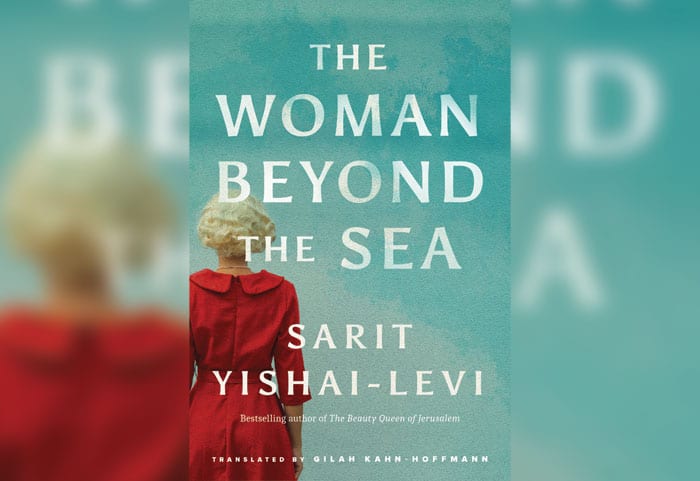
From Sarit Yishai-Levi, the author of “The Beauty Queen of Jerusalem,” comes “The Woman Beyond the Sea,” a mesmerizing and immersive multigenerational story that incorporates history, Jewish culture and family.

Photo by Maya Baumel

“Anyone who reads my books cannot help but notice that the Jewish background and Jewish values are an important part of them,” Yishai-Levi told the Journal. “And certainly that the Jewish education I received greatly influences my writing.”

“The Woman Beyond the Sea,” translated by Gilah Kahn-Hoffmann and published in English last month, traces the paths of three women. 

Eliya is a young woman who thinks she has finally found true love, until her husband ends their relationship in a Paris café, leading to a suicide attempt. There’s also Lily, Eliya’s mother, who vanishes for long hours every day and a third, mysterious woman, who abandoned her newborn baby on the doorstep of a convent on a snowy night in Jerusalem. To heal herself, Eliya seeks to piece together the jagged shards of her life and history.

“I hope people will love the story and the heroes as I love them,” she said. 

Sarit Yishai-Levi says the inspiration for the book came from life itself. 

“I can’t put my finger on a specific point, but I can say that each of the characters in ‘The Woman Beyond the Sea’ has a piece of me, both men and women,” Yishai-Levi said. “Each of the characters has experiences I’ve had, loves I’ve loved, pains I’ve had, thoughts I’ve thought. You don’t have to look far for inspiration, just look inside and around.”

Yishai-Levi was born in Jerusalem in 1947 to a family of Sephardic Jews, who spoke Ladino, and had lived in the city for eight generations.

“My ancestors came to Jerusalem from Toledo in Spain with a short stop in Thessaloniki,” she said. “My grandfather’s family on my father’s side came from the city of Bitola in Macedonia and until a very, very late age I did not know that his entire family had perished in Auschwitz.”

Yishai-Levi’s father served in the Israeli security forces and was injured while performing his duty; her mother was injured in the War of Liberation.

“My parents’ home was secular but respected tradition and holidays and this is who I am today: a secular woman who believes in God. I light Shabbat candles and celebrate all the holidays with my family.” 

“My parents’ home was secular but respected tradition and holidays and this is who I am today: a secular woman who believes in God,” she said. “I light Shabbat candles and celebrate all the holidays with my family.”

The Passover evenings she recalls having at her family’s home in Jerusalem couldn’t happen today.

“About a hundred people from the extended family from my father’s and my mother’s sides gathered around the Seder table,” Yishai-Levi said. “Today we are a much smaller family. Judaism occupies an important part of my culture.”

Yishai-Levi was an actress for a short time before turning to journalism. “When I realized that I was not very good in that demanding profession, I decided to leave,” she said.

The experience of giving birth to her daughter, Mia, shook Yishai-Levi so much that, afterwards, she had to write her feelings down.

“I sent it to my agent and asked her to make sure that the article was published,” she said. 

“From there it was easy,” Yishai-Levi said. “I became a successful journalist with many scopes. Prose writing was always a dream of mine, and I didn’t dare to fulfill it, until one day I realized that if not now, then never.”  

Yishai-Levi started to write what became the book “The Beauty Queen of Jerusalem,” which was a huge success in Israel, was translated into 17 languages and was adapted into a TV series on Netflix.

When asked how she feels about being an international success, Yishai-Levi says it’s amazing and exciting. “I suppose that if this had happened to me at a young age it might have confused me,” she said. “I have seen young people who were very confused by sudden success on a large scale. The fact that I am a mature woman makes it easier for me to deal with success, to accept it with great love and excitement and to enjoy its fruits, but I always remain with my feet on the ground.”

Yishai-Levi said she writes when the muse hits her. “It can be three months in a row, or a week in a row or even a day, and then I can stop for a very long time and come back to the story at some point,” she said.

She wrote “The Beauty Queen of Jerusalem” over six-and-a-half years, “The Woman Beyond The Sea” in three-and-a-half years and she has been writing her current book for more than three years and is still in progress. 

Her third novel takes place in the ’90s and is set in different places around the world. Unlike her previous books, where she has dealt with mother-daughter relationships, this one deals with mother-son relationships. 

“I always write about family because I think that family is the most important and meaningful part of a person’s life,” she said.

Sarit Yishai-Levi’s Mesmerizing “The Woman Beyond the Sea” Read More »

Campus Watch Apr. 13, 2023

Yale Hosts Speaker Accused of Being Antisemitic

Yale University hosted Houria Bouteldja, a French-Algerian author, on April 6 despite backlash over Bouteldja’s past controversial remarks that have been criticized as being antisemitic.

The Yale Daily News reported that Stop Antisemitism tweeted out some of Bouteldja’s comments; the Daily News specifically reported on Bouteldja believing “that Western governments impose a hierarchy in which ‘Jews are in some sense better treated’” and standing next to graffiti saying, “Zionists to the gulag” with her thumbs up. She also said in a 2012 speech, “I went to bed as myself, and woke up as Mohammed Merah. Mohammed Merah is me.” That year, Merah had committed a series of terror attacks in France, one of which was at a Jewish school.

The Daily News reported that various Jewish students had asked that Bouteldja’s talk be rescheduled so it didn’t coincide with Passover. The university declined to move it, citing free speech. Bouteldja said during her speech that she was not a bigot but a “decolonial” and explained that her Merah comment was her expressing her belief “that Merah had only resorted to violence because he was integrated into a white supremacist state,” per the Daily News.

Education Dept., UVM Reach Resolution Over Antisemitism Complaint

The Department of Education’s Office of Civil Rights (OCR) and the University of Vermont (UVM) reached a resolution agreement on April 3 over a complaint that UVM failed to adequately respond to allegations of antisemitism on campus.

According to a press release, OCR’s investigation into the complaint found that the university “declined to investigate any of the complaints” and took “delayed” measures in response, actions that “may have discouraged students and staff from raising further concerns with the university or with participating in the OCR investigation.” Under the resolution agreement, the university will “issue a statement with a commitment to address discrimination based on shared ancestry, including antisemitism” and “review and revise its policies and procedures to include a description of forms of discrimination that can manifest in the university environment, and to ensure that the university’s response to notice of discrimination including national origin harassment on the basis of shared ancestry is consistent with Title VI [of the Civil Rights Act],” among other things, per the press release.

Dept. of Education to Investigate Antisemitism Complaint Against GWU

StandWithUs announced on April 4 that they have been informed by the Department of Education’s Office of Civil Rights (OCR) that they will be investigating their complaint against George Washington University (GWU).

The complaint, filed in January, alleged that the university failed to take proper action against Assistant Professor of Psychology Lara Sheehi, who is accused in the complaint of targeting and invalidating the identities of Jewish Israeli students in her class and then retaliating against them when they complained to university administrators. GWU President Mark S. Wrighton announced on March 27 that a third-party investigation conducted by the law firm Crowell & Moring “found no evidence substantiating the allegations of discriminatory and retaliatory conduct alleged in the complaint.” 

“University administrators have an affirmative obligation to respond adequately when students report allegations of such misconduct,” StandWithUs CEO and Co-Founder Roz Rothstein said in a statement. “We are pleased that OCR has recognized the need to investigate these allegations in a thorough and unbiased manner.”

Education Dept. Could Repeal Regulations Affecting Jewish Students

The Department of Education is reportedly considering repealing some regulations from the Trump administration that would affect how Jewish students are protected on campus.

Jewish Insider (JI) reported that the regulations required that schools protect the free speech rights of students in order to qualify for grants. Kenneth L. Marcus, who head the Brandeis Center, told JI that the regulations provided “a great deal of leverage that would require universities to take these complaints much more seriously,” pointing to how they were able to get Duke University rescind its decision to block recognition of a pro-Israel club on campus. 

Columbia to Launch Tel Aviv Center Despite Faculty Pushback

Columbia University announced on April 3 that they will be launching a Columbia Global Center in Tel Aviv, resulting in pushback from faculty members.

According to the university’s website, the center will focus on “climate change, technology and entrepreneurship, and aspects of arts and the humanities, as well as biological science, public health, and medicine,” among other things. Before the announcement, at least 95 faculty members had signed onto letter denouncing the pending move, arguing that Israel violates Palestinian human rights and that the move would be seen as “endorsing or legitimizing the new government.”

“The idea of faculty protesting a center in #Israel but not a peep about similar @Columbia programs in #China, #Jordan, or #Turkey would be amusing if it weren’t so absurd,” Anti-Defamation League CEO Jonathan Greenblatt tweeted. “This is what bias looks like.”

Campus Watch Apr. 13, 2023 Read More »

A Moment in Time: “Teaching our Children to Ask Questions”

Dear all,

In 1988, a the following letter to the editor appeared in the New York Times (penned by Donald Sheff):

Isidor I. Rabbi, the Nobel laureate in physics, was once asked, “Why did you become a scientist, rather than a doctor or lawyer or businessman, like the other immigrant kids in your neighborhood?”

”My mother made me a scientist without ever intending it. Every other Jewish mother in Brooklyn would ask her child after school, ‘Nu? Did you learn anything today?’ But not my mother. She always asked me a different question. ‘Izzy,’ she would say, ‘Did you ask a good question today?’ That difference – asking good questions ‘ made me become a scientist.”

I share this letter as I reflect on this past week of Passover, which began with a seder during which Maya and Eli asked the Haggadah’s “Four Questions.” From the youngest age, we encourage questions more than answers, explorations more than conclusions, and journeys more than destinations.

Let’s take a moment in time to listen, really listen, to the questions. And let’s accept the challenge of asking good questions whenever and wherever we possibly can!

With love and shalom,

Rabbi Zach Shapiro

(Letter to the Times can be found in The Family Participation Haggadah: A Different Night, by Noam Zion and David Dishon. Published by the Shalom Hartman Institute, Jerusalem, Israel)

A Moment in Time: “Teaching our Children to Ask Questions” Read More »

The Four Seder Sons and the Four Gospels

The four sons of the haggadah can be compared

to the four versions of the gospels, Matthew, Mark,

and Luke and John, four Gingers who’re Astaired,

dancing to great Jewish jazz within a parish park,

but choreographed by Jews who thought that the messiah

had not arrived, though in Bnai Berak, Aqiba

perhaps suggested that Bar Kokhba was a qualifier

for the biblically advertised job of brothers’ keeper. 


Although my reading of these narratives may be rejected,

treated either as far too sophisticated or naïve,

the way they dance like Fred and Ginger ought to be respected

 even by those who in their agenda don’t believe.

Ginger could do everything that Fred was doing, brilliant, backwards,

but echoes only three sons dancing with their father in the seder, for the last one lacked the steps, the words. 


Gershon Hepner is a poet who has written over 25,000 poems on subjects ranging from music to literature, politics to Torah. He grew up in England and moved to Los Angeles in 1976. Using his varied interests and experiences, he has authored dozens of papers in medical and academic journals, and authored “Legal Friction: Law, Narrative, and Identity Politics in Biblical Israel.” He can be reached at gershonhepner@gmail.com.

The Four Seder Sons and the Four Gospels Read More »

Jewish Groups Condemn Terror Attacks in Tel Aviv, West Bank

Various Jewish groups are condemning the two separate terror attacks that occurred in Tel Aviv and the West Bank on April 7, resulting in three dead and several others injured.

The first terror attack, a shooting in the West Bank, resulted in the death of two British-Israeli sisters, Maia, 20, and Rina Dee, 15. Their mother Lucy, 48, succumbed to her injuries from the terror attack on April 10.  The second terror attack, a car ramming and shooting, resulted in one dead––an Italian national tourist––and six wounded. The perpetrator behind the second terror attack, who was killed by law enforcement, has been identified as Yousef Abu Jaber, 45, who resided in Kafr Qassem and had no prior offenses, per The Times of Israel. Authorities are still searching for the terrorists who killed the Dees.

The terror attacks came after Hamas launched more than 30 rockets against Israel from both the Gaza Strip and Lebanon on April 6, prompting Israel to retaliate with strikes against Hamas targets in Gaza.

Jewish groups also denounced the terror attacks.

“We mourn the loss of Lucy Dee, mother of Maia and Rina, who died today from wounds suffered in the Friday terror attack that killed her two daughters,” Anti-Defamation League CEO Jonathan Greenblatt tweeted. “Our condolences to the Dee family, and we stand in solidarity with the people of Israel during this difficult time.”

“We are devastated by the news from Israel that Lucy Dee has succumbed to her wounds and passed away,” the American Jewish Committee tweeted. “She was injured in the same Friday terror attack that took the lives of her daughters Rina and Maya. May their memories forever be a blessing.”

The Simon Wiesenthal Center tweeted, “While Palestinians distribute more candy, the whole House of Israel weeps for this Jewish mother and her daughters murdered because they were Jews living in their land.”

StandWithUs CEO and Co-Founder Roz Rothstein tweeted, “More tragedy for the same family: The mother of the two girls buried yesterday, has lost her battle to live. Lucy and her daughters were all shot in their car by Palestinian terrorists. May all their memories forever be a blessing, and may the family find comfort.”

Stop Antisemitism tweeted, “More devastating news out of Israel as Lucy Dee, mother of Rina and Maya, has passed away as a result of her fatal injuries from this weekend’s terror attack that instantly took the lives of her young daughters. May their memories always be a blessing.”

AIPAC tweeted, “Backed by Iran, Hamas is waging a terror campaign against Israelis from the south, east, & north. This isn’t about settlements, Ramadan or improving lives for Palestinians. Hamas wants to destroy Israel. America must stand by our ally as it protects its citizens from terrorism.”

David Siegel, President of the Friends of the European Leadership Network (ELNET), said in a statement, “ELNET condemns the vicious terrorist wave targeting Israel. The attacks claimed the lives of innocent civilians including British and Italian citizens. We thank those European leaders who condemn the terrorism and support Israel’s right to defend itself.”

Jewish Groups Condemn Terror Attacks in Tel Aviv, West Bank Read More »

Dem House Leader Defended Uncle and Farrakhan in 1992 Following Antisemitic Controversies

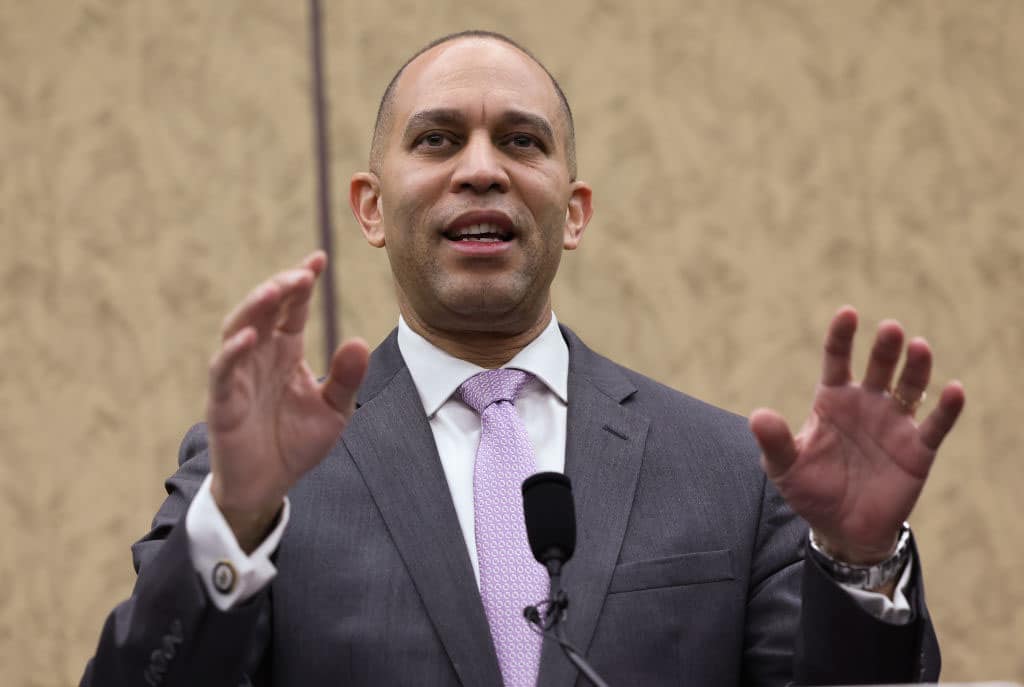
House Minority Leader Hakeem Jeffries (D-NY) reportedly defended his uncle, Leonard Jeffries, and Nation of Islam leader Louis Farrakhan in a 1992 college editorial at a time when they were both accused of making antisemitic statements. Jeffries has previously said he didn’t know much about the controversies surrounding his uncle’s comments.

CNN’s KFILE investigative team reported on April 12 that Leonard Jeffries had said during a speech at a 1991 Empire State Black Arts and Cultural Festival in Albany, NY that there is a Hollywood “conspiracy” to disparage Black people and it’s being carried out “by people called Greenberg and Weisberg and Trigliani.” Leonard, then a City College of New York (CCNY) professor and chairman of its African American Studies Department, also said during the speech that “Russian Jewry had a particular control over the movies, and their financial partners, the Mafia, put together a financial system of destruction of black people” and that “everyone knows rich Jews helped finance the slave trade.” CCNY, which is under the City University of New York (CUNY) umbrella, subsequently terminated Leonard from the school. Farrakhan, by that time, had already come under fire for referring to Adolf Hitler as a “very great man” and calling Judaism a “gutter religion” in the 1980s.

CNN unearthed an op-ed from Jeffries in The Vanguard, the Black Student Union (BSU) newspaper at Binghamton University, where he defended the BSU’s decision to invite his uncle to speak on campus. “Dr. Leonard Jeffries and Minister Louis Farrakhan have come under intense fire,” Jeffries, a board member for BSU, wrote. “Where do you think their interests lie? Dr. Jeffries has challenged the existing white supremist educational system and long standing distortion of history. His reward has been a media lynching complete with character assassinations and inflammatory erroneous accusations.” He added: “Clarence Thomas was appointed by George Bush to the highest court in the nation. Colin Powell was appointed by George Bush to lead the military establishment ‘policemen of the Wall Street Bankers,’ in the words of Cesar Agusto Sandino. Where do you think their interests lie?”

When various media outlets have previously asked about his uncle’s views, Jeffries claimed to have had a “vague recollection” over them. “My mother made a very deliberate concerted effort to shield us from a lot of the controversy that took place,” he told The Wall Street Journal’s Metropolis blog in 2013. “She didn’t want us to be distracted from our studies. My grandmother on my mother’s side always emphasized the importance of doing well in school and remaining focused. And so when a lot of the controversy took place and my brother and I were away at school. There was no Internet during that era and I can’t even recall a daily newspaper in the Binghamton, N.Y., area but it wasn’t covering the things that the New York Post and Daily News were at the time.”

A spokesperson from Jeffries’ office told CNN, “Leader Jeffries has consistently been clear that he does not share the controversial views espoused by his uncle over thirty years ago.”

Republican Jewish Coalition National Chairman Norm Coleman and CEO Matt Brooks said in a statement, “Minority Leader Hakeem Jeffries owes the Jewish community an explanation as to why he lied and attempted to cover up his defense of these revolting antisemites. The added hypocrisy here is particularly jarring: Jeffries recently falsely accused Republicans of not wanting to teach children about the Holocaust, but he’s been exposed as defending antisemites who have said Hitler was a ‘great man’ and called Judaism a ‘dirty religion.’ Unfortunately, this is yet another disturbing data point of the Democratic Party embracing and promoting antisemites, from Leonard Jeffries and Louis Farrakhan to Ilhan Omar.”

The Jewish Democratic Council of America defended Jeffries in a tweet, calling him “an unwavering partner of the Jewish American community and ally of Israel in Congress.” “We are grateful for his leadership defending democracy, fighting antisemitism and right-wing extremism, and standing with Israel,” they added. “His long record in Congress on these issues is beyond reproach and we condemn any assertions to the contrary. We are proud to call him a friend.”

Jeffries’ 1992 op-ed defending his uncle and Farrakhan was titled “The Black Conservative Phenomenon,” where Jeffries compared Black conservatives to “House Negroes,” pointing his ire at Thomas, Powell and Shelby Steele. Toward the end of the piece, Jeffries does say that he doesn’t want to restrict “Black political thought” and encouraged Black Americans to “evaluate, critically, the Black conservative phenomenon.”

When asked by Fox News if he stands by what he wrote in the 1992 op-ed about Black conservatives, a spokesperson from Jeffries’ office replied: “Leader Jeffries has consistently been clear that he does not share the controversial views espoused by his uncle over thirty years ago. Leader Jeffries has been in public service for more than 16 years as a state legislator and Member of Congress. His track record of bringing communities together and standing up for everyone speaks for itself.”

This article has been updated.

Dem House Leader Defended Uncle and Farrakhan in 1992 Following Antisemitic Controversies Read More »

Israeli Fans Attacked With Fireworks, Rocks, Bricks at Athens Basketball Game

Israeli fans were attacked with fireworks, rocks and bricks during a basketball game in Athens, Greece on April 12.

The Times of Israel reported that the game featured Hapoel Jerusalem against AEK Athens as part the Basketball Champions League’s (FIBA) quarterfinal series. Tal Hakim, one of the attendees, told the Kan public broadcaster, “A quarter of an hour after the game started, they began to throw bricks and rocks at us, and even injured some fans. We were confined to a small area to not get hurt. A quarter of an hour after that, they began to launch fireworks at us and burned the clothes of one of the fans.” He also said that various Palestinian flags and Hezbollah flags were flown during the game and that people kept trying “to enter our stand and set the Israeli flag on fire.”

The Jerusalem team referred to the incident as an act of terror in a statement that read in part, per Ynet News: “At half time we considered removing our players and fans but were unable to because the Greek fans had surrounded the stadium and the danger was real. We also considered stopping the game but were warned by our security detail that such a move would release even more violence and put lives at risk.” The team will be filing a complaint to the league over the matter.

Israeli Minister of Diaspora Affairs Amichai Chikli wrote in a letter to the Greek Ambassador in Israel that he was very concerned about “the antisemitic and anti-Israel behavior of many AEK fans” during the game. “During the match, some of AEK’s fans burned the Israeli flag, waved Palestinian and Hezbollah flags, threw firecrackers and violently attacked the over 500 Israeli fans of Hapoel Jerusalem,” Chikli said. “It should be noted that a similar event happened in December 2019 in another basketball match between the same teams in Athens, when in addition to burning the Israeli flag, AEK fans put up pictures of Marwan Barghouti, a Palestinian terrorist responsible for deadly terror activity which killed dozens of innocent Israeli civilians.”

Chikli added that due to the “sharp increase in the number of antisemitic incidents” occurring worldwide, “it is of the utmost importance for me to reach out to you personally about this problematic incident. Moreover, since this specific case has repeated itself, we demand a governmental condemnation of the criminal and antisemitic acts, open up an investigation and ensure justice prevails against the perpetrators, to ensure similar instances will not happen in the future.”

AEK ultimately won the game, 94-78.

Israeli Fans Attacked With Fireworks, Rocks, Bricks at Athens Basketball Game Read More »