fbpx

February 24, 2023

Haim Saban, Sherry Lansing and Other Leaders Call out Ticketmaster for Enabling Farrakhan Event

The leading ticketing platform in sports and entertainment doesn’t seem to have a problem with Louis Farrakahn’s long history of anti-Semitism, according to a letter sent by entertainment industry heavyweights to Ticketmaster this week.

Creative Community for Peace, a leading entertainment industry trade group that promotes tolerance through the arts, sent a letter to Ticketmaster CEO Michael Rapino, expressing great concern about Ticketmaster selling tickets to Louis Farrakhan’s upcoming Saviours’ Day event on February 26h at Wintrust Arena in Chicago.

The letter, which was signed by entertainment executives Haim Saban, Sherry Lansing, singer/songwriter Diane Warren, and more than 120 other entertainment industry leaders, highlights a list of antisemitic and homophobic statements from Louis Farrakhan at past Saviours’ Day events. It urges the company to reconsider selling tickets to the event and to adopt the IHRA working definition of antisemitism, a guideline to help identify and combat anti-Jewish hate, such as that often espoused by Farrakhan.

“Mr. Farrakhan has labeled Judaism a “gutter religion;” stated that Jewish religious writings are responsible for “pedophilia, homosexuality, and sex trafficking” in America; regularly praises Hitler, calling him “a very great man;” the letter stated. “[Farrakhan] refers to Jews as insects; and falsely and outrageously claims that Jews orchestrated and dominated the African slave trade.”

Mr. Farrakhan has repeatedly invoked “Satan” when referring to the Jewish people. In his 2017 speech at Saviors’ Day, he said “Those who call themselves ‘Jews,’ who are not really Jews, but are in fact, Satan. You should learn to call them by their real name: ‘Satan.’ You are coming face-to-face with Satan, the Arch Deceiver, the enemy of God and the enemy of the Righteous.” And in 2020, he promoted violence by stating, “”Those of you who say that you are Jews, I will not even give you the honor of calling yourself Jews. You are not a Jew. You are so-called. You are Satan. It is my job now to pull the cover off of Satan. So when every Muslim sees Satan, pick up a stone.”

The letter includes additional incendiary quotes from Mr. Farrakhan over the years, highlighting his pattern of sharing antisemitic tropes and conspiracy theories with his audience. It also notes the fact that there are more hate crimes per capita against Jews than any other minority and that “, providing support of any kind to this sort of hatred is not just unacceptable, but dangerous.”

CCFP Director Ari Ingel added, “Louis Farrakhan is one of the leading purveyors of antisemitism in America, as noted by the ADL and the Southern Poverty Law Center. His views are incredibly dangerous and we’re disappointed to see Ticketmaster enable his promulgation of hatred. We hope Mr. Rapino reconsiders, especially at a time when antisemitism continues to become more and more normalized.”

At the time of this writing, Ticketmaster CEO Michael Rapino has yet to respond to CCFP’s request.

Haim Saban, Sherry Lansing and Other Leaders Call out Ticketmaster for Enabling Farrakhan Event Read More »

Ruth Bader Ginsburg and Israel’s Anti-Terror Strategy

The Biden administration has once again criticized Israel for dismantling the homes of Palestinian Arab terrorists. U.S. officials say the practice is unfair because, as State Department spokesman Ned Price has put it, “the home of an entire family shouldn’t be demolished for the action of one individual.”

It appears that the president of the United States and his spokesmen are not familiar with some fundamental aspects of the American judicial system. That’s where one can find plenty of models for Israel’s anti-terrorist tactics.

It’s called “civil asset forfeiture”—and Supreme Court Justice Ruth Bader Ginsburg played a key role in upholding it as the law of the land.

If somebody drives drunk, the authorities can seize his automobile—even if that’s the car that he uses to drive his kids to school. The kids are innocent. But they inevitably suffer some of the consequences if their father endangers other people’s lives by driving drunk.

It’s not just drunk driving. In many states, the police can impound the family’s primary mode of transportation if it was used for any one of a wide variety of driving infractions. Reckless driving. Evading the police. Participating—or even promoting!—an illegal drag race. Driving without registration, or insurance, or a valid license.

And it’s not just the family car. If a drug dealer runs his operation from one room in the family’s house, the authorities can seize the entire house, even if the other family members had nothing to do with the drug dealing, and even if they knew nothing about it.

And it’s not as if the criminal in these cases necessarily gets his car or house back later. If he’s convicted and the property was used somehow in the commission of the crime, that property is put up for auction and the money is kept by the local government. The criminal’s children remain homeless and without transportation—but that’s the law.

In fact, even if the property owner is never charged with a crime, as long as the police suspect the car or the house might have been used in connection with the crime, that property can be seized and held for the entire duration of the investigation, which in some cases can mean years.

Yes, the innocent spouse can go to court to try to get the family’s car or house back. But that means paying lawyers and spending countless hours in a legal battle.

Consider the case of Tina Bennis. She decided to fight, and the case went all the way to the Supreme Court.

Mrs. Bennis’s husband was arrested in Detroit in 1988 for consorting with a prostitute in the family car. When he was arrested, the automobile was seized. Poor Mrs. Bennis—talk about an innocent bystander! Through no fault of her own, she was subjected to the anguish of being cheated upon, the embarrassment of having her family’s dirty laundry exposed in public, and, on top of it all, the loss of her car (she was the co-owner).

So she sued the State of Michigan to get her car back. During the trial, Mrs. Bennis proved she had no knowledge of her husband’s illegal activity in the car. She testified that she, not her husband, provided most of the money to buy the car in the first place. She lost the case anyway.

But Mrs. Bennis didn’t give up. She fought for eight years, through various appellate courts, all the way to the United States Supreme Court. But the Supreme Court ruled against her. In a five to four decision, the court upheld the right of the Michigan authorities to seize and keep Mrs. Bennis’s car. Four of the five who voted against Mrs. Bennis had been nominated to the court by Republican presidents. But the fifth and deciding vote came from a liberal justice who joined the conservatives against Mrs. Bennis—Ruth Bader Ginsburg.

Then-Senator Joe Biden was the chairman of the Senate Judiciary Committee when Ruth Bader Ginsburg was nominated to the Supreme Court in 1993. He presided over her confirmation hearings. In his opening remarks, Biden declared that Ginsburg “comes before the committee with her place already secured in history,” for her role in various legal cases related to civil rights. “You have already helped to change the meaning of equality in our Nation,” Biden said.

As it turned out, Ginsburg also ended up ensuring the right of the authorities to seize a criminal’s property, even if that seizure impacts innocent members of his family. A later Supreme Court ruling refined the application of the law just a bit, but the principle remains, and the practice continues.

So now the Biden administration is going to lecture Israel about “collective punishment”? U.S. officials are going to tell Israel to stop taking away the property of convicted terrorists, even though scholarly studies and multiple Israeli court decisions have upheld that practice as a deterrent to terrorism?

Perhaps Israel should remind the critics that its anti-terror actions are consistent with the wise counsel of the late Justice Ginsburg and her colleagues.


Stephen M. Flatow is an attorney and the father of Alisa Flatow, who was murdered in an Iranian-sponsored Palestinian terrorist attack in 1995. He is author of “A Father’s Story: My Fight for Justice Against Iranian Terror.”

Ruth Bader Ginsburg and Israel’s Anti-Terror Strategy Read More »

Plunging In Before the Sea Splits

Who we follow and what we are willing to learn from our leadership say a lot about the kind of people we envision ourselves becoming. Judaism’s leaders have always been its teachers; we see ourselves as a people always learning, ever open to new insights, new ways of thinking, deeper modes of relating to God and to each other. In focusing on leadership, we are really holding up a mirror to ourselves, to explore Jewish identity. If Jews are to be perpetual students, then our teachers are our leaders.

In what way do teachers lead?

Generally, we think of leadership as a characteristic—either you have it or you don’t. Leadership, then, must be something you possess: a personality trait, like charisma, or a skill, like public  speaking, or access to a pool of knowledge or information. When a politician is said to be a natural leader, we mean that he or she is able to steer legislation through the legislature, to negotiate treaties to the nation’s advantage, to mobilize the military to assert the national interest. In politics, leadership is the possession of competence and charisma.

In science or academics, by contrast, leadership is an ability to master a large body of knowledge and to use it in creative and fruitful ways. Thus, Einstein was a leading physicist, not because he was competent and charismatic, but because he took the same data that everyone else was looking at and, filtering it through his own remarkable creativity, was able to configure it in ways that no one else had yet dreamed. In science and scholarship, leadership is the possession of information and creativity.

Makings of a Jewish Leader

Competence and charisma, information and creativity, may well be the hallmarks of leadership in other areas, but the makings of a Jewish leader are somewhat different and worth recalling. Educator, rabbi, cantor, chaplain or youth advisor, we are all teachers, leading through the example we set, by our lives as they are lived, rather than by any skill, discipline or force of personality.

To lead in the Jewish world, to bring others to a fuller participation in Judaism and to our brit with God, a Jewish teacher must offer nothing less than access to the very depths of his or her own neshama. A teacher is one who, through a willingness to share a spiritual journey, to reveal the eddies and shoals of the soul, provides a model and a guide for others to follow. Leadership, for the Jew who would teach, is primarily a gift of spirit, a gift of shleimut, of wholeness.

A Jewish teacher is a script in search of actors.

A Jewish teacher can, indeed, make good use of skills and charisma, and certainly needs knowledge and creativity. But a teacher is distinguished from other Jews not so much in these specific areas as by an orientation of personality. A teacher is willing to have an open soul, permeated by the teachings and values of our sacred traditions, and permeable to the community of Jews who would be instructed by example. A Jewish teacher is a script in search of actors.

A teacher is an open neshama, made and molded by the sacred writings and deeds of Judaism. Our legitimacy, our ability to stand before our students with integrity, requires that we travel on the road we offer to our fellow Jews. Not as accomplished examples of perfection, but as flawed seekers of improvement, we dare to instruct and act as agents of God. We are always in the process of transforming God’s Torah (Torato) into our own (Torateinu). Only because we are first and always teaching ourselves, because before we ask how we can teach something, we must inquire, “What does this teach me?” Only then can we muster the temerity to demand that our students, congregants, and community also seek to absorb and to be absorbed by the age-old flow of Jewish striving.

For too long, we followed a model of the teacher as one who led by already having mastered, a model more properly located in the world of Zen Buddhism, or perhaps in some medieval guild. Jewish teachers are not masters, nor should they be. We are not so much ba’alei teshuva, masters of repentance, as we are rodfei teshuva, seeking always old-new paths of return. In fact, one who claims to have mastered the tradition demonstrates effrontery, an unwillingness to be mastered by the tradition. One who claims to be the ideal Jew is disqualified from the start; only if you think you lack the merit to be a lamedvavnik (one of the 36 totally righteous people) might you actually be one.

How We Do It

How then does a teacher show leadership?

Each morning we thank God for making us in the Divine image. The truth is, God gives us the tools, but we are the ones who must do the sacred work, each of us with our own neshamot. We are given the clay; the machzor affirms, “Haguf shelakh, the body is yours.” But God’s image is not what we start with; it is what we seek. Asymptotically, always closer but never actually arriving, we wrap ourselves in the shawl of our tradition, making for ourselves a context in which to live, to breathe, to learn and to act. By committing ourselves to a regimen of lifelong learning, the wisdom of our Sages becomes the companion of our minds. We bind ourselves with the straps of the mitzvot, disciplining our deeds to reflect our love and awe for our God, to dance God’s will with our hands and our every move. By filling our days with the commandments, we live as though we were wise and spiritual, and in the process, we seek to make ourselves wise and spiritual. We immerse ourselves in a liturgy of good deeds, davening kindness, dignity and involvement through our care for our fellow creatures and for all of Creation.

When Rabbi Abraham Joshua Heschel marched in Selma, he insisted he was “praying with his feet.” Only after we are so well launched, as we ourselves are engaged with learning, mitzvot and deeds, can we then present ourselves to our communities and claim that we have something to teach. Were we not first willing to remake ourselves in the image of the Divine, we would offer only tinsel-information to satisfy curiosity, memories to quench the pangs of nostalgia, posturing to allay the guilt of abandoning a beautiful and sacred way.

The Midrash teaches that God was unwilling to split the Red Sea for the slaves fleeing Mitzrayim until they themselves took the first step. Insistent on the passion for freedom and for godliness, our ancestors walked up to their necks in the waters, singing “Mi khamokha ba’elim A-do-nai? Who is like You among those who are worshipped, A-do-nai?” Still the waters did not part. They continued walking until the waters engulfed their nostrils, forced now to sing “Mi kamokha ne’edar bakodesh? Who is like You, in majestic holiness?” Only then, following their lead, did God split the waters, allowing them to complete their course.

Walking In Before the Waters Part

Leadership, then as now, means going first. It means walking into the waters before they have parted, making them split by our courage, our determination that they must indeed part.

For those of us who teach—rabbis, cantors, camp counselors, faculty of day and supplementary schools—we can only teach if we are willing first to lead. To begin our own journeys of Jewish faithfulness and Jewish growth, of learning and deeds, of prayer and passion, before we attempt to impose it on our students.

B ‘orkha nir’eh or, in your light, others will see light. That is leadership Jewish-style.

That is teaching.


Rabbi Dr Bradley Shavit Artson (www.bradartson.com), a Contributing Writer for the Jewish Journal of Greater Los Angeles, holds the Abner and Roslyn Goldstine Dean’s Chair of the Ziegler School of Rabbinic Studies and is Vice President of American Jewish University in Los Angeles. He is also dean of the Zacharias Frankel College in Potsdam, Germany, ordaining Conservative rabbis for Europe.

Plunging In Before the Sea Splits Read More »

Portable: The Story of Jewish Survival

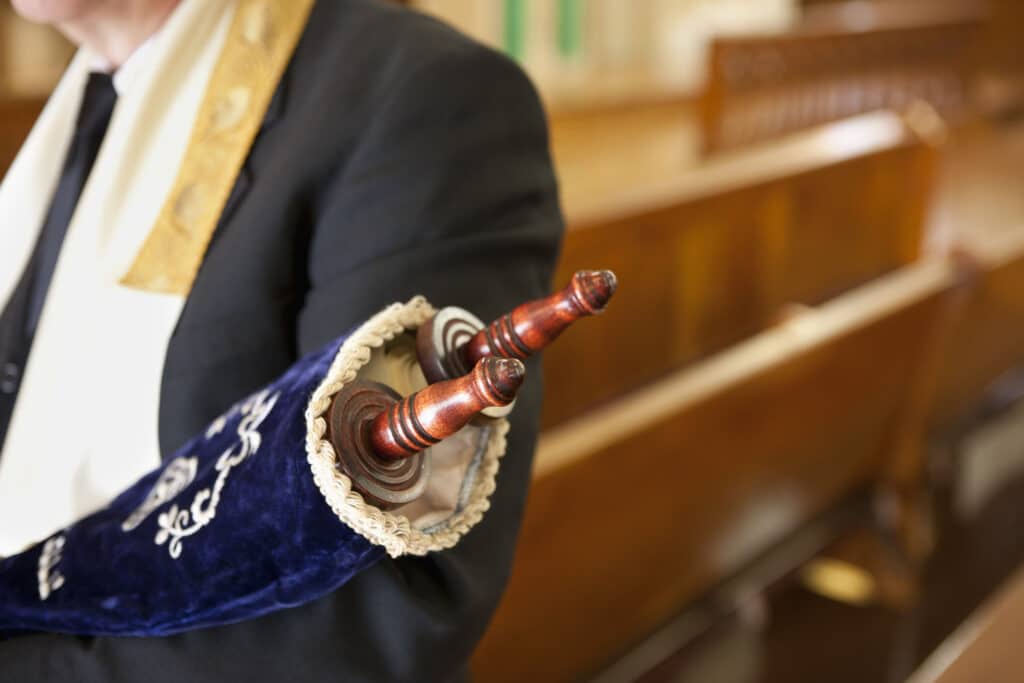
The phrase is memorable because it is apt: “portable homeland.” In a somewhat rambling essay entitled Confessions, Heinrich Heine describes how the Jews…preserved the Bible from the great conflagration of the sacred temple, and all through the middle ages carried it about with them like a portable homeland… Heine observes that the Torah became a refuge for the Jews during exile.  They found comfort inside a virtual reality, an otherworldly homeland floating in a sea of words.

Portable is the story of Parshat Terumah. The Mishkan, the first sanctuary of the Jewish people, was meant to be disassembled, transported, and reassembled at each stop during their 40-year journey in the desert. After the Jews settled in the land of Israel, a permanent Temple was built in Jerusalem, which became the spiritual and national center of the Jews. But after the Temple was destroyed, the Jews faced a profound challenge: How would they be able to maintain their religious identity without the Temple? Our Parsha hints at the solution; every sanctuary, even the Temple, can be portable, just like the very first sanctuary in the desert.

The midrashic phrase “this verse demands to be read poetically” describes an unusual verse in this week’s Torah reading. We are told how the Ark of the Covenant, (which will carry the Luchot, the tablets inscribed with the Ten Commandments), is to be constructed. Just like several other furnishings in the Mishkan, the Ark is meant to have poles that slide into the sides, to enable it to be carried from place to place. But then there is a puzzling commandment, which pertains only to the Ark: “The poles shall remain in the rings of the ark: they shall not be removed from it.” (Exodus 25:15). This is strange. Why leave the poles in permanently? And why is this rule only for the Ark?

Several commentaries explain this strange command by focusing on how remote and holy the Ark was; it was kept in the Holy of Holies, a room visited only once a year, and only by the High Priest. Bekhor Shor suggests the following. One would remove the poles from the other furnishings to create more space for people to walk by inside the sanctuary. But for the Ark, which was in the Holy of Holies, that was unnecessary; nobody ever walked near it. Ralbag offers a different explanation. He says the poles weren’t allowed to be removed in order to prevent the possibility that someone might hold the Ark while removing the poles; that touch would be disrespectful to the Ark.

Other commentaries read this prohibition as symbolic. The Luchot inside the Ark represent the Torah; and the Meshech Chochmah explains that the poles symbolize the financial supporters of Yeshivot, who “hold up” these Torah institutions. The lesson is that the dedication of philanthropists is inseparable from the Torah studied at these Yeshivot; they are two parts of one whole.

Rabbi Samson Raphael Hirsch offers an explanation that is reminiscent of Heine’s remark. He also focuses on the Ark as a symbol of the Torah, and says: The command that the poles must never be removed from the Ark establishes from the outset, and for all time to come, the truth that this Torah and its mission are not confined to the soil on which the sanctuary and the Temple once stood. Like the Ark, the Torah must be ever-ready, at a moment’s notice, for any journey. Even in exile, the portable homeland is always with us, ensuring the continuation of the Jewish people.

This lesson became critical after the destruction of the Temple when Rabbinic leadership focused on repairing the spiritual breach.  Some despaired; others recognized that Judaism had to carry on. When Rabbi Joshua exclaimed that with the destruction of the Temple, there was no longer any way to find atonement for one’s sins, his teacher, Rabbi Yochanan ben Zakai said to him: “my son, don’t be upset. There is another atonement that is just as good: acts of kindness.” (Avot deRabbi Natan 5.) The synagogue became a “miniature sanctuary,” and prayer became a replacement for sacrifice; the Hebrew names for the furnishings of the synagogue are even borrowed from the Temple: Aron, Shulchan, Parochet, Ner Tamid.  And the home too became a domestic Temple. The Talmud (Berakhot 55a) remarks: “when the Temple was standing, the altar (and sacrifices) atoned for a person, but now that the Temple is destroyed, a person’s table brings atonement for them, (by being a place where one invites the poor and needy.)” The home and synagogue became the new centers of Jewish worship.

After the destruction, the Rabbis found a way to rebuild a broken people. Replacements were found for what had been lost; Jewish life would still thrive even after exile and destruction. The locus of Judaism moved from Israel to the Diaspora, and from the Temple to the synagogue and home. Rabbinic Judaism was a brilliant reinvention, a way to enable the soul of the Torah to live on even after upheaval and displacement.

At the same time, the Rabbis made certain to retain the connection to the Temple and the Land of Israel. Tisha B’Av mourns the destruction, and is filled with prayers for a return to the land. The Chanukah candles commemorate the Menorah in the Temple, and the holiday itself celebrates the rededication of the Temple. On Pesach and Yom Kippur, holidays in which the Temple service once played a central role, we end by declaring “next year in Jerusalem.”

The Torah served as both a replacement for, and a reminder of, what had been lost and destroyed. Immersed in the Torah, the Jews could retain their religious identity in the diaspora; imbued with hope of returning home, they could endure the bitterness of exile. This unique combination is the recipe for a portable homeland; and with it, Jews could survive far into the west, even while their hearts remained in the east.

Roger Kamenetz, in his book The Jew in the Lotus, describes meetings that the Dalai Lama held with American Jewish leaders after receiving the Nobel Peace Prize in 1989. Worried that Tibetan culture will disappear in exile, he turned to these Jewish leaders and asked: “tell me your secret..the secret of Jewish survival.” He understood that the Jews had managed to survive two millennia of wandering; as Kamenetz puts it, “in the Dalai Lamas’s eyes, and in the eyes of many Tibetans, the Jews are survival experts.”

The answer to his question can be found in one phrase: portable homeland. Wherever Jews went, they carried the Torah with them. They lived in a virtual reality filled with learning and spirituality, hopes and dreams.

Diaspora should have been the end of the Jewish people; instead, it was their finest hour, an era characterized by a heroic display of tenacity and determination. All this was possible because of their portable homeland.


Rabbi Chaim Steinmetz is the Senior Rabbi of Congregation Kehilath Jeshurun in New York.

Portable: The Story of Jewish Survival Read More »

Synchronicity in the Chaos of Life

Synchronicity is a wondrous thing. In the last couple of weeks, the following have entered my path through various routes. In my Twitter feed, someone posted, after Israel had sent one of its crack search-and-rescue teams to Turkey, that it looks like “corrupt Israel” was trying to generate some positive PR in the world. In Pakistan, a man was dragged from his jail cell by a mob and lynched for desecrating the Quran. I picked up a copy of JLiving that featured, in its “Dear Maven” (Jewish “Dear Abby”) section, two “favorite rabbi jokes” submitted by two LA rabbis (both very funny). I began reading a profile on Salman Rushdie that centered on the near-lethal attack on his life in service to a decades-old fatwa by the late Ayatollah Khomeini after publication of “The Satanic Verses.” Two Jews were shot and wounded—the perpetrator, an admitted antisemite, was arrested—in LA’s Pico-Robertson neighborhood. I was forwarded a short speech by Dennis Praeger, speaking at the Israeli-American Council (IAC), which had a three-pronged message: In every age someone will rise up to destroy the Jews (Iran is cited for this age); Jews living outside Israel have no right to criticize Israel and Israeli-Americans should be speaking and doing more on Israel’s behalf; and the Israeli Knesset moved legislation to gain political control over the Judiciary (at a moment when the Prime Minister is in legal proceedings, accused of corruption) and passed legislation allowing the State to strip residency from Palestinians convicted of terrorism (it doesn’t take much to imagine a new, more elastic definition of “terrorism” under a politically controlled judiciary).

I swiftly rebutted the Tweet, noting that Israel has lent its post-disaster expertise around the world and questioned whether the characterization of Israel was “as opposed to regimes in Turkey and Syria.” There was no response. Israel, of course, is notorious for its poor international PR, mostly because it doesn’t care. It walks the edge of doing what it feels is right for Israel—depending on the administration—and pretty much lets the chips fall where they may. However, the current regime is pushing that edge, and the result is both a foreign and domestic response. There have already been two massive demonstrations in Israel against the direction the Netanyahu administration is headed. How this plays out will eventually affect groups like the IAC. Though Praeger received several moments of applause and a standing ovation after his talk, one wonders to what extent Israeli-Americans enjoy being lectured by Praeger, who regardless of the topic, always seems to know best. One also wonders, if Netanyahu is able to make his new laws stick, to what extent the IAC will be growing exponentially, leaving the field to the enablers of Bibi’s more autocratic designs.

Since 1948, nearly three-quarters of a million Israelis have emigrated, the overwhelming majority to the U.S., and never returned. More than a million Israelis have established dual- citizenship in the past 20 years. The current administration is birthing organizations like “Leaving the country—together.” In the end, “corruption” my not be as important as politics in Israel’s worldwide image. The tolerance that is associated with Western Democracies allows for demonstrations opposing the government, but leaving indicates that civic opposition has proved underwhelming. The IAC may find itself populated more and more in the coming years by those more disinclined to rise and clap for being criticized for not supporting Israel enough.

Which brings us to the “tolerance” of Judaism as a whole. While some on the far right may tend to look at Reform Jews as a branch of Unitarianism, the many splinters of contemporary Jews have found ways to coexist without fatwas and lynchings. Yes, we’ve had a Prime Minister assassinated. We are not immune. While antisemitism is again on the rise, and the world often seems to look at Jews and Israel through the most negatively hued prism, we are renowned for both our self-deprecating humor and drop-everything desire to help others. These are among “the gifts of the Jews” that those with more objective perspectives have continually showcased. Steadfastness, criticism, and flexibility have been our hallmark and served us well as we evolve in a constantly evolving world. Above all, we revere life. We have been the objects of murderous intent infinitely more than perpetrators.

While some on the far right may tend to look at Reform Jews as a branch of Unitarianism, the many splinters of contemporary Jews have found ways to coexist without fatwas and lynchings.

Still, and again, we are not immune to the pitfalls of human nature. In every age it’s not just about who may rise up to annihilate us; it’s about the choices we, ourselves, make and demons that may rise up to overwhelm our better judgement. We cannot control a crazy man who wants to attack Jews or the prejudices of other faiths, but we can work to “not put a stumbling block before the blind.” We can heed the sage words of Hillel: “Whatever is abhorrent to you, do not do to others.” And for God’s sake, let’s never lose our sense of humor.


Mitch Paradise is a writer/producer and teacher living in Los Angeles.

Synchronicity in the Chaos of Life Read More »

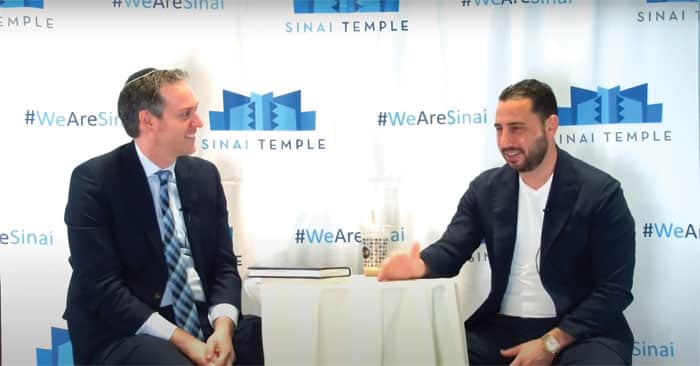
Josh Altman Tells Rabbi Erez Sherman How He Became King of The Castle

Josh Altman is never late to a listing appointment. The top real estate agent who stars on “Million Dollar Listing Los Angeles” is always on time for Yom Kippur services, Rabbi Erez Sherman said when Altman was the guest on the 80th episode of his podcast, “Rabbi On the Sidelines.”

The impressive podcast delves into connections between faith and sports. Altman noted that he was excited to get on the bima at Sinai Temple and noted that his bar mitzvah haftorah was for Shabbat Zachor, which is chanted the Shabbat before for Purim.

The portion from the book of Samuel tells of efforts to defeat the enemy of Amalek. Altman noted that the tallit he uses was given to him by his grandfather. He explained that he is Conservative, but his father came from a Modern Orthodox background, and that his Jewish upbringing is a backbone that is “so valuable, it’s tough to even describe.”

Altman was a kicker for Syracuse University’s football team, though he did not get a chance to get on the field, as the starter was chasing a record. He chose Syracuse because his mother didn’t want him to be far away and because it was a good school. He said he learned how to be competitive but noted that while some may think his success is due to luck, it is more due to hard work and being prepared for the big opportunities when they come your way.

One new opportunity that came his way last year was Dolphin Terrace in Newport Beach, which he sold for $19,130,000, and on the 10th episode, we learn that his team as well as that of fellow realtors Josh Flagg and Tracy Tutor will be selling 33 high end estates in Las Vegas for Terra Firma Development. Renderings show those who buy the homes, which average $16,000,000, can provide the luxury L.A. lifestyle 15 minutes from the Vegas strip with no income tax.

Sherman noted that with “Beit Knesset” the first word “Beit” means a house.

Altman and Flagg, whose grandmother Edith was a Holocaust survivor who killed Nazis and became a business success (and was a wonderful character on the show) often use Jewish references. Flagg told someone “you should be so lucky” and used what might be the most obscure reference of the season, citing virtuoso violinist Jascha Heifetz, who was born in Vilnius, Lithuania and played at Carnegie Hall In New York.

With a show that goes out to more than 70 countries and is seen by millions of people, the two men could choose to hide their Jewishness. But that isn’t the case. With both Altman and Flagg “being Jewish, you’ll see that in different scenes,” Altman said on the podcast.

Sherman noted he was touched by former Patriot wide receiver Julian Edelman, who tweeted a message of support in 2018 after a gunman murdered 11 Jews at The Tree of Life Synagogue. “My heart is broken for the families of Pittsburgh,” Edelman tweeted. “It’s hard to even imagine such senselessness. As a Jew, an American and a human, I’m devastated. We are with you, Pittsburgh …” Altman called the former NFL receiver a hero, friend and client.

While what Altman does might look easy due to his great charisma and charm, he explained that he and his brother Matt, who is his partner in their business, started with a small amount of money, got a bank loan and flipped houses until they sunk all their capital into a big castle. It felt great, until the mortgage bubble exploded and they lost it.

“That fall from the top made me who I am today,” Altman told Sherman, adding that he worked in a mailroom at one point, and the new workforce should not be lazy and realize hard work is necessary.

Altman said he looks at people’s movements and facial expressions from the minute they come into a house. “I love emotion because it’s the easiest thing I can see,” Altman said.

Those who watch the show (now in its 15th season) will know that Altman is smitten by Heather, his wife and mother of their two children. She converted to Judaism, showed her real estate prowess and ability to work well with anybody, coming up with great solutions to diffuse problems. She is now the company’s CEO. “Since I met her, my career went through the roof,” Altman said, and in a past interview, said she made him a better person.

Altman said he spends about an hour-and-a-half working out and spending time in the sauna to prepare for each day and estimates that he sells $4,000,000 in real estate every day, does about 1,000 negotiations a year, and the top team has hit $1.5 billion in one year.

Altman said it is crucial to dress for success and that “everybody has their cape, their uniform in life.” He said everyone has value as a person and, in terms of real estate, even if they’re not currently looking to buy a house, they often know someone who does.

He said when he and his brother Matt were starting out, they would go to fancy hotspots and order a glass of water and allow people to think it was alcohol so they could schmooze with the heavy hitters. Altman said as a result of the show, he gets about 1,000 e-mails from teens seeking tips about how to break into the real estate industry.

He was thrilled that there are now classes in college about real estate, which did not exist when he was in college. He won’t have to teach one, because people can tune into the show on Bravo.

The bestselling author writes in “The Altman Close: Million-Dollar Tactics From America’s Top Real Estate Agent” that “We all love a slam dunk, a Hail Mary caught, a grand slam, yet even in this past year when my second-home team, the Los Angeles Dodgers, lost the World Series to my beloved Boston Red Sox, the Dodgers took out a full-page ad in the Boston Globe congratulating the Sox on their win. That’s class. That makes a loss a win for them — a form of close in itself.”

Sherman told the Journal that Altman was a great guest, not only because he was the first to cite his bar mitzvah haftorah portion, but because of his character.

“Josh is someone who cares deeply about Jewish life and Jewish education. He comes from a family rooted in community. So many of the lessons on the football field and in the world of real estate are lessons we find steeped in our tradition.”

“Josh is someone who cares deeply about Jewish life and Jewish education,” Sherman told the Journal. “He comes from a family rooted in community. So many of the lessons on the football field and in the world of real estate are lessons we find steeped in our tradition.”


Sinai Temple’s Rabbi Erez Sherman interviews Josh Altman on “Rabbi On The Sidelines.” 

Josh Altman Tells Rabbi Erez Sherman How He Became King of The Castle Read More »

USHMM Holds Discussion, Beit Ruth Webinar, Birthright Foundation CEO to Retire

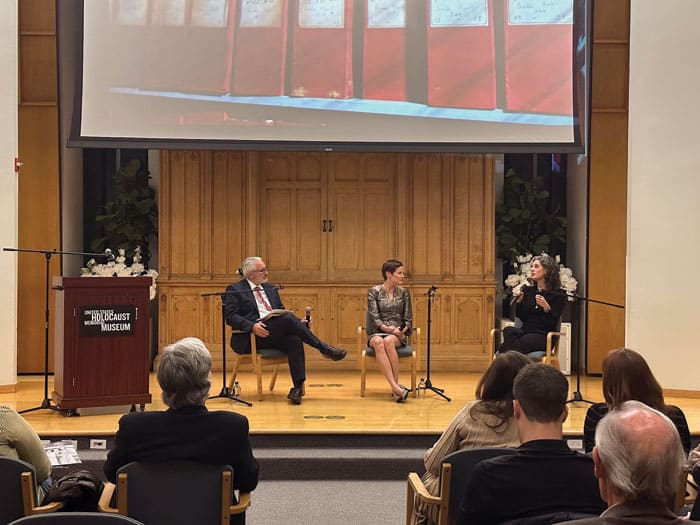
The United States Holocaust Memorial Museum held the 2023 Linda and Tony Rubin Lecture program, “Open and Accessible: Taking Stock of the Vatican’s Holocaust-Era Archives,” on Feb. 8 at Wilshire Boulevard Temple.

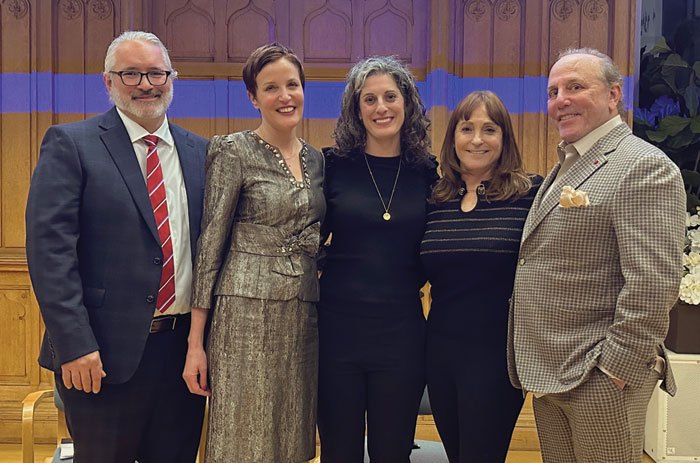
The 13th annual Linda and Tony Rubin Lecture series participants were (from left) moderator and NPR News’ Jason DeRose; Suzanne Brown-Fleming, director of the U.S Holocaust Memorial Museum’s international academic programs; Alexis Herr, adjunct professor at the University of San Francisco; and Linda and Tony Rubin. Photo by United States Holocaust Memorial Museum

More than 100 guests turned out for an informative panel discussion with moderator and NPR News’ Jason DeRose; Suzanne Brown-Fleming, director of the U.S Holocaust Memorial Museum’s international academic programs; and Alexis Herr, adjunct professor at the University of San Francisco and author of “The Holocaust and Compensated Compliance in Italy.” The speakers discussed the Vatican’s archival material related to the Holocaust.

In March 2019, Pope Francis famously said, “The Church is not afraid of history” and spoke about opening the estimated 16 million pages of archival material. February this year marked nearly three years since one of the most important new archives about the Holocaust opened. 

The conversation at Wilshire Boulevard Temple centered on what scholars have discovered since the archive became available, what crucial questions remain and how the archive has reshaped scholars’ understanding of this era.

Philanthropists Linda and Tony Rubin co-sponsored the program.


At the Beit Ruth for Young Women and Girls At Risk, counselors offer supportive services to young women in need. Courtesy of Beit Ruth

An international panel of experts explored solutions to ending gender-based violence during “This Doesn’t Happen in My Community: Understanding Violence Against Girls and Young Women Locally and Globally,” a Feb. 12 webinar convened by Beit Ruth for Young Women & Girls At Risk, a long-term therapeutic residence and school for vulnerable young women in Israel.

“We know that it’s a natural human response to deny problems in our own communities and to think about issues as happening ‘out there’ or ‘over there’ or to ‘those people,’ but not here, not to us,” Beit Ruth Executive Director Danielle Burenstein said. “Our vision is to confront the challenge of gender-based violence by looking into all of our communities, and to realize that violence afflicts everyone regardless of background, education, religion, or wealth.”

Randee Kogan, who specializes in trauma counseling, was the webinar’s keynote speaker. 

The event brought together participants from Africa to Latin America, Israel to the U.S., around issues of gender-based violence. It was produced in partnership with Israel’s Ministry of Foreign Affairs and Jewish Council of North Central Florida.

Additional speakers included Mor Ben Simchon Lipin, director of advocacy and outreach at Beit Ruth; Shachar Re’em, director of the MASHAV Carmel Training Center; and Rabbi Menachem Creditor, scholar-in-residence at the UJA-Federation of New York. They stressed the importance of everyone working to combat gender-based violence.

“Wherever we are in the world,” Burenstein said, “we can all be part of the fight and the solution to end violence against girls and young women.”


Israel “Izzy” Tapoohi.
Courtesy of Birthright Israel Foundation

Birthright Israel Foundation President and CEO Israel Tapoohi has announced plans to retire this December.

“The last six years at Birthright Israel Foundation have been tremendously rewarding, both personally and professionally. I truly believe there is no greater Jewish program than Birthright Israel,” Tapoohi said. “In today’s current climate there is no greater gift that we can give our children and grandchildren than a firsthand experience in Israel and a connection to Judaism and knowing I have been a part of it fills me with pride.”

Birthright Israel International CEO Gidi Mark and Birthright Israel Foundation Chair of the Board Phil de Toledo expressed gratitude for the contributions Tapoohi, known to friends and colleagues as “Izzy,” has made to the organization.

“Izzy has been a true asset to our team in Israel and his passion and love for our program is evident. He is not only my partner, but he is my friend and while I am sad to see him retire from this role, I look forward to him coming back home to Israel,” Mark said. 

A search committee and a consulting company will undertake an international search for Tapoohi’s successor. 

USHMM Holds Discussion, Beit Ruth Webinar, Birthright Foundation CEO to Retire Read More »

StandWithUs Conference, New Etta President, FIDF Appoints National Chairman

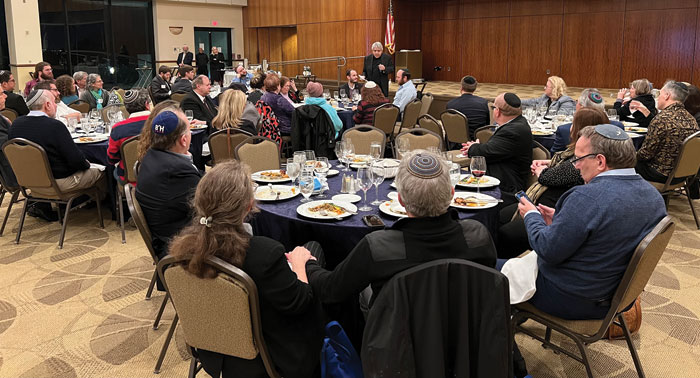
Rabbis United, a new division of StandWithUs, held its inaugural conference on Jan. 30 at Sinai Temple.  

Attendees included rabbis from the Orthodox, Conservative, Reform, and Chabad streams of Judaism who gathered for 12 hours to learn about the free resources available at StandWithUs, a pro-Israel education organization.

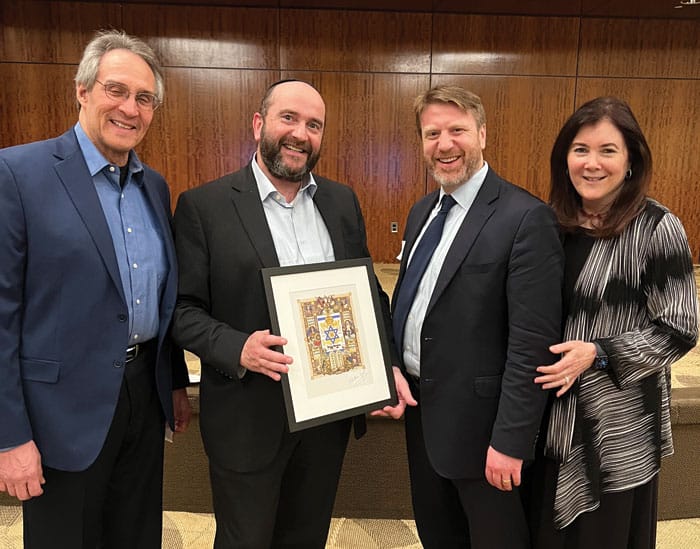
Young Israel of Beverly Hills Rabbi Pini Dunner (second from left) won a signed lithograph by artist/activist Arthur Szyk at the inaugural conference for Rabbis United. He was joined by StandWIthUs CEO Roz Rothstein (right). Courtesy of StandWithUs

In a show of interdenominational unity around supporting Israel and combating antisemitism, the rabbis participated in discussions with StandWithUs’ international experts. Sessions ranged from understanding the importance of the adoption of the IHRA definition of antisemitism to understanding the challenging experiences of Jewish students on high school and middle school campuses. 

Presenters also addressed legal avenues for responding to antisemitic assaults on individuals and communities, as well as understanding the record of antisemitism at the United Nations and its anti-Israel Commission of Inquiry. The evaluations filled out by the rabbis at the end of the day indicated that they were grateful for this unusual opportunity to gather with their colleagues from different denominations, that they gained knowledge, a sense of collegiality and inspiration, and are looking forward to continued follow-up with Rabbis United, particularly during these challenging times.


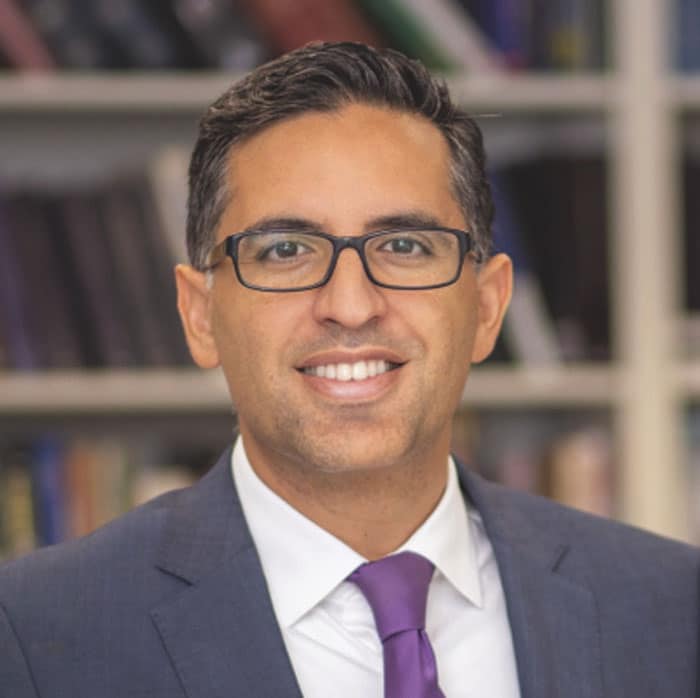
Attorney Sam Yebri, the recently appointed president of the ETTA board of directors. Courtesy of ETTA

ETTA, a leading provider of support services for adults with intellectual and developmental disabilities, has named Sam Yebri as the president of its board of directors.

Yebri joined the ETTA board in 2014. He succeeds Kam Babaoff, who served as president for the past seven years. 

“It has been my great honor and pleasure to serve as president of the ETTA board,” Babaoff said. “I have truly valued the opportunity to work with such a strong and dedicated team and am confident in Sam’s leadership as we continue to thrive and expand our impact.” 

Yebri is an accomplished trial lawyer as well as a civic and nonprofit leader in the Los Angeles Jewish community. He has been involved with a number of organizations, including Bet Tzedek, Jewish Free Loan Association and Builders of Jewish Education. As president of the ETTA board, he will work alongside ETTA Executive Director Michael Held.

“I am incredibly honored to have been selected as ETTA’s next president, and I stand ready to take on this exciting challenge with the passion and unwavering commitment that ETTA’s clients deserve,” Yebri said. “As a proud supporter of ETTA’s mission for nearly 20 years, I believe in our organization’s unique ability to make a real difference in the lives of people with intellectual and developmental disabilities in Los Angeles.” 


FIDF National Chairman Fred Gluckman. Courtesy of Friends of Israel Defense Forces

Friends of the Israel Defense Forces (FIDF) has named Los Angeles-based wealth manager Fred Gluckman its new national chairman.

Gluckman brings 25 years of executive leadership experience as a people-focused leader and longtime FIDF supporter, according to a spokesperson of the organization.

He began his involvement with the organization a decade ago, when he joined the local Los Angeles board of directors. He has held a role as an executive committee member since 2015, served as national treasurer from 2015-2017, and became the national president in 2021. 

Gluckman and his wife, Judy, have two children in college. He runs a family office focused on private equity and real estate in the Los Angeles area, and Judy serves on the boards of multiple businesses and nonprofit businesses.

FIDF offers financial, educational, wellbeing and cultural initiatives to the young men and women serving in the Israel Defense Forces.

StandWithUs Conference, New Etta President, FIDF Appoints National Chairman Read More »