fbpx

February 21, 2023

Federation Holds Town Hall on Recent Shootings

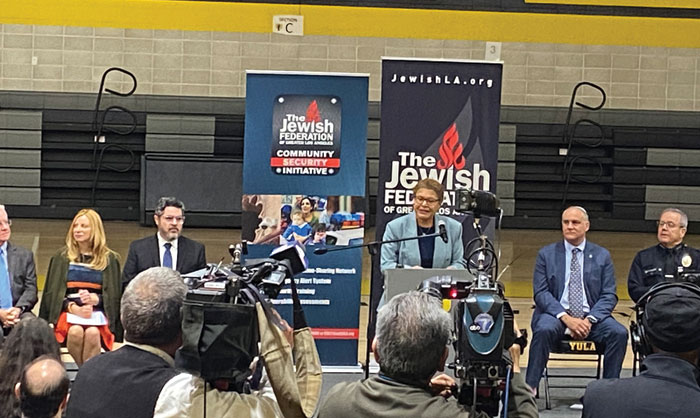
The Jewish Federation of Greater Los Angeles held a town hall at YULA High School on February 20 addressing the recent shootings in the Pico-Robertson area. The town hall featured both elected officials and law enforcement, most notably Mayor Karen Bass.

“Antisemitism has no place in Los Angeles,” Bass declared, adding that she viewed the shooting as a serious escalation from previous flyers and banners spreading white supremacist propaganda around Los Angeles. “I want to work with the community specifically on how we can proactively get on top of these things when they happen,” Bass said. Some examples she listed included more cameras and license plate readers.

She said that she heard from some constituents that they were too scared to go to synagogue, while others remained defiant. “The fact is no one should have to face that choice,” Bass said. She hoped the Jewish community can take solace in knowing that that law enforcement is focused on this issue across all levels.

Bass was later asked questions from the audience about how her administration should be gauged on antisemitism. She replied that she wants people from the community to “develop a plan with me and then hold me accountable.” Part of this plan should involve educating people on how to report a hate crime since they’re vastly underreported, she said. 

Regarding law enforcement, Bass touted her good relationship with the Los Angeles Police Department (LAPD) and pointed out that the number of officers in the department is on the decline and needed to be increased.

The gunman admitted to police that he looked up a kosher supermarket on Yelp to pick his targets. “He was hunting Jews,” Farkas said. “The horror we’re experiencing is real.”

Before Bass spoke, Jewish Federation of Greater Los Angeles President and CEO Rabbi Noah Farkas kicked off the event by pointing out that the gunman admitted to police that he looked up a kosher supermarket on Yelp to pick his targets. “He was hunting Jews,” Farkas said. “The horror we’re experiencing is real.” He pointed out that the American Jewish Committee’s most recent survey found that 69% of American Jews have experienced antisemitism online in the last 12 months and 1 in 4 have changed their behavior, such as not wearing religious items and not going to synagogue. “What begins with words often ends with bullets,” Farkas said. 

City Councilwoman Katy Yaroslavsky said that “unease remains because we know this isn’t the end of it. As a people we know we always have to be vigilant.” She later added that every time “we walk to shul or enter a kosher market or a local Jewish community space, we are taking part in a centuries act of defiance” by saying “we belong here.”

Democratic Assemblymembers Jesse Gabriel and Isaac Bryan also spoke, touting their work in passing legislation to fight hate and gun violence, with the former saying they included $100 million in nonprofit security grants and established a statewide commission addressing hate. Gabriel, who heads the CA Legislative Jewish Caucus, added that a new state law will be going into effect requiring social media companies to be transparent “on what they’re doing to crack down on hate.” 

Israeli Minister of Diaspora Affairs Amichai Chikli spoke on video from Israel, saying that the shootings should be viewed as “in a wide context and unfortunately…. antisemitism is on the rise in the U.S.” He noted that there have been other violent antisemitic acts in 2023, such as in New Jersey, where a man firebombed a synagogue, and intifada chants at the University of Michigan. 

“Antisemitism today is sophisticated,” Chikli said. “Sometimes it hides behinds the mask of human rights discussions. It infiltrates academies, even high schools.” Chikli said he didn’t want to see what happened in Sweden, where some synagogues and community centers closed down because so many Jews were afraid to attend, happen in the United States.

Other speakers included County Supervisor Lindsey Horvath, Country Sheriff Robert Luna, City Attorney Hydee Feldstein Soto, LAPD Chief Michel Moore and Simon Wiesenthal Center Dean and Founder Rabbi Marvin Hier. Dr. Hillel Newman, Israeli Consul General of Los Angeles, introduced Chikli.

Federation Holds Town Hall on Recent Shootings Read More »

4000 Years of Judaism in ‘The Book of Jewish Knowledge’

The first thing one must say about this 496-page volume, edited/compiled by Rabbi Yanki Tauber, is that it is absolutely gorgeous. Clearly no expense was spared in the printing, the full-color graphics, the top-notch photographs, charts and maps, in addition to the comprehensive text itself, which reflects the seven years of copious research and writing that went into it. Even the meticulously detailed timelines are accompanied by miniature full-color graphics and photos. It is beautifully organized and user friendly.

For example, in the section on the matriarchs and patriarchs, called “The First Jews,” there is a timeline with text and tiny drawings of the events in Jacob’s life, which gives not only chronological information, but makes the topic understandable to a reader of almost any age. There is a similarly excellent depiction, though map, graphics and text, of the Israelites’ 40 years in the wilderness.

If all one does is pick up the book and flip through it to look at the photos and captions and charts such as these, they will gain a wide window into Jewish history, scholarship and life.

If all one does is pick up the book and flip through it to look at the photos and captions and charts such as these, they will gain a wide window into Jewish history, scholarship and life.

The publishers are upfront about the worldview represented in the book, and even write, “Our approach is unabashedly traditional.” They also write that the dates quoted, which may differ in some cases from those in academic sources, are from traditional Jewish source texts.

But they have wisely also brought quotes from an eclectic range of sources and people. In the very first section, the first two pages include quotes from Genesis, Isaiah, Midrash Tanchuma, Mark Twain, Franz Rosenzweig and Maimonides (in that order). This approach continues throughout the book. Even though this is a Chabad publication, quotes by Rabbi Menachem M. Schneerson (the last Lubavitcher Rebbe) appear throughout the book but not overwhelmingly so. 

The book opens with biblical highlights such as the Binding of Isaac, Jacob’s Ladder, and the saga of Joseph and his brothers, marking the beginning of the Jewish History section, which also includes Exodus and Sinai, In the Jewish Homeland and Diaspora. The Jewish Teaching section begins, again, with the Bible. It continues with excellent overviews of Talmud and Midrash, including the Chain of Tradition, Torah Exegesis Methodologies and the Art of the Parable. The section on Halachah includes Halachic Responsa, Medical and Business Ethics and more. You can read about Jewish Philosophy and Kabbala, and a section called “Moral and Character” includes topics such as Self and Fellow, Joy and Humility, Love and Awe and Trust. There are also sections on Jewish Practice, The Jewish Year, and Lifecycle Milestones. 

In short, almost anything you could possibly want to know about where our people came from, Jewish customs, holidays or how to live your life from month to month and through your lifetime, can be found here.

“The Book of Jewish Knowledge” also deals with painful times in Jewish history. Its six page section with both a timeline and text called “Persecution and Genocide” does not shy away from some of the modern roots of terror. It notes that in 1988 “Hamas publishes its ‘covenant,’ which includes the pledge to destroy Israel and kill Jews wherever they are found.” This is a critically important piece of information, especially for those living in the Diaspora who are less familiar with this bit of history that has had such a horrifying impact on life for Israelis and Jews everywhere. The editors list a number of terrorist mass murders; tragically, it would have been a gargantuan task to list every one. Having said that, the last terror attack noted in the one of a Pittsburgh synagogue in 2018 and the book was published four years later. Sadly, there were more in between.

In the “Notable Aliyahs” section, preceded, appropriately, by Rabbi Yehudah Halevi’s iconic poem, “My heart is in the east,” space is given to the various immigrations to Israel – such as the early aliyot, including the early Hasidic and Lithuanian aliyahs, and also those from Yemen, the Arab countries, the Soviet Union, Ethiopia, and more, but, surprisingly, there is no mention at all of aliyah from western countries, in spite of the fact that it rose exponentially after the Six Day War. 

The editors pose questions in the beginning and they hope this book will give people the answers, which they say, comes from offering “1200 answers in 1200 voices”:

“What is Judaism?

“What does it mean to be a Jew?

“What is Judaism’s message to the world?”

Yet, reading this book, as outstanding as it is, left me with several questions.

How is it possible that a book on Jewish knowledge, that even gives you a recipe for gefilte fish, does not list any Israeli war after 1967, and even that war is mentioned only in the context of “the temple and the mount”? Or that there is no listing at all (in text or in a map anywhere) for Gush Katif, or make any mention of the Disengagement, a highly controversial and painful chapter in Israel’s history? 

The only Israeli war noted (after the 1948 War of Independence) is the Six Day War, which gets one page of text, a photo, and a few quotes. On the facing page is a map of Israel on which it is noted, in small letters, like other notes on that page, ”In 2005, Israel unilaterally ‘disengaged’ from the Gaza Strip, removing some 8,000 Jewish residents and 21 Jewish settlements.” Thankfully, this is followed with the words: “… the area fell under the control of the Islamic terrorist group Hamas, which uses it to launch terror and rocket attacked on Israel.”

The Timeline of “historical milestones” in “The Modern State of Israel” ends in 1948.

At the end of the book, a section called “Authors and Works cited in This Book” includes the names of approximately 350 people. Only seven of those are women, of whom two are biblical personalities (Esther and Deborah). 

In conclusion, this truly is a book that should be in every Jewish home, and not left to whither on a coffee table, but meant to be read, consulted, and pored over. However, for comprehensive information on modern Israel, you’ll need several companion books to bring you up to speed. One of those could be “Israel: A Concise History of a Nation Reborn,” by Daniel Gordis. Though published in 2016, it is more up-to-date on modern Israel than this book under review. 

If one buys directly from the publisher, the price is $109 (raised from its original $99) and a Flexcover edition can be purchased for $79. From Amazon, they are $125 and $95 respectively. The project’s principal benefactor was George Rohr, but there are a number of important foundations and benefactors listed as partners in the project.  

Now what is needed are other partners in this book – those who will read and learn from it. The opportunity is in your hands.


The author is an award-winning journalist and theatre director, and editor-in-chief of WholeFamily.com. She lives in Israel.

4000 Years of Judaism in ‘The Book of Jewish Knowledge’ Read More »

Comedy, Shootings, Debate, Party

When you’re a weekly columnist and you go through an eventful week, column ideas have a way of bumping into each other.

After cracking up for several hours at the Chosen Comedy Festival on Tuesday night in downtown LA, I was sure this would be my column this week. Among other things, I wanted to discuss the crucial role that laughter plays in our lives, and how it is so easily overlooked during anxious times. I was planning to argue, in fact, that laughter is precisely what we need during anxious and chaotic times.

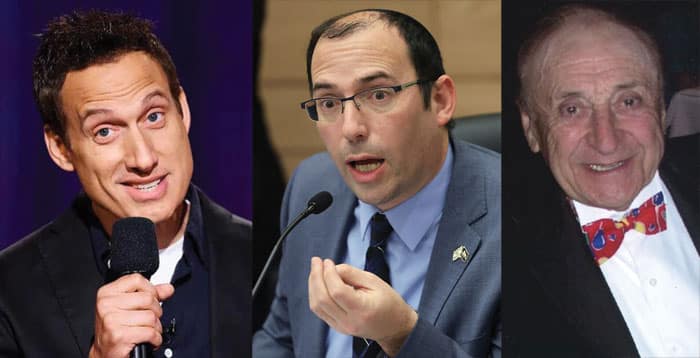
Elon Gold and Modi, the two main stars of the evening, are always hysterical. But on that Chosen night, in front of a packed house at the Orpheum Theatre, they seemed to kill more than usual. I was planning to cite some of my favorite material from their show, and urge the organizers to make the festival an annual event.

But then, the next morning, another column interrupted. 

After our “AI is Here” edition went to press and while we were in our editorial meeting, we heard that a Jewish man was shot on Pico Boulevard. We jumped on the story, which moved very quickly as another man was shot the following day and anxiety spread through the community.

By the time the suspect was in custody and we learned about the antisemitic nature of the shootings, the comedy column faded in the distance and I asked myself:  How can I not make this hate crime the subject of my column?

By the time the suspect was in custody and we learned about the antisemitic nature of the shootings, the comedy column faded in the distance and I asked myself: How can I not make this hate crime the subject of my column?

But on Sunday morning, after a Shabbat where security was likely the #1 topic of conversation at synagogues and Shabbat tables, we hosted a global Zoom audience of more than 700 registered attendees for what was billed as the “Debate of the Year on Judicial Reforms.”

In partnership with The Tikvah Fund, the Journal had lined up two highly knowledgeable panelists around an enormously controversial and divisive issue — the proposed overhaul of the judicial system by Prime Minister Benjamin Netanyahu’s right-wing coalition.

Member of Knesset Simcha Rothman, chair of the Constitution, Law and Justice Committee and a driving force behind the reforms, debated constitutional expert Professor Yaniv Roznai of Reichman University, an outspoken critic of the reforms. Jewish Journal columnist Shmuel Rosner moderated.

The debate was so electric, so full of substance, so civil and enlightening in so many ways regardless of which side you’re on, how could I not make that the subject of my column?

Here we were livecasting a debate on a historic crisis that has been roiling Israel, with hundreds of thousands of protestors flooding the streets week after week, and opposition to the reforms coming from countless corners. Much of the debate and media coverage has been polarized. The Rothman-Roznai faceoff may not have changed anyone’s mind, but at least it highlighted the many issues involved. (For anyone interested, I encourage you to see the debate on Jewishjournal.com and draw your own conclusions.) 

So, after considering a comedy column and a hate crime column and a judicial crisis column, later on Sunday I found myself at Jack Sinder’s 100th birthday party at Valley Beth Shalom. It’s true that with so much going on  during a crazy week, a column on a birthday party would not be my obvious first choice.

But I did hear something at the party that caught my attention and could have been the subject of an interesting column. One of the speakers spoke about the noble imperative of “fighting” for the causes we believe in, and heaven knows there’s an abundance of such causes in our community — from fighting antisemitism and anti-Zionism to fighting for justice and human rights. 

Then he made an important distinction in reference to Jack Sinder. There’s a difference between fighting and building. Jack, he said, has always been a builder.

With so much fighting going on, from fighting the rise in hate crimes to fighting the judicial overhaul, the notion of building is a good reminder that fighting is necessary but insufficient. We still need a vision for what comes after the fighting.

That distinction could have made for quite a column. With so much fighting going on, from fighting the rise in hate crimes to fighting the judicial overhaul, the notion of building is a good reminder that fighting is necessary but insufficient. We still need a vision for what comes after the fighting.

Whether it’s to build festivals of laughter or centers of communal gatherings and learning, as Jack Sinder has done, the Jewish future hinges on our ability to actually build things. Of my four column ideas after a long week, that might be my favorite.

Comedy, Shootings, Debate, Party Read More »

Supreme Court Upholds Arkansas Anti-BDS Law

The Supreme Court announced on February 21 that they would not be reviewing a lower court decision upholding Arkansas’ law against the Boycott, Divestment and Sanctions (BDS), the Associated Press (AP) reported.

The law had barred the state government from entering contracts with those who refused to sign a pledge against boycotting Israel. The case, Arkansas Times v. Waldrip, stemmed from an advertiser from The Arkansas Times refusing to sign a pledge to not boycott Israel as part of the state law, as The Times receives funding from a state college. The Times argued that this was a violation of the First Amendment. In June, the Eighth Circuit Court of Appeals ruled 9-1 against The Times, arguing that the law “only prohibits economic decisions that discriminate against Israel.” The Supreme Court declined to intervene on February 21, thus upholding the federal appeals court’s decision.

“The Supreme Court has confirmed our view that state statutes opposing BDS are indeed constitutional,” American Jewish Committee (AJC) General Counsel Marc Stern said in a statement. “The primary aim of the BDS movement is to eliminate the State of Israel. The court’s action gives a boost to efforts to put a stop to the pernicious effort to isolate Israel economically and morally.” The AJC had filed a brief in support of the law.

Kenneth L. Marcus, Chairman and Founder of the Louis D. Brandeis Center for Human Rights Under Law, also said in a statement that the Supreme Court “put to rest the absurd notion that anti-BDS laws are incompatible with robust protections for the freedom of speech. Anti-Israel boycotts will now be seen for what they are: discriminatory conduct rather than political speech.” 

He added: “Like many other states, Arkansas had commendably decided that its state’s taxpayers should not subsidize anti-Semitic boycotts of Israel through their government contracting process. When states prohibit discrimination against other groups, they must be consistent in preventing bias against the Jewish people. It is notable that, in this case, BDS supporters could not find even one justice—there were no dissenters—to support their discriminatory activities. The Louis D. Brandeis Center was pleased to support the State of Arkansas through its amicus work, just as we have fought BDS in higher education, corporate America, and most recently in the Ben & Jerry’s case. We will continue to fight against discriminatory BDS activities from the campus to the ice cream parlor, and from the boardroom to the U.S. Supreme Court.”

Arkansas State Senator Jim Dotson, a Republican who helped draft the law, said in a statement, “BDS supporters have purposely tried to confuse understanding of the difference between free speech and commercial  conduct. Today’s denial is a welcome development for those who support the First Amendment and oppose antisemitism and anti-Israel discrimination. It is timely that the court’s decision followed our state’s unanimous passage of the country’s strongest-ever law dealing with antisemitic crime and discrimination.”

Christians United for Israel (CUFI) said in a statement, “Elected officials, business leaders, and anti-Israel activists should take note: the American people have spoken, and they are pro-Israel. CUFI applauds the Supreme Court’s unanimous decision today to push back against the effort to use American taxpayer dollars to subsidize economic antisemitism.”

Israeli-American Coalition for Action Chairman Shawn Evenhaim called the ruling a “significant Constitutional victory for states that have taken a strong stand against the BDS hate movement. Now, this ruling will allow even more states to do what’s right and prevent publicly funded commercial interests from discriminating against the Jewish state.”

Supreme Court Upholds Arkansas Anti-BDS Law Read More »

you-dont-know-schiff

Talking Schiff with Mark & Lowell #21: Parking

In a quick catch up this week, Mark and Lowell discuss the trials and tribulations of parking.

YOUR HOSTS:
MARK SCHIFF
markschiff.com
Twitter: @markschiff
Instagram: markschiff1
Mark’s new book “Why Not?: Lessons on Comedy, Courage, and Chutzpah” is available!
Click on these links to buy:
Amazon
Barnes & Noble
Books-A-Million
Bookshop.org
 LOWELL BENJAMIN
Twitter: @lowellcbenjamin
Instagram: @lowellcbenjamin
Please follow “You Don’t Know Schiff” so you don’t miss out on any exciting episodes. Click here to subscribe on Apple Podcasts (and please leave us 5 stars and a positive review – your support means the world to us and it helps us get discovered by new listeners)


Talking Schiff with Mark & Lowell #21: Parking Read More »

Talking Schiff with Mark & Lowell #21: Parking

In a quick catch up this week, Mark and Lowell discuss the trials and tribulations of parking.

YOUR HOSTS:
MARK SCHIFF
markschiff.com
Twitter: @markschiff
Instagram: markschiff1
Mark's new book “Why Not?: Lessons on Comedy, Courage, and Chutzpah” is available!
Click on these links to buy:
Amazon
Barnes & Noble
Books-A-Million
Bookshop.org
 LOWELL BENJAMIN
Twitter: @lowellcbenjamin
Instagram: @lowellcbenjamin
Please follow “You Don’t Know Schiff” so you don’t miss out on any exciting episodes. Click here to subscribe on Apple Podcasts (and please leave us 5 stars and a positive review – your support means the world to us and it helps us get discovered by new listeners)

Talking Schiff with Mark & Lowell #21: Parking Read More »