fbpx

December 1, 2022

Eleanor Roosevelt’s Commitment to Israel Explored in ‘Refuge Must Be Given’

John F. Sears, “Refuge Must Be Given: Eleanor Roosevelt, the Jewish Plight and the Founding of Israel” (West Lafayette, IN: Purdue UP, 2022) pp. 327.

Throughout “America and the Holocaust,” Ken Burns’, Lynn Novick’s and Sarah Botstein’s six-hour documentary,  one name kept being mentioned: Eleanor Roosevelt. In her column “My Day” as well as in public statements, multiple activities and private exchanges, Roosevelt was a fierce advocate of admitting Jewish refugees to the United States in the years when their admission was the difference between life and death. John Sears, who directed the Franklin and Eleanor Roosevelt Institute in the 1980s and ’90s and co-edited Eleanor Roosevelt’s papers in 2007, has written an important book detailing her work on behalf of Jewish refugees during her years as first lady and then, perhaps more importantly and more effectively, in her career after the death of her husband on April 12, 1945. 

No longer constrained by the limitations of her role and her marriage, she spoke her mind, lending her name, presence, prestige, talents and energies to the post-war refugee crisis.

FDR was at best a cautious and lukewarm supporter of Zionism, but as his widow, Eleanor Roosevelt became a fierce advocate for the creation of the Jewish State.

FDR was at best a cautious and lukewarm supporter of Zionism, but as his widow, Eleanor Roosevelt became a fierce advocate for the creation of the Jewish State and was an integral part of the efforts 75 years ago this week to pass the November 29, 1947 United Nations Resolution supporting the establishment of a separate Jewish and Arab State in Mandate Palestine.

It wasn’t supposed to happen quite that way.

Judging from her childhood upbringing and the antisemitism that characterized elite, monied WASP society, Eleanor Roosevelt was a young antisemite. One can go through her early writings and family history and see a disdain for Jews shared by her social class, freely expressed, seldom condemned, and widely assumed. Jews were too pushy, too aggressive, unrefined, materialistic, or shabby and unkempt. Ironically, Franklin Delano Roosevelt’s family was far more accepting of the Jews who were his father’s business colleagues as well as neighbors in Hyde Park; by the time FDR became Governor, Jews were an essential part of his coalition. As Yehuda Bauer, Israel’s preeminent Holocaust historian, put it, “antisemitism was against the society FDR was trying to build.” Well before her husband became President, Eleanor’s views had changed and as her social circle widened, including many Jews who were integral to Democratic politics and supportive of her values. As her experience broadened, she enjoyed enduring and close friendships with Jews, especially Jewish women.

Unlike her husband, who saw things in political terms, Eleanor Roosevelt perceived what she experienced in deeply personal terms; perhaps this difference reflected their genders, or perhaps it was a result of her innate shyness. FDR was outgoing and gregarious; he talked more than he listened. Eleanor visited many places he could not go because of his physical limitations. She not only saw more but also listened more and reflected upon what she heard. Throughout Sears’ book, we learn how deeply she responded to people and how they influenced the views she espoused. 

Her widely syndicated column “My Day,” her many public appearances, the attention that all First Ladies command as well as the enormous influence she had later as the widow of a widely popular President who continued her work in political and humanitarian affairs gave her unique influence.

Yet despite her many efforts, she was only mildly effective in achieving her goals regarding accepting refugees before the war. It was not for want of trying. 

Sears details her tactics. Eleanor Roosevelt was deeply involved with staunch advocates for the refugees including James McDonald, High Commissioner for Refugees (also the first US Ambassador to Israel), and Clarence Pickett of the American Friends Service Committee, the Quaker organization committed deeply to refugee causes. They were not just allies but also friends. When formal meetings with the President might be controlled by White House staff and FDR himself, she invited these men and others with similar views to dine with the first family and to have some private time with the President. She forwarded information to her husband that he might not otherwise see and also approached other members of the Roosevelt Administration with specific requests, most especially Sumner Welles, the Under Secretary of State, the man in the State Department most responsive — perhaps more accurately least unresponsive — to Jewish issues. 

There were three limits to her effectiveness. First, there was little political support for receiving refugees — especially Jewish refugees — during the Great Depression, since they might take American jobs. Later, in the pre-war and early war years, it was feared that some might be planted as German spies or as Communists. Furthermore, the State Department considered these refugees potentially compromised if they had relatives in German-occupied countries, which so many did and therefore routinely excluded them. Further, when specific inquiries were made, FDR might forward a request to Welles or Eleanor Roosevelt might contact him directly and Welles would assign the response to his subordinate Breckenridge Long, a noted anti-refugee antisemite whose staff shared his views, to prepare a response. For a very long time — far too long — FDR trusted Long. So his wife’s efforts died there. Finally, the President was of the view, all too widely shared, that the U.S. must win the war and then address the issue of refugees. As Jan Karski, then a young Polish courier, well knew, by then it would be too late.

Eleanor Roosevelt persisted, especially when the issue involved children, and so she supported the failed Wagner-Rogers Bill to admit 20,000 children after the November 1938 pogroms, commonly known as Kristallnacht, and also the efforts to admit English children escaping the German bombing in the Battle of Britain. Her concern for children was genuine and, after the war, decisive in her support for Israel and her deep involvement in Youth Aliyah, which first brought Jewish children fleeing Nazi Germany to Palestine and then resettled orphan children in Palestine and, after May 15, 1948, in Israel. Her commitment strengthened even more when Youth Aliyah devoted itself to caring for North African and Arab countries’ Jewish immigrant children and facilitating their integration into Israel.

The death of her husband did not stymie Eleanor Roosevelt’s political influence. She still had a very significant public voice, many public platforms and influence within the Truman administration as the very public wife of the former President lauded by the public for defeating the Depression and the Nazis. She no longer needed to consult her husband’s political staff or the State Department whether to lend her name or her voice to specific political causes. She traveled widely. As far as Jews and Jewish efforts to establish a Jewish State were concerned, these travels were all important in shaping her commitment to Israel.

She did not begin as a Zionist. Her class and many of her Jewish friends were either anti-Zionist or non-Zionists, feeling at home in the United States and fearing that the establishment of a Jewish state might hamper their acceptance as Americans. But during the immediate post-war years, as Holocaust survivors were living in Displaced Persons (DP) Camps, and as the United States was still reluctant to receive them, the resettlement of refugees in Palestine united most Jews and enjoyed the full support of the former first lady.

She reported on her trip to a Displaced Persons Camp:

“Most of all, I remember an old woman whose family had been driven from home by the war’s madness and brutality. I had no idea who she was and we could not speak each other’s language, but she knelt in the muddy road and simply threw her arms around my knees. ‘Israel,’ she murmured over and over. ‘Israel! Israel!’  

“As I looked at her weather-beaten face and heard her old voice, I knew for the first time what that small land meant to so many, many people.” 

Eleanor Roosevelt became a fierce advocate for the establishment of Israel and cemented herself as a loyal defender, using her influence first within the Truman administration and later in the public sphere as a critic of the Eisenhower administration’s tilt toward the Arabs.

President Truman appointed her to the U.S. United Nations delegation, where she championed the creation of the International Declaration of Human Rights in December of 1948. She played an important role in the U.S. support for the November 29th, 1947 UN General Assembly Resolution in support of the creation of a Jewish State. There was fierce opposition from the State Department led by war-hero General George Marshall. Pitted against them were advisors to Truman including Clark Clifford and David Niles as well as the pressure from the Jewish community, including Truman’s friend and former partner Eddie Jacobson. Eleanor Roosevelt fought alongside them both privately and publicly and was one of the few within the State Department to support the partition plan, the creation in Palestine of two states: an Arab State and a Jewish State.

The Resolution passed by a more than two-to-one vote with both U.S. and Soviet support. Months later she also pushed for American recognition of the Jewish State, once again against State Department officials. George Marshall had told the President privately that he would not vote for him in 1948 if he recognized Israel. Eleanor Roosevelt countered that the U.S. should recognize and support the fledgling state. In the spirit of the Cold War, she advocated that the U.S. be the first. It was known that the Soviet Union would recognize the Jewish State not because of Stalin’s love of Jews but because it would weaken the British Empire.

Eleanor Roosevelt visited Israel four times between its establishment and her death in 1962, maintaining close personal friendships with its leaders and seeing on each of her trips not only the progress that Israel had made but also the people who she had come to know as friends including Joseph Baratz, the founder of Degania Alef, and Moshe Kol, her partner in Youth Aliyah whose work she championed to her dying day. Characteristically, she not only saw leadership but also the ordinary people she had met in DP camps or as orphaned children or young couples in development towns, seeing their progress, visiting their homes, admiring their accomplishments. She was deeply impressed by the young and dynamic nation and wrote of it glowingly.

Sears comments time and again that Eleanor Roosevelt had bought into the Israeli narrative, celebrating its achievements, and contrasting them with the lack of progress and unending enmity of the Arab nations and Arab leaders toward Israel. Her relationship with Israel was deep, personal and meaningful. Sears compensates for her one-sided perspective by reminding his readers of what she did not see as she became a leading — if not the leading — gentile supporter of Israel in the United States.

Reading of her efforts and the struggle to create and sustain the Jewish State takes us back to the birth of Israel, which has just celebrated its 75th anniversary. Eleanor Roosevelt was a great woman and a cherished friend of the Jewish people. She believed that the United States had failed the Jews once and must not fail them again. She felt that friendship for Israel was an expression of the best of American values, the best of human values. One would hope that the incoming Israeli government does not betray the trust she placed in the Jewish State.


Michael Berenbaum is a Distinguished Professor of Jewish Studies and Director of the Sigi Ziering Institute: Exploring the Ethical and Religious Implications of the Holocaust at American Jewish University. 

Eleanor Roosevelt’s Commitment to Israel Explored in ‘Refuge Must Be Given’ Read More »

Seniors & Zumba: An Unlikely Combo

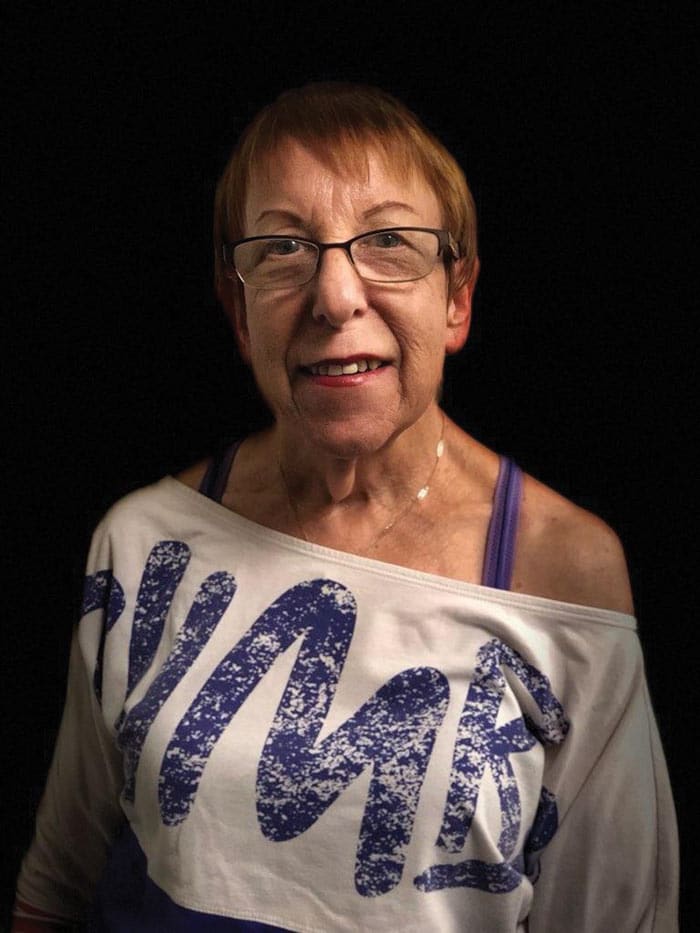
Senior citizens doing Zumba® is not something you see every day.

For Gayellen Davis, bringing dance, music and fun to her students brings her as much joy as it does to them.

Davis, who lives in Woodland Hills, teaches Zumba® Gold — and also Drums Alive® — at assisted living communities and the YMCA in Calabasas, Agoura Hills, Thousand Oaks and throughout the Valley.

“I’m 69 years old and they all call me a baby.” – Gayellen Davis

“I’m 69 years old and they all call me a baby,” she said.

Zumba® Gold is a lower-intensity version of the typical Zumba® class. It’s for seniors, beginners and people with limited movement. The Latin-inspired fitness program is great for physical, mental and emotional wellbeing. It’s fun, and that is key.

“Gayellen’s Zumba® Gold classes are one of the most popular exercise programs we offer at Los Angeles Jewish Health,” Annette Weinberg, campus lifestyle and enrichment director at Eisenberg Village, Los Angeles Jewish Health, told the Journal.

Weinberg said that the residents “adore” Davis’ energy and music selections. 

“Part of what sets us apart in the senior living and care space is our abundance of programming that supports our residents’ overall well-being,” Weinberg said.

Recently, a new participant told Davis she hadn’t had that much fun in a very long time. 

“My heart is full,” Davis said.

Davis and Zumba® have been together since 2013.

Gayellen Davis
Photos courtesy of Gayellen Davis

“I love to dance,” Davis said. Growing up, every wedding, every bar or bat mitzvah, she was on the dance floor. Her ex didn’t dance, so even when Davis was married she didn’t have a dance partner. 

“When I saw Zumba®, I said, ‘That’s it. That’s my exercise.’” 

In March 2014, she got her Zumba® teaching license. She had been working office jobs and needed a plan B. In October of that year, she became licensed to teach Zumba® Gold.

“I was 60 at the time, and I decided that specializing in seniors would be the way to go for me,” she said.

Davis started working with Fit 4 The Cause in February 2021. Fit 4 the Cause is a nonprofit organization providing expert fitness programs for the underserved at public schools, regional centers, senior living facilities and hospitals.

“As baby boomers are living longer than any previous generation, our senior populations need energetic, engaging, smart, generous motivators like Gayellen to keep them fit both mentally and physically,” Cindy Rakowitz, Fit 4 The Cause’ founder, executive director and kinesiology chief, told the Journal.

Davis became a part of the Fit 4 The Cause community during its inception, enthusiastically instructing at local Zumba® Community gatherings. As the demand for the fitness services for senior living facilities increased, they officially hired her. She currently teaches at two of their locations.

“We are so pleased with her impact and ongoing success,” Rakowitz said.

Horizons in Calabasas brought Davis on to teach via Zoom for a couple of weeks during the pandemic. In May 2021, she began teaching there in person. 

“They brought me back for a Mother’s Day event,” she said. “When I walked in there, you would think Robert Redford walked in the place. I got a greeting that was unbelievable.”

After the event, Davis told the coordinator that she had something else the residents might enjoy: Drums Alive®, which is a rhythmic drumming fitness program.

Davis discovered Drums Alive® when she was looking through YouTube videos for Zumba® choreography.

“I came across this woman with seniors drumming on a chair,” she said. “I had to learn more.” 

A couple years later, during COVID, Davis became certified online in Drums Alive®; the senior version is called Golden Beats®. Davis’ class at Horizons fills the room every week.

“One of the things that makes it so much fun is that they’re a community,” she said. “They all really care about each other.”

The community spirit is a theme in all of Davis’ classes. Everybody is happy, going at their own pace and enjoying the experience.

Davis’ position at some of the facilities has gone way beyond group fitness instructor, as she often helps with events. These clients have mixed religious and cultural residents, but have significant Jewish populations.

“Because I am Jewish, two of my clients have asked me to conduct Shabbat services for their residents when they didn’t have a rabbi available.”
– Gayellen Davis 

“Because I am Jewish, two of my clients have asked me to conduct Shabbat services for their residents when they didn’t have a rabbi available,” Davis said. “One of those clients also asked me to conduct their Rosh Hashanah service.”

Davis did her research and talked to her rabbi and his wife.

“I was able to do quite a nice service,” she said. “Between Zumba® and Drums Alive®, my life has gone through the roof,” she said. 

Davis spent her life working in an office, going from job to job to job. She started teaching part time at the YMCA in 2015; they were looking for a Zumba® Gold teacher and pretty much hired her on the spot. Davis stopped doing office work in October 2020, focusing entirely on group fitness.

“Now I hit what we call my sweet spot,” she said. “You know how everybody usually dreads Monday mornings? I wake up and I’m raring to go.”

Seniors & Zumba: An Unlikely Combo Read More »

De Toledo High School Students Travel to Uganda to Collaborate with Local Jewish Community

An outbreak of Ebola didn’t stop a group from de Toledo High School from traveling to Uganda to help a Jewish community tackle the challenge of food insecurity.

This unique program sent the Los Angeles high school students thousands of miles around the globe to help Uganda’s Abayudaya Jewish community begin the cultivation of spirulina, a blue-green algae with purported health and nutritional benefits.

The students sought to encourage the production of spirulina to help give added food security to one of sub-Saharan Africa’s largest Jewish communities.

The group of seven science students had been studying spirulina as part of de Toledo’s Spirulina Research Program and visited the town of Mbale in eastern Uganda in November to share their findings with the Abayudaya community and partner with local high school students. The students sought to encourage the production of spirulina to help give added food security to one of sub-Saharan Africa’s largest Jewish communities.

There was a lot more at stake for the students than studying abroad, according to de Toledo Head of School Mark Shpall.

“This is tikkun olam. There is no other word to describe what a profound experience this is to be part of. This is about much more than a class … This is an opportunity to teach and go into a community where our help is really valued,” said Shpall. De Toledo’s Global Jewish Education Department, which alongside the school’s science department organized the trip to Uganda, runs a host of similar programs, sending students to Israel, Uruguay, and Hungary.

While every Jewish community around the globe has a unique origin story, that of the Abayudaya community in Uganda is rather an unusual one. At the turn of the last century, Samei Kakungulu conquered a large portion of modern Uganda as a warlord in service of British Colonial authorities. Yet, he soon had a change of heart. Around the end of World War I, he renounced much of his worldly ambitions and founded a small community in a remote district of Uganda. His Hebrew Bible-based congregation grew and became known as the “Jews who trust in the Lord” (Kibina Kya Bayudaya Absesiga Katonda). Today, the community observes the Sabbath, abides by kashrut and maintains other Jewish practices. In the 1970s, the community suffered greatly under Ugandan dictator Idi Amin, but the community has rebounded under Ugandan President Yoweri Museveni and now numbers around 2,000.

This particular program was the result of a four-year relationship between de Toledo’s science and Global Jewish Education departments and the Abayudaya Jewish community. All seven students involved in the program are women, with two staff members joining them on the trip.

Shpall said that the de Toledo students’ trip and research on spirulina will have a “nutritional impact on the Abayudaya community.”

“During the drought season, this community often has an acute need for foods with fatty acids and proteins. Spirulina is easily stored and can be grown during the whole year. This will provide additional food security. If I can borrow a phrase from our friends in the Christian community, this is teaching a man how to fish,” he continued.

The trip was initially delayed by COVID-19, but when an outbreak of Ebola began in Uganda, it posed a different challenge. Yet, Shpall said, despite the risk, no parents decided to pull their child from the program. Shpall also noted that the center of the outbreak has been far from the rural area where the Abuyadaya community lives and the students are staying. The students and their trip leaders have taken a number of precautions as well.

Organized under de Toledo’s Global Jewish Education program, the trip to Uganda is just one part of a program to help make graduates of the high school well-rounded global citizens, Shpall said. “In a period of rising antisemitism and anti-Israel activity, our exchange programs are part of allowing to contextualize both their Jewishness and their American identity – to be proud of who they are and not let the BDS movement or the Kanye Wests of the world define who they are,” he added.

The school hopes to implement similar programs with other communities around the globe through its Global Jewish Education program. It also hopes to expand its relationship with the Jews of Uganda.

The school hopes to implement similar programs with other communities around the globe through its Global Jewish Education program. It also hopes to expand its relationship with the Jews of Uganda.

“De Toledo’s Global Jewish Education Department is the first of its kind,” said Associate Director of Global Jewish Education Lior Sibony, who accompanied the student delegation to Uganda, in a media statement. “We send our students on meaningful exchange programs each year to learn and study with their peers in Jewish communities around the world, and we host teens from those communities at our school as well. We are excited to take part in this experience with the Jewish Abayudaya community for the first time.”


Joseph Hammond is a Los Angeles-based journalist, who has spent more than a decade of reporting internationally, including from the Congo, Sri Lanka, Rwanda, Iraq, Egypt, and Somalia. 

De Toledo High School Students Travel to Uganda to Collaborate with Local Jewish Community Read More »

GOATS! – A poem for Parsha Vayetzei

And [Jacob] became exceedingly wealthy, and he had prolific animals,
and maidservants and manservants, and camels and donkeys.
–Genesis 30:43

I count myself wealthy by the number of animals
I have in my house. At last count, it’s three cats and
three humans. That sounds equal, as in one cat for
every human, but really, I’m the only one who gets to
use the cats. (Their choice and I’m fine with it.)

There was a time once when there were nine cats
(plus the three humans) but that was short-lived
after one of the outside cats started making more
and we thought it would be in everybody’s best interest
to bring them inside, feed them, and give them away.

But for these almost two months we were the richest people
in Van Nuys, again assuming you accept cats as currency.
I’d tell you about the lizards we had but there’s only
so much room on the page.

Jacob, who, according to the musical and the original text
was also known as Israel, became rich with goats
(and camels and donkeys.) This had something to do
with stripes and speckles. I’d like to leave that explanation
as a mystery for you to discover with your own reading.

I wonder how many goats it costs to buy a
pumpkin-spiced latte and do they take Goatcoin?
Our systems of currency seem so different now.
I can’t imagine anyone paying me in livestock, though
if I ever received a live chicken for writing a poem
I’d celebrate my wealth and maybe put in a jacuzzi.

Just be honest. Not like old Uncle Laban who started out
with all the goats and then ended up with none.
Equal goats for equal whatever you do for goats.
That’s always been my motto, at least since stanza one.
Let’s break the goat ceiling, together.
Thank you for reading.


God Wrestler: a poem for every Torah Portion by Rick LupertLos Angeles poet Rick Lupert created the Poetry Super Highway (an online publication and resource for poets), and hosted the Cobalt Cafe weekly poetry reading for almost 21 years. He’s authored 26 collections of poetry, including “God Wrestler: A Poem for Every Torah Portion“, “I’m a Jew, Are You” (Jewish themed poems) and “Feeding Holy Cats” (Poetry written while a staff member on the first Birthright Israel trip), and most recently “I Am Not Writing a Book of Poems in Hawaii” (Poems written in Hawaii – Ain’t Got No Press, August 2022) and edited the anthologies “Ekphrastia Gone Wild”, “A Poet’s Haggadah”, and “The Night Goes on All Night.” He writes the daily web comic “Cat and Banana” with fellow Los Angeles poet Brendan Constantine. He’s widely published and reads his poetry wherever they let him.

GOATS! – A poem for Parsha Vayetzei Read More »

Kanye Says He Sees “Good Things About Hitler”

Rapper Kanye West said in a December 1 interview with far-right conspiracy theorist Alex Jones that he sees “good things about Hitler.”

Jones told West, who appeared with his face covered alongside white nationalist Nick Fuentes, that people were portraying the rapper as a Nazi. “I see good things about [Adolf] Hitler,” West replied. “I love everyone and Jewish people are not going to tell me: You can love us and you can love what we’re doing to you with the contracts, and you can love what we’re pushing with the pornography.” He then falsely claimed that Hitler invented microphones and highways, per Yahoo! News. “I like Hitler,” West added, claiming that the “Jewish media” have made it seem like Hitler and the Nazis provided zero “value” to the world. West also claimed that Hitler didn’t murder six million Jews. Jones said he agreed that the “Jewish mafia” is real, though he acknowledged that most Jews are “great people.” West later suggested that Zionists were behind the Planned Parenthood killing Blacks, according to The New York Post.

Anti-Defamation League CEO Jonathan Greenblatt tweeted, “Saying you ‘like Hitler,’ ‘love the Nazis,’ and spending all your time with a white supremacist makes one thing clear: Ye is a vicious antisemite. His comments today on InfoWars are not just vile and offensive: they put Jews in danger.”

The American Jewish Committee similarly tweeted, “When three of America’s top antisemites and conspiracy theorists—Ye, Fuentes, and Jones—come together to demonize Jews and praise Hitler, it’s incumbent on all people of goodwill to forcefully condemn this vile hatred. Will you join us? Will you stand with the Jewish community?”

Simon Wiesenthal Center Founder and Dean Rabbi Marvin Hier and Associate Dean and Director of Global Social Action Agenda Rabbi Abraham Cooper also said in a statement, “History teaches us that words and ideas can have profound consequences. Kanye West’s serial anti-Semitism is now accompanied with the deconstruction of evil. Louis Farrakhan, America’s godfather of hate called Hitler ‘a great man.’ Following in his footsteps, Kanye West—influencer of millions—now touts Hitler as ‘bringing something of value to the table.’ Yes Kanye, what Hitler brought to the table was genocide, racism, and a world war that killed tens of millions and almost destroyed our civilization. Before he had the power to act, back in 1919, Hitler already outlined his vision of ‘the final removal of Jews.’”

Republican Jewish Coalition National Chairman and CEO Matt Brooks condemned West’s remarks in a statement. “Today’s InfoWars show featuring Alex Jones, Nick Fuentes, and Kanye West – a disgusting triumvirate of conspiracy theorists, Holocaust deniers, and antisemites – was a horrific cesspool of dangerous, bigoted Jew hatred,” they said. “We vehemently condemn those comments and call on all political leaders to reject these messengers of hate and relegate them to the dustbin of history where they belong. Given his praise of Hitler, it can’t be overstated that Kanye West is a vile, repellent bigot who has targeted the Jewish community with threats and Nazi-style defamation. Conservatives who have mistakenly indulged Kanye West must make it clear that he is a pariah. Enough is enough.”

Representative Ritchie Torres (D-NY) tweeted that West’s remarks were “Nazism.” “When are we going to say ENOUGH?” the congressman asked.

Kanye Says He Sees “Good Things About Hitler” Read More »

Talking Schiff with Mark & Lowell #13: Mark’s Book Might Save The World

That's right. One page and one life at a time, Mark's new book “Why Not?: Lessons on Comedy, Courage, and Chutzpah” can make the world a better place. From how to handle stress to how to appreciate your parents and so much more, in these concise, fun and heartfelt essays, Mark shares great insights, advice and inspiration.  Plus it makes a great holiday gift for someone you love!
❤️💚🎄🕎

Click on these links to buy:
Amazon
Barnes & Noble
Books-A-Million
Bookshop.org

Read road stories from some of the best comedians of our generation in Mark's first book  “I Killed: True Stories of the Road from America's Top Comics” available now!

Please follow “You Don’t Know Schiff” so you don’t miss out on any exciting episodes. Click here to subscribe on Apple Podcasts (and please leave us 5 stars and a positive review – your support means the world to us and it helps us get discovered by new listeners):

Your hosts:
markschiff.com
Twitter: @markschiff
Instagram: markschiff1
 

Lowell Benjamin
Twitter: @lowellcbenjamin
Instagram: @lowellcbenjamin

Talking Schiff with Mark & Lowell #13: Mark’s Book Might Save The World Read More »

you-dont-know-schiff

Talking Schiff with Mark & Lowell #13: Mark’s Book Might Save The World

That’s right. One page and one life at a time, Mark’s new book “Why Not?: Lessons on Comedy, Courage, and Chutzpah” can make the world a better place. From how to handle stress to how to appreciate your parents and so much more, in these concise, fun and heartfelt essays, Mark shares great insights, advice and inspiration.  Plus it makes a great holiday gift for someone you love!
❤️💚🎄🕎

Click on these links to buy:
Amazon
Barnes & Noble
Books-A-Million
Bookshop.org

Read road stories from some of the best comedians of our generation in Mark’s first book  “I Killed: True Stories of the Road from America’s Top Comics” available now!

Please follow “You Don’t Know Schiff” so you don’t miss out on any exciting episodes. Click here to subscribe on Apple Podcasts (and please leave us 5 stars and a positive review – your support means the world to us and it helps us get discovered by new listeners):

Your hosts:
markschiff.com
Twitter: @markschiff
Instagram: markschiff1
 

Lowell Benjamin
Twitter: @lowellcbenjamin
Instagram: @lowellcbenjamin


Talking Schiff with Mark & Lowell #13: Mark’s Book Might Save The World Read More »

‘Cinema Sabaya’: Israel’s Official Entry for the 2023 Academy Awards

Israeli filmmaker Orit Fouks Rotem’s first feature takes on a difficult subject: facilitating peace and empathy among a focus group of four Jewish and four Arab women.

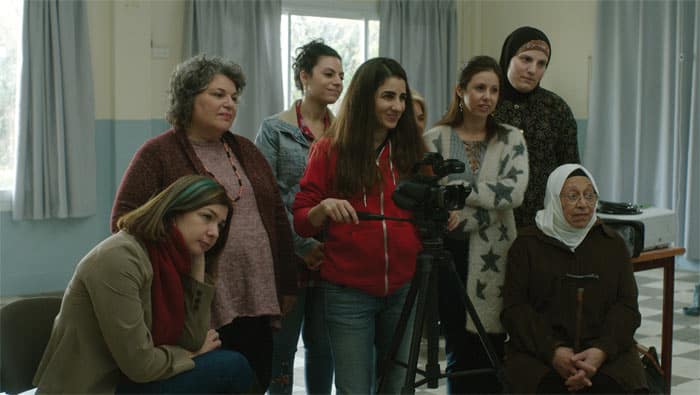
In “Cinema Sabaya,” Dana Ivgy plays Rona, a filmmaker who gathers a group of women and has them record their individual lives at home, then screen their videos for each other.

It’s hard to convey just how mind-opening and hopeful it is to watch a focus group for 94 minutes. But for “Cinema Sabaya,” the simplicity works. While each character is remarkably distinct, they see parts of themselves in each other as they allow strangers to see footage of their private lives. 

“The themes that arise from the women’s stories aren’t highly dramatic, in a sense of life and death,” Rotem said. “But they bring up daily dilemmas that preoccupy almost every woman’s mind — financial freedom, motherhood, sexual assault, self-realization and more.”

The conversations between the four Jewish and four Arab women are tense, and the arguments are relevant to the ongoing conflict today. The film dramatizes a very real Israeli government program (sometimes in the form of focus groups) aimed at getting Jews and Arabs to empathize with each other.

Director Rotem’s inspiration for the film came five years ago when her mother was working in Gender Affairs for the Mayor of Hadera, a city near Haifa. Rotem’s mother led a government-sponsored enrichment course that brought Jewish and Arab women together to facilitate empathy. Rotem herself worked with at-risk youth all over Israel. She led the “film your home” exercise while facilitating for these groups in real life. 

“The first thing I said in every group that I did, I also told the women [in the film]: ‘this is not a therapy group, I’m not a therapist, and you need to think about what you’re bringing here because the camera has a lot of power. And you’ll touch subjects that are really in your guts, and you have to be careful,’” Rotem said. 

At first, “Cinema Sabaya” may seem like a documentary, but it is indeed scripted—although there were times where Rotem encouraged the actresses to improvise. 

“I didn’t tell the Arab actresses what to say in some parts. I can’t tell them what to say in the political parts; they improvised it and brought it themselves,” Rotem said. 

The word “Sabaya” has multiple meanings in Arabic: a morning light, prisoners of war, and a group of young women — as they say in the film, “just like us.” The characters range in age from 22 to 73. 

The first question they are asked is “what are your dreams?” One woman’s dream is to be a grandmother, another dreams of owning a house. And then there’s Souad, an Arab woman in a hijab played by actress Joanna Said, who simply dreams of one day getting her driver’s license. Each of them  are issued a video camera and tasked with recording their home life. 

“The camera just won’t let you hide, and when your life is seen on a big screen and everybody can see it, it has a power,” Rotem told the Journal. 

What ensues is a powerful and immersive journey of discovery. You can feel the tension, you can see the raw emotion on each of the characters’ faces — the tears, the laughs, the jaw-drops and the connections. Rotem only had the actresses do two table reads of the script, as she wanted the characters to discover their counterparts while the camera was rolling. 

“I didn’t allow them to be friends and to know details about one another before (the movie was shot), so we didn’t rehearse,” Rotem said. “Some of their dreams were theirs The one who says she wants to be a grandmother, it’s really her dream. I had another dream [written] in my script. I asked them for real what their dream is, and some of them are in the film. Some stories are really theirs in their life as a person. But yeah, I think it’s a special film for the actresses because they really gave a lot of themselves.”

And now, Cinema “Sabya” is Israel’s official entry for Best Foreign Film at the 95th Academy Awards. “Cinema Sabaya” is the 54th Academy Awards submission for Israel. AwardsWatch.com says that Israel’s 10 nominations are the most for any country without a win for Best Foreign Film.

“Cinema Sabaya” has already won five Ophir Awards (Israeli Academy of Film and Television), including Best Picture, Best Director for Rotem, and Best Supporting Actress for Joanna Said. The film also received the Best Picture Award and Audience Award at the Jerusalem International Film Festival. 

Without revealing the ending, the film is overall positive and optimistic. And that’s exactly what Rotem hopes audiences will take from watching “Cinema Sabaya.” 

“I wish people would come out from this film with feelings that are the opposite of depression — hope,” Rotem said. “I believe there is hope, if we concentrate in what people want on both sides, there is hope. It’s just that we are under these leaders that wants us to fight. So for me it’s a helpful film.”

More information on “Cinema Sabaya” can be found on the film’s  website: https://www.cinemasabaya.com/

https://youtu.be/URKn2oAcURE

‘Cinema Sabaya’: Israel’s Official Entry for the 2023 Academy Awards Read More »

Amazon Won’t Remove Antisemitic Movie Shared by Kyrie Irving

Amazon CEO Andy Jassy said on November 30 that the platform will not remove the antisemitic movie that was infamously shared on social media by Brooklyn Nets star Kyrie Irving.

Speaking at The New York Times DealBook Summit in Manhattan, Jassy––who is Jewish––said, per Fox News: “When you have content that actively incites or promotes violence or teaches people to do things like pedophilia, I mean, those are easy. We don’t allow those, those are straight-forward decisions.” But he argued that it is “trickier” for content that doesn’t primarily “espouse hate or ascribe negative characteristics to people.” “We have to be willing to allow access to those viewpoints even if they are objectionable and even if they differ from our personal viewpoints,” Jassy said.

The moderator, Times columnist Andrew Ross Sorkin, who is also Jewish, objected to Jassy’s rationale, saying that he is concerned that rising antisemitism worldwide will result in violence. Jassy replied that he shared Sorkin’s concern and that the movie itself was “very objectionable” but maintained that the film needs to remain on the platform. Sorkin also asked Jassy if Amazon would put a disclaimer on the film, to which Jassy said that the company doesn’t engage in such measures and that the customer reviews will mention if there is hate speech content.

The movie in question, “Hebrews to Negroes: Wake Up America,” promotes “claims that modern Jews are imposters who stole the religious heritage of Black people” as well as “claims of a global Jewish conspiracy to oppress and defraud Black people, allegations that Jews are in part responsible for the transatlantic slave trade and the claim that Jews falsified the history of the Holocaust in order to ‘conceal their nature and protect their status and power,’” according to the Anti-Defamation League (ADL).

ADL CEO Jonathan Greenblatt tweeted, “If @amazon insists on selling a film that, among other things, denies the FACT that millions of Jews were murdered in the Holocaust, it’s unconscionable not to do the bare minimum & provide a disclaimer explaining why the film is problematic & antisemitic.”

Human rights lawyer Arsen Ostrovsky, who heads the International Legal Forum, tweeted: “Holocaust distortion and incitement to violence against Jews is not merely a ‘different viewpoint.’ It is shameful and inexcusable.”

Irving was suspended for several games but has since returned to basketball after apologizing for sharing the film.

Back in January, Amazon removed 26 films promoting Nazi propaganda. The American Jewish Committee noted this to Jassy in a tweet, telling him: “You removed neo-Nazi products from the @Amazon platform in the past, yet antisemitic books and films promoting Holocaust denial are still being sold. End this double standard. Remove these hateful products immediately.”

Amazon Won’t Remove Antisemitic Movie Shared by Kyrie Irving Read More »

Twitter Bans Group That Praised Jerusalem Bombings

Twitter banned a group that praised the two bombings in Jerusalem on November 23.

The Jerusalem Post reported that social media influencer Ian Miles Cheong tweeted to Twitter CEO Elon Musk that a group called the Jisr Collective media group has been “promoting and celebrating violence against the Jews.” Cheong’s tweet included screenshots of tweets from the Jisr Collective, one of which said “the resistance has spoken” with a video of the bombings and another saying, “How many billions of dollars do the imperialists want to spend for these spectacular moments?” on top of a photo of a burning bus. Another screenshot showed the Jisr Collective tweeting that Mizrahi Jews are “traitors” for allying with “white supremacist Zionists,” adding that “we all know what happens to traitors.” Musk replied to Cheong that the Jisr Collective’s tweets are “not ok” and the group has since been banned from Twitter.

Anti-Defamation League (ADL) CEO Jonathan Greenblatt tweeted that he was “glad” that the group was banned from Twitter, but there are more groups that need to be removed from the social media platform. “We need consistent, transparent policies,” Greenblatt wrote. “If there’s a new approach to antisemitism on the service, why are Khamenei, PIJ [Palestinian Islamic Jihad] and Hamas still allowed to tweet?”

The Simon Wiesenthal Center tweeted that the removal of the Jisr Collective was “important.” “Let’s hope @elonmusk’s decision here becomes new @Twitter policy,” they wrote.

The Post report also noted that Jisr Collective has previously advocated for “armed ‘resistance’” and has praised the Mapping Project, a website that lists various Jewish institutions in Massachusetts on a map as among groups that need “dismantling.” 

Twitter Bans Group That Praised Jerusalem Bombings Read More »